Behavioural Interview STAR Stories: Turn College Projects into Strong Answers
You do not need full-time experience to give a specific behavioural answer. Your college projects already hold the decisions, setbacks and numbers that three strong STAR stories need.
KnowledgeGate Team
Exam prep & CS education
Updated 20 Aug 20266 min read
Many freshers assume behavioural questions require an internship or full-time job story. They then say, “We worked well as a team,” even though their college projects contain real decisions, setbacks and delivery pressure. The problem is not a lack of experience. It is a lack of specific evidence and personal ownership. The work here is building the raw material: verified evidence rows and three worked stories from your own project decisions, each carrying one number you can defend. The conflict, failure and leadership posts in this series show how to frame that material for their specific prompts. The three worked stories here are invented illustrations: keep their shape and replace every figure with facts from your own work.
Start with project evidence, not polished interview language
List five coursework, club or hackathon moments. Record six fields in this order: project, the problem and its deadline, your personal responsibility, your personal action, evidence of change, and the lesson. Reject “built an e-commerce app” unless it names one decision or obstacle.
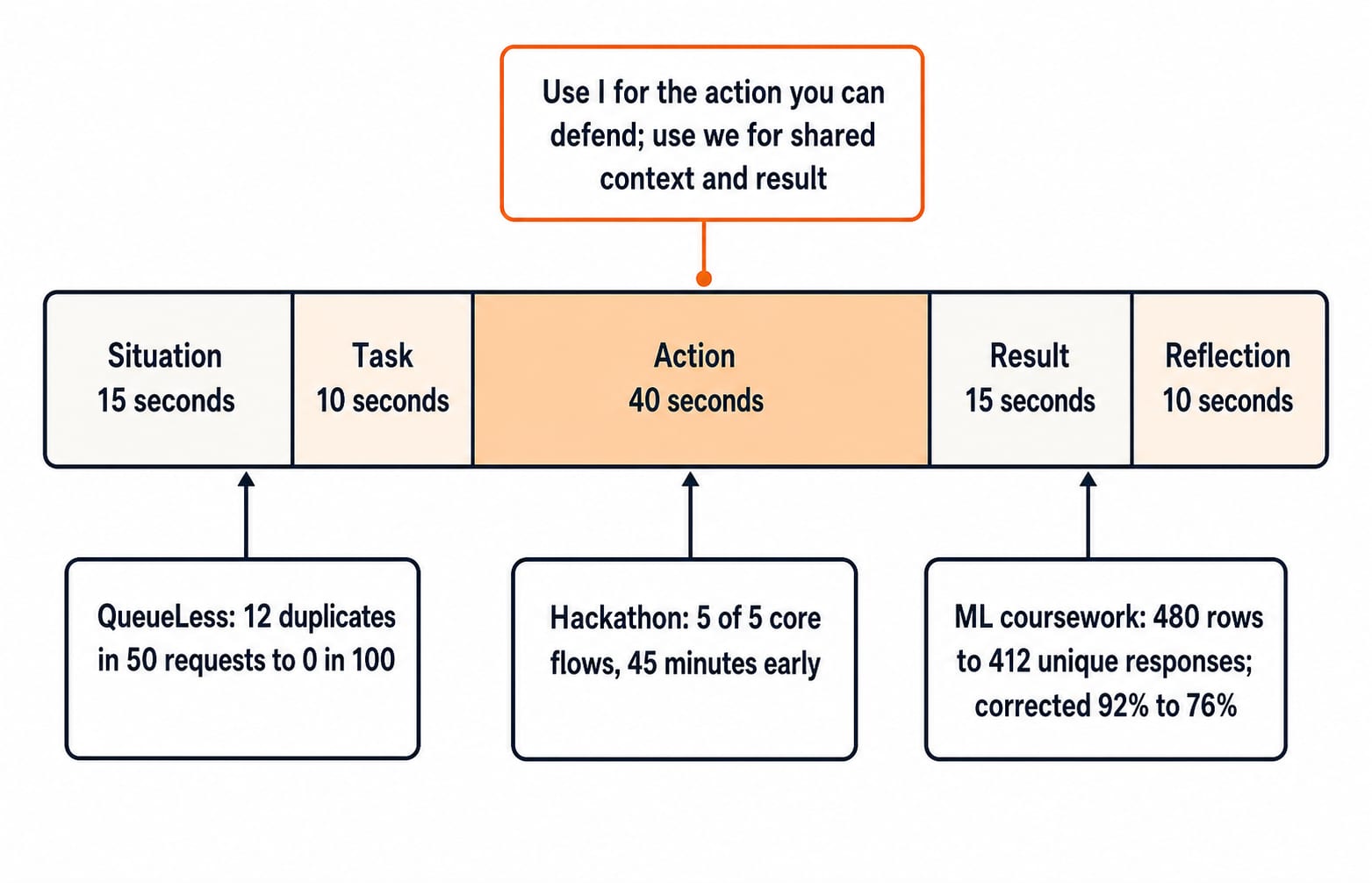
QueueLess capstone | duplicate orders 9 days before demo | backend owner | fixed retry handling | 12 duplicates in 50 requests to 0 in 100 | test retries in the first integration week36-hour hackathon | scope disagreement with 20 hours left | coordinator | applied a demo-critical constraint and reassigned work | 5 of 5 demo checks passed, submitted 45 minutes early | set scope gates before buildingML coursework | leaked validation data 10 days before review | evaluation owner | deduplicated and resplit data | 480 rows to 412 unique responses, reported 76% instead of misleading 92% | separate data by respondent before tuning
Keep the sheet editable, because the same rows will later feed your resume bullets and your follow-up answers. Other guides in the Resume & Interview category start from the same evidence rows.
Fit STAR into ten sentences with ownership at the centre
Count sentences: Situation gets two sentences, Task gets one, Action gets four, Result gets two and Reflection gets one. That is ten sentences and roughly 170 to 190 written words. Counting sentences forces cuts at the draft stage, where they are cheap. Action gets the largest share because the interviewer must separate your work from the team’s output.
Circle every “we” in the draft. What did you diagnose, propose, decide, build, measure or communicate? Keep “we” for shared context and results. Use “I” for defensible actions without claiming to be a solo hero. The fresher resume guide can help recover scope from project bullets. Verify details through logs, commits, test sheets, reports or submission timestamps. With no reliable number, stay qualitative.
Worked STAR story 1: recover a capstone after a technical setback
A four-student team built a canteen ordering app over eight weeks. Nine days before the demo, a retry test produced 12 duplicate orders from 50 checkout requests. As backend owner, the task was to make retries safe within three days while the other members finished the interface and report. The team set an acceptance check of zero duplicates across 100 retry requests.
The owner reproduced the fault with the same script and traced two requests carrying the same client request ID. They proposed a database uniqueness constraint on that ID and returned the existing order when it arrived again. One teammate reviewed the test cases. Results were recorded after 25, 50 and 100 retry requests.
The result was zero duplicates in 100 retry requests. The fix took two days, leaving seven before the demo. Next time, run concurrency and retry tests in the first integration week.
Worked STAR story 2: turn disagreement into a delivery decision
In a four-person, 36-hour hackathon, data import remained unstable after 16 hours. The team disagreed between a five-chart dashboard and three stable core flows. As coordinator, the task was to choose scope with 20 hours left without overruling anyone.
The coordinator held a 15-minute session and asked each option to pass one constraint: could the team demonstrate a complete user journey if data import remained unavailable? The dashboard failed because every chart depended on the unstable import. The stable core passed because its three flows could run on controlled input. The team chose the stable core, wrote five demo checks across those three flows, gave data import, interface, testing and pitch one owner each, then checked integration at hours 24, 30 and 34.
All five demo checks passed, and the team submitted 45 minutes early. Next time, define scope gates before building. Say, “I created a decision process the team accepted,” not, “I convinced everyone I was right.” Do not invent an award, rank or judge reaction.
Worked STAR story 3: own a bad metric and protect credibility
In a three-student ML project, the model showed 92% validation accuracy ten days before review. The evaluation owner found that duplicate survey exports put the same people in both training and validation data. The task was to tell the team, correct the evaluation and submit a reproducible report on time, even if the metric fell.
They grouped rows by respondent ID and removed duplicates, changing 480 rows to 412 unique responses. They split by respondent, reran the same model, replaced the chart and added a leakage note. Both teammates received corrected figures before revising the report and slides.
Corrected validation accuracy was 76%. The notebook reran on all 412 unique responses, and the report met its deadline. This was better evidence and honest delivery, not an improvement from 92% to 76%. Next time, validate entity-level separation before model tuning. A mistake story like this one has its own question family; behavioural interview failure, feedback and learning shows how to prove the lesson lasted beyond one project.
Reuse three stories without memorising one script
Map setback or pressure prompts to QueueLess, and mistake, integrity or difficult feedback prompts to the ML evaluation. One story can answer several prompts, but its opening Task and closing Reflection must address the question asked. For “Tell me about a setback,” the QueueLess Task becomes “make retries safe within three days.” The actions and results never change, because the event must not change.
The hackathon story carries the facts for conflict and leadership prompts, but each of those prompts needs its own framing. If the prompt is conflict, the decision-rule framing in behavioural interview conflict and teamwork questions turns the same hackathon facts into a conflict answer. If the prompt is leadership, the same facts need the earned-agreement framing shown in the series post on leadership without a formal title.
Move each story through five gates
Rehearsal works better as a pipeline than a calendar. Move each story through five gates, in order. Gate 1: the evidence row is written in the six fields. Gate 2: every number is traced to a named artifact (a commit, a log, a test sheet, a report or a submission timestamp) or downgraded to qualitative. Gate 3: the ten-sentence draft is written. Gate 4: one recording is reviewed against the draft. Gate 5: the story survives three follow-ups cold: “What did you personally do?”, “What would you change?” and “How did you measure the result?”
A story only advances when the previous gate passes. If a number fails gate 2, the story goes back, not forward. Three stories through gate 5 means ready, at whatever pace the week allows.
Final check: make every number and pronoun defensible
Ask: Is the situation short? Is my task explicit? Are the actions mine? Does the reflection show changed future behaviour? Then write an evidence-source ledger: list every number in each story and label it Verified (name the artifact), Qualitative (keep the claim, drop the number) or Delete. A story is defensible when its ledger has no unlabeled numbers.
Inventory moments, verify evidence, draft ten sentences per story, and move all three stories through the five gates. Write one QueueLess-style evidence row for a real project, not polished prose. For resume feedback and mock practice, explore the Interview & Resume Preparation Course. Keep every answer grounded in your experience.
Keep learning
Placement Mock Analysis: One Error Ledger Across Every Test Round
Use one error ledger without flattening unlike round results. This worked example shows how to find the first wrong step, prioritise repairs and close errors only after fresh retests.
Updated 4 Oct 20265 min readInterview Corner
Internship to PPO: Build a Weekly Evidence Trail Before the Final Review
Use a weekly outcome ledger to make your internship work visible before the final review. This practice model shows how to record delivery, feedback, effect and handoff honestly.
Updated 28 Sep 20265 min readInterview Corner
DSA Mock Interview Rubric: A 100-Point Scorecard for Reasoning, Code and Communication
A practical six-part scorecard for running comparable DSA mocks, grading visible evidence and turning weak areas into the next week's practice.
Updated 25 Sep 20265 min readInterview Corner
Campus Recruitment Timeline: Stage by Stage from Pre-Placement Talk to Written Offer
Follow a campus drive without guessing. Build an evidence sheet, verify eligibility, plan each preparation window and check the written offer before responding.
Updated 24 Sep 20265 min readInterview Corner