DSA Mock Interview Rubric: A 100-Point Scorecard for Reasoning, Code and Communication
A practical six-part scorecard for running comparable DSA mocks, grading visible evidence and turning weak areas into the next week's practice.
KnowledgeGate Team
Exam prep & CS education
Updated 25 Sep 20265 min read
Two peers can watch the same DSA mock and disagree because one notices final code while the other rewards explanation. Assess clarification, reasoning, optimisation, code, testing and communication, then identify next week's practice. Compare practice mocks, not employer decisions. An 80/100 score does not mean an 80% offer chance.
1. DSA mock interview rubric: six dimensions, 100 points
Use this KnowledgeGate practice model within the wider Resume & Interview Preparation:
Dimension | Weight |
|---|---|
Clarification and constraints | 10 |
Baseline reasoning | 15 |
Optimisation and trade-offs | 20 |
Code correctness and quality | 25 |
Testing and debugging | 15 |
Communication and ownership | 15 |
The total is 10 + 15 + 20 + 25 + 15 + 15 = 100. Score only transcript, code and test-run evidence.
Score every row 0 to 4: 0, not demonstrated or materially incorrect; 1, major gaps and repeated direction; 2, partly correct with a missing step or substantial prompt; 3, independently correct and clearly explained; 4, independently correct while anticipating constraints, trade-offs or tests. Use weight x score / 4. Allow halves only for two observations spanning adjacent anchors.
For 45 comparable minutes, use 3 to read, 7 to clarify, 10 for a baseline, 10 to optimise, 10 to code and 5 to test and recap. Record P0, no prompt; P1, neutral restatement; P2, targeted hint; or P3, solution direction. Time aids observation but earns no points.
2. Score clarification and baseline reasoning before rewarding speed
Use this prompt: "Given an integer array nums and integer target, return the indices of two distinct elements whose values sum to target; no valid pair may exist." Agree that no solution returns [] and any valid index pair is accepted. Score clarification of the output, limits, duplicates, no-solution case and indices versus values.
An executable baseline runs i = 0..n-1, then j = i+1..n-1, compares nums[i] + nums[j] with target, and returns the first match. It takes O(n^2) time and O(1) auxiliary space. Use DSA Interview Questions for Placements for more themes, not answers to memorise.
3. Score optimisation and code quality as separate skills
For Two Sum, store each earlier value and index. For value x, check target - x before inserting x, preventing reuse of its position. Extra memory replaces the nested scan: average O(n) time and O(n) auxiliary space.
Trace this reference implementation:
def two_sum(nums, target):
    seen = {}
    for index, value in enumerate(nums):
        needed = target - value
        if needed in seen:
            return [seen[needed], index]
        seen[value] = index
    return []
Score independently. A correct map plan can earn optimisation points despite a syntax defect. Correct baseline code need not earn optimisation points. Code earns 4 only with correct behaviour, clear names, a return contract and the invariant that seen contains only earlier indices.
4. Score testing and communication from observable actions
Use four evaluator tests:
| Expected result |
|---|---|
|
|
|
|
|
|
|
|
Testing credit comes from proposing, tracing and learning, not a silent run. Communication means narrating decisions, answering without losing the thread, naming both costs and closing with contract, approach and risk. Ignore accent, fluency, camera confidence, typing speed, language and prior familiarity. A quiet needed = 9 - 7 = 2, seen[2] = 0, return [0, 1] trace beats vague talk.
Use observation, consequence and action: "Your recap stated average O(n) time but omitted O(n) extra space, so the trade-off was incomplete; in the next mock, close with contract, approach, time, space and one risk in 45 seconds."
5. Worked DSA mock interview score: calculate every weighted point
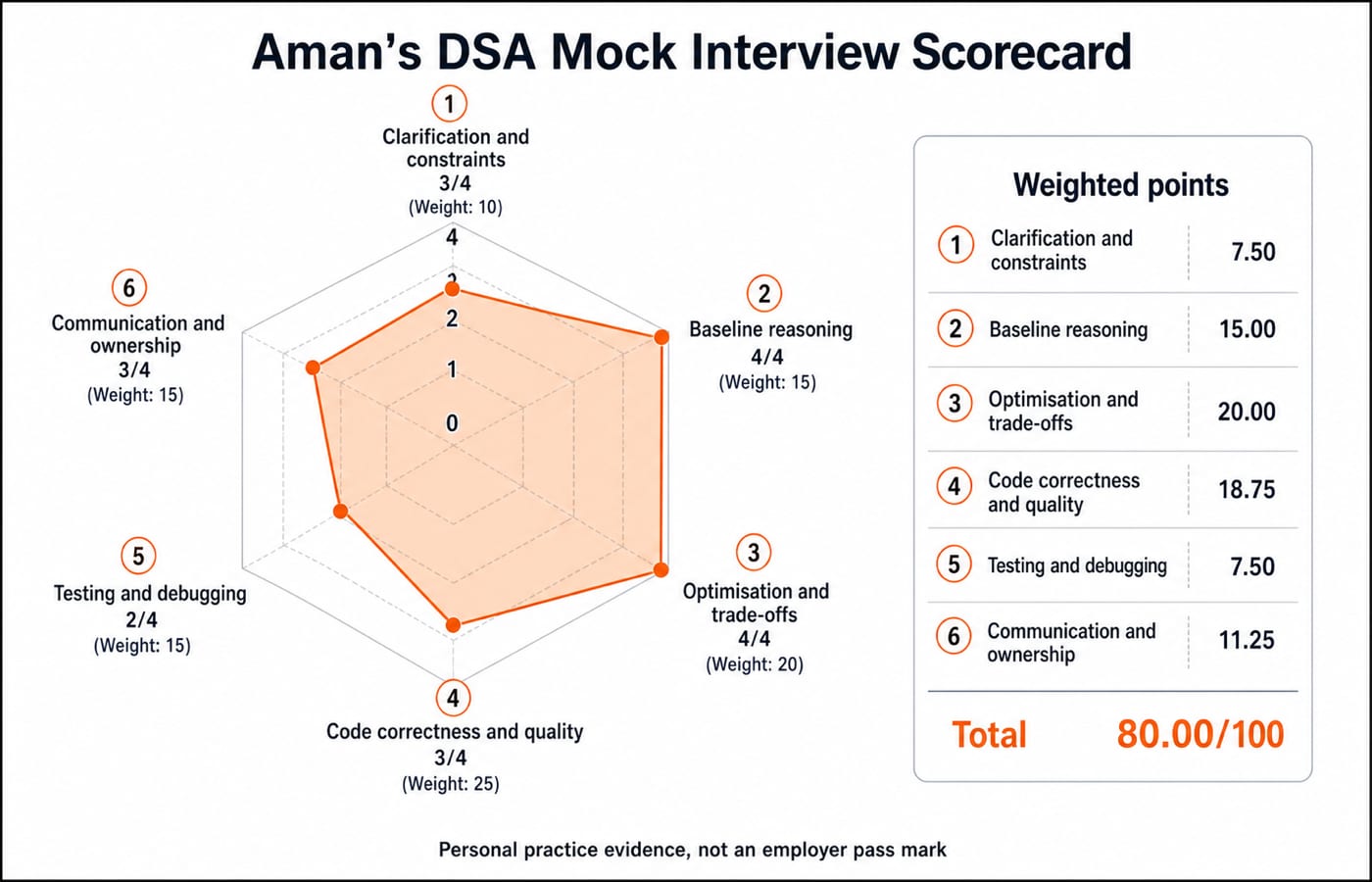
Aman's notes cover indices, distinct elements, duplicates and [], but not multiple-pair choice. His whiteboard gives nested loops at O(n^2) time and O(1) space, then a one-pass map at average O(n) time and O(n) space. His code returns the right results, but he omits the no-solution contract and seen invariant. His test log covers only the first two cases, and his recap omits extra space until prompted.
Dimension | Calculation | Points |
|---|---|---|
Clarification |
| 7.50 |
Baseline reasoning |
| 15.00 |
Optimisation |
| 20.00 |
Code |
| 18.75 |
Testing |
| 7.50 |
Communication |
| 11.25 |
Total: 7.50 + 15 + 20 + 18.75 + 7.50 + 11.25 = 80.00/100.
Aman's strengths are reasoning and optimisation. Next come the no-solution and negative-value tests, a one-sentence return-contract explanation, then a 45-second complexity recap. His 80/100 is a practice baseline, not a hiring bar or probability.
6. Apply DSA blocker rules before comparing scores
A weighted total can hide failure. Mark the mock incomplete if there is no valid algorithm, the code breaks the return contract, the candidate cannot state time and space costs, or cannot trace one normal and one edge case. Keep all six scores for diagnosis, but do not treat the total as readiness.
Peer calibration starts from the same statement, code snapshot, test results and prompt log. For a score gap of at least 1, each reviewer cites a code line, derivation or test trace. Execute disputed code or replay the relevant explanation. If a two-point gap remains, retain both scores and ask a third reviewer; never average unsupported impressions.
Do not reuse this rubric for a group discussion. Campus GD Debrief: Score Ideas, Clarity and Teamwork owns multi-speaker ideas, listening and group-effect evidence; this scorecard owns algorithm clarification, complexity, executable code and tests.
7. Use the rubric in a four-week, 22-hour practice cycle
Week | Focus and work | Hours |
|---|---|---|
1 | Calibration: 60-minute briefing, 90-minute shared recording, two 75-minute mocks with feedback | 5 |
2 | Reasoning and optimisation: two 90-minute drills, two 75-minute mocks, 30-minute comparison | 6 |
3 | Code and testing: three 60-minute edge-case drills, two 75-minute mocks, 30-minute review | 6 |
4 | Communication: two 75-minute mocks, 60-minute trace, 60-minute paired calibration, 30-minute trend review | 5 |
Thus 5 + 6 + 6 + 5 = 22 hours. End every week with a vector, prompt count and action. Fictional results: Week 1 3,4,4,3,2,3 = 80.00, two P1s; Week 2 3,4,4,3,3,3 = 83.75, one P1; Week 3 3,4,4,4,3,3 = 90.00, zero prompts; Week 4 4,4,4,4,3,4 = 96.25, zero prompts. This is not an expected curve.
Never double the next day. Move a missed drill to the 30-minute review and preserve the next mock. A missed mock extends the phase one week. Two missed sessions retain the last comparable baseline rather than claiming progress. Use DSA using Java for structured repair, then alternate algorithm drills with OS, DBMS, CN and OOP recall.
8. Score evidence, then prescribe one next drill
Agree the contract, run 45 comparable minutes, score six dimensions, cite evidence, calibrate disagreements and prescribe one drill from the lowest row. Compare scores only when difficulty and interviewer help are similar.
The Interview & Resume Preparation Course is a structured next step for mock-interview, explanation or communication practice. If one DSA technique is weak, repair it and rerun a mock of similar difficulty and help. The rubric makes feedback consistent, but cannot reproduce employer evaluation or guarantee selection.
Keep learning
Placement Mock Analysis: One Error Ledger Across Every Test Round
Use one error ledger without flattening unlike round results. This worked example shows how to find the first wrong step, prioritise repairs and close errors only after fresh retests.
Updated 4 Oct 20265 min readInterview Corner
Internship to PPO: Build a Weekly Evidence Trail Before the Final Review
Use a weekly outcome ledger to make your internship work visible before the final review. This practice model shows how to record delivery, feedback, effect and handoff honestly.
Updated 28 Sep 20265 min readInterview Corner
Campus Recruitment Timeline: Stage by Stage from Pre-Placement Talk to Written Offer
Follow a campus drive without guessing. Build an evidence sheet, verify eligibility, plan each preparation window and check the written offer before responding.
Updated 24 Sep 20265 min readInterview Corner

Campus GD Debrief Rubric: Score Ideas, Clarity and Teamwork
Turn a recorded campus group discussion into useful evidence. This five-part rubric helps you justify each score and choose one behaviour to test in your next mock.
Updated 23 Sep 20265 min readInterview Corner