Placement Mock Analysis: One Error Ledger Across Every Test Round
Use one error ledger without flattening unlike round results. This worked example shows how to find the first wrong step, prioritise repairs and close errors only after fresh retests.
KnowledgeGate Team
Exam prep & CS education
Updated 4 Oct 20265 min read
A mock score seldom tells you what to repair on Tuesday. The loop that does is simple: preserve the evidence, find the first error, make the smallest repair, then close the row only after a fresh retest. That loop never averages incomparable results into a fake placement-readiness number.
Use aptitude, coding, communication and interview evidence together
Consider a hypothetical learner, Kavya. Her mixed practice week contains four simulations: aptitude, coding, communication and interview.
Round | Native result | Time evidence | Replay artefact |
|---|---|---|---|
Aptitude | 40 questions: 28 correct, 8 wrong, 4 unattempted; attempted accuracy | 50 minutes | Question paper and workings |
Coding | Problem A passes 8 of 10 practice cases; Problem B not submitted | 90 minutes | Code and failed-case output |
Communication | 132 words, 17 fillers, no measurable result | 84 seconds for a planned 60-second response | Recording and transcript |
Interview | Six prompts: 3 complete, 2 vague, 1 unanswered | Per-prompt recording | Recording and notes |
KnowledgeGate's placement-preparation resources span written, aptitude, company-specific, resume and interview support. Keep each result in its native unit: 77.8% accuracy, 8 of 10 cases and 3 of 6 complete answers describe different evidence.
Build one placement mock error ledger without flattening the rounds
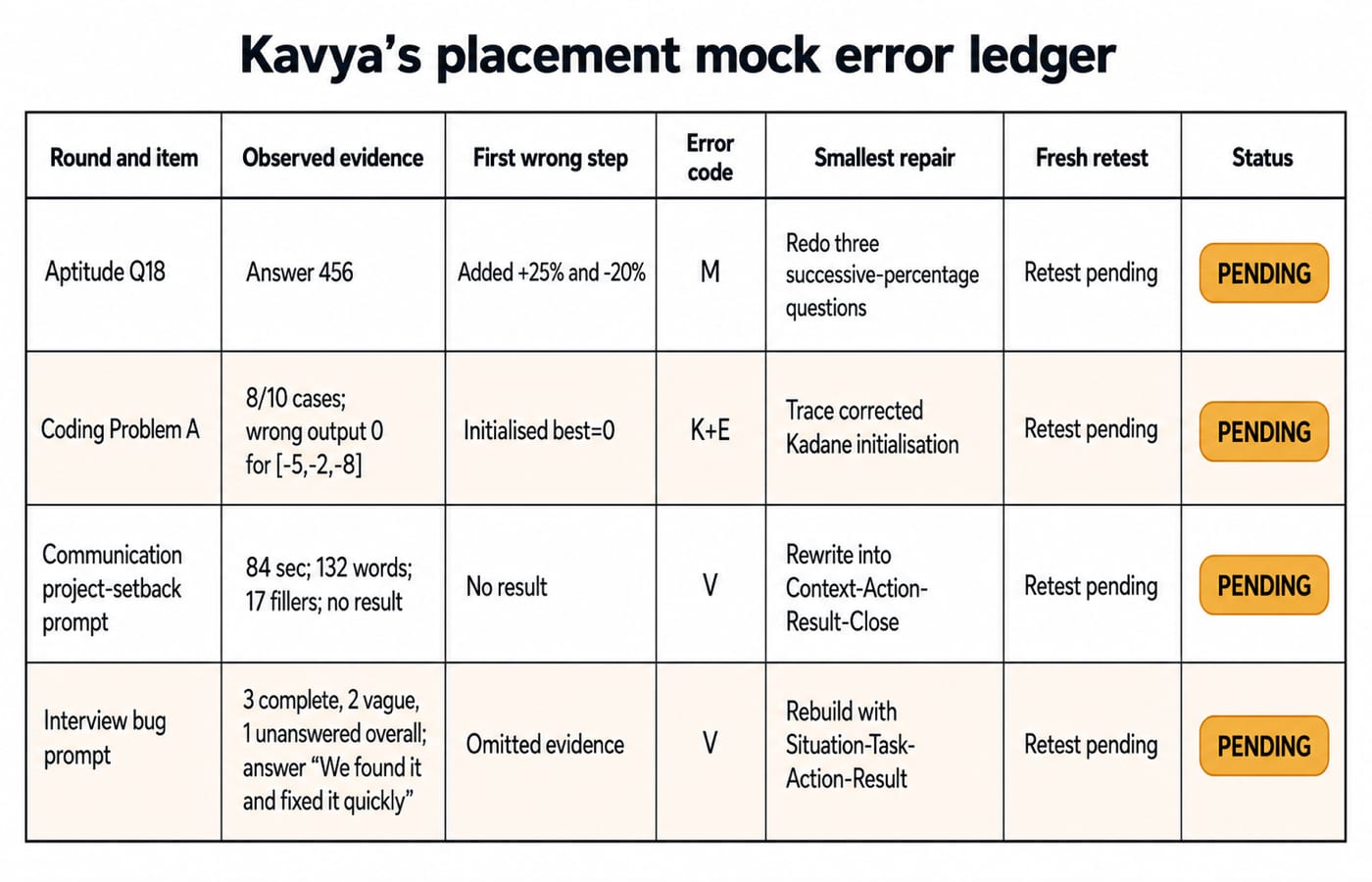
Track the date, round and item, observed evidence, first wrong step, main error, smallest repair, fresh retest and review state. Codes: M = method, K = concept knowledge, E = edge case, and V = verbal structure.
Date | Round and item | Observed evidence | First wrong step | Error code | Smallest repair | Fresh retest | Status |
|---|---|---|---|---|---|---|---|
Week 1 | Aptitude Q18 | Chose | Added | M | Redo 3 successive-percentage questions | Pending | OPEN |
Week 1 | Coding Problem A | 8/10 cases; output | Initialised | K + E | Trace corrected Kadane initialisation | Pending | OPEN |
Week 1 | Communication, project setback | 84 sec, 132 words, 17 fillers, no result | Began without a four-part frame | V | Use Context-Action-Result-Close | Pending | OPEN |
Week 1 | Interview, bug fixed | “We found it and fixed it quickly”; overall 3 complete, 2 vague, 1 unanswered | Omitted evidence | V | Rebuild with Situation-Task-Action-Result | Pending | OPEN |
Work the aptitude and coding rows to the first wrong step
Increase 480 by 25%: 480 × 1.25 = 600; reduce by 20%: 600 × 0.80 = 480. Answer: 480, not 456; the two changes act on different bases. The 456 comes from folding +25% and -20% into one 5% move and applying it downwards on 480. Repair: three fresh successive-percentage questions.
current = 0 and best = 0 make [-5, -2, -8] return 0. Set current = best = -5. At -2, current = max(-2, -5 + -2) = -2 and best = -2. At -8, current = max(-8, -2 + -8) = -8; best remains -2. Output: -2.
Before viewing a solution, find the first error: combined percentage or initial state.
Convert communication and interview replays into observable corrections
Frame 60 seconds as 15 + 25 + 15 + 5 = 60: context, action, result, close. In this hypothetical practice project, five screens were planned over four days. One day behind, she delivered three required screens before the demo and deferred two optional screens. A new, unedited take measures 59 seconds, 108 words and 2 fillers, down from 84 seconds and 17 fillers.
STAR evidence: Situation, 8 of 40 image uploads fail when filenames contain spaces. Task, isolate the fault before the next practice demo. Action, reproduce it and correct the URL-encoding step. Result, rerun 40 filenames with 0 failures. Use truthful project, lab or team records, then log structural answer defects in the ledger like any other error.
During an internship, Internship to PPO: Build a Weekly Evidence Trail Before the Final Review records manager-facing outcomes over eight weeks. After a placement practice round, this error ledger instead records one performance error, one repair and one fresh retest.
Prioritise errors by recurrence and blocking risk
Build the queue from recurrence and blocking risk: priority points = occurrences in the last 3 mocks (1-3) + blocker weight (0 or 2) + untested-repair weight (0 or 1). Blockers prevent submission or completion; untested repairs lack a pass.
Interview evidence omission:
3 + 2 + 1 = 6.Coding boundary assumptions:
2 + 2 + 1 = 5.Aptitude method errors:
2 + 0 + 1 = 3.Communication filler overload, passed on a new recording:
3 + 0 + 0 = 3.
Work on 6 and 5; break the 3-point tie by earliest retest. Avoid chasing the lowest score. Keep four errors in the active queue and backlog the rest.
Use a seven-hour weekly review cycle, with room for missed days
The mocks themselves sit outside this budget. Spend 45 minutes capturing evidence, 105 minutes tracing aptitude and coding errors, 105 minutes on small repairs and communication replay, 120 minutes on fresh retests, and 45 minutes closing rows and choosing the next four. Total: 45 + 105 + 105 + 120 + 45 = 420 minutes = 7 hours.
Generate and rehearse questions from resume claims with Resume-Based Interview Questions: Predict Every Follow-Up. After a mixed placement mock, use the cycle here to diagnose and retest errors across aptitude, coding, communication and interview rounds.
If one block is missed, preserve the 45-minute evidence capture and at least 60 minutes of fresh retesting; carry the rest into the next two available days. Never double tomorrow. If two or more blocks are missed, extend the cycle by three or four days and postpone lower-priority retests. Retest before a full mock; otherwise it remains a hypothesis.
Close an error only after a fresh retest
OPEN is diagnosed, RETESTING corrected, and CLOSED two fresh checks at least 48 hours apart.
Aptitude:
720 × 1.25 × 0.80 = 720in 2 minutes 40 seconds, then320 × 1.50 × 2/3 = 320in 2 minutes 25 seconds.Coding:
-1for[-4, -1, -7],6for[3, -2, 5, -9]; all 8 locally prepared edge cases pass.Communication: “Explain a deadline trade-off” in 61 seconds, 112 words, 3 fillers, with “three required screens delivered, two optional screens deferred”.
Interview: answer “Describe a quality issue” from a hypothetical practice record: 6 of 30 image uploads fail for filenames with spaces, URL encoding is corrected, and 30 of 30 pass on rerun.
Close interview rows only with truthful evidence from your own work. Route concept or method gaps to Aptitude for Placement, and resume or interview gaps to the Interview & Resume Preparation Course.
Keep learning
Internship to PPO: Build a Weekly Evidence Trail Before the Final Review
Use a weekly outcome ledger to make your internship work visible before the final review. This practice model shows how to record delivery, feedback, effect and handoff honestly.
Updated 28 Sep 20265 min readInterview Corner
DSA Mock Interview Rubric: A 100-Point Scorecard for Reasoning, Code and Communication
A practical six-part scorecard for running comparable DSA mocks, grading visible evidence and turning weak areas into the next week's practice.
Updated 25 Sep 20265 min readInterview Corner
Campus Recruitment Timeline: Stage by Stage from Pre-Placement Talk to Written Offer
Follow a campus drive without guessing. Build an evidence sheet, verify eligibility, plan each preparation window and check the written offer before responding.
Updated 24 Sep 20265 min readInterview Corner

Campus GD Debrief Rubric: Score Ideas, Clarity and Teamwork
Turn a recorded campus group discussion into useful evidence. This five-part rubric helps you justify each score and choose one behaviour to test in your next mock.
Updated 23 Sep 20265 min readInterview Corner