Technical interview prep: OS, DBMS, CN and OOP questions freshers face
Coding is only half of a technical interview. The other half is the core CS subjects, and that is where freshers who only did DSA get caught. Here are the Operating Systems, DBMS, Computer Networks and OOP concepts fresher interviews keep returning to, with answers crisp enough to say out loud.
KnowledgeGate Team
Exam prep & CS education
Updated 26 Jul 20265 min read352 views
Coding is only half of a technical interview. The other half is the core computer science subjects, and this is where freshers who "only did DSA" get caught. The good news is that the fresher-level questions on Operating Systems, DBMS, Computer Networks and Object-Oriented Programming are remarkably predictable. Learn a compact set of concepts well and you can answer almost anything an interviewer asks at this level.
Across the four subjects that is about a dozen ideas: deadlock, CPU scheduling and paging in Operating Systems; normalization, ACID and joins in DBMS; TCP versus UDP and the OSI layers in Computer Networks; and the four pillars of Object-Oriented Programming.
Operating Systems: deadlock, scheduling and paging
Three OS areas dominate fresher interviews.
Deadlock. A deadlock is a set of processes each waiting for a resource another process in the set is holding, so none can proceed. It can occur only when all four Coffman conditions hold together: mutual exclusion, hold and wait, no preemption, and circular wait. The one-line answer interviewers want for prevention is to break circular wait by imposing a global ordering on resources and requiring every process to request them in increasing order.
CPU scheduling. Know the common algorithms and what each optimises: First Come First Serve (simple, but a long job delays everyone, the convoy effect), Shortest Job First (optimal average waiting time, but needs burst-time knowledge), Round Robin (fair, time-sliced, good for interactive systems), and Priority scheduling (with starvation as its risk, solved by ageing).
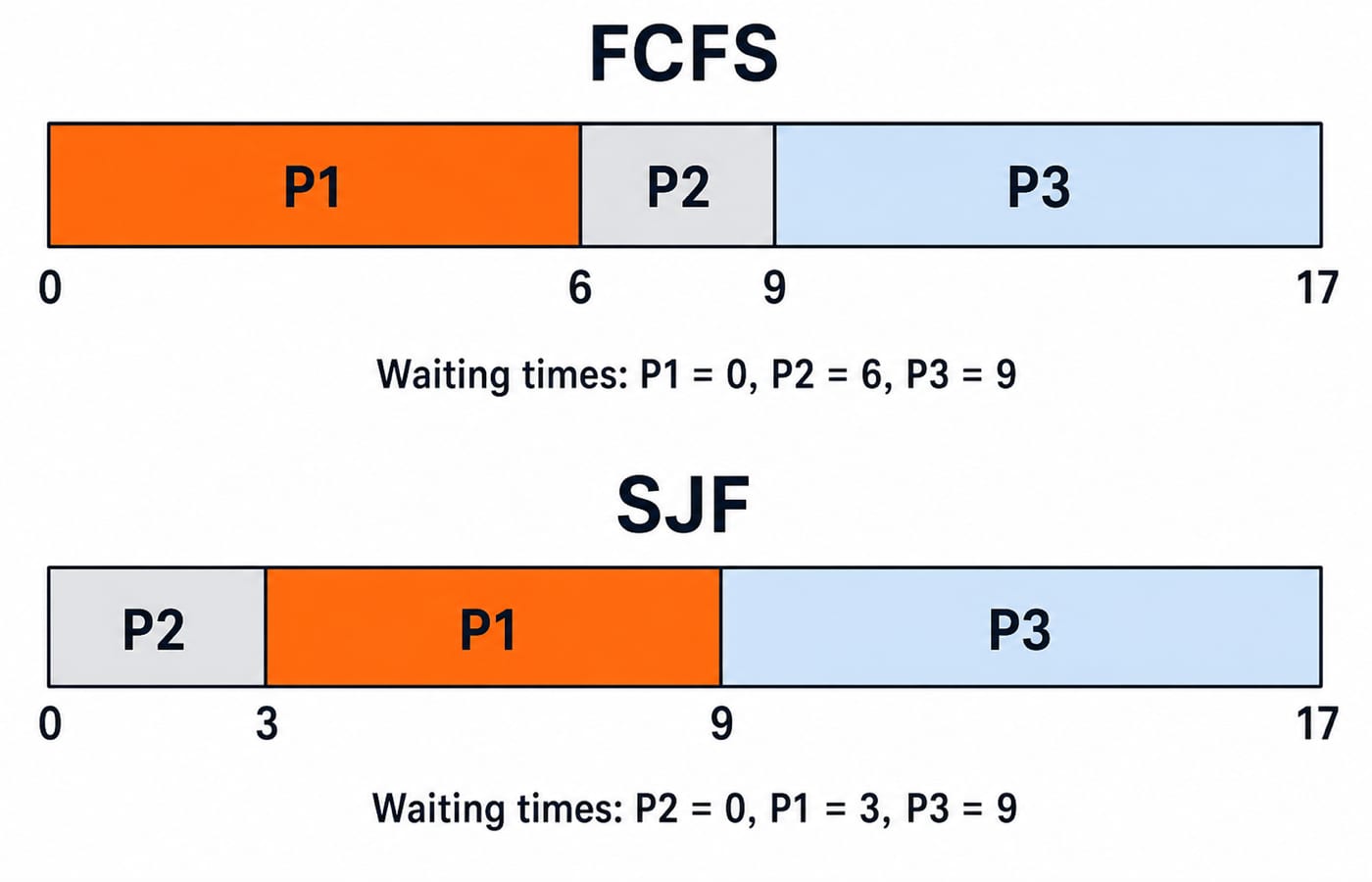
A worked example makes this stick. Take three processes arriving together, with burst times P1 = 6, P2 = 3, P3 = 8.
Under FCFS in arrival order, waiting times are 0, 6, 9, so the average waiting time is (0 + 6 + 9) / 3 = 5.
Under SJF, we run the shortest first (P2, then P1, then P3). Waiting times become P2 = 0, P1 = 3, P3 = 9, averaging (0 + 3 + 9) / 3 = 4.
Same processes, better average waiting time, purely from ordering. That is the entire intuition behind SJF, and computing it by hand once is worth more than reading the definition ten times.
Paging. Paging removes external fragmentation by splitting logical memory into fixed-size pages and physical memory into frames of the same size, mapped through a page table. Be ready to explain a page fault (the page is not in memory, so the OS fetches it from disk) and one replacement policy such as LRU.
DBMS: normalization, ACID and joins
Normalization is organising tables to remove redundancy and update anomalies. Know the first three normal forms cold: 1NF removes repeating groups so every cell is atomic; 2NF removes partial dependency, where a non-key attribute depends on only part of a composite key; 3NF removes transitive dependency, where a non-key attribute depends on another non-key attribute. The standard mnemonic is that every non-key attribute must depend on "the key, the whole key, and nothing but the key".
ACID is the set of guarantees a transaction gives: Atomicity (all or nothing), Consistency (valid state to valid state), Isolation (concurrent transactions do not interfere), and Durability (committed data survives a crash). Interviewers love asking you to give a one-line real example of each, so prepare those.
Joins are the other reliable question. Be able to distinguish an INNER JOIN (only matching rows), a LEFT JOIN (all rows from the left table plus matches), a RIGHT JOIN (the mirror image), and a FULL OUTER JOIN (everything from both). Draw the two-table picture in your head and the answer is immediate.
Computer Networks: TCP vs UDP and the OSI model
TCP versus UDP is the single most-asked networking question. TCP is connection-oriented and reliable: it sets up a connection, guarantees ordered delivery, and retransmits lost segments, which is why it carries web pages, email and file transfers. UDP is connectionless and best-effort: no handshake, no delivery guarantee, lower overhead, which is why it suits live video, voice and gaming where speed matters more than a resent packet. The clean framing is reliability versus speed.
The OSI model gives you the seven-layer vocabulary: Physical, Data Link, Network, Transport, Session, Presentation, Application. You do not need to recite trivia, but you should be able to place a protocol on its layer (IP at Network, TCP and UDP at Transport, HTTP at Application) and explain what each layer is responsible for. A common mnemonic is "Please Do Not Throw Sausage Pizza Away".
Object-Oriented Programming: the four pillars
OOP questions almost always start with the four pillars, so answer with a one-line definition and a concrete example for each.
Encapsulation: bundling data with the methods that operate on it and hiding internal state behind an interface, for example private fields exposed through getters and setters.
Abstraction: exposing what an object does while hiding how, for example an abstract class or interface that declares behaviour without implementing it.
Inheritance: a child class reusing and extending a parent's members, modelling an "is-a" relationship.
Polymorphism: one interface, many implementations, split into compile-time (method overloading) and run-time (method overriding).
Follow-ups build on these: the difference between an abstract class and an interface, overloading versus overriding, and why composition is often preferred over deep inheritance. If your four-pillar answer is solid, these follow-ups are easy.
How these subjects are tested in interviews
Fresher technical interviews rarely go deep. They go broad and fast, sampling one or two questions per subject to check that your fundamentals are real, not memorised the night before. Expect a definition, then a "why" or a small example: name the four Coffman conditions, then how you would prevent a deadlock; define normalization, then normalise a small table; TCP or UDP for a video call, and why. The winning move is a crisp definition followed immediately by a concrete example, delivered without hesitation.
For the OS topics in exam depth, our Operating Systems for GATE breakdown sequences scheduling, deadlock and memory management, and the DBMS side is covered in normalization explained. Both double as strong interview revision.
Your next step
If you want these subjects taught in interview-ready form alongside the coding round, our Coding for Placement course pairs DSA with the core CS subjects interviewers actually ask about. For the full drive from aptitude to offer in one place, the Mera Placement Hoga bundle bundles the stages together. You can also browse the whole placement preparation catalog.
Revise these four subjects the way they are tested: broad, fast, and example-first. Do that and the non-coding half of your technical interview stops being the part you fear.
Keep learning

Which Skill Sets Are in Demand for Tech Jobs?
Explore the technical and human skill combinations showing up across software, AI, data, cloud, and security roles—and how students can prove them with focused projects.
21 Oct 20265 min readPlacement Preparation
AI Is Changing Campus Hiring: How Students Can Show Their Skills
Make your technical skills visible in AI-assisted campus hiring with clear resume evidence, one explainable project, and a practical interview routine.
15 Oct 20265 min readPlacement Preparation
Resume Checklist: What Must Be Included and What Must Be Left Out
3 Oct 20264 min readPlacement Preparation
LDAP Explained: DNs, Bind, Search Filters, and a Developer Login Flow
Build one LDAP mental model from directory tree to login. Trace a service bind, escaped user search, password-verifying user bind, and group-based role check.
Updated 13 Aug 20265 min readPlacement Preparation