Campus Recruitment Timeline: Stage by Stage from Pre-Placement Talk to Written Offer
Follow a campus drive without guessing. Build an evidence sheet, verify eligibility, plan each preparation window and check the written offer before responding.
KnowledgeGate Team
Exam prep & CS education
Updated 24 Sep 20265 min read
A pre-placement talk may sound continuous, but later steps have separate evidence, deadlines and preparation needs. A missed form or assumption can end it before interview. Current employer and placement-cell documents control the sequence.
Campus recruitment timeline at a glance
Map events, not a fixed pattern: talk, evidence, eligibility/application, assessments, invitation, interviews, checks, offer. Omit or reorder stages only when the current drive says so. Placement Preparation Courses cover preparation, not employer rules.
Stage | Controlling evidence | Candidate output | Next gate |
|---|---|---|---|
Day 0, 10:00 talk | Notice | 10-field sheet | Apply |
Day 2, 18:00 deadline | Form | Timestamped receipt | Assessment |
Day 6, 09:30 aptitude | Invite | Error log | Next invite |
Day 8, 14:00 coding or technical | Invite | Two-task review | Interview |
Day 12, 10:30 technical interview | Invite | Eight-question notebook | Update |
Day 13, 15:00 HR discussion | Communication | HR notes | Document check |
Day 17 offer | Offer letter | Eight-field checklist | Response |
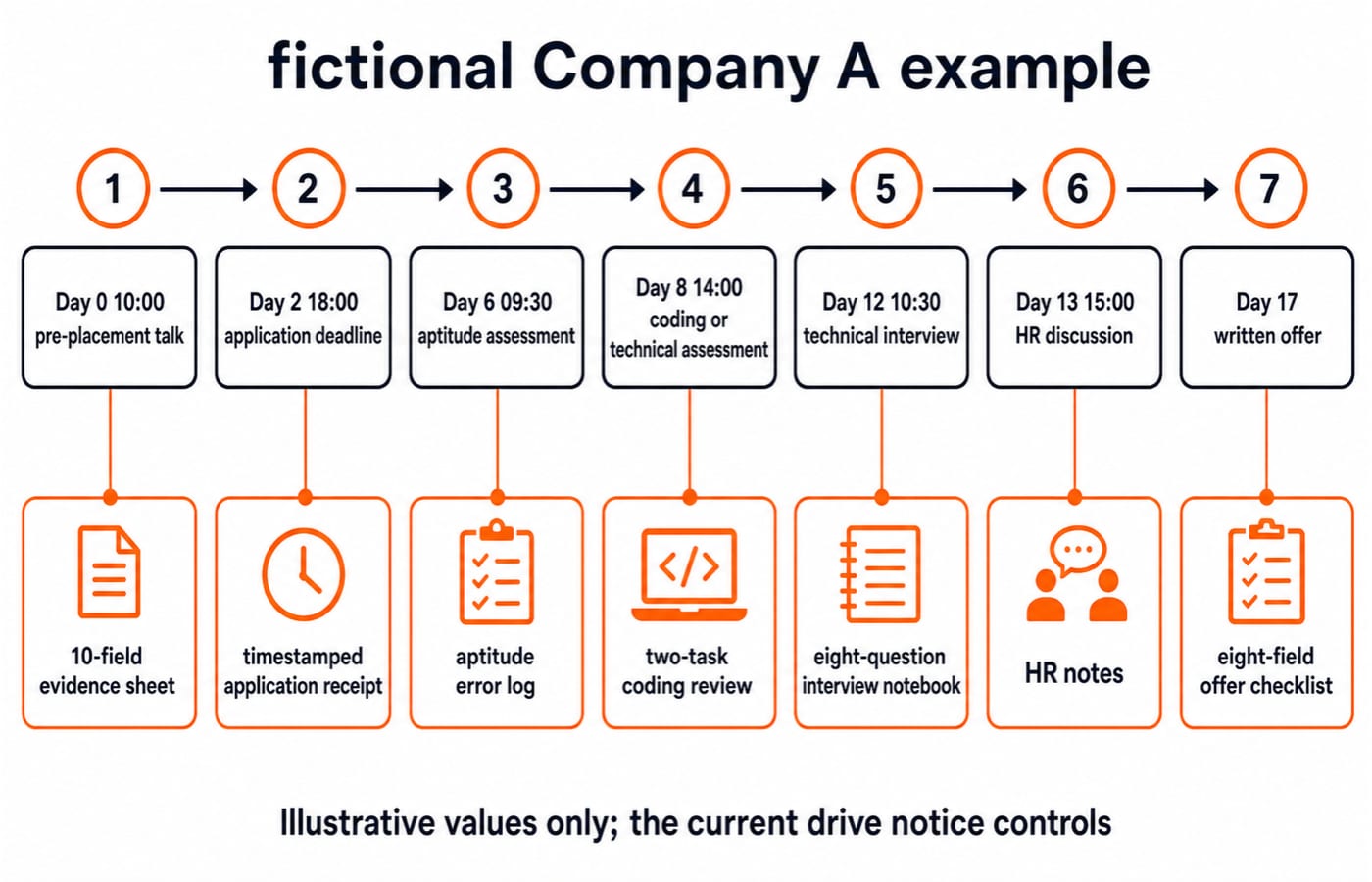
Pre-placement talk: build a 10-field evidence sheet
Record role title; eligible degree or branch; graduation batch; academic or backlog condition; application deadline; named stages; assessed areas; venue or platform; required documents; official help channel. Each needs a source and retrieval time, or not stated.
Fictional Company A confirms 7 of 10. Venue or platform, required documents and the official help channel are not stated. So 7 confirmed / 10 total = 7/10, not a 70% eligibility score or licence to guess. Send one precise placement-cell query listing those three gaps, save its reply and update the sheet. Verbal remarks are leads, not policy.
Campus application: prove eligibility and keep a buffer
Fictional candidate Riya checks eight facts field by field: BTech CSE; 2026 graduation; 7.4/10 CGPA; Class XII 67%; Class X 84%; zero active backlogs; government photo ID; one-page resume. Seven match the notice, but its percentage wording does not explain CGPA conversion. Her status is one unresolved field, not eligible; the authorised channel must resolve it.
For the Day 2, 18:00 deadline, her 14:00 cutoff leaves 18:00 - 14:00 = 4 hours. Documents take 25 minutes, form 35, review 20: 25 + 35 + 20 = 80 minutes, requiring a 12:40 start. She saves the final resume and timestamped receipt. The Interview & Resume Preparation Course covers resume building, one-to-one review, and technical, HR and mock-interview practice.
Campus assessments: map the notice to preparation
Current-notice signal | Practice artefact | Relevant preparation resource | Check before using it |
|---|---|---|---|
Aptitude, reasoning, verbal | Three 20-question diagnostics | Aptitude for Placement | Confirm named areas |
Resume, technical, HR | One-page evidence map, eight-question mock | Interview & Resume Preparation Course | Confirm next gate |
Company-specific, coding | Named-format practice | Notice-based placement practice | No assumed coverage |
Fictional Day 0 to Day 6 uses 12 hours: quantitative 4, reasoning 3, verbal 2, named company area 2, review 1. Check: 4 + 3 + 2 + 2 + 1 = 12. Aptitude for Placement covers the first three.
For fictional Day 6 to Day 8, two 90-minute coding tasks plus 60 minutes of test-case review give 90 + 90 + 60 = 240 minutes = 4 hours. Replace this block if the invitation names another stage.
Assessment result to interview: preserve the handoff
After an assessment, record five non-confidential items in 20 minutes: sections attempted, time-management issue, two weak areas, technical setup issue, organiser's stated next communication channel. Never invent a result date or treat silence as rejection.
Begin interview preparation only when evidence supports that gate, while transferable practice continues. Fictional Day 8 to Day 12 uses 8 hours: CS fundamentals 3, project evidence 2, code-trace practice 1.5, HR and resume consistency 1, logistics 0.5. Check: 3 + 2 + 1.5 + 1 + 0.5 = 8. The mock has four CS fundamentals questions, two project follow-ups, one code trace and one resume or HR question. Technical Interview: OS, DBMS, CN & OOP Prep supports the CS block.
Technical interview: make resume claims checkable
Use four answer-card columns: claim, action, measurement, likely follow-up. Project numbers must come from your logs or tests. If a number is unsupported, say I do not have that measurement and explain what you can verify.
Fictional Riya tests 500 synthetic API requests. A validated index lowers median response time from 620 ms to 240 ms. Reduction = 620 - 240 = 380 ms. Percentage reduction = 380 / 620 x 100 = approximately 61.3%. She explains the setup, query plan, trade-off and rollback. She presents 61.3% as a result from that test setup, not as a universal benchmark.
HR discussion to written offer: verify the document
Separate four things: an interview completed, a verbal positive signal, a provisional selection message and a written offer. Only the received document proves its terms; a call cannot fill gaps.
Check eight fields: legal employer name, role title, work location, joining conditions, verification clauses, compensation components, training or probation terms, acceptance deadline. Mark gaps not stated; ask authorised staff.
Fictional timing is Day 17, 11:00 arrival to Day 19, 17:00 deadline: 48 + 6 = 54 hours. Use 24 for the eight-field review, 24 for authorised questions, 6 as buffer. Check: 24 + 24 + 6 = 54. Do not treat 54 hours as a standard deadline; use the interval stated in the received offer.
Campus recruitment timeline: the short version
Keep five artefacts: 10-field evidence sheet, eligibility comparison, timestamped receipt, stage-specific practice log, eight-field offer checklist. Advance on current written evidence.
The full example allocates 12 + 4 + 8 = 24 hours. With 18, use 9 before aptitude (quantitative 3, reasoning 2, verbal 2, named area 1, review 1), 3 for two 60-minute coding tasks plus 60-minute review, and 6 before interview (CS 2, project 1.5, trace 1, HR 1, logistics 0.5). Checks: 3 + 2 + 2 + 1 + 1 = 9; 60 + 60 + 60 = 180 minutes = 3 hours; 2 + 1.5 + 1 + 1 + 0.5 = 6; 9 + 3 + 6 = 18. Keep hours for the stage named in the latest written invitation; cut speculative preparation for later gates first.
For a separate audit of failure patterns, use 7 Placement Preparation Mistakes to Avoid. For stage-specific practice, use Aptitude for Placement after an assessment is confirmed, or the Interview & Resume Preparation Course after an interview is confirmed.
Keep learning
Placement Mock Analysis: One Error Ledger Across Every Test Round
Use one error ledger without flattening unlike round results. This worked example shows how to find the first wrong step, prioritise repairs and close errors only after fresh retests.
Updated 4 Oct 20265 min readInterview Corner
Internship to PPO: Build a Weekly Evidence Trail Before the Final Review
Use a weekly outcome ledger to make your internship work visible before the final review. This practice model shows how to record delivery, feedback, effect and handoff honestly.
Updated 28 Sep 20265 min readInterview Corner
DSA Mock Interview Rubric: A 100-Point Scorecard for Reasoning, Code and Communication
A practical six-part scorecard for running comparable DSA mocks, grading visible evidence and turning weak areas into the next week's practice.
Updated 25 Sep 20265 min readInterview Corner

Campus GD Debrief Rubric: Score Ideas, Clarity and Teamwork
Turn a recorded campus group discussion into useful evidence. This five-part rubric helps you justify each score and choose one behaviour to test in your next mock.
Updated 23 Sep 20265 min readInterview Corner