HR Interview Strengths and Weaknesses: Build Answers That Survive Follow-Ups
Turn one truthful project incident into a defensible strength, an honest weakness, and a practice routine that prepares you for probing questions.
KnowledgeGate Team
Exam prep & CS education
Updated 29 Jul 20265 min read
“Hard-working” and “perfectionist” may sound safe until the interviewer asks for a recent example, your exact contribution, or proof that the weakness is improving. The answer collapses because the adjective came before the evidence. A better method is to mine one real incident, build a compact strength and a credible weakness from it, then pressure-test both. You can also prepare the rest of the standard HR round with the same evidence-first approach.
1. Start With Evidence, Not a List of Good-Sounding Traits
A useful strength shows repeated behaviour, personal action, a visible result, and role relevance. A useful weakness names a current behaviour, its cost, and a repair loop.
Apply three filters. The example must be true enough to survive “what exactly happened?”, recent enough for you to remember its details, and owned by you rather than hidden inside “we”. Reject a trait supported only by a certificate, a teammate’s work, or a result you cannot explain.
A stock answer is an unsupported label such as “hard-working”, a disguised boast such as “I care too much”, or memorised wording with no dates, decisions, quantities, or mistakes attached.
2. Build a One-Page Evidence Bank From One Real Project
Build six columns: situation, my action, observable result, what was difficult, what changed afterwards, and role relevance. Mine your resume, internships, projects, volunteering, coursework, or part-time work, starting with projects and achievements already on the page.
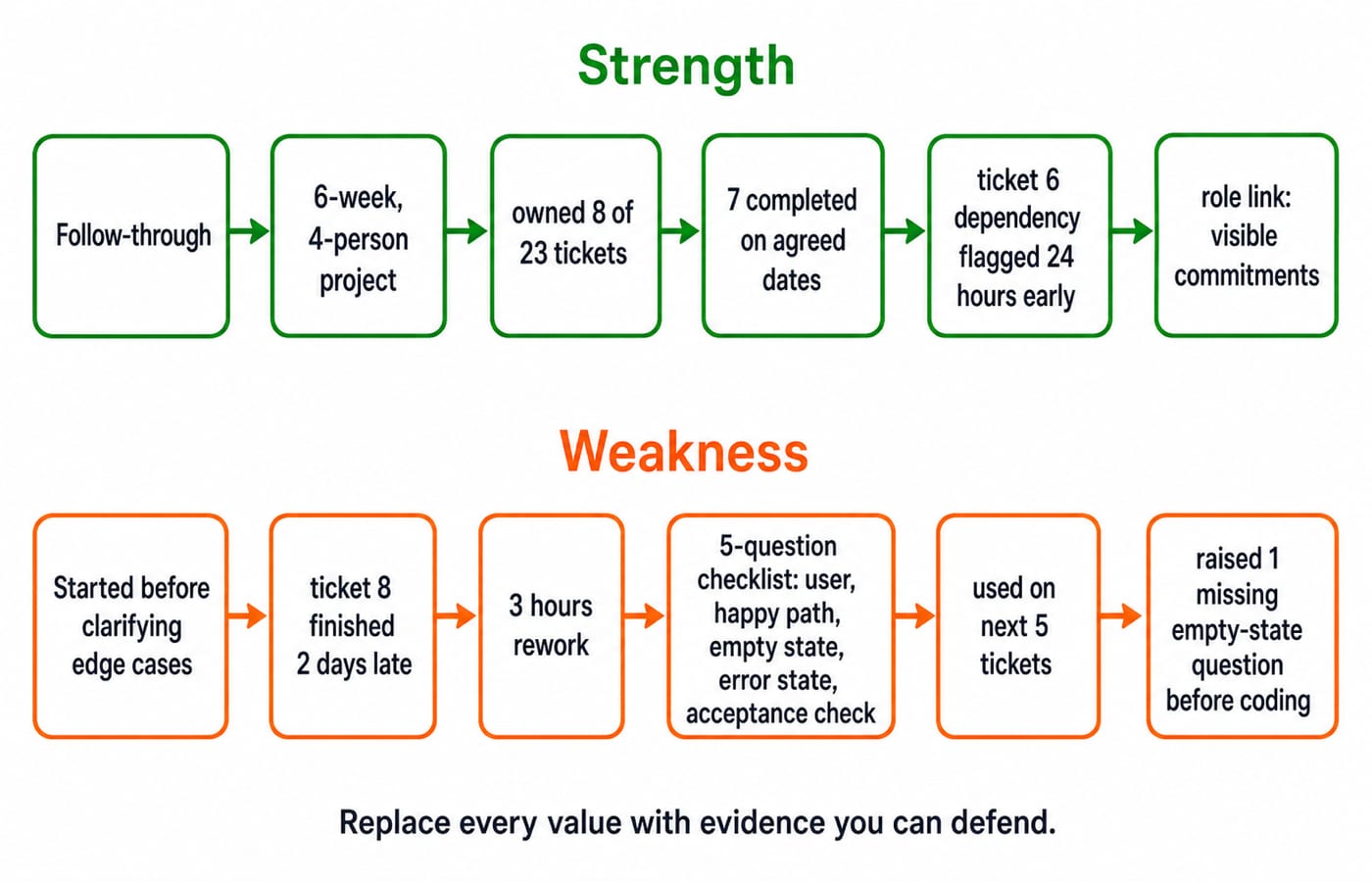
The candidate below is invented, so replace every number with one you can defend. In a 6-week library seat-tracker project, a 4-person team created 23 backlog tickets. The candidate owned 8 tickets, completed 7 by their agreed dates, and sent a risk update 24 hours before a database dependency could block ticket 6. Ticket 8 finished 2 days late because the candidate coded before confirming the empty-state requirement. The correction took 3 hours of rework.
Shortlist follow-through as the strength and starting before clarifying edge cases as the weakness. Neither erases the missed requirement or the seven on-time deliveries.
3. Turn the Strength Into Claim, Evidence, Result and Role Link
Use four parts: the claim (one trait), the evidence (context plus your owned action), the result, and a short role link. Aim for 55-70 seconds. Avoid inflated words such as “always”, “best”, and “excellent”.
In your own words, roughly like this:
“One strength I rely on is follow-through. In a 6-week library seat-tracker project, our 4-person team had 23 backlog tickets and I owned 8. I completed 7 by the agreed dates, and for ticket 6 I flagged a database dependency 24 hours early so the team could unblock it. The eighth ticket was late, so I would not claim a perfect record, but I kept the team informed and closed what I owned. That habit helps me make commitments visible in team-based work.”
Keep the late ticket. Bounded imperfection makes “follow-through” testable instead of polished.
4. Choose a Weakness That Is Real, Bounded and Under Repair
Choose a current, manageable weakness that matters, is not a core inability, and already has a repair action. Reject “perfectionism”, “working too hard”, jokes, and fatal mismatches such as disliking coding for a coding role.
The same incident, told as a weakness:
“A weakness I am working on is starting implementation before I have clarified edge cases. In the same library project, I assumed the empty-state behaviour for one ticket, finished it 2 days late, and spent 3 hours reworking the flow after review. I now use a 5-question pre-start checklist covering the user, happy path, empty state, error state, and acceptance check. I used it on my next 5 tickets and raised one missing empty-state question before coding. I still need to use the checklist consistently when a task feels familiar, so I keep it in every ticket template.”
The present tense shows progress without claiming a cure.
5. Pressure-Test Both Answers With Four Follow-Up Questions
Use the same evidence for every response:
What did you personally own? Eight of 23 tickets, not the entire project.
What did you do when work was at risk? Sent the ticket 6 dependency update 24 hours early.
What was the real cost of the weakness? Ticket 8 was 2 days late and needed 3 hours of rework.
How do you know the repair is being used? The checklist went onto the next 5 ticket templates and surfaced 1 missing empty-state decision before coding.
Cross-check your resume and technical round. If you cannot explain the app, dependency, or ownership, the example is unsafe. Use your facts as you prepare the CS and project questions behind the story. Answer each probe in 20-30 seconds. Say “I do not remember the exact number” instead of inventing precision.
6. Use This Two-Week, 8-Hour Practice Plan
Set a weekly rhythm of Monday 35 minutes, Tuesday 35, Thursday 40, Friday 35, Saturday 65, and Sunday 30, with Wednesday for recovery: 35 + 35 + 40 + 35 + 65 + 30 = 240 minutes.
Week 1: mine evidence Monday, shortlist strengths Tuesday, draft both answers Thursday, run four probes Friday, record twice Saturday, and revise evidence Sunday. Week 2: unseen follow-ups Monday, role relevance Tuesday, mock 1 Thursday, repairs Friday, mock 2 plus resume check Saturday, and cue-card reduction Sunday. It is another 240 minutes, so 240 + 240 = 480 minutes, and 480 / 60 = 8 hours.
Move one missed 35- or 40-minute session to Wednesday. If you miss two, drop one optional recorded take, preserve both mocks, and never double the next day. Explore broader placement paths and course options after protecting the practice time.
7. Record, Score and Remove the Lines That Sound Rehearsed
Rate five parts from 0 to 2: specific claim, ownership, evidence, reflection, and role relevance. “I am hard-working” scores 1 + 0 + 0 + 0 + 1 = 2/10. The revised strength scores 2 + 2 + 2 + 2 + 2 = 10/10. Anything under 8 means one of the five parts is still an adjective, so go back and attach a date, a number, or a decision to it.
Record two takes: 55-70 seconds for the strength, 60-80 for the weakness, and 20-30 per follow-up. After take 1, remove throat-clearing, repeated adjectives, and guesses. After take 2, keep six prompts: trait, project, my action, result, cost, repair.
If an impressive sentence cannot answer “when?”, “how many?”, or “what did you do?”, replace it with a smaller truthful claim.
8. Final Check Before the Interview: Truth First, Then Brevity
The readiness gate is two mocks on different days, both answers without reading, four contradiction-free follow-ups, and every number traceable to a resume, project board, message, calendar, or honest memory. Stable facts matter more than identical wording. Then trim: if a take runs past its window, cut the sentence that carries no number, date, or decision.
The short version: collect evidence, choose a defensible behaviour, name a real cost, show the repair, and rehearse the probes. Never borrow this candidate’s 23 tickets, 8 owned tickets, 2-day delay, or 3-hour rework.
For a structured next step, the live Interview & Resume Preparation Course covers resume preparation, technical and HR interviews, one-to-one resume review, and mock-interview preparation.
Keep learning
Placement Mock Analysis: One Error Ledger Across Every Test Round
Use one error ledger without flattening unlike round results. This worked example shows how to find the first wrong step, prioritise repairs and close errors only after fresh retests.
Updated 4 Oct 20265 min readInterview Corner
Internship to PPO: Build a Weekly Evidence Trail Before the Final Review
Use a weekly outcome ledger to make your internship work visible before the final review. This practice model shows how to record delivery, feedback, effect and handoff honestly.
Updated 28 Sep 20265 min readInterview Corner
DSA Mock Interview Rubric: A 100-Point Scorecard for Reasoning, Code and Communication
A practical six-part scorecard for running comparable DSA mocks, grading visible evidence and turning weak areas into the next week's practice.
Updated 25 Sep 20265 min readInterview Corner
Campus Recruitment Timeline: Stage by Stage from Pre-Placement Talk to Written Offer
Follow a campus drive without guessing. Build an evidence sheet, verify eligibility, plan each preparation window and check the written offer before responding.
Updated 24 Sep 20265 min readInterview Corner