RSSB 2025 Previous Year Questions (PYQs) with Solutions
Real questions from the RSSB 2025 paper, solved. Every question below shows its options, the correct answer, and a full text solution — free to read, no login needed. Open any question to practice it interactively inside its course.
- Questions:
- 200
- With solutions:
- 200
- Tagged RSSB 2025 in the bank:
- 324
- Q1.RSSB 2025
Which of the following regions of Rajasthan is NOT a part of East–West corridor? (Choose the most appropriate option from below)
- A.
Udaipur
- B.
Chittorgarh
- C.
Kota
- D.
Sri Ganganagar
- E.
Question not attempted
Correct answer: D
Solution
The East–West Corridor is a major highway corridor project under the National Highways Development Programme (NHDP). In Rajasthan, this corridor passes through important southern and southeastern regions such as:
Udaipur
Chittorgarh
Kota
These cities are connected through the corridor for better transportation and trade.
However, Sri Ganganagar is located in the northern part of Rajasthan and is not included in the East–West Corridor route.
Therefore, the correct answer is Sri Ganganagar.
- A.
- Q2.RSSB 2025
In which of the following regions in Rajasthan are Sub-Tropical mountain forests found?
- A.
Jhalawar
- B.
Mount Abu
- C.
Jaisalmer
- D.
Barmer
- E.
Question not attempted
Correct answer: B
Solution
Sub-tropical mountain forests in Rajasthan are mainly found in Mount Abu, which is located in the Aravalli Hills of Sirohi district.
Mount Abu has:
Higher altitude
Cooler climate
Greater rainfall compared to other parts of Rajasthan
These conditions support sub-tropical mountain vegetation and forests. The region contains trees like conifers, evergreen species, and rich biodiversity, which are not commonly found in the desert regions of Rajasthan.
Other options like Jaisalmer and Barmer are desert regions with arid vegetation, while Jhalawar mainly has tropical dry deciduous forests.
Therefore, the correct answer is Mount Abu.
- A.
- Q3.RSSB 2025
Which of the following soil is mainly found in the arid western plain of Rajasthan?
- A.
Black soil
- B.
Desert soil
- C.
Alluvial soil
- D.
Marsh soil
- E.
Question not attempted
Correct answer: B
Solution
The arid western plain of Rajasthan corresponds to the Thar Desert region. Due to low rainfall, high evaporation rates, and arid climatic conditions, the predominant soil type found in this area is Desert soil.
- A.
- Q4.RSSB 2025
Rajasthan’s South-eastern plateau region is also known as the ______.
- A.
Semi-arid plateau
- B.
Hadoti plateau
- C.
Shekhawati region
- D.
Arid desert plain
- E.
Question not attempted
Correct answer: B
Solution
The South-eastern plateau region of Rajasthan is popularly known as the Hadoti Plateau.
This region mainly includes the districts of:
Kota
Bundi
Baran
Jhalawar
The Hadoti Plateau is characterized by:
Fertile black soil
Plateau topography
Good rainfall compared to western Rajasthan
Rich agricultural production
It forms part of the Malwa Plateau extension and is one of the important physical regions of Rajasthan.
Therefore, the correct answer is Hadoti Plateau.
- A.
- Q5.RSSB 2025
According to Census 2011 of Rajasthan, which of the following regions has the highest literacy rate?
- A.
Jaipur
- B.
Dungarpur
- C.
Jalore
- D.
Sirohi
- E.
Question not attempted
Correct answer: A
Solution
According to the Census 2011 of Rajasthan, Jaipur district had the highest literacy rate among the given options.
Jaipur, being the capital city of Rajasthan, has:
Better educational infrastructure
Higher urban population
More schools, colleges, and universities
Greater awareness about education
These factors contributed to a higher literacy rate compared to districts like Dungarpur, Jalore, and Sirohi.
Therefore, the correct answer is Jaipur.
- A.
- Q6.RSSB 2025
The second phase of the “Mukhya Mantri Yuva Kaushal Yojana (MMYKY)” 2.0 in Rajasthan was launched in:
- A.
2017
- B.
2024
- C.
2021
- D.
2023
- E.
Question not attempted
Correct answer: D
Solution
State flagship skill-development / welfare schemes are often revamped and re-launched, and are then rolled out to beneficiaries in separately dated phases: an initial launch, followed later by a further intake round (a "second phase"). A question asking when a scheme's specific phase was launched is asking for that later, distinct date - not the date the overall (revamped) scheme itself first began.
The Mukhya Mantri Yuva Kaushal Yojana (MMYKY) was first launched in Rajasthan's government colleges in November 2019. It was then revamped as MMYKY 2.0 and rolled out afresh under a state government order issued in late December 2020, going live and being publicised in early 2021. The Rajasthan Skill and Livelihoods Development Corporation (RSLDC) subsequently reopened intake for a further, second phase of MMYKY 2.0, with registrations for this phase conducted in 2023 (the window was extended into the middle of that year). Since the question asks specifically for the year the second phase of MMYKY 2.0 was launched, the applicable year is 2023 - not the year the 2.0 scheme itself first began.
2017 predates even the original (pre-2.0) MMYKY, which only began in November 2019 - too early for any phase of the revamped 2.0 scheme to exist yet.
2021 marks MMYKY 2.0's own first rollout under the December 2020 government order - the initial launch of the 2.0 scheme, not its later second phase.
2024 falls after the documented second-phase registration window, which had already been extended and closed within 2023.
2023 matches RSLDC's second-phase intake window for MMYKY 2.0, confirmed by the scheme's own registration records for that year.
- A.
- Q7.RSSB 2025
Which of the following animals is not included for insurance coverage under the “Mukhyamantri Mangla Pashu Bima Yojana” 2024–25?
- A.
Cow
- B.
Camel
- C.
Buffalo
- D.
Pig
- E.
Question not attempted
Correct answer: D
Solution
The Mukhyamantri Mangla Pashu Bima Yojana (2024–25) provides insurance coverage for various livestock animals such as cows, buffaloes, camels, goats, and sheep. Pigs are not included under the insurance coverage provided by this scheme.
Correct Answer: (D) Pig
- A.
- Q8.RSSB 2025
Which of the following is used to control fire caused due to electrical equipment? (Choose the most appropriate option from below)
- A.
Water
- B.
Carbon dioxide
- C.
Carbon monoxide
- D.
Hydrogen
- E.
Question not attempted
Correct answer: B
Solution
Electrical fires require extinguishing agents that do not conduct electricity to prevent electrocution risks. Carbon dioxide is a non-conductive gas that effectively smothers electrical fires without damaging equipment, making it the appropriate choice. Water should not be used as it conducts electricity.
- A.
- Q9.RSSB 2025
Which of the following human diseases is not correctly matched to their causative microorganism?
- A.
Tuberculosis – bacteria
- B.
Measles – virus
- C.
Cholera – bacteria
- D.
Malaria – bacteria
- E.
Question not attempted
Correct answer: D
Solution
Tuberculosis and cholera are bacterial diseases, and measles is viral. Malaria is caused by Plasmodium, a protozoan parasite, not bacteria.
- A.
- Q10.RSSB 2025
Which of the following polymers is used to make oil seals, gaskets, and the surface coating of non-stick utensils?
- A.
Polythene
- B.
Teflon
- C.
Nylon
- D.
Bakelite
- E.
Question not attempted
Correct answer: B
Solution
Teflon (Polytetrafluoroethylene – PTFE) is a synthetic fluoropolymer known for its non-stick properties, high heat resistance, and chemical inertness. Therefore, it is widely used in non-stick cookware coatings, oil seals, gaskets, bearings, and chemical-resistant linings.
Correct Answer: (B) Teflon
- A.
- Q11.RSSB 2025
The Khejri tree of Rajasthan belongs to which of the following types of forests? (Choose the most appropriate option from below)
- A.
Tropical Thorn Forests
- B.
Tropical Dry Deciduous Forests
- C.
Sub-tropical Mountain Forests
- D.
Mangrove Forests
- E.
Question not attempted
Correct answer: A
Solution
The Khejri tree (Prosopis cineraria) is the state tree of Rajasthan. It thrives in arid conditions typical of Tropical Thorn Forests, which cover a large portion of the state's geography. These forests are characterized by low rainfall and dry climates, providing the ideal habitat for this ecologically significant species.
- A.
- Q12.RSSB 2025
Which of the following is a major Rabi crop in the arid western plain agro-climatic zone in Rajasthan?
- A.
Rice
- B.
Wheat
- C.
Pearl millet
- D.
Moth bean
- E.
Question not attempted
Correct answer: B
Solution
In Rajasthan, the arid western plain agro-climatic zone mainly includes desert and semi-desert areas with low rainfall and sandy soil. Despite harsh climatic conditions, wheat is an important Rabi crop grown in irrigated parts of this region, especially where canal irrigation facilities like the Indira Gandhi Canal are available.
Other options are mainly Kharif crops:
Rice requires high rainfall and water availability.
Pearl millet (Bajra) is mainly a Kharif crop.
Moth bean is also primarily grown during the Kharif season.
Therefore, the major Rabi crop in this region is Wheat.
- A.
- Q13.RSSB 2025
In which of the following agro-climatic zones, cotton is a major kharif crop in Rajasthan?
- A.
Irrigated North-Western Plain
- B.
Internal Drainage Dry Zone
- C.
Transitional Plain of Luni Basin
- D.
Sub-humid Southern Plains
- E.
Question not attempted
Correct answer: A
Solution
Cotton is a major kharif crop in the Irrigated North-Western Plain Zone of Rajasthan. This zone benefits from canal irrigation systems which support cotton cultivation effectively, unlike the Internal Drainage Dry Zone where water scarcity limits major production.
- A.
- Q14.RSSB 2025
In which of the following regions of Rajasthan are being developed for artificial silk (Tussar)?
- A.
Jaisalmer, Jalore and Baran
- B.
Bikaner and Pali
- C.
Barmer and Dungarpur
- D.
Kota, Udaipur and Banswara
- E.
Question not attempted
Correct answer: D
Solution
Artificial silk (Tussar silk) development in Rajasthan is mainly promoted in the southern and southeastern regions where climatic and forest conditions are more suitable for sericulture activities.
The districts Kota, Udaipur, and Banswara are being developed for Tussar silk production because these regions have:
Better vegetation and forest cover
Suitable climatic conditions
Tribal population involved in sericulture activities
The Rajasthan government promotes silk production in these areas to generate employment and support rural livelihoods.
Therefore, the correct answer is Kota, Udaipur and Banswara.
- A.
- Q15.RSSB 2025
Which of the following large projects of Rajasthan also known as the lifeline/Maruganga of the state?
- A.
Narmada Canal Project
- B.
Jakham Project
- C.
Indira Gandhi Canal Project
- D.
Sidhmukh Nahar Project
- E.
Question not attempted
Correct answer: C
Solution
The Indira Gandhi Canal Project (IGNP) is known as the “Lifeline” or “Maruganga” of Rajasthan. It is one of the largest canal irrigation projects in India and plays a crucial role in transforming the desert regions of western Rajasthan.
The canal brings water from the Satluj and Beas rivers through the Harike Barrage in Punjab and supplies water to arid districts such as:
Bikaner
Jaisalmer
Barmer
Jodhpur
Sri Ganganagar
The project has greatly helped in:
Irrigation development
Drinking water supply
Agriculture expansion
Desert area development
Because of its huge contribution to Rajasthan’s desert economy and water supply, it is called the Maruganga (Ganga of the Desert).
Therefore, the correct answer is Indira Gandhi Canal Project.
- A.
- Q16.RSSB 2025
Which of the following dams have been built under the Chambal Project in Rajasthan?
- A.
Jawahar Sagar Dam
- B.
Mahi Bajaj Sagar Dam
- C.
Meja Dam
- D.
Morel Dam
- E.
Question not attempted
Correct answer: A
Solution
The Chambal Project is a joint river valley project of Rajasthan and Madhya Pradesh developed on the Chambal River for irrigation and hydroelectric power generation.
The major dams constructed under the Chambal Project are:
Gandhi Sagar Dam
Rana Pratap Sagar Dam
Jawahar Sagar Dam
Among the given options, Jawahar Sagar Dam is part of the Chambal Project.
Other dams listed belong to different river projects:
Mahi Bajaj Sagar Dam → Mahi Project
Meja Dam → Meja irrigation project
Morel Dam → Built on Morel River
Therefore, the correct answer is Jawahar Sagar Dam.
- A.
- Q17.RSSB 2025
Due to reduction in the price of tea leaves of a particular brand by 8%, Ajay is able to buy 125g more for ₹ 460. The reduced price of tea leaves per kg is:
- A.
₹ 320
- B.
₹ 290.50
- C.
₹ 284.40
- D.
₹ 294.40
- E.
Question not attempted
Correct answer: D
Solution
Concept: If a shopper spends the same total money M both before and after a price cut, and the price falls by a fraction r, then the extra quantity bought after the cut, valued at the NEW (reduced) price, is exactly equal to r × M. In symbols: r × M = (extra quantity) × (reduced price).
Applying this to the given values (r = 8% = 0.08, M = ₹460, extra quantity = 125 g = 0.125 kg, reduced price per kg = P):
Write the identity with the known values: r × M = (extra quantity) × P, i.e. 0.08 × 460 = 0.125 × P.
Evaluate the left-hand side: 0.08 × 460 = 36.8, so 36.8 = 0.125 × P.
Solve for P: P = 36.8 ÷ 0.125 = 294.4.
Therefore the reduced price per kilogram is ₹294.40.
Cross-check independently by reconstructing the original price and both quantities bought:
A reduced price of ₹294.40 is 92% of the original price (since the cut is 8%), so the original price per kg = 294.40 ÷ 0.92 = ₹320.
Quantity bought for ₹460 at the original price: 460 ÷ 320 = 1.4375 kg = 1437.5 g.
Quantity bought for ₹460 at the reduced price: 460 ÷ 294.40 = 1.5625 kg = 1562.5 g.
Difference in quantity: 1562.5 g − 1437.5 g = 125 g, which matches the extra quantity given in the question — confirming the reduced price.
Hence, the reduced price of tea leaves per kg is ₹294.40.
- A.
- Q18.RSSB 2025
Two vessels A and B contain mixtures of ethanol and water, having these in the ratio 5:2 and 7:6, respectively. To obtain a new mixture having ethanol and water in the ratio 8:5, in what ratio should the mixtures from vessels A and B be mixed?
- A.
7:4
- B.
7:6
- C.
7:9
- D.
6:7
- E.
Question not attempted
Correct answer: C
Solution
To solve this problem, we can use the method of allegation, which is ideal for finding the ratio in which two mixtures must be combined.
Step-by-Step Analysis
Analyze the Ratios:Vessel A: Ethanol to Water = 5:2. The fraction of ethanol is 5 / (5 + 2) = 5/7.
Vessel B: Ethanol to Water = 7:6. The fraction of ethanol is 7 / (7 + 6) = 7/13.
Target Mixture: Ethanol to Water = 8:5. The fraction of ethanol is 8 / (8 + 5) = 8/13.
Apply Allegation:
We want to find the ratio of Vessel A to Vessel B. Let's look at the difference between the ethanol fractions:Difference between Vessel B and Target: |7/13 - 8/13| = 1/13
Difference between Vessel A and Target: |5/7 - 8/13|
To calculate |5/7 - 8/13|, find a common denominator (7 * 13 = 91):
|65/91 - 56/91| = 9/91Find the Ratio:
The ratio of Vessel A to Vessel B is the ratio of these differences:
Ratio = (1/13) : (9/91)
Multiply both sides by 91:
(1/13 * 91) : (9/91 * 91) = 7 : 9The correct ratio in which the mixtures from vessels A and B should be mixed is 7:9, which corresponds to Option 3.
- A.
- Q19.RSSB 2025
The average of 15 consecutive natural numbers arranged in ascending order is A. The average of the first 11 of these numbers is:
- A.
A-1
- B.
A-2
- C.
A-3
- D.
A-4
- E.
Question not attempted
Correct answer: B
Solution
To find the average of the first 11 numbers, we first need to understand the structure of the 15 consecutive natural numbers.
Step-by-Step Analysis
Define the sequence: Let the 15 consecutive natural numbers be:
x, x+1, x+2, ..., x+14.Use the average property: For any arithmetic progression, the average is the middle term.
With 15 terms, the middle term is the 8th term.
The 8th term is x + 7.
Therefore, the average (A) = x + 7, which means x = A - 7.
Analyze the first 11 numbers: These are:
x, x+1, x+2, ..., x+10.The average of these 11 numbers is the middle term, which is the 6th term.
The 6th term is x + 5.
Substitute x:
Substitute x = A - 7 into the expression for the new average:
New average = (A - 7) + 5 = A - 2.
- A.
- Q20.RSSB 2025
The average marks of a class of 40 students is 62. The average marks of the students who have passed is 74 and the average marks of the students who have failed is 26. The number of students who have failed is:
- A.
20
- B.
18
- C.
16
- D.
10
- E.
Question not attempted
Correct answer: D
Solution
To find the number of students who failed, we can use the concept of weighted averages or an algebraic approach.
Step-by-Step Analysis
Understand the Data:Total students = 40
Average marks of total students = 62
Total marks of the class = 40 * 62 = 2,480
Average marks of passed students = 74
Average marks of failed students = 26
Formulate the Equation:
Let the number of failed students be F.
Then, the number of passed students = (40 - F).
Total marks = (Marks of passed students) + (Marks of failed students)
2,480 = 74 * (40 - F) + 26 * F
2,480 = 2,960 - 74F + 26F
2,480 = 2,960 - 48F
48F = 2,960 - 2,480
48F = 480
F = 10
- A.
- Q21.RSSB 2025
A sum of ₹ 4,080 is divided between Ajay and Vijay in such a way that when invested on compound interest, the amount Ajay receives after 10 years is equal to the amount Vijay receives after 11 years, the interest being compounded annually at 4% per annum. The share of Ajay is:
- A.
2,000
- B.
2,080
- C.
2,280
- D.
2,200
- E.
Question not attempted
Correct answer: B
Solution
To find the share of Ajay, we need to divide the total amount of 4,080 between Ajay (let's call his share A) and Vijay (let's call his share V) such that their amounts after specific periods are equal.
Step-by-Step Analysis
Define the equation:
The amount Ajay receives after 10 years is A * (1 + 4/100)^10.
The amount Vijay receives after 11 years is V * (1 + 4/100)^11.
Given: A * (1.04)^10 = V * (1.04)^11Simplify the ratio:
Divide both sides by (1.04)^10:
A = V * (1.04)^1
A = V * 1.04
A / V = 1.04 / 1 = 104 / 100 = 26 / 25Divide the total sum:
The ratio of Ajay's share to Vijay's share is 26 : 25.
Total parts = 26 + 25 = 51.
Ajay's share (A) = (26 / 51) * 4,080.Final Calculation:
4,080 / 51 = 80.
A = 26 * 80 = 2,080.Ajay's share is 2,080, which corresponds to Option 2.
- A.
- Q22.RSSB 2025
The selling price of an article is 5/4 times its cost price. What is the profit percentage?
- A.
25%
- B.
24%
- C.
50%
- D.
30%
- E.
Question not attempted
Correct answer: A
Solution
To calculate the profit percentage when the selling price (SP) is 5/4 times the cost price (CP), follow these steps:
Step-by-Step Analysis
Understand the Relationship:SP = (5/4) * CP
This can be written as SP/CP = 5/4.
Let CP = 4 and SP = 5.
Calculate Profit:
Profit = SP - CP
Profit = 5 - 4 = 1
Calculate Profit Percentage:
Profit Percentage = (Profit / CP) * 100
Profit Percentage = (1 / 4) * 100
Profit Percentage = 25%
- A.
- Q23.RSSB 2025
Chandrayaan I is: (Choose the most appropriate option from below)
- A.
an earth observation satellite
- B.
a lunar probe
- C.
a navigation satellite
- D.
a geostationary satellite
- E.
Question not attempted
Correct answer: B
Solution
Chandrayaan is India's lunar exploration mission launched by ISRO (Indian Space Research Organisation) to study the Moon. The term "Chandrayaan" literally means "Moon Craft", and its missions are designed to explore the lunar surface, atmosphere, and composition.
Correct Answer: (B) A lunar probe
- A.
- Q24.RSSB 2025
Transmission of sound is not possible in: (Choose the most appropriate option from below)
- A.
water
- B.
air
- C.
iron rod
- D.
vacuum
- E.
Question not attempted
Correct answer: D
Solution
Sound is a mechanical wave and requires a material medium (solid, liquid, or gas) for its propagation. It travels by transferring vibrations from one particle to another.
In a vacuum, there are no particles present to vibrate and carry the sound energy. Therefore, sound cannot travel through a vacuum.
Since water, air, and an iron rod all contain particles, sound can travel through them. However, sound transmission is not possible in a vacuum.
Hence, the correct answer is Vacuum.
- A.
- Q25.RSSB 2025
Which of the following gases is most abundant in the earth atmosphere?
- A.
Hydrogen
- B.
Oxygen
- C.
Carbon dioxide
- D.
Nitrogen
- E.
Question not attempted
Correct answer: D
Solution
Nitrogen (N₂) is the most abundant gas in Earth's atmosphere, constituting approximately 78% of the atmospheric volume. Oxygen is the second most abundant gas at about 21%, while carbon dioxide is present in only trace amounts (~0.04%).
Correct Answer: (D) Nitrogen
- A.
- Q26.RSSB 2025
Which of the following is not a non-contact force?
- A.
Magnetic force
- B.
Electrostatic force
- C.
Gravitational force
- D.
Muscular force
- E.
Question not attempted
Correct answer: D
Solution
Muscular force requires physical contact between objects to act, making it a contact force. Magnetic, electrostatic, and gravitational forces can act over distances without direct contact.
- A.
- Q27.RSSB 2025
Which of the following objectives of the Mitigating Poverty in Western Rajasthan is not correct ?
- A.
Drought mitigation and water securitization
- B.
Income enhancement and employment generation
- C.
Market-led productivity improvements
- D.
Expansion of industrialization in the Thar Desert
- E.
Question not attempted
Correct answer: D
Solution
The objectives of the Mitigating Poverty in Western Rajasthan program mainly focus on improving the living conditions of people in drought-prone and economically weaker desert regions.
Its major objectives include:
Drought mitigation and water security
Income enhancement and employment generation
Market-led productivity improvements
These objectives aim to improve agriculture, livestock, water management, and rural livelihoods in western Rajasthan.
However, “Expansion of industrialization in the Thar Desert” is not one of the stated objectives of this poverty mitigation program. The program is more focused on sustainable rural development rather than industrial expansion.
Therefore, the correct answer is Option D.
- A.
- Q28.RSSB 2025
According to the Crisis Management Plan-2014 of Rajasthan, which of the following regions does not belong to the “once in 5 years” drought recurrence period?
- A.
Alwar
- B.
Jaipur
- C.
Sirohi
- D.
Pali
- E.
Question not attempted
Correct answer: D
Solution
According to the Crisis Management Plan-2014 of Rajasthan, districts are classified on the basis of drought recurrence periods such as “once in 3 years,” “once in 5 years,” etc.
The districts Alwar, Jaipur, and Sirohi fall under the category of “once in 5 years” drought recurrence period. These regions face drought conditions comparatively more frequently.
However, Pali district does not belong to this category. Its drought recurrence classification falls under a different frequency group according to the plan.
Therefore, the correct answer is Pali.
- A.
- Q29.RSSB 2025
Which of the following steps should not be taken for the control of desertification in Rajasthan?
- A.
Ban on cutting of desert vegetation
- B.
Control overgrazing
- C.
Proper use of available ground water resources
- D.
Over exploitation of ground water
- E.
Question not attempted
Correct answer: D
Solution
Controlling desertification in Rajasthan requires sustainable land management practices. Over-exploiting groundwater accelerates land degradation and worsens desertification, making it an action that should not be taken. Instead, measures like banning vegetation cutting, controlling grazing, and ensuring proper water usage are effective strategies to preserve the ecosystem.
- A.
- Q30.RSSB 2025
Which region of Rajasthan is known for its internationally acclaimed variety of green marble?
- A.
Makrana
- B.
Rishabdeo – Kesariyaji
- C.
Rampura – Agucha
- D.
Basantgarh – Deri
- E.
Question not attempted
Correct answer: A
Solution
The Rishabdeo–Kesariyaji region of Rajasthan is internationally famous for its green marble variety. This high-quality marble is widely used in:
Flooring
Decorative stone work
Sculptures
Export-quality construction material
The marble from this region is known for its attractive green color and durability, making it popular in both Indian and international markets.
Other options are known for different minerals or marble types:
Makrana → White marble
Rampura-Agucha → Zinc mine
Basantgarh-Deri → Mineral belt region
Therefore, the correct answer is Rishabdeo–Kesariyaji.
- A.
- Q31.RSSB 2025
According to the Agricultural Statistics of Rajasthan 2022–23, which was the largest land use category in Rajasthan?
- A.
Gross Cropped area
- B.
Forest
- C.
Gross irrigated area
- D.
Current Fallow
- E.
Question not attempted
Correct answer: A
Solution
According to the Agricultural Statistics of Rajasthan 2022–23, the Gross Cropped Area was the largest land use category in Rajasthan.
Gross Cropped Area refers to the total area sown once or more than once during an agricultural year. Since Rajasthan has a large agricultural base, this category occupies the maximum land area compared to forests, irrigated area, or current fallow land.
Other categories like forest area and irrigated area cover comparatively smaller portions of land.
Therefore, the correct answer is Gross Cropped Area.
- A.
- Q32.RSSB 2025
Mukundra Hills National Park is located in which of the following regions of Rajasthan?
- A.
Alwar
- B.
Pratapgarh
- C.
Kota
- D.
Bhilwara
- E.
Question not attempted
Correct answer: C
Solution
Mukundra Hills National Park is located in the Kota region of Rajasthan. It lies mainly in the districts of Kota, Bundi, Chittorgarh, and Jhalawar.
Earlier, it was known as Darrah Wildlife Sanctuary and later declared a national park. The park is famous for:
Rich biodiversity
Tiger conservation projects
Forested hills and valleys
Wildlife such as tigers, leopards, deer, and sloth bears
Because the park is primarily associated with the Kota region, the correct answer is Kota.
- A.
- Q33.RSSB 2025
Which of the following cattle breeds is native to Rajasthan?
- A.
Rathi
- B.
Ongole
- C.
Deoni
- D.
Krishna Valley
- E.
Question not attempted
Correct answer: A
Solution
The Rathi breed is native to Rajasthan, specifically originating from the Jodhpur and Bikaner districts. It is a well-documented dual-purpose breed. In contrast, Ongole is from Andhra Pradesh, Deoni from Maharashtra, and Krishna Valley breeds are associated with Karnataka.
- A.
- Q34.RSSB 2025
Match the districts of Rajasthan given in List I with the ODOP products given in List II. List I (Districts of Rajasthan) List II (ODOP products) a. Churu I. Orange b. Jaipur II. Coriander c. Jhalawar III. Groundnut products d. Kota IV. Tomato
- A.
a-I, b-II, c-III, d-IV
- B.
a-II, b-IV, c-I, d-III
- C.
a-IV, b-III, c-II, d-I
- D.
a-III, b-IV, c-I, d-II
- E.
Question not attempted
Correct answer: D
Solution
This question is based on matching Rajasthan districts with their ODOP (One District One Product) products.
Correct matching is:
Churu → Groundnut products (III)
Jaipur → Tomato (IV)
Jhalawar → Orange (I)
Kota → Coriander (II)
Explanation:
Jhalawar is famous for high-quality oranges and is called the “Orange Belt of Rajasthan.”
Kota is well known for coriander production.
Churu is associated with groundnut products under ODOP.
Jaipur is linked with tomato production in this list.
Therefore, the correct matching is:
a-III, b-IV, c-I, d-II - A.
- Q35.RSSB 2025
According to the Rising Rajasthan-2024 report which of the following regions is famous for wooden furniture and handicrafts?
- A.
Jaipur
- B.
Jodhpur
- C.
Bikaner
- D.
Udaipur
- E.
Question not attempted
Correct answer: B
Solution
According to the Rising Rajasthan-2024 report, Jodhpur is especially famous for its wooden furniture and handicrafts industry.
The city is internationally known for:
Handcrafted wooden furniture
Antique-style furniture
Carved handicraft items
Export-quality home décor products
Jodhpur has become a major hub for handicraft exports due to skilled artisans and traditional craftsmanship. The furniture industry of Jodhpur contributes significantly to Rajasthan’s economy and export sector.
Therefore, the correct answer is Jodhpur.
- A.
- Q36.RSSB 2025
According to Rajasthan Economic Review (2024-25), which tribal community receives 100 additional days of employment under Chief Minister Rural Employment Guarantee Scheme (CMREGS) in Baran region?
- A.
Bhils
- B.
Garasia
- C.
Sahariya
- D.
Meena
- E.
Question not attempted
Correct answer: C
Solution
According to the Rajasthan Economic Review (2024–25), the Sahariya tribal community in the Baran region receives an additional 100 days of employment under the Chief Minister Rural Employment Guarantee Scheme (CMREGS).
The Sahariya tribe is categorized as a particularly vulnerable tribal group (PVTG) and mainly resides in the Shahbad and Kishanganj areas of Baran district. To improve livelihood security and reduce poverty, the Rajasthan government provides extra employment opportunities beyond the regular scheme limits.
Therefore, the correct answer is Sahariya.
- A.
- Q37.RSSB 2025
The Rajasthan Institute for Transformation and Innovation (RITI) has been established in which year?
- A.
2018
- B.
2020
- C.
2022
- D.
2024
- E.
Question not attempted
Correct answer: D
Solution
The Rajasthan Institute for Transformation and Innovation (RITI) was established in 2024. It was formed by the state government to replace the State Planning Board, mirroring the transition of the central Planning Commission into NITI Aayog.
Key Information about RITI
Structure: The Chief Minister serves as the Chairman of RITI.
Mandate: Its primary role is to act as a policy think-tank for the state, providing strategic and technical advice on various sectors of the economy.
Viksit Rajasthan 2047: One of its core objectives is to formulate the roadmap and policy framework for the "Viksit Rajasthan 2047" initiative, aiming to make Rajasthan a developed state by the centenary of India's independence.
Knowledge Partners: The University of Rajasthan has been designated as the Lead Knowledge Institution (LKI) to provide academic and research support to RITI under the State Support Mission of NITI Aayog.
- A.
- Q38.RSSB 2025
Which of these is true under RIPS 2024 regarding Data Centers and the Sunrise Booster in Rajasthan?
- A.
Any Data Center project, irrespective of size or number of units, is eligible for a 25% Sunrise Booster over the chosen Asset Creation Incentive.
- B.
Only the first 3 units of Data Centers of minimum capacity 10 MW are eligible for a 25% Sunrise Booster.
- C.
Data Centers do not qualify as a Sunrise Sector under RIPS 2024.
- D.
Only Data Center units with capacity exceeding 50 MW get the Sunrise Booster under RIPS 2024.
- E.
Question not attempted
Correct answer: B
Solution
What is the "Sunrise Booster"?
The Sunrise Booster is a special feature of RIPS 2024 designed to provide extra financial weight to sectors that are considered futuristic or high-growth (like Green Hydrogen, Electric Vehicles, and Data Centers).
How it works:
Base Incentive: An investor chooses an incentive path (usually the Asset Creation Incentive).
The Boost: If the industry falls under the "Sunrise" category, they get an additional percentage (in this case, 25%) added to their base benefits.
The Goal: This makes Rajasthan more competitive compared to other states for high-tech investments.
- A.
- Q39.RSSB 2025
Under the One District One Product (ODOP) initiative of the PMFME Scheme, which of the following products has been identified as the key product for the Sawai Madhopur district of Rajasthan?
- A.
Garlic
- B.
Guava
- C.
Fennel based product
- D.
Fenugreek
- E.
Question not attempted
Correct answer: B
Solution
Understanding ODOP in Rajasthan
The One District One Product (ODOP) initiative aims to turn every district into an export hub by identifying a product with a comparative advantage. Here are a few other notable ODOPs from Rajasthan for your reference:
District
Identified Product
Jaipur
Blue Pottery and Jewelry
Jodhpur
Furniture / Handicrafts
Bikaner
Bhujia and Namkeen
Alwar
Onion
Dholpur
Milk Powder (Skimmed Milk)
- A.
- Q40.RSSB 2025
The Mahi Bajaj Sagar Project is a joint-venture between which of the following states?
- A.
Rajasthan and Punjab
- B.
Rajasthan and Haryana
- C.
Rajasthan and Uttar Pradesh
- D.
Rajasthan and Gujarat
- E.
Question not attempted
Correct answer: D
Solution
Key Features of the Mahi Bajaj Sagar Project
The project is named after the famous freedom fighter Jamnalal Bajaj and is a lifeline for the tribal regions of southern Rajasthan.
Location: The main dam (Mahi Bajaj Sagar Dam) is located at Banswara (Borkhera village) in Rajasthan.
Water Sharing Ratio:
The cost and water for irrigation are shared in a specific ratio: 45% for Rajasthan and 55% for Gujarat.
Electricity: A unique feature of this project is that 100% of the hydroelectric power generated from this project is provided to Rajasthan alone.
Purpose: It provides irrigation, drinking water, and hydroelectricity to the tribal districts of Banswara and Dungarpur.
Secondary Dams: The project also includes the Kagdi Pick-up Dam (Rajasthan) and the Kadana Dam (located in Gujarat).
- A.
- Q41.RSSB 2025
Drought Prone Area Programme was initiated during which of the following Five Year Plans?
- A.
Fourth Five Year Plan
- B.
Eighth Five Year Plan
- C.
Ninth Five Year Plan
- D.
Second Five Year Plan
- E.
Question not attempted
Correct answer: A
Solution
The Drought Prone Area Programme (DPAP) was launched in 1973–74 during the Fourth Five Year Plan (1969–1974). It was the first major integrated area development programme initiated by the Central Government to address the specific problems of areas frequently affected by drought.
- A.
- Q42.RSSB 2025
The Mewat Area Development Programme is being implemented in which region of Rajasthan?
- A.
Jaipur and Sikar
- B.
Alwar and Bharatpur
- C.
Kota and Bundi
- D.
Udaipur and Rajsamand
- E.
Question not attempted
Correct answer: B
Solution
Since the Mewat area has historically lagged behind in terms of infrastructure and literacy, the government implements this 100% state-funded scheme to:
Create Basic Infrastructure: Building roads, drinking water facilities, and electrification.
Improve Education: Constructing additional classrooms and improving school facilities to raise the literacy rate.
Generate Employment: Developing local skills and small-scale industries to provide livelihoods within the region.
- A.
- Q43.RSSB 2025
Which of the following is NOT associated with the Indira Gandhi Canal Project?
- A.
Growth of new towns and establishment of new business markets
- B.
Increased desertification
- C.
Development of pastures and forest area
- D.
Development of fisheries and animal husbandry
- E.
Question not attempted
Correct answer: B
Solution
The Indira Gandhi Canal, often called the "Maruganga" (Ganga of the Desert), changed the ecology of Western Rajasthan.
Environmental Impacts:
Positive: Increased crop intensity (Wheat, Mustard, Cotton), rise in groundwater levels, and improved biodiversity.
Negative (Side-effects): Excessive irrigation in areas with hard pan (clay) underground layers led to waterlogging (the Sem problem) and increased alkalinity in the soil.
- A.
- Q44.RSSB 2025
Which of the following is the main tributary canal constructed in Jaisalmer under the Indira Gandhi Canal Project?
- A.
Sagarmal Gopa branch
- B.
Rawatsar branch
- C.
Suratgarh branch
- D.
Pugal branch
- E.
Question not attempted
Correct answer: A
Solution
The IGNP is the longest canal in India, designed to transform the Thar Desert into fertile land. As the canal moves from north to south, its branches are distributed across various districts.
Key points about the Jaisalmer section:
Tail End: Jaisalmer represents the "tail" of the main canal.
Shahgarh Extension: The canal project was extended towards the Shahgarh bulge in Jaisalmer to provide water for both irrigation and the needs of the border security forces.
Lilwa and Digha: These are important distributaries within the Sagarmal Gopa branch system in Jaisalmer.
- A.
- Q45.RSSB 2025
Which of the following is the main problem hindering the rapid development of the cement industry in Rajasthan?
- A.
Updated production techniques
- B.
Irregular supply of electricity
- C.
Sufficient demand of cement
- D.
Lack of coal
- E.
Question not attempted
Correct answer: D
Solution
The Problem: Rajasthan has vast deposits of limestone (the raw material), but it has almost no high-grade coal deposits.
The Impact: Cement plants in Rajasthan must transport coal from distant eastern states like Jharkhand, Odisha, or Chhattisgarh, or rely on expensive imported coal. This significantly increases the cost of production and remains the biggest bottleneck for the industry in the state.
- A.
- Q46.RSSB 2025
Who first used the term ‘Rajasthani’ in 1912 in the Linguistic Survey of India for the languages of Rajasthan?
- A.
George Richard
- B.
George Macaulay
- C.
James Tod
- D.
George Abraham Grierson
- E.
Question not attempted
Correct answer: D
Solution
It is helpful to remember the different "firsts" for the name of the state and its language:
George Thomas (1800): First to use the term "Rajputana" for the region.
James Tod (1829): First to use the term "Rajasthan" or "Raethan" in his historical writings.
George Grierson (1912): First to use the term "Rajasthani" for the collection of languages/dialects spoken there.
- A.
- Q47.RSSB 2025
Who is the author of the Rajasthani language book “Gir Uncha Uncha Gadhan”?
- A.
Rani Lakshmi Kumari Chundawat
- B.
Shiv Chandra Bharatiya
- C.
Yavendra Sharma
- D.
Mohan Joshi
- E.
Question not attempted
Correct answer: A
Solution
Gir Uncha Uncha Gadhan is written by Rani Lakshmi Kumari Chundawat.
- A.
- Q48.RSSB 2025
Who is the author of “Achaldas Khinchi ri Vachnika” ?
- A.
Shivdas Gadan
- B.
Kaviraj Bankidas
- C.
Prithviraj Rathore
- D.
Madhodas
- E.
Question not attempted
Correct answer: A
Solution
The author of the Rajasthani work Achaldas Khinchi ri Vachnika is Shivdas Gadan.
- A.
- Q49.RSSB 2025
Match the Rajasthani dialects given in List I with the districts of Rajasthan given in List II . List I List II / सूची II a. Hadoti I. Jaipur b. Mewati II. Kota c. Dhundhari III. Udaipur d. Mewari IV. Alwar–Bharatpur
- A.
a-II, b-IV, c-I, d-III
- B.
a-IV, b-II, c-I, d-III
- C.
a-III, b-II, c-IV, d-I
- D.
a-II, b-III, c-IV, d-I
- E.
Question not attempted
Correct answer: A
Solution
Dialect
Region / District
a. Hadoti
II. Kota (Also spoken in Bundi, Jhalawar, and Baran)
b. Mewati
IV. Alwar–Bharatpur (The "Mewat" region)
c. Dhundhari
I. Jaipur (The historical "Dhundhar" region)
d. Mewari
III. Udaipur (The historical "Mewar" region)
Hadoti (Kota): This dialect is a sub-dialect of Dhundhari and is spoken in the Hadoti region (South-East Rajasthan). It is known for its distinct grammatical features and was used extensively in the literary works of the poet Suryamal Misran.
Mewati (Alwar–Bharatpur): Spoken in the North-Eastern part of the state, this dialect shows a strong influence of Braj Bhasha due to its proximity to Haryana and Uttar Pradesh. It is the language of the Mewat region.
Dhundhari (Jaipur): Also known as Jaipuri, it is one of the most widely spoken dialects in Central Rajasthan. Historically, it was the official language of the Jaipur princely state and has a rich tradition of saintly literature (like the works of Dadu Dayal).
Mewari (Udaipur): This is the second most important dialect of Rajasthan after Marwari. It is spoken in the Mewar region, which includes Udaipur, Chittorgarh, Rajsamand, and Bhilwara.
- A.
- Q50.RSSB 2025
Which of the following folk dance does NOT belong to Rajasthan?
- A.
Khoria
- B.
Gawri
- C.
Kalbelia
- D.
Chari
- E.
Question not attempted
Correct answer: A
Solution
Dance
Community / Region
Key Feature
Kalbelia
Kalbelia Tribe
Sensual, snake-like movements; black embroidered costumes.
Gawri
Bhil Tribe
A 40-day dance-drama dedicated to Lord Shiva and Parvati.
Chari
Gujjar Community
Balancing flaming pots on the head; high level of skill and balance.
- A.
- Q51.RSSB 2025
Match the following Rajasthani personalities given in List I with their Art/Cultural contribution given in List II.
List I List II
a. Shakir Ali I. Folk Singer
b. Kripal Singh Shekhawat II. Miniature Painting
c. Mahesh Raj Soni III. Blue Pottery
d. Allah Jilai Bai IV. Thewa Art- A.
a-II, b-IV, c-III, d-I
- B.
a-II, b-III, c-IV, d-I
- C.
a-I, b-IV, c-III, d-IV
- D.
a-I, b-III, c-II, d-IV
- E.
Question not attempted
Correct answer: B
Solution
Personality
Art / Cultural Contribution
a. Shakir Ali
II. Miniature Painting
b. Kripal Singh Shekhawat
III. Blue Pottery
c. Mahesh Raj Soni
IV. Thewa Art
d. Allah Jilai Bai
I. Folk Singer
Shakir Ali (Miniature Painting): He was a master of the Mughal and Persian styles of miniature painting. His work is celebrated for its intricate detail and was instrumental in keeping the traditional miniature aesthetic alive in Rajasthan.
Kripal Singh Shekhawat (Blue Pottery): Known as the "Father of Blue Pottery," he is credited with reviving this dying art form in Jaipur. He famously expanded the traditional color palette (originally just blue and white) to include 25 different shades, including yellow and pink.
Mahesh Raj Soni (Thewa Art): A prominent artist from the Raj Soni family of Pratapgarh, he is a recipient of the Padma Shri for his excellence in Thewa Art (gold work on glass). His family has protected the secrets of this craft for generations.
Allah Jilai Bai (Folk Singer): She was a legendary folk singer from Bikaner, famous for her mastery of the Maand singing style. She is best known for her rendition of the song "Kesariya Balam Aavo Ni Padharo Mare Des," which has become the unofficial anthem of Rajasthan tourism.
- A.
- Q52.RSSB 2025
Match the Folk dances given in List I with the Performers / Occasions on which they are performed given in List II . List I (Folk Dances) List II (Performer / Occasion) a. Ghoomar I. Mostly performed by Bhil tribes on auspicious occasions b. Gair II. Mostly performed by Jasnathis c. Gawri III. Mostly performed on marriage occasions d. Fire Dance IV. Mostly performed on the occasion of Holi
- A.
a-I, b-II, c-III, d-IV
- B.
a-II, b-I, c-IV, d-III
- C.
a-III, b-IV, c-I, d-II
- D.
a-IV, b-III, c-II, d-I
- E.
Question not attempted
Correct answer: C
Solution
Folk Dance
Performer / Occasion
a. Ghoomar
III. Marriage occasions (and other festive events)
b. Gair
IV. Occasion of Holi
c. Gawri
I. Bhil tribes on auspicious occasions
d. Fire Dance
II. Jasnathis
Ghoomar (Marriage/Festive): Often called the "Soul of Rajasthan Folk Dance," Ghoomar is characterized by the graceful twirling of women in long, flowing skirts (ghagharas). While it is performed during Gangaur, it is a staple at marriage ceremonies, where it symbolizes joy and the welcoming of a new bride.
Gair (Holi): This is a popular dance primarily performed by men, especially in the Mewar and Marwar regions. It is synonymous with the Holi festival. Performers move in a circle and strike wooden sticks (khanda) against each other in a rhythmic pattern.
Gawri (Bhil Tribes): This is a dance-drama performed by the Bhil tribe of the Mewar region. It is dedicated to Goddess Gauri (Parvati) and is performed over a 40-day period during the monsoon season. It is a deeply spiritual and auspicious ritual for the tribe.
Fire Dance (Jasnathis): This breathtaking dance is performed by the Siddhs of the Jasnathi sect in Bikaner. Performers dance on a bed of live charcoal, moving to the beat of drums and the chant of "Fateh Fateh!" (Victory). It is a display of spiritual devotion and mastery over the elements.
- A.
- Q53.RSSB 2025
Nanu Ram of Chirwa is the most prominent artist of:
- A.
Jaipuri Khayal
- B.
Shekhawati Khayal
- C.
Kuchamani Khayal
- D.
Hela Khayal
- E.
Question not attempted
Correct answer: B
Solution
The Shekhawati Khayal is a traditional folk-opera from the Shekhawati region of Rajasthan. Here is what makes Nanu Ram's contribution so significant:
Linguistic Style: Nanu Ram composed his plays in the local Marwari and Shekhawati dialects, making them highly accessible to the common people.
Theatrical Elements: Unlike some other folk forms that are purely musical, Nanu Ram introduced a blend of intense dialogue, traditional music, and dance.
Instruments: The performances typically involve the use of the Harmonium, Sarangi, Dholak, and Nagara.
Themes: The stories usually revolve around historical legends, bravery, and religious devotion, which helped preserve the cultural folklore of the region.
- A.
- Q54.RSSB 2025
Match the Rajasthani ornaments given in List I with the body parts given in List II.
List I (Rajasthani ornaments) List II (Body parts)
a. Chhelkadi I. Fingers / उंगलियाँ
b. Nammukh II. Feet / पैर
c. Khadwas (Anklets) III. Hands / हाथ
d. Moondriya IV. Ears / कान- A.
a-IV, b-III, c-II, d-I
- B.
a-I, b-II, c-IV, d-III
- C.
a-II, b-III, c-I, d-IV
- D.
a-III, b-I, c-II, d-IV
- E.
Question not attempted
Correct answer: A
Solution
Ornament
Body Part
a. Chhelkadi
IV. Ears (Specifically worn by men in rural Rajasthan)
b. Nammukh
III. Hands (A type of bangle or wristlet)
c. Khadwas
II. Feet (Heavy traditional anklets)
d. Moondriya
I. Fingers (A traditional ring, often with intricate designs)
- A.
- Q55.RSSB 2025
Which lake is located near the Shri Manshapurna Karni Mata Temple in Rajasthan?
- A.
Pushkar Lake
- B.
Suraj Tal
- C.
Doodh Talai Lake
- D.
Varun Sagar Lake
- E.
Question not attempted
Correct answer: C
Solution
The Shri Manshapurna Karni Mata Temple is located on the Machhala Magra hills in Udaipur. Doodh Talai Lake sits at the foot of this hill. Visitors often take the ropeway (Karni Mata Ropeway) from the banks of Doodh Talai to reach the temple.
- A.
- Q56.RSSB 2025
Which of the following fair is the second biggest cattle fair in India?
- A.
Nagaur Fair
- B.
Bikaner Camel Fair
- C.
Pushkar Fair
- D.
Sonepur Mela
- E.
Question not attempted
Correct answer: A
Solution
The Nagaur Fair (also known as the Ramdeoji Cattle Fair) is recognized as the second largest cattle fair in India. It is famous for the trading of the Nagauri breed of cattle and takes place annually between January and February.
- A.
- Q57.RSSB 2025
Match the Art form given in Column A with the Region given in Column B . Column A (Art Form) Column B (Region) a. Blue Pottery I. Pratapgarh / प्रतापगढ़ b. Thewa Art (Gold work on glass) II. Kishangarh / किशनगढ़ c. Phad Painting III. Jaipur / जयपुर d. Miniature Painting (Bani Thani Style) IV. Bhilwara / भीलवाड़ा
- A.
a-III, b-I, c-IV, d-II
- B.
a-II, b-III, c-I, d-IV
- C.
a-III, b-IV, c-I, d-II
- D.
a-I, b-II, c-III, d-IV
- E.
Question not attempted
Correct answer: A
Solution
Art Form
Region
a. Blue Pottery
III. Jaipur (Known for its distinct blue dye and lack of clay)
b. Thewa Art
I. Pratapgarh (Intricate gold work fused onto colored glass)
c. Phad Painting
IV. Bhilwara (Religious scroll paintings, specifically from Shahpura)
d. Miniature Painting
II. Kishangarh (Famous for the "Bani Thani" or Indian Mona Lisa)
- A.
- Q58.RSSB 2025
The fastest type of computers, often employed for specialized operations and large mathematical calculations are:
- A.
PDAs
- B.
Mainframe Computers
- C.
Ultra Pro Computers
- D.
Supercomputers
- E.
Question not attempted
Correct answer: D
Solution
Supercomputers are the fastest type of computers, designed for specialized operations and large mathematical calculations. They use parallel processing and high-speed processors to perform complex computations at extremely high speeds. These systems are used in scientific research, weather forecasting, nuclear simulations, and other fields requiring massive computational power. Unlike general-purpose computers, supercomputers are optimized for speed and efficiency in handling large datasets and intensive calculations.
- A.
- Q59.RSSB 2025
Which of the following is NOT a type of operating system for computers?
- A.
Unix
- B.
Opera
- C.
Ubuntu
- D.
MacOS
- E.
Question not attempted
Correct answer: B
Solution
Step 1: Understand the question. The question asks for the option that is NOT a type of operating system for computers.
Step 2: Evaluate each option.
Option A: Unix / यूनिक्स – Unix is a powerful, multi-user, multitasking operating system. It is widely used in servers, workstations, and embedded systems. This is a valid operating system.
Option B: Opera / ओपेरा – Opera is a web browser developed by Opera Software. It allows users to access websites but does not function as an operating system. It runs on top of an OS, not as one.
Option C: Ubuntu / उबुन्टू – Ubuntu is a Linux-based operating system. It is free and open-source, used for personal computers, servers, and cloud platforms. This is a valid operating system.
Option D: MacOS / मैकओएस – MacOS is an operating system developed by Apple for its Mac computers. It manages hardware and software resources. This is a valid operating system.
Option E: Question not attempted / अनुत्तरित प्रश्न – This indicates the student did not answer the question. It is not a type of operating system.
Step 3: Identify the correct choice. The option that is NOT an operating system is Opera, as it is a web browser.
- A.
- Q60.RSSB 2025
Which of the following is NOT a type of primary memory in computers?
- A.
DRAM
- B.
HDD
- C.
PROM
- D.
SRAM
- E.
Question not attempted
Correct answer: B
Solution
Primary memory refers to the volatile memory directly accessible by the CPU, such as RAM (DRAM, SRAM) and ROM variants (PROM). These are used for temporary data storage during processing.
Secondary memory, like HDD (Hard Disk Drive), is non-volatile and used for long-term data storage. It is not directly accessible by the CPU and is not considered primary memory.
Therefore, HDD is not a type of primary memory, making it the correct choice for the question.
- A.
- Q61.RSSB 2025
A shopkeeper bought two items for a total of ₹60,000. He sold one item with 25% profit and the other at 15% loss, thereby gaining 4% on the whole. What is the cost price of the item sold with profit?
- A.
₹30,000
- B.
₹29,800
- C.
₹29,200
- D.
₹28,500
- E.
Question not attempted
Correct answer: D
Solution
To solve this problem, we can use the method of allegation, which is a very efficient way to find the ratio of the cost prices of two items when their individual profit/loss percentages and the overall gain percentage are known.
Step-by-Step Analysis
Identify the profit/loss percentages:Item 1 (Profit): +25%
Item 2 (Loss): -15%
Overall Gain: +4%
Apply the Allegation Method:
The allegation method allows us to find the ratio of the cost prices by taking the difference between the overall gain and the individual profit/loss percentages.Difference 1 (between Item 2 and Overall): |4 - (-15)| = 4 + 15 = 19
Difference 2 (between Item 1 and Overall): |25 - 4| = 21
The ratio of the Cost Price of Item 1 to the Cost Price of Item 2 is therefore 19 : 21.
Divide the total cost:
Total cost = 60,000
Total parts in ratio = 19 + 21 = 40
Value of one part = 60,000 / 40 = 1,500
Cost Price of Item 1 (sold with profit) = 19 * 1,500 = 28,500
The cost price of the item sold with profit is 28,500, which corresponds to Option 4.
- A.
- Q62.RSSB 2025
Radhika bought an article with a 20% discount on the marked price. She made a profit of ₹4,800 by selling it for ₹32,480. The marked price of the article is:
- A.
₹37,280
- B.
₹29,824
- C.
₹34,600
- D.
₹40,600
- E.
Question not attempted
Correct answer: C
Solution
To find the marked price of the article, we can break the problem down into the steps of calculating the cost price first and then deriving the marked price.
Step-by-Step Analysis
Find the Cost Price (CP):Radhika sold the article for ₹32,480 and made a profit of ₹4,800.
The formula for Cost Price is: CP = Selling Price - Profit.
CP = 32,480 - 4,800 = ₹27,680.
Find the Marked Price (MP):
Radhika bought the article with a 20% discount on the marked price. This means the Cost Price (CP) she paid is equal to 80% of the Marked Price (MP) (since 100% - 20% = 80%).
The formula is: CP = 0.80 * MP.
27,680 = 0.80 * MP.
MP = 27,680 / 0.80.
MP = ₹34,600.
- A.
- Q63.RSSB 2025
Find the single discount equivalent to successive discounts of 25%, 20% and 10%.
- A.
55%
- B.
50%
- C.
46%
- D.
42%
- E.
Question not attempted
Correct answer: C
Solution
To find the single equivalent discount for successive discounts of 25%, 20%, and 10%, we can calculate the final price after these discounts are applied sequentially to an initial value of 100.
Step-by-Step Calculation
Initial Value: Assume the marked price is 100.First Discount (25%):
Discount = 25% of 100 = 25.
Remaining value = 100 - 25 = 75.
Second Discount (20%):
Discount = 20% of 75 = 15.
Remaining value = 75 - 15 = 60.
Third Discount (10%):
Discount = 10% of 60 = 6.
Remaining value = 60 - 6 = 54.
Final Equivalent Discount:
Total discount = Initial value - Final value = 100 - 54 = 46.
As a percentage, this is 46%.
- A.
- Q64.RSSB 2025
The sides of a rectangle are in the ratio 5:3 and the perimeter is 80 cm. If the longer side is increased by 20% and the other side is increased by 40%, what will be the perimeter of the new rectangle?
- A.
100 cm
- B.
102 cm
- C.
106 cm
- D.
104 cm
- E.
Question not attempted
Correct answer: B
Solution
To find the perimeter of the new rectangle, let's break the problem down into steps.
Step-by-Step Analysis
Find the original sides:The ratio of sides is 5:3. Let the sides be 5x and 3x.
The perimeter formula is 2 * (length + width) = 80 cm.
2 * (5x + 3x) = 80
2 * (8x) = 80
16x = 80
x = 5.
Original length = 5 * 5 = 25 cm.
Original width = 3 * 5 = 15 cm.
Calculate the new sides:
The longer side (length) is increased by 20%:
New length = 25 + (20% of 25) = 25 + 5 = 30 cm.
The other side (width) is increased by 40%:
New width = 15 + (40% of 15) = 15 + 6 = 21 cm.
Calculate the new perimeter:
New perimeter = 2 * (new length + new width)
New perimeter = 2 * (30 + 21)
New perimeter = 2 * 51 = 102 cm.
- A.
- Q65.RSSB 2025
Two trains 1.1 km and 0.9 km long are moving in opposite directions at speeds of 60 km/h and 90 km/h respectively. The time taken by the two trains to cross each other (in seconds) is:
- A.
22
- B.
120
- C.
48
- D.
27
- E.
Question not attempted
Correct answer: C
Solution
Total distance = 1.1 + 0.9 = 2 km. Relative speed = 60 + 90 = 150 km/h. Time = (2/150)*3600 = 48 seconds.
- A.
- Q66.RSSB 2025
A man reaches his office late by 15 minutes if he drives his car at 30 km/hr, and reaches his office early by 5 minutes if he drives his car at 40 km/hr. Which of the following is closest to the speed (in km/hr) at which he should drive to reach the office on time?
- A.
46
- B.
48
- C.
36
- D.
52
- E.
Question not attempted
Correct answer: C
Solution
Concept: In a “reach on time” speed-time-distance problem with two trial speeds (one giving a late arrival, one giving an early arrival), treat the on-time travel duration T and the distance D as unknowns. Each trial speed gives a travel time equal to T adjusted by the stated lateness/earliness, and distance = speed × time must be the SAME D in both cases — equating the two expressions for D pins down T and D, after which the required speed is simply D ÷ T.
Application:
Let T (hours) be the time needed to reach exactly on time, and D (km) the distance to the office.
At 30 km/hr he is 15 min (0.25 h) late, so his travel time is T + 0.25 h, giving D = 30(T + 0.25).
At 40 km/hr he is 5 min (1/12 h) early, so his travel time is T − 1/12 h, giving D = 40(T − 1/12).
Equate the two expressions for D: 30(T + 0.25) = 40(T − 1/12) → 30T + 7.5 = 40T − 3.333 → 10T = 10.833 → T = 13/12 h (65 minutes).
Substitute back: D = 30(13/12 + 1/4) = 30 × 4/3 = 40 km.
Required speed = D ÷ T = 40 ÷ (13/12) = 480/13 ≈ 36.92 km/hr.
Cross-check: using the second equation, D = 40(13/12 − 1/12) = 40 × 1 = 40 km, which matches — the distance and time are consistent both ways.
Note: 480/13 is not a whole number, so the exact required speed (≈ 36.92 km/hr) does not fall exactly on any offered whole-number option. Since the question asks for the value closest to the required speed, 36 km/hr is the intended answer — it differs from the exact figure by under 1 km/hr, whereas every other offered speed is off by roughly 9 km/hr or more.
- A.
- Q67.RSSB 2025
A and B entered into partnership by investing in the ratio 4:5. After 3 months, A withdrew 1/4 of his investment and B withdrew 1/5 of his investment. After 10 months they shared the profit of ₹6,080. The share of A in the profit is:
- A.
₹2,640
- B.
₹2,655
- C.
₹2,635
- D.
₹2,771
- E.
Question not attempted
Correct answer: A
Solution
To find the share of A in the profit, we need to calculate the ratio of their effective investments over the 10-month period.
Step 1: Calculate Effective Investment
Let the initial investments be 4x and 5x.A's investment:
For the first 3 months: 4x * 3 = 12x
After 3 months, A withdraws 1/4 of his investment: 4x - (1/4 * 4x) = 3x.
For the remaining 7 months (10 - 3 = 7): 3x * 7 = 21x
Total effective investment for A = 12x + 21x = 33x
B's investment:
For the first 3 months: 5x * 3 = 15x
After 3 months, B withdraws 1/5 of his investment: 5x - (1/5 * 5x) = 4x.
For the remaining 7 months: 4x * 7 = 28x
Total effective investment for B = 15x + 28x = 43x
Step 2: Determine Profit Share
The ratio of their investments is 33:43.
Total ratio parts = 33 + 43 = 76.
Total profit = ₹6,080.A's share = (33 / 76) * 6,080
A's share = 33 * 80 = ₹2,640This matches Option 1.
- A.
- Q68.RSSB 2025
Which sector holds the largest share in Rajasthan’s Gross State Value Added (2024–25) at current price?
- A.
Agriculture
- B.
Service Sector
- C.
Industry
- D.
Mining
- E.
Question not attempted
Correct answer: B
Solution
According to the Economic Review of Rajasthan 2024–25, the Service Sector holds the largest share in Rajasthan’s Gross State Value Added (GSVA) at current prices.
The service sector includes:
trade & hotels,
transport,
banking & finance,
real estate,
public administration,
education and healthcare.
As Rajasthan’s economy modernizes, the service sector contributes the highest share, more than agriculture and industry.
- A.
- Q69.RSSB 2025
Match the Institution/Park given in List I with the City given in List II. List I (Institution / Park) List II (City) a. CAZRI I. Jaisalmer / जैसलमेर b. Fossil Park II. Bikaner / बीकानेर c. RWF TI III. Jodhpur / जोधपुर d. SKRAU IV. Jaipur / जयपुर
- A.
a-II, b-I, c-III, d-IV
- B.
a-III, b-IV, c-I, d-II
- C.
a-III, b-I, c-IV, d-II
- D.
a-IV, b-III, c-II, d-I
- E.
Question not attempted
Correct answer: C
Solution
Central Arid Zone Research Institute → III. Jodhpur
CAZRI is headquartered in Jodhpur and focuses on arid zone/desert research.
Akal Fossil Wood Park (Fossil Park) → I. Jaisalmer
Famous fossil park near Jaisalmer.
RWF TI (Rail Wheel Factory Training Institute) → IV. Jaipur
Located in Jaipur.
Swami Keshwanand Rajasthan Agricultural University → II. Bikaner
Major agricultural university in Bikaner.
- A.
- Q70.RSSB 2025
Which of the following bodies is responsible for the development of SEZs (Special Economic Zones) in Rajasthan?
- A.
RIICO
- B.
SEBI
- C.
IIRC
- D.
SIDBI
- E.
Question not attempted
Correct answer: A
Solution
Rajasthan State Industrial Development and Investment Corporation is the main government agency responsible for industrial development in Rajasthan, including the development of Special Economic Zones (SEZs), industrial areas, and investment promotion. It develops infrastructure like land, roads, utilities, and industrial parks to attract industries and exports.
- A.
- Q71.RSSB 2025
In which of the following regions of Rajasthan has an Agro Food Park been established?
- A.
Bharatpur
- B.
Jaisalmer
- C.
Bikaner
- D.
Alwar
- E.
Question not attempted
Correct answer: D
Solution
An Agro Food Park has been established in Alwar by RIICO to promote food processing, agro-based industries, storage, packaging, and value addition of agricultural products. It supports farmers and boosts agro-industrial development in the region.
- A.
- Q72.RSSB 2025
Which of the following regions of Rajasthan is NOT associated with the Magra Area Development Programme?
- A.
Ajmer
- B.
Bhilwara
- C.
Chittorgarh
- D.
Kota
- E.
Question not attempted
Correct answer: D
Solution
The Magra Area Development Programme was launched for the Magra (hilly/upland) region of Rajasthan to improve agriculture, water resources, and rural livelihoods in the Aravalli-related upland areas.
It mainly covers districts like:
Ajmer
Bhilwara
Chittorgarh
Kota lies in the Hadoti/plain and plateau region, not the Magra belt, so it is not associated with this programme.
- A.
- Q73.RSSB 2025
Gora and Badal were the commanders under which ruler of Chittor?
- A.
Bappa Rawal
- B.
Ratan Singh
- C.
Jaitra Singh
- D.
Maharana Lakha
- E.
Question not attempted
Correct answer: B
Solution
Gora and Badal were brave Rajput commanders under Rawal Ratan Singh, the ruler of Chittorgarh Fort.
They are famous for their heroic role during Siege of Chittor (1303), when Alauddin Khalji attacked Chittor. According to Rajput tradition, Gora and Badal fought bravely while protecting their king and honor.
- A.
- Q74.RSSB 2025
Which folk deity, other than Tejaji, is worshipped as ‘Nagaraja’ by the Hindus in Rajasthan?
- A.
Gogaji
- B.
Pabuji
- C.
Mallinathji
- D.
Ramdevji
- E.
Question not attempted
Correct answer: A
Solution
Gogaji, also known as Goga Veer or Jahar Veer Gogga, is worshipped in Rajasthan as “Nagaraja” (King of Serpents), similar to Tejaji. Devotees believe he has the power to protect people from snake bites and snake-related dangers. His major shrine is at Gogamedi, an important pilgrimage site.
- A.
- Q75.RSSB 2025
Match Column A (Sect / Sampradaya) with Column B (Founder / Originator).
Column A (Sects / Sampradaya) Column B (Founder / Originator)
a. Bishnoi Sect I. Guru Jambheshwar (Jambhoji)
b. Niranjani Sect II. Krishnadas Payahari
c. Charandas Sect III. Charandas Ji
d. Ramanuga Vaishnavism in Rajasthan (Galta-ji Center) IV. Sant Haridas (Harisingh Sankhla)- A.
a-I, b-II, c-III, d-IV
- B.
a-II, b-I, c-IV, d-III
- C.
a-I, b-IV, c-III, d-II
- D.
a-IV, b-I, c-III, d-II
- E.
Question not attempted
Correct answer: C
Solution
Bishnoi Sect → I. Guru Jambheshwar
Founded by Guru Jambheshwar (Jambhoji) in 1485 AD, famous for 29 principles (Bish + Noi = 29).
Niranjani Sect → IV. Sant Haridas
Founded by Sant Haridas, also known as Harisingh Sankhla.
Charandas Sect → III. Charandas
Founded by Saint Charandas, emphasizing devotion and spiritual discipline.
Ramanuga Vaishnavism (Galta-ji) → II. Krishnadas Payahari
Established in Rajasthan through Krishnadas Payahari at Galta Ji.
- A.
- Q76.RSSB 2025
Who is known as “Banasur ka Shaheed” in Rajasthan?
- A.
C.H.M. Piru Singh
- B.
Naik Jadunath Singh
- C.
Karam Singh
- D.
Major Shaitan Singh
- E.
Question not attempted
Correct answer: D
Solution
Major Shaitan Singh is popularly known in Rajasthan as “Banasur ka Shaheed” (often written as “Banasar/Banasur ka Shaheed”) because he belonged to Banasar village in Rajasthan.
He became a national hero for his exceptional bravery in the Battle of Rezang La, where he led Indian troops against overwhelming odds and was posthumously awarded the Param Vir Chakra.
- A.
- Q77.RSSB 2025
Which fort of Rajasthan is also known as Sudarshangarh?
- A.
Nahargarh
- B.
Jaigarh
- C.
Taragarh (Bundi)
- D.
Junagarh
- E.
Question not attempted
Correct answer: A
Solution
Nahargarh Fort in Jaipur, Rajasthan, was originally named Sudarshangarh. Built in 1734 by Maharaja Sawai Jai Singh II to strengthen Jaipur's defense, it was later renamed Nahargarh, which means "abode of tigers".
- A.
- Q78.RSSB 2025
In which fort of Rajasthan do we find nine identical suites constructed by the king for his queens?
- A.
Ranthambore Fort
- B.
Churu Fort
- C.
Nahargarh Fort
- D.
Mehrangarh Fort
- E.
Question not attempted
Correct answer: C
Solution
Inside Nahargarh Fort, there is the famous Madhavendra Bhawan, built by Sawai Madho Singh II. It contains nine identical suites (apartments) built for the queens, arranged around a central courtyard for privacy and comfort. This architectural design is well known in Rajasthan GK.
- A.
- Q79.RSSB 2025
In which place of Rajasthan is Jaswant Thada located?
- A.
Udaipur
- B.
Jodhpur
- C.
Jaisalmer
- D.
Bikaner
- E.
Question not attempted
Correct answer: B
Solution
Jaswant Thada is located in Jodhpur, near the famous Mehrangarh Fort. It is a beautiful white marble cenotaph (memorial) built in 1899 by Maharaja Sardar Singh in memory of his father Maharaja Jaswant Singh II. It is often called the “Taj Mahal of Marwar” because of its elegant marble architecture.
- A.
- Q80.RSSB 2025
Which keyboard key is used to delete the character to the right of the cursor while typing on a computer screen using Windows or Linux?
- A.
Backspace
- B.
Delete
- C.
Tab
- D.
Shift
- E.
Question not attempted
Correct answer: B
Solution
To delete the character to the right of the cursor, the Delete key is used. This key removes the character immediately after the cursor position.
Backspace deletes the character to the left of the cursor, so it is incorrect.
Tab is used to move the cursor or insert a tab, not to delete text.
Shift is a modifier key and does not delete characters.
The option 'Question not attempted' is only valid if no answer is selected.
- A.
- Q81.RSSB 2025
Match the following computer-related terms (given in List I) with their examples (given in List II). Choose the correct answer from the options given below.
List I (Computer-related Terms)
List II (Examples)
a. URL
I. report.docx
b. IP Address
II. george01@yahoo.com
c. File Name
III. https://www.india.gov.in
d. Email Address
IV. 192.158.1.38
- A.
a-III, b-IV, c-I, d-II
- B.
a-II, b-III, c-IV, d-I
- C.
a-II, b-III, c-I, d-IV
- D.
a-IV, b-I, c-III, d-II
- E.
Question not attempted
Correct answer: A
Solution
A URL (Uniform Resource Locator) is the web address used to locate a resource on the internet; it begins with a scheme such as http/https followed by a domain. An IP address is a numeric identifier assigned to a device on a network, written in dotted-decimal form for IPv4. A file name identifies a stored file and typically ends in an extension (such as .docx). An email address identifies a mailbox for sending and receiving messages and always contains the '@' symbol separating the username from the domain.
Apply each definition to the examples in List II:
https://www.india.gov.in begins with the scheme https:// followed by a domain, so it is a URL: a → III.
192.158.1.38 is written in dotted-decimal numeric form, so it is an IP Address: b → IV.
report.docx names a stored file with the extension .docx, so it is a File Name: c → I.
george01@yahoo.com contains the '@' symbol separating a username from a domain, so it is an Email Address: d → II.
Each example satisfies exactly one defining feature — a scheme with a domain, a dotted-decimal number, a file extension, or the '@' symbol — so no term can be reassigned to a different example; the pairing above is the only consistent one.
Hence, the correct match is a-III, b-IV, c-I, d-II.
- A.
- Q82.RSSB 2025
Which of the following is NOT a standard paragraph alignment text style on MS Word?
- A.
Align Left
- B.
Justify
- C.
Top Left
- D.
Centre
- E.
Question not attempted
Correct answer: C
Solution
Step 1: In MS Word, paragraph alignment refers to how text is positioned horizontally within a document.
Step 2: Standard alignment options include Align Left, Justify, Centre, and Align Right.
Step 3: Align Left aligns text to the left margin, which is the default setting.
Step 4: Justify aligns text to both left and right margins, creating a clean block of text.
Step 5: Centre aligns text in the middle of the page, often used for headings.
Step 6: Top Left is not a paragraph alignment style; it refers to positioning, not text alignment.
Step 7: Question not attempted is not a formatting option; it is a status indicator.
- A.
- Q83.RSSB 2025
In computer memory, 4 bits is equal to:
- A.
1024 Bytes
- B.
2 Kilo Bytes
- C.
1 Nibble
- D.
1 MB
- E.
Question not attempted
Correct answer: C
Solution
Explanation
In computer memory, data is measured in bits and bytes. A single bit is the smallest unit of data (0 or 1). When we group 4 bits together, it forms a specific unit called a Nibble.
Therefore, 4 bits = 1 Nibble. This is a fundamental concept in computer architecture, often used to represent a single hexadecimal digit.
- A.
- Q84.RSSB 2025
Which of the following is NOT a cyber security threat?
- A.
Firewall
- B.
Trojan Horse
- C.
Phishing
- D.
Denial of Service
- E.
Question not attempted
Correct answer: A
Solution
A Firewall is not a cyber security threat—it is actually a security mechanism used to protect systems and networks.
It monitors and controls incoming and outgoing network traffic
Acts as a barrier between trusted and untrusted networks
- A.
- Q85.RSSB 2025
According to the Economic Review 2024–25 of Rajasthan, how much unemployment allowance is disbursed to male beneficiaries under the “Mukhyamantri Yuva Sambal Yojana”?
- A.
₹5000
- B.
₹4500
- C.
₹3000
- D.
₹4000
- E.
Question not attempted
Correct answer: D
Solution
According to the Economic Review 2024–25 of Rajasthan, under the Mukhyamantri Yuva Sambal Yojana, male beneficiaries receive an unemployment allowance of ₹4000 per month.
Male beneficiaries: ₹4000/month
Female / Transgender / Specially-abled beneficiaries: ₹4500/month
This allowance is provided to support educated unemployed youth in Rajasthan.
- A.
- Q86.RSSB 2025
The water resources of our country are very much underutilized. The main reason of this underutilization is the lack of capital and technology. A large portion of our water resources is wasted due to floods and unwise use of water for irrigation as well as domestic purposes. We can make full use of water resources by building dams on rivers and by adopting policies of spreading awareness among people not to waste water. In addition, effective implementation of rainwater harvesting system adds to water resources.
The country does not have enough funds to develop water resources.
- A.
Definitely false
- B.
Probably true
- C.
Probably false
- D.
Definitely true
Correct answer: D
Solution
This is a statement-based reasoning item that uses a four-level truth scale — Definitely True, Probably True, Probably False, and Definitely False — to judge a given statement strictly against the content of the passage above, not against outside knowledge. A statement earns the 'Definitely' level when it is an explicit fact stated in the passage, or its direct paraphrase, or its exact opposite; it earns only the 'Probably' level when it goes beyond what is explicitly stated and rests on a reasonable inference instead.
The passage explicitly names 'the lack of capital and technology' as 'the main reason' for the underutilization of the country's water resources. 'Capital' here is a direct synonym for financial funds — money available for investment. The statement under evaluation, 'The country does not have enough funds to develop water resources,' is a direct paraphrase of this explicitly stated cause, substituting 'funds' for 'capital', without adding any claim the passage does not already make (it does not, for instance, claim funds are the ONLY missing factor — the passage also names technology).
Definitely false would require the statement to directly contradict a fact given in the passage; here it does the opposite — it restates one.
Probably true would apply only if the statement went beyond the passage's explicit wording into a reasonable-but-uncertain inference; here the link to 'capital' is a direct paraphrase, not an inference.
Probably false would apply if the statement ran against the general sense of the passage without a direct contradiction; that is not the case here, since the passage supports it outright.
Definitely true fits because the statement is a straightforward restatement, in different words, of a cause the passage states explicitly.
Because the statement is an explicit, directly-supported restatement of the passage's own stated cause, the correct classification is Definitely true.
- A.
- Q87.RSSB 2025
The water resources of our country are very much underutilized. The main reason of this underutilization is the lack of capital and technology. A large portion of our water resources is wasted due to floods and unwise use of water for irrigation as well as domestic purposes. We can make full use of water resources by building dams on rivers and by adopting policies of spreading awareness among people not to waste water. In addition, effective implementation of rainwater harvesting system adds to water resources.
Occurrence of floods adds to the water resources.
- A.
Definitely false
- B.
Probably true
- C.
Probably false
- D.
Definitely true
Correct answer: A
Solution
Concept
Passage-based statement questions are classified by how directly the passage's stated facts support or oppose the given statement: Definitely True (the passage states it outright or it is an exact paraphrase), Probably True (the passage's overall content makes it seem likely without stating it explicitly), Probably False (the passage's overall content makes it seem unlikely without an explicit contradiction), and Definitely False (the statement directly contradicts an explicit fact given in the passage).
Application
The passage explicitly states that a large portion of the country's water resources is wasted due to floods and unwise use of water. This is an explicit fact given in the passage, and it establishes floods as a cause of loss to water resources, not a contributor to them. The statement under evaluation says the opposite — that the occurrence of floods adds to the water resources. Because this statement is the direct opposite of an explicit fact already stated in the passage, no additional inference is needed to see the conflict.
Cross-check
The passage separately names a genuine addition to water resources — effective implementation of a rainwater harvesting system — which is unrelated to floods and is never grouped with resource-building actions in the passage. This independent read confirms the same conclusion.
Probably True would apply if the passage only implied the statement without stating a fact that opposes it; here an opposing fact is stated explicitly, so probability language understates the conflict.
Probably False would apply if the passage only suggested the opposite without an explicit contradicting fact; here the contradiction is explicit, so 'probably' understates it.
Definitely True would apply if the statement matched or restated an explicit fact in the passage; here the statement is the reverse of what the passage explicitly states.
Result: the statement directly contradicts an explicit fact in the passage, so the correct classification is Definitely False.
- A.
- Q88.RSSB 2025
The water resources of our country are very much underutilized. The main reason of this underutilization is the lack of capital and technology. A large portion of our water resources is wasted due to floods and unwise use of water for irrigation as well as domestic purposes. We can make full use of water resources by building dams on rivers and by adopting policies of spreading awareness among people not to waste water. In addition, effective implementation of rainwater harvesting system adds to water resources.
Rainwater harvesting plays no role in increasing water resources.
- A.
Probably true
- B.
Probably false
- C.
Definitely false
- D.
Definitely true
Correct answer: C
Solution
Concept: In a statement-and-conclusion (assertion) reasoning question, you judge how a given statement relates to the facts stated in the passage, using only what the passage explicitly says and never any outside knowledge. The statement is Definitely True or Definitely False only when the passage directly and explicitly confirms or contradicts it; it is Probably True or Probably False when the passage merely implies or partially supports or opposes it without a direct statement.
Application: The passage states, In addition, effective implementation of rainwater harvesting system adds to water resources. The statement to evaluate claims, Rainwater harvesting plays no role in increasing water resources. These are direct opposites: the passage explicitly asserts that rainwater harvesting does add to water resources, while the statement asserts that it does not. Because this contradiction is explicit and direct, not merely inferred, the statement is Definitely False.
Cross-check: If the passage had only hinted at rainwater harvesting's benefit without stating it plainly, the statement would be merely Probably False. Since the passage names rainwater harvesting specifically and states its positive effect in plain terms, the stronger verdict, Definitely False, applies rather than the weaker Probably False.
Definitely True and Probably True would require the passage to support the statement's claim that rainwater harvesting has no role; the passage does the opposite, so both are ruled out.
Probably False would fit if the contradiction were only indirect or inferential; here the contradiction is direct, so this option understates the certainty.
Definitely False fits because the passage's contradiction of the statement is explicit and unambiguous.
- A.
- Q89.RSSB 2025
In a row of 5 girls facing North, Rita is sitting second to the right of Lata and Alka is sitting third to the left of Seema. Seema is not sitting at either of the extreme ends of the row. Who is sitting in the middle of the row ?
- A.
Rita
- B.
Lata
- C.
Seema
- D.
Alka
Correct answer: B
Solution
Concept
Linear (single-row) seating-arrangement puzzles are solved by converting each relational clue ("X is n seats to the right/left of Y") into an algebraic relationship between numbered seat positions, then solving that system together with any stated restriction (such as an excluded end-seat) to fix every person's exact seat.
Application
Number the five seats 1 (extreme left) through 5 (extreme right). Since all five girls face North, each girl's own right hand points toward seat 5 and her own left hand points toward seat 1.
Translate "Alka is sitting third to the left of Seema" into an equation: Alka = Seema - 3.
Alka's seat number must be at least 1, so Seema >= 4. Seema is not at either extreme end of the row (not seat 1 or seat 5), so the only value left for her is Seema = 4, which gives Alka = 1.
Translate "Rita is sitting second to the right of Lata" into an equation: Rita = Lata + 2.
With seat 1 (Alka) and seat 4 (Seema) fixed, the remaining seats are {2, 3, 5}. Among these, the only pair satisfying Rita = Lata + 2 is Lata = 3 and Rita = 5.
The one seat still unassigned, seat 2, belongs to the fifth (unnamed) girl in the row.
Final seat map: seat 1 = Alka, seat 2 = unnamed girl, seat 3 = Lata, seat 4 = Seema, seat 5 = Rita.
Cross-check
Verify every clue against the seat map: Rita (seat 5) is exactly two seats to the right of Lata (seat 3) - matches. Alka (seat 1) is exactly three seats to the left of Seema (seat 4) - matches. Seema (seat 4) is not at either extreme end - matches. All conditions hold.
Seat 3 is the middle seat of the five-seat row, and seat 3 is occupied by Lata. So Lata is sitting in the middle of the row.
- A.
- Q90.RSSB 2025
If in a certain language, ‘ORANGE’ is coded as ‘QTCPIG’, then ‘YCVGTOGNQP’ is the code for which word ?
- A.
WATERFILTER
- B.
WATERAPPLE
- C.
WATERMELON
- D.
WATERPISTON
Correct answer: C
Solution
In letter-shift (Caesar-style) coding, every letter of the original word is replaced by another letter that lies a fixed number of positions ahead in the English alphabet. Decoding simply reverses this rule: each coded letter is moved back by that same fixed number of positions to recover the original letter.
Comparing ORANGE with its given code QTCPIG letter by letter fixes the exact shift used, which can then be reversed to decode YCVGTOGNQP.
O (15th letter) becomes Q (17th letter): a forward shift of 2.
R (18th letter) becomes T (20th letter): a forward shift of 2.
A (1st letter) becomes C (3rd letter): a forward shift of 2.
N (14th letter) becomes P (16th letter): a forward shift of 2.
G (7th letter) becomes I (9th letter): a forward shift of 2.
E (5th letter) becomes G (7th letter): a forward shift of 2.
Every letter shifts forward by exactly 2 positions, so the coding rule is: replace each letter with the letter 2 places ahead in the alphabet.
Y (25th letter) shifted back 2 places gives W (23rd letter).
C (3rd letter) shifted back 2 places gives A (1st letter).
V (22nd letter) shifted back 2 places gives T (20th letter).
G (7th letter) shifted back 2 places gives E (5th letter).
T (20th letter) shifted back 2 places gives R (18th letter).
O (15th letter) shifted back 2 places gives M (13th letter).
G (7th letter) shifted back 2 places gives E (5th letter).
N (14th letter) shifted back 2 places gives L (12th letter).
Q (17th letter) shifted back 2 places gives O (15th letter).
P (16th letter) shifted back 2 places gives N (14th letter).
Reading the recovered letters in order gives W, A, T, E, R, M, E, L, O, N, that is, WATERMELON. As a check, shifting every letter of WATERMELON forward by 2 places reproduces Y, C, V, G, T, O, G, N, Q, P exactly, confirming the decode.
- A.
- Q91.RSSB 2025
A boy comes to meet his friend in the morning at 8:30 AM, he again comes at 9:15 AM then he comes third time at 10:15 AM and the fourth time he comes at 11:30 AM. When will he come again ?
- A.
12:30 PM
- B.
01:00 PM
- C.
01:15 PM
- D.
12:45 PM
Correct answer: B
Solution
Concept: In a repeating-visit or repeating-event puzzle, the successive gaps between the known times often follow their own numeric pattern (a constant difference, a constant ratio, or a second layer of differences). Find that gap pattern, extend it one more step, and add the resulting gap to the last known time to get the next occurrence.
List the four known visit times: 8:30 AM, 9:15 AM, 10:15 AM, 11:30 AM.
Find the gap between each consecutive pair: 9:15 AM minus 8:30 AM equals 45 minutes; 10:15 AM minus 9:15 AM equals 60 minutes; 11:30 AM minus 10:15 AM equals 75 minutes.
Find the pattern in these gaps: 60 minus 45 equals 15 minutes, and 75 minus 60 equals 15 minutes, so each gap is 15 minutes longer than the one before it.
Extend the pattern one more step: the next gap equals 75 plus 15, which is 90 minutes.
Add 90 minutes (1 hour 30 minutes) to the last known time, 11:30 AM: 11:30 AM plus 1 hour 30 minutes equals 1:00 PM.
Cross-check: the gaps 45, 60, 75, ... form an arithmetic progression with first term 45 and common difference 15, so the nth gap equals 45 plus (n minus 1) times 15. The fourth gap (from the fourth visit to the next one) is 45 plus 3 times 15, which is 90 minutes -- independently confirming that the boy comes again at 1:00 PM.
- A.
- Q92.RSSB 2025
A word and number arrangement machine was given an input line of words and numbers rearranges them following a particular rule in each step. The following is an illustration of input and rearrangement.
Input : Various 26 Target 21 For 88 Host 54 Taste 46
Step I : For Various 26 Target 21 88 Host 54 Taste 46
Step II : Host For Various 26 Target 88 54 Taste 46 21
Step III : Taste Host For Various 26 Target 54 46 21 88
Step IV : Target Taste Host For Various 54 46 21 88 26
Step V : Various Target Taste Host For 46 21 88 26 54
Step V is the last step. Find the various steps and final output for the input given below :
Input : Strike 82 Reference 25 Depends 38 Of 53 Wind 36
Which of the following elements is second to the left of third element from right end in Step III ?
- A.
Depends
- B.
Wind
- C.
Of
- D.
53
Correct answer: D
Solution
Concept
In a word-and-number arrangement machine, each step moves exactly one word to one end and one number to the other end, following two fixed ordering rules. You first decode both rules from the given illustration, then replay them on the new input.
Words are ordered by their length (number of letters): the shortest word goes to the left end first, then the next shortest, and so on.
Numbers are ordered by their digital root — repeatedly add a number's digits until a single digit remains (for example 88 gives 8 + 8 = 16, then 1 + 6 = 7). The number with the smallest digital root goes to the right end first, then the next smallest, and so on.
Applying the rule
New input: Strike 82 Reference 25 Depends 38 Of 53 Wind 36.
Word order by length: Of (2) is shortest, then Wind (4), Strike (6), Depends (7), Reference (9).
Number order by digital root: 82 gives 1, 38 gives 2, 25 gives 7, 53 gives 8, 36 gives 9.
Of Strike Reference 25 Depends 38 53 Wind 36 82
Wind Of Strike Reference 25 Depends 53 36 82 38
Strike Wind Of Reference Depends 53 36 82 38 25
Depends Strike Wind Of Reference 36 82 38 25 53
Reference Depends Strike Wind Of 82 38 25 53 36
Locating the required element
Take Step III: Strike Wind Of Reference Depends 53 36 82 38 25. Counting from the right end, 25 is the 1st, 38 is the 2nd and 82 is the 3rd, so the third element from the right end is 82.
Now move two places to the left of 82: the first place to its left is 36 and the second place to its left is 53. So the required element is 53.
Cross-check: these same two rules reproduce the illustration exactly — For (3), Host (4), Taste (5), Target (6), Various (7) to the left, and 46 (root 1), 21 (root 3), 88 (root 7), 26 (root 8), 54 (root 9) to the right — which confirms the decoding.
- A.
- Q93.RSSB 2025
A word and number arrangement machine, when given an input line of words and numbers, rearranges them following a particular rule in each step. The following is an illustration of input and rearrangement.
Input : Various 26 Target 21 For 88 Host 54 Taste 46
Step I : For Various 26 Target 21 88 Host 54 Taste 46
Step II : Host For Various 26 Target 88 54 Taste 46 21
Step III : Taste Host For Various 26 Target 54 46 21 88
Step IV : Target Taste Host For Various 54 46 21 88 26
Step V : Various Target Taste Host For 46 21 88 26 54
Step V is the last step. Find the various steps and final output for the input given below :
Input : Strike 82 Reference 25 Depends 38 Of 53 Wind 36
Which of the following elements is second to the left of third element from right end in Step V ?
- A.
Wind
- B.
Depends
- C.
82
- D.
38
Correct answer: D
Solution
Concept: In a word-and-number rearrangement (machine input-output) question, the input line is really two separate sequences running together -- the words, in their original left-to-right order, and the numbers, in their original left-to-right order. A fixed pair of rules is applied once per step: among the words, the shortest word (by letter count) that has not yet been moved is sent to the very front of the line, ahead of every word moved in an earlier step; and, starting one step later, among the numbers, the machine alternately removes the smallest and then the largest of whichever numbers are still un-moved and sends that number to the very end of the line. With five words and five numbers, all five word-moves happen across Steps I-V (one per step, in ascending order of word length) and the four number-moves happen across Steps II-V, so by Step V the words occupy the first five positions in the reverse of the order they were moved (since each newly relocated word is placed ahead of every word relocated earlier), and the numbers occupy the last five positions in the order they were moved (since each relocated number is appended after the ones already sent to the end), with the one number never singled out for a move keeping the front-most spot of the number block.
Application: For the given input -- Strike 82 Reference 25 Depends 38 Of 53 Wind 36 -- the five words ranked by letter count are Of (2), Wind (4), Strike (6), Depends (7), Reference (9), and the five numbers are 82, 25, 38, 53, 36.
Step I: Of, the shortest word, moves to the front; the numbers keep their original order on this first step. Step I: Of Strike 82 Reference 25 Depends 38 53 Wind 36
Step II: Wind (4 letters), the next-shortest word, moves to the front ahead of Of. Among the numbers, the overall smallest, 25, is sent to the very end. Step II: Wind Of Strike 82 Reference Depends 38 53 36 25
Step III: Strike (6 letters) moves to the front next. Among the numbers still un-moved (82, 38, 53, 36), the largest, 82, is sent to the end. Step III: Strike Wind Of Reference Depends 38 53 36 25 82
Step IV: Depends (7 letters) moves to the front next. Among the numbers still un-moved (38, 53, 36), the smallest, 36, is sent to the end. Step IV: Depends Strike Wind Of Reference 38 53 25 82 36
Step V: Reference (9 letters), the longest word, moves to the front last. Among the numbers still un-moved (38, 53), the largest, 53, is sent to the end -- leaving 38, the middle value of the five numbers, as the one number that is never moved. Step V (final): Reference Depends Strike Wind Of 38 25 82 36 53
Cross-check:
Word-order check: since each step's word is placed at the very front, the final left-to-right word order is exactly the reverse of the move order (Of, Wind, Strike, Depends, Reference), giving Reference, Depends, Strike, Wind, Of -- matching the Step V word block above.
Number-order check: since each moved number is appended at the very end, the final number block is the one un-moved number (38) followed by the other four numbers in the exact order they were moved (25, 82, 36, 53), giving 38, 25, 82, 36, 53 -- matching the Step V number block above.
Result: Step V, ten positions in all, reads Reference(1) Depends(2) Strike(3) Wind(4) Of(5) 38(6) 25(7) 82(8) 36(9) 53(10). The third element from the right end is position 10 - 3 + 1 = 8, which holds 82. Second to the left of that element is position 8 - 2 = 6, which holds 38. So the element that is second to the left of the third element from the right end in Step V is 38.
- A.
- Q94.RSSB 2025
What is the full form of FTP in computer terminology ?
- A.
File Transfer Protocol
- B.
File Transferred Protocol
- C.
Form Transfer Protocol
- D.
File Transmission Protocol
Correct answer: A
Solution
Networking acronyms used in computer terminology are formal, standardized abbreviations — each letter maps to one specific word defined in the governing standard (an RFC, in this case), so the correct expansion must match that official wording exactly, not merely sound plausible.
FTP stands for File Transfer Protocol, defined in RFC 959. It is an application-layer protocol used to move files between a client and a server over a TCP/IP network: a control connection (typically on port 21) manages commands and login, while a separate data connection carries the actual file contents.
Checking each option word-for-word against the official name:
"File Transferred Protocol" uses the past-tense word "Transferred" in place of the standard term "Transfer".
"Form Transfer Protocol" replaces "File" with "Form", naming a different object (an input form or document) rather than a file.
"File Transmission Protocol" substitutes "Transmission" for "Transfer" — a related but distinct networking word that does not match the official RFC 959 name.
Only "File" paired with "Transfer" reproduces the official name defined in RFC 959, so the standard expansion of FTP is File Transfer Protocol.
- A.
- Q95.RSSB 2025
Which is not a commonly used type of cell data in Spreadsheet ?
- A.
Numeric value
- B.
Date and time
- C.
User authentication
- D.
Label and Formula
Correct answer: C
Solution
Spreadsheet applications recognize a fixed set of native cell-content types, each processed differently by the program: numeric values (used directly in calculations), text or label content (descriptive, non-computational information), date-and-time values (stored internally as date/time serial data so they support date arithmetic and calendar formatting), and formulas (expressions that compute a result from other cells). Only content the spreadsheet itself can store, format, or compute qualifies as a cell data type.
Checking each option against this classification:
Numeric value: a genuine cell data type; numbers are stored so they can be summed, averaged, or used inside other calculations.
Date and time: a genuine cell data type; spreadsheets store dates and times internally so they can be used in date arithmetic and displayed with calendar or clock formatting.
Label and Formula: both are genuine cell data types; a label is descriptive text used to identify or annotate data, and a formula is an expression that computes a result from values in other cells.
User authentication: not a cell data type at all; it is a security process that verifies who is using an application, unrelated to the kind of value a cell can hold or compute.
Since numeric values, date and time, and label and formula are all standard cell-content classifications, while user authentication is a security process rather than a data type, the option that is not a commonly used type of cell data in a spreadsheet is User authentication.
- A.
- Q96.RSSB 2025
The given question has a statement followed by two conclusions I and II. Consider the statement and the following conclusions and decide which of the conclusions follow from the statement. STATEMENT : People who speak too much against bribery are those who had taken it themselves. CONCLUSIONS : I. All people are corrupt. II. It is easier said than done.
- A.
Only conclusion II follows
- B.
Neither conclusion I nor II follows
- C.
Both conclusions I and II follow
- D.
Only conclusion I follows
Correct answer: B
Solution
Concept: Testing Conclusions Against a Statement
In statement-conclusion questions, a conclusion follows only when it can be derived from the statement alone, without adding outside knowledge or drawing a broader inference. A conclusion that generalises beyond the group the statement names, or that introduces an idea the statement never raises, does not follow.
Applying It to This Statement
The statement is limited to one named group: people who speak too much against bribery. It says this specific group had taken bribes themselves.
Conclusion I claims something about all people in general, a class far broader than the group of vocal anti-bribery critics the statement actually describes. The statement gives no information about anyone outside that named group.
Conclusion II is a general remark about the gap between saying and doing. The statement is about a group of people taking an action (bribery) that contradicts their own speech, not about how hard or easy that action is to carry out. That saying-versus-doing contrast is not part of what the statement asserts.
Cross-check
The statement makes no claim about anyone outside the named group of vocal anti-bribery critics -- their corruption status could vary freely without affecting what the statement asserts. This confirms the statement supports no claim about people in general, and that it never sets up an easier-said-than-done comparison.
Result
Since both conclusions step outside what the statement actually asserts, neither conclusion I nor II follows from it.
- A.
- Q97.RSSB 2025
By selling an article for ₹ 100, a man gains ₹ 15. What is the gain percentage for the article ?
- A.
11 16/17%
- B.
8 16/23%
- C.
17 11/17%
- D.
15%
Correct answer: C
Solution
Gain percentage is always calculated on the Cost Price (CP), not the Selling Price (SP): Gain% = (Gain ÷ CP) × 100, where CP = SP − Gain when the sale results in a profit.
Given: Selling Price (SP) = ₹100, Gain = ₹15.
Cost Price (CP) = SP − Gain = 100 − 15 = ₹85.
Gain% = (Gain ÷ CP) × 100 = (15 ÷ 85) × 100 = 1500 ÷ 85 = 300/17%.
Converting 300/17 to a mixed fraction: 300 ÷ 17 = 17 remainder 11, so Gain% = 17 11/17%.
Cross-check: the gain implied by this cost price and gain percentage is 85 × (300/17) ÷ 100 = 25500 ÷ 1700 = ₹15, which matches the given gain of ₹15 — confirming the answer.
- A.
- Q98.RSSB 2025
A library has an average of 252 visitors on Sundays, and 120 on other days. What is the average number of visitors per day in the month of June, beginning with a Sunday ?
- A.
172
- B.
139
- C.
142
- D.
184
Correct answer: C
Solution
When a set of items splits into two groups with different per-unit values, the overall average is a weighted average: multiply each group's value by its count, add the two products, and divide by the total count -- not a simple average of the two rates.
June has 30 days in total.
Since June begins on a Sunday, the Sundays in the month fall on the 1st, 8th, 15th, 22nd, and 29th -- 5 Sundays.
The remaining 30 − 5 = 25 days are the "other days" with the lower visitor count.
Total visitors on Sundays = 5 × 252 = 1260.
Total visitors on the other days = 25 × 120 = 3000.
Total visitors for the whole month = 1260 + 3000 = 4260.
Average visitors per day = 4260 ÷ 30 = 142.
As an independent check, start from the lower rate and add only the extra contributed by Sunday's higher rate, weighted by how often Sundays occur: 120 + (5/30) × (252 − 120) = 120 + (1/6) × 132 = 120 + 22 = 142, which matches the direct calculation.
So the average number of visitors per day in June is 142.
- A.
- Q99.RSSB 2025
Arrange the following geometrical figures in ascending order based on the number of their angles. i. Heptagon ii. Triangle iii. Hexagon iv. Decagon v. Pentagon vi. Quadrilateral
- A.
ii, vi, v, i, iii, iv
- B.
ii, v, vi, iii, i, iv
- C.
ii, vi, v, iii, i, iv
- D.
iv, i, iii, v, ii, vi
Correct answer: C
Solution
In a simple polygon, the number of interior angles is always equal to its number of sides — each polygon's name corresponds to one fixed, standard side count.
Figure
Number of angles (= sides)
Triangle
3
Quadrilateral
4
Pentagon
5
Hexagon
6
Heptagon
7
Decagon
10
Arranging these six figures from the smallest angle-count to the largest:
Triangle (3 angles) has the smallest count, so it comes first.
Quadrilateral (4 angles) comes next.
Pentagon (5 angles) comes third.
Hexagon (6 angles) comes fourth.
Heptagon (7 angles) comes fifth.
Decagon (10 angles) has the largest count, so it comes last.
Using the roman-numeral labels given in the question (i. Heptagon, ii. Triangle, iii. Hexagon, iv. Decagon, v. Pentagon, vi. Quadrilateral), this ascending order corresponds to the sequence ii, vi, v, iii, i, iv.
Cross-check: reading off the angle counts in this order gives 3, 4, 5, 6, 7, 10 — a strictly increasing sequence, confirming the arrangement is correct.
- A.
- Q100.RSSB 2025
If ₹ R are divided between ‘A’ and ‘B’ in the ratio of a/b : c/d, then what is the amount that A shall receive ?
- A.
adR/(ad + bc)
- B.
abR/(ad + bc)
- C.
abR/(ac + bd)
- D.
adR/(ab + cd)
Correct answer: A
Solution
Concept: A ratio does not change when both of its terms are multiplied by the same non-zero quantity — a : b and ka : kb describe exactly the same division, because both shares are scaled by the identical factor k. That invariance is what allows a ratio written with fractions to be replaced by an equivalent whole-number ratio. And once a total is to be split in a whole-number ratio m : n, the total is read as m + n equal parts, so the first party receives R × m/(m + n).
The two shares stand in the ratio A : B = a/b : c/d. As written, both terms are fractions, so they cannot yet be read as a count of parts — the denominators must be cleared first.
Choose the multiplier. The invariance above permits any non-zero multiplier, so choose one that clears both denominators at the same time: bd, the product of the two denominators, because bd is divisible by b and also by d.
Multiply the first term by bd: (a/b) × bd = a × (bd ÷ b) = a × d = ad. The b in the denominator cancels the b inside bd, so only d is left standing beside a.
Multiply the second term by bd: (c/d) × bd = c × (bd ÷ d) = c × b = bc. This time the d in the denominator cancels the d inside bd, so only b is left standing beside c.
Both terms were multiplied by the same quantity bd, so by the invariance the ratio is unchanged: A : B = a/b : c/d = ad : bc. This is the step the rest of the working rests on — A corresponds to ad parts and B corresponds to bc parts.
Total number of parts = ad + bc.
A's share = R × [ad/(ad + bc)] = adR/(ad + bc).
The clearing step at a glance:
Term
Multiplied by bd
What cancels
Whole-number term
a/b
(a/b) × bd
b against b
ad
c/d
(c/d) × bd
d against d
bc
Cross-check with numbers: take a = 1, b = 2, c = 1, d = 3, so the ratio is 1/2 : 1/3. Multiplying both terms by bd = 6 gives 3 : 2, that is 5 parts in all, so A should get (3/5)R. Substituting the same values into adR/(ad + bc) gives ad = 1 × 3 = 3 and bc = 2 × 1 = 2, so the share is 3R/(3 + 2) = 3R/5. The direct split and the formula agree, so the amount A receives is adR/(ad + bc).
- A.
- Q101.RSSB 2025
In the following sum, which digit does the symbol “*” stand for ?
*2 + * + 1* + *0 = 1**
- A.
7
- B.
8
- C.
4
- D.
9
Correct answer: B
Solution
Concept: When the same masked symbol stands for one fixed digit throughout a sum, assign that digit a variable and rebuild every masked number by place value (tens digit × 10 + units digit). This turns the puzzle into a single linear equation in one unknown, restricted to 0–9.
Application:
Let the digit represented by “*” be x, where 0 ≤ x ≤ 9.
Rewrite each masked term by place value: *2 = 10x + 2; * = x; 1* = 10 + x; *0 = 10x.
Rewrite the right-hand side the same way: 1** = 100 + 10x + x = 100 + 11x.
Add the left-hand terms: (10x + 2) + x + (10 + x) + 10x = 22x + 12.
Equate both sides: 22x + 12 = 100 + 11x, so 11x = 88 and x = 8.
Cross-check: Substituting x = 8 back into every term: 82 + 8 + 18 + 80 = 188, and the right-hand side 1** with x = 8 reads 188 — both sides match, confirming the digit.
So the symbol “*” stands for the digit 8.
- A.
- Q102.RSSB 2025
Which of the following is NOT a type of computer network ?
- A.
LAN (Large Area Network)
- B.
MAN (Metropolitan Area Network)
- C.
WAN (Wide Area Network)
- D.
PAN (Personal Area Network)
Correct answer: A
Solution
Concept: One standard way to classify computer networks is by their geographic span. Under this scheme, each classification has one single, universally accepted acronym and full form:
PAN (Personal Area Network) — a few metres around one person or device, e.g. a Bluetooth-paired headset.
LAN (Local Area Network) — one building or campus, e.g. an office Ethernet/Wi-Fi network.
MAN (Metropolitan Area Network) — an entire city or large urban region, e.g. a city-wide cable-TV or fibre backbone.
WAN (Wide Area Network) — countries or continents, e.g. the Internet itself.
Application: Check each offered label against its standard accepted full form:
Label as given
Standard accepted full form
LAN (Large Area Network)
Local Area Network
MAN (Metropolitan Area Network)
Metropolitan Area Network
WAN (Wide Area Network)
Wide Area Network
PAN (Personal Area Network)
Personal Area Network
Three of the four labels already match the standard full form exactly. The LAN entry pairs a real, standard acronym with a full form that is not the accepted one — "Large Area Network" is not a recognised network classification.
Why this is not ambiguous: Each option names a class by an acronym together with its full form, so an option names a real network type only when the two agree. The acronym LAN does denote a genuine class of network — but only as Local Area Network. Expanded as "Large Area Network" it names no recognised class at all, and spotting that acronym-vs-expansion mismatch is exactly what this question asks for.
Cross-check: RSSB’s own Shift-1 question paper prints the LAN entry exactly as "LAN (Large Area Network)" in both languages, so the option set reproduced here is faithful to the original paper — the mismatched expansion is the paper’s deliberate distractor, not a typing error on our side. The official RSSB Patwar 2025 Shift-1 answer key gives Q23’s answer as the "LAN (Large Area Network)" entry, and the board’s final key and deleted-question list left this question standing. Standard references (the NIST Computer Security Glossary and IEEE networking literature) likewise define LAN as "Local Area Network" and recognise no network class named "Large Area Network."
Result: The entry "LAN (Large Area Network)" is therefore the one that is NOT an accurately named type of computer network.
- A.
- Q103.RSSB 2025
Which of the following shortcut key is used to close the currently open document in MS Word ?
- A.
Ctrl + W
- B.
Ctrl + R
- C.
Ctrl + K
- D.
Ctrl + M
Correct answer: A
Solution
In Microsoft Word, Ctrl-based shortcuts fall into two distinct groups: window/file-level controls (opening, closing, or printing a document) use one set of key combinations, while text-formatting operations (alignment, indent, hyperlinks, styles) use a different, separately documented set. Identifying which group a given Ctrl+ key belongs to is the skill this question tests.
Checking each offered shortcut against Microsoft's own Word keyboard-shortcut reference:
Shortcut
Bound Word function
Ctrl + W
Closes the currently open document/window
Ctrl + R
Right-aligns the selected paragraph
Ctrl + K
Opens the Insert Hyperlink dialog for the selection
Ctrl + M
Increases the indent level of the selected paragraph
Only one of the four is a window/file-level control; the other three all act on text formatting inside the already-open document.
This is confirmed by two independent sources: Microsoft's published Word keyboard-shortcut documentation binds Ctrl+W to closing a document, and the RSSB Patwar 2025 (Shift 1) official answer key marks the same option as correct for this item, with no overlap between that function and the other three keys' documented roles.
- A.
- Q104.RSSB 2025
The simple interest accrued on a sum of ₹ 20000 in 3 years is ₹ 7200. What would be the compound interest accrued on the same sum at the same rate for the same period ?
- A.
₹ 8232.32
- B.
₹ 8098.56
- C.
₹ 8878.42
- D.
₹ 8641.75
Correct answer: B
Solution
Simple interest (SI) is worked out only on the original principal every year, so SI = P × R × T / 100 stays proportional to time. Compound interest (CI), by contrast, is worked out on the principal plus every interest amount already added in earlier periods, so for annual compounding CI = P × [(1 + R/100)T − 1]. Because interest starts earning interest of its own from the second period onward, CI is always greater than SI for the same P, R and T once T is more than 1 year, and the gap between them widens as time passes.
Find the rate R from the given simple interest: R = (SI × 100) / (P × T) = (7200 × 100) / (20000 × 3) = 720000 / 60000 = 12% per annum.
Write the amount after 3 years of annual compounding at this rate: A = P × (1 + R/100)3 = 20000 × (1.12)3.
Evaluate the power: (1.12)3 = 1.12 × 1.12 × 1.12 = 1.404928.
So the amount A = 20000 × 1.404928 = ₹28098.56.
Compound interest = Amount − Principal = ₹28098.56 − ₹20000 = ₹8098.56.
Independent check using the standard shortcut for the CI−SI gap over 3 years, CI − SI = P × R2 × (300 + R) / 106: with P = 20000 and R = 12, this gives 20000 × 144 × 312 / 1,000,000 = ₹898.56, so CI = ₹7200 + ₹898.56 = ₹8098.56 — matching the direct computation above.
- A.
- Q105.RSSB 2025
From a vessel containing pure milk, 20% is replaced by water and the process is repeated 2 more times. At the end of the third operation, the percentage of pure milk in the mixture is :
- A.
40%
- B.
51.2%
- C.
60%
- D.
25%
Correct answer: B
Solution
Concept: When a fraction of a solution is removed and replaced by another liquid, the fraction of the original substance that survives one operation equals (1 − replaced fraction) of whatever was present just before that operation. Repeating the operation n times multiplies the retained fraction by itself n times, so the substance left after n operations = initial quantity × (1 − replaced fraction)n.
Application:
Take the vessel to initially hold 100 units of pure milk, so that the amount of milk left after each step reads directly as a percentage.
Each operation replaces 20% of the current mixture with water, so the fraction of the mixture retained after one operation is 1 − 0.20 = 0.80.
After the 1st operation: milk left = 100 × 0.80 = 80 units.
After the 2nd operation: milk left = 80 × 0.80 = 64 units.
After the 3rd operation: milk left = 64 × 0.80 = 51.2 units.
Because the base quantity was taken as 100, the milk left after the third operation equals the percentage of pure milk remaining in the mixture: 51.2%.
Cross-check: Applying the successive-replacement formula directly gives the same figure: retained fraction after 3 operations = 0.803 = 0.512, i.e. 51.2%, matching the step-by-step calculation above.
- A.
- Q106.RSSB 2025
If ‘Z+Y’ means Z is the brother of Y, ‘Z÷Y’ means that Z is the father of Y and ‘Z×Y’ means that Z is the sister of Y. Which of the following means ‘M’ is the uncle of ‘P’ ?
- A.
M ÷ N × P + K
- B.
M + S ÷ R ÷ P
- C.
M ÷ N + K × P
- D.
M + K ÷ T × P
Correct answer: D
Solution
Concept
In coded blood-relation puzzles, a multi-symbol expression is decoded strictly left to right, one operator (one direct relation) at a time. Two combination rules matter here: a sibling relation (brother/sister) carries a shared parent's relation unchanged to the sibling, since siblings have the same parents; and a sibling relation immediately followed by a parent relation, applied one generation down, produces an uncle/aunt link — the brother of someone's father is that person's uncle.
Application
Decode each coded chain the same way and track exactly how M ends up related to P:
M ÷ N × P + K: M is father of N; N is sister of P, so N and P share the same parents — which makes M the father of P directly, a one-generation-up relation, not an uncle relation.
M + S ÷ R ÷ P: M is brother of S; S is father of R; R is father of P. So S is grandfather of P, and M — S's brother — becomes P's grand-uncle: one generation too far to be simply 'uncle'.
M ÷ N + K × P: M is father of N; N is brother of K, so N and K share the same parents (making M father of K too); K is sister of P, so K and P also share the same parents — which again makes M the father of P directly.
M + K ÷ T × P: M is brother of K; K is father of T; T is sister of P, so T and P share the same parents — which makes K the father of P as well. M, being K's brother, is therefore the brother of P's father: exactly the definition of uncle.
Cross-check
Rebuilding the family tree behind 'M + K ÷ T × P' confirms it independently: K and M are siblings of the same generation; K is the father of both T and P, since T and P (linked by the sister code) share the same parents. That places M exactly one generation above P, as his father's brother, with no extra generation gap — matching the concept above and matching none of the other three chains, each of which either lands M as P's direct father or as a grand-uncle two generations up.
- A.
- Q107.RSSB 2025
Which of the following is equivalent to 1024 TB (Terabyte) ?
- A.
1 EB (Exabyte)
- B.
1 YB (Yottabyte)
- C.
1 GB (Gigabyte)
- D.
1 PB (Petabyte)
Correct answer: D
Solution
Concept: Computer-storage units form a fixed chain, and each unit equals 1024 (210) times the unit immediately before it: Byte -> Kilobyte (KB) -> Megabyte (MB) -> Gigabyte (GB) -> Terabyte (TB) -> Petabyte (PB) -> Exabyte (EB) -> Zettabyte (ZB) -> Yottabyte (YB).
Applying to this question:
The given quantity is 1024 TB.
In the chain above, multiplying any unit by 1024 gives the very next unit in the chain.
TB is immediately followed by PB in the chain, so multiplying TB by 1024 produces PB.
Therefore, 1024 TB converts to 1 PB.
Cross-check: Expressing both sides in bytes confirms this: 1 TB = 240 bytes, so 1024 TB = 210 x 240 bytes = 250 bytes. Since 1 PB is defined as 250 bytes, the two values match exactly.
Result: 1024 TB is equivalent to 1 Petabyte (PB).
- A.
- Q108.RSSB 2025
The sum of the radii of two circles is 75 cm and difference in their circumferences is 44 cm. The radii of the circles are : (use π = 22/7)
- A.
40 cm, 35 cm
- B.
41 cm, 34 cm
- C.
39 cm, 36 cm
- D.
44 cm, 31 cm
Correct answer: B
Solution
Concept: The circumference of a circle is C = 2πr. For two circles, the DIFFERENCE of their circumferences is directly proportional to the difference of their radii: C1 − C2 = 2π(r1 − r2). A "sum of radii" condition together with a "difference of circumferences" condition converts into a standard pair of linear equations in r1 and r2.
Let the two radii be r1 and r2. The given sum condition is r1 + r2 = 75 cm.
The given difference-of-circumferences condition is 2π(r1 − r2) = 44 cm. Substituting π = 22/7: 2 × (22/7) × (r1 − r2) = 44.
Simplify the left side: (44/7)(r1 − r2) = 44, so r1 − r2 = 44 × (7/44) = 7 cm.
Solve the two linear equations together — r1 + r2 = 75 and r1 − r2 = 7. Adding them: 2r1 = 82, so r1 = 41 cm. Subtracting them: 2r2 = 68, so r2 = 34 cm.
Cross-check: 41 + 34 = 75 cm, matching the given sum. Also 2 × (22/7) × (41 − 34) = 2 × (22/7) × 7 = 44 cm, matching the given circumference difference. Both conditions hold together only for this pair of radii.
Hence the radii of the two circles are 41 cm and 34 cm.
- A.
- Q109.RSSB 2025
Which of the following is an output device ?
- A.
Projector
- B.
Keyboard
- C.
Mouse
- D.
Scanner
Correct answer: A
Solution
An input device sends data or instructions from the user into a computer, while an output device sends processed information out of a computer to the user in a visible, printed, or projected form.
Checking each option against this rule:
Projector: enlarges and casts the computer's video output onto a screen, delivering it as visible output.
Keyboard: sends key-press signals from the user into the computer for processing.
Mouse: sends pointer-movement and click signals from the user into the computer for processing.
Scanner: sends a captured image of a document from the user into the computer for processing.
Cross-check: only the projector carries data out of the computer for the user to view; the keyboard, mouse, and scanner all carry data into the computer, confirming they are input devices.
Hence, the projector is the output device among the given options.
- A.
- Q110.RSSB 2025
Arrange the following words in a logical sequence and select the correct sequence from the options provided. i. Adult ii. Old iii. Infant iv. Youth v. Child
- A.
iii, v, i, iv, ii
- B.
v, iii, i, iv, ii
- C.
iii, v, iv, i, ii
- D.
v, iii, iv, i, ii
Correct answer: C
Solution
Concept: Reasoning items that ask for a logical or chronological sequence require identifying the real-world relationship governing the given items (such as a time order, a size order, or a hierarchy) and then arranging the given labels to match that natural order.
Application:
The five labels stand for stages of human life: Adult (i), Old age (ii), Infant (iii), Youth (iv), and Child (v).
The natural chronological order in which a person passes through these stages is: Infant, then Child, then Youth, then Adult, then Old age.
Substituting the roman numeral for each stage in that chronological order gives the sequence: iii, v, iv, i, ii.
Cross-check:
The sequence iii, v, i, iv, ii places Adult before Youth, which breaks the natural age progression.
The sequence v, iii, i, iv, ii places Child before Infant, which does not match the natural order of these two stages.
The sequence v, iii, iv, i, ii also places Child before Infant, even though the later stages are ordered correctly.
The sequence that keeps every stage in its natural chronological place is iii, v, iv, i, ii.
- A.
- Q111.RSSB 2025
Which of the following types of computers are the fastest and are employed for specialized applications that require large amounts of mathematical calculations ?
- A.
Computer Notebooks
- B.
Micro-computers
- C.
Personal Computer
- D.
Super-computers
Correct answer: D
Solution
Computers are classified by processing capability and intended use into categories such as micro-computers, personal computers, mini-computers, mainframes, and super-computers. Super-computers sit at the top of this hierarchy: they combine very large numbers of processors working together in parallel (massively parallel processing) to achieve extremely high computational throughput, measured in FLOPS (floating-point operations per second).
Applying this to the given options: Computer Notebooks, Micro-computers, and Personal Computer are all general-purpose, single-user machines meant for everyday tasks such as document editing, browsing, and office work; none is built around large-scale parallel processing.
Computer Notebooks - a portable single-user device for everyday personal computing.
Micro-computers - single-microprocessor-based machines built for individual, general-purpose use.
Personal Computer - a general-purpose machine for one user's everyday tasks.
Super-computers - large numbers of processors combined to deliver very high computational throughput for specialized, computation-intensive work such as weather forecasting, nuclear simulations, and climate modeling.
Since the question asks for the fastest computer type built for specialized applications needing large amounts of mathematical calculation, the correct option is Super-computers. This matches RSSB Patwar 2025 Shift 1 official answer key, which confirms Super-computers as the correct answer.
- A.
- Q112.RSSB 2025
The radii of two cones are in the ratio 2 : 1 and their volumes are equal. The ratio of their heights is :
- A.
1 : 2
- B.
2 : 1
- C.
1 : 4
- D.
1 : 8
Correct answer: C
Solution
Concept: For a cone of radius r and height h, volume V = (1/3)×π×r2×h. When two cones have equal volumes, the common factor (1/3)π cancels from both sides, leaving r2h as an invariant quantity — so, for a fixed volume, the height of a cone varies inversely as the square of its radius.
Application:
Let the radii of the two cones be r1 and r2, with r1 : r2 = 2 : 1, so r1 = 2k and r2 = k for some common unit k.
The volumes are equal, so (1/3)πr12h1 = (1/3)πr22h2. Cancelling (1/3)π from both sides gives r12h1 = r22h2.
Substituting r1 = 2k and r2 = k: (2k)2h1 = (k)2h2, i.e. 4k2h1 = k2h2.
Cancelling k2 from both sides: 4h1 = h2, so h1 / h2 = 1 / 4.
Therefore h1 : h2 = 1 : 4.
Cross-check: Take r1 = 2, r2 = 1, h1 = 1, h2 = 4 (any common unit works). Volume1 = (1/3)π(2)2(1) = (4/3)π; Volume2 = (1/3)π(1)2(4) = (4/3)π. The two volumes are equal, confirming the height ratio.
Result: The ratio of the heights is 1 : 4.
- A.
- Q113.RSSB 2025
Which tab in PowerPoint allows you to insert the shapes ?
- A.
Review
- B.
Insert
- C.
Design
- D.
View
Correct answer: B
Solution
Concept: PowerPoint's ribbon groups every command by the job it performs. The Insert tab holds all commands that add new content — shapes, images, tables, charts, and text boxes — onto a slide, while the Review, Design, and View tabs each handle a different job (proofing, appearance, or display) rather than adding objects.
Application: A shape is new content being added to the slide, so the Shapes gallery sits inside the Insert tab, in its Illustrations group (Insert > Illustrations > Shapes).
Cross-check: Contrasting the other tabs by what they actually contain confirms this by elimination:
Review groups proofing and collaboration commands — Spelling, Comments, Compare — for checking content, not adding it.
Design groups appearance commands — Themes, Variants, Slide Size — for styling a presentation, not adding objects.
View groups display-mode commands — Normal, Slide Sorter, Notes Page — for changing how slides are viewed while editing, not adding objects.
Result: Only the Insert tab groups object-creation commands, so it is the tab that lets you insert shapes.
- A.
- Q114.RSSB 2025
x is six times as large as y. The percentage by which y is less than x, is :
- A.
27 1/3%
- B.
33 1/3%
- C.
87 1/3%
- D.
83 1/3%
Correct answer: D
Solution
Concept: When a larger quantity B exceeds a smaller quantity A, the percentage by which A is less than B is calculated using B as the base: Percentage = ((B − A) / B) × 100.
Let y = 1 unit; since x is six times as large as y, x = 6 × 1 = 6.
Find the difference between the two quantities: x − y = 6 − 1 = 5.
Apply the "less than" formula with x as the base (the comparison is "y is less than x"): Percentage = ((x − y) / x) × 100 = (5 / 6) × 100.
Simplify: (5 / 6) × 100 = 500 / 6 = 83 1/3.
Cross-check: If y is 83 1/3% less than x, then y should equal x × (1 − 5/6) = x × (1/6). Since x = 6y, x × (1/6) = 6y × (1/6) = y, which matches the given relation — confirming the result.
Result: y is less than x by 83 1/3%.
- A.
- Q115.RSSB 2025
Which conclusion would follow on the basis of given statements. Assume that given statements are fact. STATEMENTS : No A is B. Some B are C. All C are D. CONCLUSIONS : I. Some A are D is a possibility. II. All A are C.
- A.
Only conclusion II follows
- B.
Both conclusions I and II follow
- C.
Either I or II conclusion follows
- D.
Only conclusion I follows
Correct answer: D
Solution
Syllogism conclusions are tested with Venn diagrams drawn to satisfy every given statement. A definite conclusion (a plain "all/some/no X are Y" claim) follows only if it is true in every such diagram. A possibility conclusion ("X are Y is a possibility") follows if at least one valid diagram can be drawn where it holds, even if other valid diagrams make it false.
No A is B means no single object can belong to both A and B at once.
Some B are C means at least one object, call it p, belongs to both B and C.
All C are D means every object in C, including p, also belongs to D; so p belongs to B, C, and D together (and, being in B, p itself cannot belong to A).
No statement forbids placing a second, separate object, q, in both A and D while keeping q out of B and out of C, and no statement forces every object in A to also lie in C; adding q this way still satisfies "No A is B" (q is not in B) and leaves "Some B are C" and "All C are D" unaffected (already satisfied by p), so the whole diagram remains valid.
This second object q settles both conclusions at once: q belongs to A and D, so "Some A are D" is realized in this valid diagram, which is exactly what conclusion I claims as a possibility. At the same time, q belongs to A but not to C, so "All A are C" is false in this very same valid diagram; since a definite conclusion must hold in every valid diagram and this one diagram alone breaks it, "All A are C" cannot be a definite conclusion.
Only conclusion I follows.
- A.
- Q116.RSSB 2025
If a shopkeeper reduces the selling price of a fan from ₹ 800 to ₹ 780, his loss increases by 2%. The cost price of the fan is :
- A.
₹ 1000
- B.
₹ 1200
- C.
₹ 1500
- D.
₹ 900
Correct answer: A
Solution
Loss percentage is always calculated relative to the cost price (CP): Loss% = ((CP − SP) / CP) × 100. For a fixed cost price, lowering the selling price raises the rupee loss while CP (the denominator) stays the same, so the loss percentage also rises.
Let the cost price of the fan be ₹x.
Loss percentage when the selling price is ₹800: Loss%1 = ((x − 800) / x) × 100.
Loss percentage when the selling price is ₹780: Loss%2 = ((x − 780) / x) × 100.
The problem states the loss percentage rises by 2, so Loss%2 − Loss%1 = 2, i.e. [(x − 780) − (x − 800)] / x × 100 = 2.
The numerator simplifies to a constant: (x − 780) − (x − 800) = 20, so (20 / x) × 100 = 2.
Solving 2000 / x = 2 gives x = 1000.
Check with x = ₹1000: at SP = ₹800, loss = ₹200, i.e. 20%; at SP = ₹780, loss = ₹220, i.e. 22%. The loss percentage moves from 20% to 22%, a rise of exactly 2 percentage points, which matches the condition given in the problem.
So the cost price of the fan is ₹1000.
- A.
- Q117.RSSB 2025
The difference between the simple interest received from two different sources on ₹ 2000 for 4 years is ₹ 80. The difference between their rate of interest is :
- A.
1.25%
- B.
1.75%
- C.
2%
- D.
1%
Correct answer: D
Solution
Concept: Simple Interest is SI = (P × T × R) / 100, where P is the principal, T is the time in years and R is the annual rate. When the same principal is invested for the same time at two different rates R₁ and R₂, the difference between the two simple interests is directly proportional to the difference between the rates: SI₁ − SI₂ = (P × T × (R₁ − R₂)) / 100.
Application
Let the two rates of interest be R₁ and R₂, so the required difference is R₁ − R₂.
Given: Principal P = ₹2000, Time T = 4 years, and the difference between the two simple interests = ₹80.
Substitute into SI₁ − SI₂ = (P × T × (R₁ − R₂)) / 100: 80 = (2000 × 4 × (R₁ − R₂)) / 100.
Simplify the right-hand side: 80 = 80 × (R₁ − R₂).
Divide both sides by 80: R₁ − R₂ = 1.
Cross-check: With a rate difference of 1%, the interest difference works out to (2000 × 4 × 1) / 100 = ₹80, which matches the amount given in the question.
So the difference between the two rates of interest is 1%.
- A.
- Q118.RSSB 2025
In the field of computer science, which of the following is the full form of SSD ?
- A.
Semi Storage Drive
- B.
Solid State Drive
- C.
Solo Storage Device
- D.
Short Storage Device
Correct answer: B
Solution
Concept: Abbreviations for storage-drive names like SSD and HDD are built from two parts — the storage technology used to hold data, and the device's storage role (drive/device). Splitting such an abbreviation into these two parts lets you derive its full form instead of guessing.
Application: SSD splits into "Solid State" + "Drive". "Solid state" names the storage technology — flash memory built from semiconductor chips with no moving mechanical parts — and "Drive" names its role as a storage unit. So SSD expands to Solid State Drive.
"Semi Storage Drive" — the prefix "semi-" (partial/half) is not the storage-technology term used in this abbreviation.
"Solo Storage Device" — "solo" (single/standalone) is not the storage-technology term used in this abbreviation.
"Short Storage Device" — "short" (small length/duration) is not the storage-technology term used in this abbreviation.
Cross-check: this follows the same naming pattern as HDD (Hard Disk Drive), where the first part names the storage technology and "Drive" names the role. Storage-standards references such as NIST's computer-security glossary and the SNIA industry dictionary both expand SSD as Solid State Drive, confirming the derivation.
- A.
- Q119.RSSB 2025
A man is walking at a speed of 10 km/h. After every kilometer, he rests for 5 minutes. The time taken to cover a distance of 5 km by the man is :
- A.
30 minutes
- B.
45 minutes
- C.
55 minutes
- D.
50 minutes
Correct answer: D
Solution
When a journey of several kilometres includes a fixed rest break after each kilometre, the total time equals the pure walking time plus the rest time. Because no rest is needed once the destination is reached, a journey of n kilometres has only (n − 1) genuine rest breaks between kilometres, not n.
Speed = 10 km/h, so time to walk 1 km = 60 minutes ÷ 10 = 6 minutes.
Time to walk the full 5 km = 5 × 6 minutes = 30 minutes.
Rests occur only between consecutive kilometres — after km 1, km 2, km 3 and km 4 — giving (5 − 1) = 4 rest breaks.
Rest time = 4 × 5 minutes = 20 minutes.
Total time = walking time + rest time = 30 minutes + 20 minutes = 50 minutes.
Cross-check: counting a rest after every one of the 5 kilometres (including the last) would add 5 × 5 = 25 minutes to the 30 minutes of walking, giving 55 minutes — but the final rest is not actually taken since the journey ends at that point, so the extra 5 minutes must be removed, bringing the total back down to 50 minutes.
- A.
- Q120.RSSB 2025
According to their functioning, which of the following is not a category of computers ?
- A.
Analog
- B.
Hydrobrid
- C.
Digital
- D.
Hybrid
Correct answer: B
Solution
Computers are classified by their functioning — that is, by how they process and represent data — into three standard categories: Analog, Digital, and Hybrid.
Analog computers process data represented as continuously varying physical quantities, such as voltage, temperature, or pressure.
Digital computers process data represented in discrete binary form (0s and 1s).
Hybrid computers combine both analog and digital processing techniques within a single system.
Checking each option against this classification: Analog, Digital, and Hybrid are all established functioning-based categories, matching the three types above. "Hydrobrid" does not correspond to any of them — it is not a term used in computer science classification at all.
Analog — matches the continuous-signal category above.
Digital — matches the discrete-binary category above.
Hybrid — matches the combined analog-digital category above.
Hydrobrid — does not match any of the three categories; it is not a recognized classification term.
Therefore, among the given options, the one that is not a category of computers (by functioning) is Hydrobrid.
- A.
- Q121.RSSB 2025
Shilpi sold a washing machine for ₹ 10200. She incurred a loss of 15% in this transaction. At what price did she buy the washing machine ?
- A.
₹ 12000
- B.
₹ 12400
- C.
₹ 10800
- D.
₹ 11200
Correct answer: A
Solution
Concept
When an item is sold at a loss, the loss percentage is always calculated on the cost price (CP), not the selling price (SP). The relation is SP = CP × (1 − Loss%/100), so given SP and the loss percentage, the cost price can be recovered as CP = SP ÷ (1 − Loss%/100).
Application
Let the cost price be CP. Given: selling price SP = ₹10200, loss = 15% of CP.
Since the loss is 15% of the cost price, the selling price equals 85% of the cost price: SP = CP × (1 − 15/100) = CP × 0.85.
Substitute the given selling price: 10200 = CP × 0.85.
Solve for CP: CP = 10200 ÷ 0.85 = ₹12000.
Cross-check
If CP = ₹12000, the loss amount is 12000 − 10200 = ₹1800, and the loss percentage is (1800 ÷ 12000) × 100 = 15%, which matches the loss percentage given in the question.
Hence, Shilpi bought the washing machine for ₹12000.
- A.
- Q122.RSSB 2025
Which component of an operating system is responsible for managing the files ?
- A.
Memory Manager
- B.
Process Manager
- C.
Device Driver
- D.
File System Manager
Correct answer: D
Solution
An operating system splits its core functionality across several distinct manager subsystems, each governing one category of resource: executing programs, primary memory, persistent file/directory data, and hardware communication.
The stem asks specifically which subsystem is responsible for files — that is the component that creates, names, organizes into directories, and retrieves data held on secondary storage.
Memory Manager: allocates and tracks pages/frames of primary memory (RAM) for running programs; it does not organize persistent file data.
Process Manager: creates, schedules, and terminates processes and threads for execution; it governs CPU time, not stored files.
Device Driver: translates a generic OS I/O request into device-specific commands for one hardware peripheral; it operates below the file abstraction, not the file organization itself.
The subsystem that organizes, names, stores, and retrieves files and directories on secondary storage is the File System Manager.
- A.
- Q123.RSSB 2025
Observe the following figures carefully and find the missing number in figure (iii).
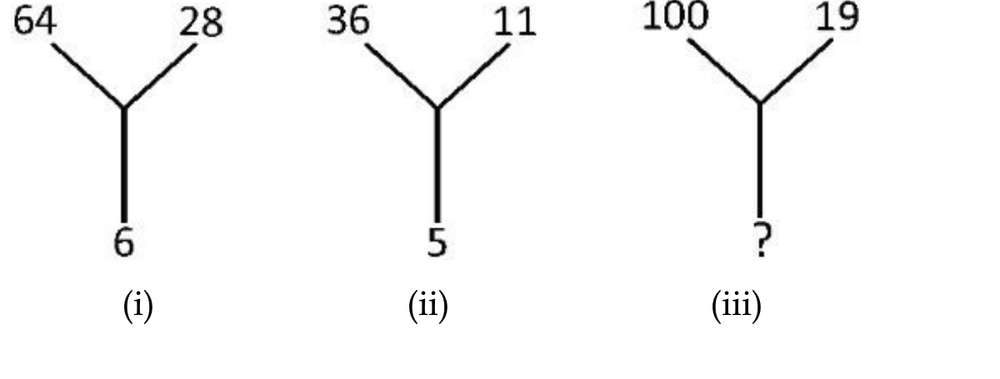
- A.
3
- B.
7
- C.
9
- D.
8
Correct answer: C
Solution
Concept
In this figure series, the three branches of each Y-shape are related by one fixed rule: the bottom number equals the square root of the difference between the top-left number and the top-right number (top-left minus top-right).
Application
Apply the rule to figure (iii), where the top-left value is 100 and the top-right value is 19:
Subtract the top-right value from the top-left value: 100 - 19 = 81.
Take the square root of that difference: √81 = 9.
So the missing number at the bottom of figure (iii) is 9.
Cross-check
Confirm the same rule against the two given figures before trusting it:
Figure (i): 64 - 28 = 36, and √36 = 6, which matches the bottom value shown (6).
Figure (ii): 36 - 11 = 25, and √25 = 5, which matches the bottom value shown (5).
Since the rule reproduces the given bottom values in both figures (i) and (ii), the same rule applied to figure (iii) reliably gives 9.
- A.
- Q124.RSSB 2025
Observe the given figures carefully and find the missing number in the figure (iii).
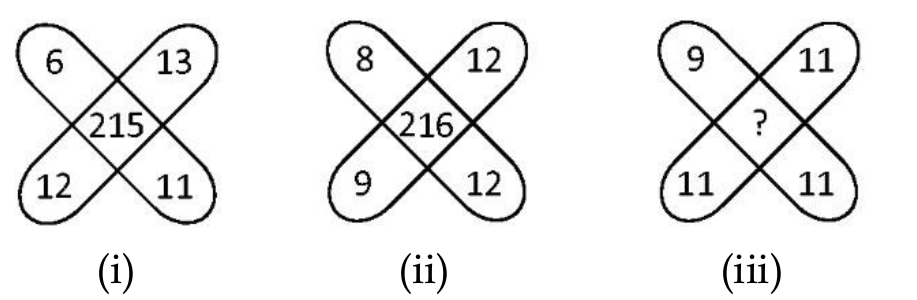
- A.
220
- B.
218
- C.
219
- D.
217
Correct answer: A
Solution
In this family of X-shaped figures, the four numbers at the ends of the cross pair by side: the top-left number pairs with the bottom-left number (the left side), and the top-right number pairs with the bottom-right number (the right side). The number placed at the centre equals the sum of these two side-wise products.
In figure (i): top-left = 6 and bottom-left = 12, so their product is 6 × 12 = 72; top-right = 13 and bottom-right = 11, so their product is 13 × 11 = 143. Adding the two products gives 72 + 143 = 215, which matches the given centre value.
In figure (ii): top-left = 8 and bottom-left = 9, so their product is 8 × 9 = 72; top-right = 12 and bottom-right = 12, so their product is 12 × 12 = 144. Adding the two products gives 72 + 144 = 216, which matches the given centre value.
In figure (iii): top-left = 9 and bottom-left = 11, so their product is 9 × 11 = 99; top-right = 11 and bottom-right = 11, so their product is 11 × 11 = 121. Adding the two products gives 99 + 121 = 220.
As a cross-check, testing the other pairing — by row: (top-left × top-right) + (bottom-left × bottom-right) — on figure (i) gives 6 × 13 + 12 × 11 = 78 + 132 = 210, which does not match the given centre value of 215. This confirms that the side-wise pairing (left side and right side) is the rule governing all three figures.
Applying only this confirmed rule to figure (iii) gives 99 + 121 = 220, so the missing number is 220.
- A.
- Q125.RSSB 2025
You are facing East. You turn 45° in the clockwise direction and then 180° in the anti-clockwise direction. Again you turn 270° in the clockwise direction. Which direction are you facing now ?
- A.
South-West
- B.
West
- C.
North-East
- D.
South
Correct answer: A
Solution
The eight compass directions sit at fixed bearings measured clockwise from North — North = 0°, North-East = 45°, East = 90°, South-East = 135°, South = 180°, South-West = 225°, West = 270°, North-West = 315°. A clockwise turn increases the current bearing and an anti-clockwise turn decreases it, with the result taken modulo 360°.
Start facing East, so the starting bearing is 90°.
Turn 45° clockwise: 90° + 45° = 135°.
Turn 180° anti-clockwise: 135° − 180° = −45°, which is 315° after adding 360°.
Turn 270° clockwise: 315° + 270° = 585°, which is 225° after subtracting 360°.
A bearing of 225° is the South-West direction.
As a check, treat every clockwise turn as positive and every anti-clockwise turn as negative: the three turns combine to +45° − 180° + 270° = +135° net clockwise rotation from the starting East bearing. Adding this to 90° gives 90° + 135° = 225°, the same bearing obtained above.
Both methods place the final bearing at 225°, which is South-West.
- A.
- Q126.RSSB 2025
Which of the following shortcut key is used to insert a hyperlink in MS Word ?
- A.
Alt + X
- B.
Ctrl + K
- C.
Ctrl + S
- D.
Ctrl + F
Correct answer: B
Solution
MS Word assigns a dedicated keyboard shortcut to many of its frequently used commands, so a user can trigger a specific action instantly without navigating through the ribbon or menus.
The command that inserts a hyperlink in MS Word is triggered by pressing Ctrl + K. This opens the "Insert Hyperlink" dialog box, where the selected text (or the current cursor position) can be linked to a web address, an email address, a file, or another location within the same document.
Alt + X converts the character code immediately before the cursor into its Unicode character, or back into its code, and has no role in linking text.
Ctrl + S writes the current document to its existing file (or opens the Save As dialog box the first time a new document is saved); it does not create any link.
Ctrl + F opens the search box in the Navigation pane to locate a word or phrase in the document; it also does not insert a link.
Since only Ctrl + K opens the hyperlink-insertion dialog among the given options, it is the shortcut for this task.
- A.
- Q127.RSSB 2025
Maximum amount of food is absorbed in the blood in : Choose the most appropriate answer from the options given below.
- A.
Ileum
- B.
Esophagus (Oesophagus)
- C.
Caecum
- D.
Duodenum
Correct answer: A
Solution
Concept: Digested food is absorbed into the blood mainly through the wall of the small intestine, which is lined with millions of finger-like projections called villi (each further covered with microvilli). These structures increase the surface area available for nutrients to pass into the blood capillaries beneath, working alongside digestion carried out earlier by intestinal, pancreatic, and biliary secretions.
Application: The small intestine runs, in order, through three parts:
Duodenum -- the first and shortest part, immediately after the stomach, where bile from the liver and enzymes from the pancreas mix into the partly-digested food and digestion of proteins, fats, and carbohydrates gets underway.
Jejunum -- the middle part, where much of the bulk digestion of proteins, fats, and carbohydrates is completed and where absorption of these nutrients is most active.
Ileum -- the third and longest part of the small intestine (roughly 3-4 metres), considerably longer than the duodenum and jejunum together. It absorbs vitamin B12, bile salts, and whatever nutrients and water were not already taken up earlier, and -- being the final and longest stretch the digested food passes through -- is the part that standard school and competitive-exam biology (matching this exam's own official answer key) identifies as where the maximum absorption of digested food into the blood is completed.
In more detailed physiology, the duodenum and jejunum carry out much of the bulk absorption of macronutrients, while the ileum's distinctive role is absorbing vitamin B12, bile salts, and residual nutrients and water. Even so, because it is the longest segment and the last stop before the large intestine, the ileum is the part conventionally credited -- in NCERT-level biology and in this exam's own official key -- with the maximum absorption of digested food into the blood.
Cross-check: This also fits the other three options by elimination: the esophagus is a transport tube with no villi and no digestive or absorptive role; the caecum lies beyond the small intestine, at the start of the large intestine, dealing with what has already left the small intestine rather than absorbing nutrients from it; and the duodenum, though it is where key digestive secretions are added, is not the part credited with maximum absorption. That leaves the ileum as the correct choice among the four options offered.
Hence, the ileum is the correct answer, as confirmed by RSSB's own official Patwar 2025 Shift 1 answer key for this question.
- A.
- Q128.RSSB 2025
Who was the court poet of Maharana of Mewar, Shambhu Singh ?
- A.
Dursa Adha
- B.
Kaviraj Shyamal Das
- C.
Bavji Chatur Singh
- D.
Dayaldas
Correct answer: B
Solution
Concept: In princely-state Rajasthan, a "court poet" (rajkavi/kaviraj) was an officially appointed literary-historian at a ruler's court, entrusted with composing dynastic chronicles (khyats), genealogies, and eulogistic verse; the same officeholder frequently continued serving across the reigns of successive rulers of that dynasty.
Application: Kaviraj Shyamal Das (1836-1893) held this office at the Mewar court across the reigns of Maharana Shambhu Singh (1861-1874) and his successor, Maharana Sajjan Singh (1874-1884). He is best known for authoring Vir Vinod, the first comprehensive chronicle-history of the Mewar dynasty from its origins.
Cross-check - each named figure by value:
Dursa Adha (c. 1535-1655): a Dingal-verse poet remembered for eulogizing Maharana Pratap's resistance against the Mughals, placing his best-known work nearly three centuries before Shambhu Singh's reign.
Kaviraj Shyamal Das (1836-1893): held the Mewar court-poet office through Shambhu Singh's reign and authored Vir Vinod, the Mewar dynastic chronicle.
Bavji Chatur Singh (1880-1929): a Mewar royal-lineage saint-poet remembered for translating the Gita and Yogasutra into the Mewari language, active a generation after Shambhu Singh's reign.
Dayaldas (1798-1891): a chronicler at the Bikaner court, not Mewar, remembered for authoring a khyat on the Rathore rulers of Bikaner.
Result: the court poet of Maharana Shambhu Singh of Mewar was Kaviraj Shyamal Das - this also matches RSSB's own official Patwar (2025, Shift 1) answer key for this question.
- A.
- Q129.RSSB 2025
“Operation Sard Hawa” was conducted by which of the following in the Indo-Pak border of Rajasthan ? Choose the most appropriate answer from the options given below.
- A.
Border Security Force (BSF)
- B.
Central Industrial Security Force (CISF)
- C.
Central Reserve Police Force (CRPF)
- D.
Indo Tibetan Border Police (ITBP)
Correct answer: A
Solution
Concept
India's central armed police forces (CAPFs) each have a distinct primary role assigned by their charter — the general category of border, installation, or internal-security duty each force is principally raised to handle.
Application
The Border Security Force (BSF) is India's designated force for guarding the international land borders with Pakistan and Bangladesh, including the desert stretch of the Indo-Pak border in Rajasthan. “Operation Sard Hawa” (“Cold Wind”) is a winter anti-infiltration and high-alert exercise that the BSF runs along this Rajasthan sector, since dense winter fog historically raises infiltration risk along that stretch. This matches the force named in the question.
Cross-check
Checking each other force's actual mandate confirms none of them fits this border role:
Central Industrial Security Force (CISF) protects industrial undertakings, airports, metro systems, and other critical infrastructure installations, not international land borders.
Central Reserve Police Force (CRPF) is primarily an internal-security force for law-and-order support, anti-Naxal operations, and election duty within Indian states.
Indo-Tibetan Border Police (ITBP) guards the Himalayan sector of India's border with China, from Ladakh to Arunachal Pradesh, not the Rajasthan Indo-Pak sector.
Result: the Border Security Force (BSF) conducted “Operation Sard Hawa” on the Indo-Pak border in Rajasthan.
- A.
- Q130.RSSB 2025
‘Languriya’ songs sung by the devotees of Kela Devi are very popular in which region of Rajasthan ? Choose the most appropriate answer from the options given below.
- A.
Jaisalmer
- B.
Karauli
- C.
Dholpur
- D.
Mewar
Correct answer: B
Solution
Concept
In Rajasthan's folk culture, a devotional song genre is historically anchored to the specific temple and deity whose devotees composed and popularised it — and therefore to the geographic region surrounding that temple's principal seat.
Application
Kela Devi (also spelled Kaila Devi), a form of goddess Durga, has her principal hilltop temple near the town of Karauli, in Karauli district in eastern Rajasthan. Each year during the Chaitra fair (mela) held at this temple, devotees traditionally sing Languriya songs in her honour. This temple-fair association is why Languriya songs are most popular in the Karauli region.
Cross-check
Jaisalmer, in the western Thar Desert, was the seat of the Bhati Rajput dynasty and has its own folk-song identity built around styles such as Maand — it carries no Kela Devi association.
Dholpur, in the eastern Chambal region, is historically known for its red-sandstone quarries and Chambal-ravine geography, with a distinct local folk repertoire of its own.
Mewar, centred on Udaipur and Chittorgarh, was the seat of the Sisodia Rajput dynasty and is associated with its own devotional/folk forms such as Gangaur and Gawari songs.
None of the other three regions carries the Kela Devi temple-fair association, which confirms Karauli as the region where Languriya songs are popular.
- A.
- Q131.RSSB 2025
Who appoints the Advocate General for the state ?
- A.
Chief Justice of High Court
- B.
Governor
- C.
Leader of Opposition
- D.
Speaker
Correct answer: B
Solution
Article 165 of the Constitution of India establishes the office of the Advocate General for each State — the State's chief law officer. The article provides that the Governor of the State appoints the Advocate General, who must be a person qualified to be appointed as a Judge of a High Court, and holds office during the pleasure of the Governor.
Applying this provision to the question: the appointing authority named in Article 165(1) is the Governor, so that is the office being asked about here.
Cross-checking against the other offices named in the options confirms none of them carries this appointing power:
Chief Justice of High Court — heads the administration of the High Court and exercises judicial and administrative authority over that court and its staff, but holds no constitutional power to appoint the State's law officer.
Leader of Opposition — is the recognised head of the principal opposition party in the Legislative Assembly and takes part in certain statutory committees, but has no appointing power over any State legal office.
Speaker — presides over the Legislative Assembly, regulates its proceedings and decides certain procedural and disqualification matters, but is not vested with any appointing power over the Advocate General or other executive law officers.
As an independent check, the Union-level parallel confirms the same pattern: Article 76 of the Constitution provides that the Attorney General of India, the Union's chief law officer, is appointed by the President of India. Since the President is the head of the Union executive and appoints the Union's law officer, the analogous head of the State executive — the Governor — is the one who appoints the State's law officer, the Advocate General.
- A.
- Q132.RSSB 2025
In which of the following the transmission of sound is NOT possible ? Choose the most appropriate answer from the options given below.
- A.
Air
- B.
Vacuum
- C.
Aluminium
- D.
Water
Correct answer: B
Solution
Concept: Sound is a mechanical wave: it travels only by making the particles of a material medium (solid, liquid, or gas) oscillate about their equilibrium positions and transfer that oscillation to their neighbours — through direct collisions in gases and liquids, and through elastic restoring forces between bonded particles in solids — passing the disturbance on as alternating regions of compression and rarefaction. Because this transfer mechanism always requires particles of a medium, sound cannot propagate through empty space.
Application: Checking each option against this requirement:
Air is a gas made of freely moving molecules; their compressions and rarefactions carry sound at about 343 m/s at room temperature.
Aluminium is a solid whose tightly packed, strongly bonded atoms transmit sound very efficiently via elastic restoring forces between neighbouring atoms, at around 6300 m/s — faster than in air or water.
Water is a liquid whose molecules also support compressional waves; sound travels through water at about 1480 m/s, faster than in air.
A vacuum is a region essentially devoid of matter. With no particles present to oscillate or collide, there is no mechanism left to carry a mechanical wave through it.
Cross-check: The classic demonstration of ringing a bell inside a sealed jar and pumping the air out confirms this — as the vacuum is created, the sound fades to silence even though the bell can still be seen striking, because no particles remain to carry the vibration outward. (This is unlike light, an electromagnetic wave, which needs no medium and travels through vacuum — for example, sunlight reaching Earth across space.)
Result: Among the options, a vacuum is the medium in which the transmission of sound is not possible.
- A.
- Q133.RSSB 2025
In which of the following regions of the Andaman and Nicobar islands is the Saddle Peak located ?
- A.
South Andaman
- B.
Middle Andaman
- C.
Great Nicobar
- D.
North Andaman
Correct answer: D
Solution
The Andaman and Nicobar Islands are divided into distinct geographic regions — the Andaman group consists of North Andaman, Middle Andaman, and South Andaman, while the Nicobar group (including Great Nicobar) lies further south. Each region has its own prominent landmarks within this hilly, forested archipelago of volcanic-tectonic origin.
Saddle Peak rises to 732 metres, making it the highest point of the entire Andaman and Nicobar Islands. It is situated within Saddle Peak National Park in the North Andaman region, near the town of Diglipur.
Comparing the other regions confirms this placement:
South Andaman houses Sri Vijaya Puram (formerly Port Blair), the union territory's capital, and the hill point of Mount Manipur (formerly Mount Harriet) — a separate location from Saddle Peak.
Middle Andaman contains Rangat town and the Interview Island Wildlife Sanctuary, along the archipelago's central stretch.
Great Nicobar, the southernmost major island of the Nicobar group, is home to Mount Thullier (642 m) — the highest point of the Nicobar Islands, but a distinct peak in a different island group.
Since Saddle Peak lies specifically within the North Andaman region, North Andaman is the correct answer.
- A.
- Q134.RSSB 2025
In the field of agriculture, the full form of HYV is :
- A.
High Yielding Variety
- B.
Horticulture Yield Variety
- C.
Honey Yeast Variety
- D.
Hemp Yarn Variety
Correct answer: A
Solution
Concept
In agriculture General-Knowledge questions, abbreviation items like HYV test recall of Green Revolution-era terminology. HYV stands for High Yielding Variety - crop seed strains specially bred (through selective breeding/hybridisation) to produce substantially more grain per hectare than traditional (desi) varieties, when grown with the accompanying package of assured irrigation, chemical fertilisers and pesticides.
Application
Decoding the letters in the abbreviation for this item - H = High, Y = Yielding, V = Variety - gives 'High Yielding Variety', which is exactly the term introduced during India's Green Revolution (1960s onward) to describe improved wheat and rice seed strains (e.g. the varieties associated with Norman Borlaug's research) that raised national foodgrain output.
Contrast
Each distractor borrows one of the letters but pairs it with a term from an unrelated field:
Horticulture Yield Variety - 'horticulture' is the branch of agriculture concerned with fruits, vegetables, flowers and ornamental plants; this combination is not a recognised agricultural terminology.
Honey Yeast Variety - 'honey' belongs to apiculture (bee-keeping) and 'yeast' is a fermentation micro-organism used in baking/brewing; neither relates to crop seed classification.
Hemp Yarn Variety - 'hemp' is a fibre crop and 'yarn' is spun thread used in textile manufacture; this describes a textile-industry concept, not a seed-technology term.
Result: The full form of HYV in agriculture is High Yielding Variety.
- A.
- Q135.RSSB 2025
A rare carnivorous plant ‘Utricularia’ has been found at which National Park in Rajasthan ?
- A.
Darrah National Park
- B.
Desert National Park
- C.
Ranthambore National Park
- D.
Keoladeo National Park
Correct answer: D
Solution
Concept
National parks and wildlife sanctuaries in Rajasthan are often reported for specific flora/fauna sightings that get recorded by state forest authorities and subsequently referenced in current-affairs and competitive-exam questions. Utricularia (bladderworts) is a genus of insectivorous plants, most species of which are aquatic or wetland-dwelling, trapping tiny organisms with bladder-like suction traps in standing or slow freshwater such as marshes and ponds.
Application
Among Rajasthan's national parks, Keoladeo National Park in Bharatpur is the state's principal wetland protected area — a UNESCO World Heritage network of marshes, ponds, and seasonally flooded grassland originally developed as a royal duck-hunting reserve and now a habitat for migratory waterfowl. This wetland setting is well suited to an aquatic species of Utricularia, and the plant's presence there has been formally recorded by the state's forest and wetland authorities. The RSSB Patwar 2025 Shift 1 official answer key confirms Keoladeo National Park as the location for this discovery.
Cross-check
The recorded discovery and the official answer key are the decisive evidence for this item; habitat differences between the offered parks corroborate this without being treated as an absolute rule, since some dry-forest reserves do contain limited water bodies. Darrah National Park (part of the Mukundra Hills Tiger Reserve) and Ranthambore National Park are primarily dry deciduous forest tiger habitats, while Desert National Park is an arid sand-dune and scrubland tract — none of them is reported as the location of this Utricularia discovery, whereas Keoladeo National Park's wetland ecosystem and the official record together confirm it as the correct location.
- A.
- Q136.RSSB 2025
Who propounded the Agni-kund theory of the origin of the Rajputs ?
- A.
Chandra Bardai
- B.
Barui
- C.
Jodhraj
- D.
Amir Khusro
Correct answer: A
Solution
The Agnikula (fire-born) theory is one of the classical explanations offered for the origin of the Rajput clans, alongside the foreign/Central-Asian-origin theory and the solar-lunar (Suryavanshi-Chandravanshi) dynastic theory. According to this legend, sage Vashishtha performed a yajna at a fire-pit (agni-kund) on Mount Abu, from which four warrior clans emerged to destroy demons: the Pratihara (Parihar), Chalukya (Solanki), Paramara (Pawar), and Chahamana (Chauhan).
The earliest known account of this fire-origin narrative is Prithviraj Raso, a medieval epic composed by Chand Bardai, the court poet of the Chahamana ruler Prithviraj III (Prithviraj Chauhan) of Ajmer-Delhi. Chand Bardai is therefore credited with propounding (first articulating) the Agni-kund theory for the origin of the Rajput clans, including his own patron's Chauhan lineage.
Why not the other names?
Barui does not appear as the author of any Rajasthani bardic or chronicle work in standard historiography of the medieval Rajput clans, and no clan-origin narrative is attributed to this name.
Jodhraj is credited as the author of Hamir Raso, a later bardic work centred on Hamir Dev Chauhan of Ranthambore. Later bardic literature, including Hamir Raso, repeats the fire-born clan narrative with minor variations, but it is Chand Bardai's earlier Prithviraj Raso that is credited with first propounding it.
Amir Khusro was a poet-historian at the Delhi Sultanate court across the 13th-14th centuries, working in a Persian literary tradition -- seen in works such as Tarikh-i-Alai -- distinct from the Rajasthani bardic tradition that carries the Rajput clan-origin narratives.
Hence, among the offered names, the Agni-kund theory of the origin of the Rajputs was first propounded by Chand Bardai in his epic Prithviraj Raso; later bardic works merely repeat the narrative he first set down.
- A.
- Q137.RSSB 2025
What is the study of inscriptions called ?
- A.
Numismatics
- B.
Palaeontology
- C.
Mycology
- D.
Epigraphy
Correct answer: D
Solution
Historical evidence is classified into literary sources and archaeological sources. Archaeological sources include epigraphy (the study of inscriptions engraved on stone, metal, or pottery), numismatics (the study of coins and currency), and physical remains such as monuments and artefacts. Epigraphy is especially valuable because inscriptions directly record the names of rulers, dates, land grants, and events, making them a primary source for history.
The question asks which branch of study is defined as "the study of inscriptions." Checking each named field against this definition shows that only one field matches: the branch devoted to reading, decoding, and interpreting inscriptions found on pillars, rocks, copper plates, and temple walls.
Numismatics is the study of coins, currency, and medals — not inscriptions.
Palaeontology is the study of fossils and prehistoric life forms — not inscriptions.
Mycology is the branch of biology dealing with fungi — not inscriptions.
Epigraphy is the study of inscriptions, which is exactly the definition given in the question — confirming it as the answer.
- A.
- Q138.RSSB 2025
Who among the following is the main officer in-charge of the district administration ?
- A.
District Collector
- B.
S.D.O. (Sub-Divisional Officer)
- C.
Tehsildar
- D.
Division Commissioner
Correct answer: A
Solution
In Indian state administrative structure, a state is organised into nested units for general and revenue administration: division, district, sub-division, and tehsil. Each unit has its own designated head officer responsible for administration at that specific level.
The District Collector (also called District Magistrate in some states) is the officer appointed to head the overall general administration of a single district. This officer coordinates revenue work, exercises magisterial authority for law and order, and supervises development and welfare programmes running within that district.
S.D.O. (Sub-Divisional Officer) heads a sub-division, a smaller unit comprising a group of tehsils within a district, not the district as a whole.
Tehsildar heads a tehsil, the smallest revenue administrative unit, primarily handling land records and revenue collection at that local level.
Divisional Commissioner heads a division, a larger unit made up of several districts, one administrative level above the district itself.
Since the district itself is the unit named in the question, and only the District Collector's charge matches the district as a whole, District Collector is the correct answer.
- A.
- Q139.RSSB 2025
Which one of the following comes under the “State List” of the Constitution of India ?
- A.
Police
- B.
Forest
- C.
Defence
- D.
Banking
Correct answer: A
Solution
Concept: Article 246, read with the Seventh Schedule of the Constitution, divides law-making subjects between the Union and the States through three lists — the Union List (List I, ordinarily an exclusive Parliament domain), the State List (List II, ordinarily an exclusive State Legislature domain, subject to constitutional exceptions such as Articles 249, 250, 252, 253 and 356 under which Parliament may legislate on State List matters), and the Concurrent List (List III, subjects on which both Parliament and State Legislatures may legislate, with the Union law ordinarily prevailing over a conflicting State law under Article 254, subject to Article 254(2) where a State law that received Presidential assent prevails in that State unless Parliament later legislates further on the same matter).
Application: Mapping each option to its constitutional list:
Option
Constitutional List
Entry
Police
State List (List II)
Entry 2
Forest
Concurrent List (List III)
Entry 17A (originally State List Entry 19 until the 42nd Amendment, 1976)
Defence of India
Union List (List I)
Entry 1
Banking
Union List (List I)
Entry 45
Only Police sits in the State List among the four options. Forest was originally a State List subject (old Entry 19) but was shifted into the Concurrent List by the 42nd Constitutional Amendment Act, 1976; Defence and Banking have always been Union List subjects.
Cross-check: This fits the general federal design — subjects needing uniform national policy or security, such as the armed forces and currency/banking, sit in the Union List, while day-to-day law-and-order administration such as policing stays with the states. RSSB's official Patwar 2025 Shift 1 answer key also confirms Police as the correct answer.
- A.
- Q140.RSSB 2025
The height of Western Ghats progressively increases from :
- A.
East to West
- B.
South to East
- C.
North to South
- D.
West to East
Correct answer: C
Solution
Concept: The Western Ghats (Sahyadri) form a continuous mountain range running roughly north to south along India's west coast, parallel to the Arabian Sea, for about 1,600 km. Along its length, the average elevation and the height of individual peaks are not constant — they follow a broad north-to-south gradient tied to the range's geological structure as the western edge of the Deccan Plateau.
Application: Moving along the range from north to south, the elevation of its highest peaks rises steadily:
Northern Western Ghats (Maharashtra) — highest peak Kalsubai, about 1,646 m.
Central Western Ghats (Karnataka) — highest peak Mullayanagiri, about 1,930 m.
Southern Western Ghats (Kerala–Tamil Nadu border) — highest peak Anamudi, about 2,695 m, the tallest point in the entire Western Ghats.
So the range's height progressively rises at each stage moving south — the height increases from north to south.
Cross-check: Contrasting the other direction pairs offered:
East to West / West to East describe the range's width — from the Konkan-Malabar coastal strip in the west to the Deccan Plateau interior in the east — not the direction along which peak height changes.
South to East does not correspond to a continuous axis of the Western Ghats at all; the range runs along the west coast and has no meaningful eastern end of its own.
Hence, the height of the Western Ghats progressively increases from North to South, matching RSSB's official answer key for this question and NCERT's Class XI Physical Geography of India textbook, which states this pattern directly.
- A.
- Q141.RSSB 2025
Which of the following is the main object guaranteed by Article 21 of the Indian Constitution?
- A.
Right to Protection of Life and Personal Liberty
- B.
Right Against Exploitation
- C.
Right to Freedom of Religion
- D.
Right to Equality
Correct answer: A
Solution
Concept: Part III of the Constitution guarantees several distinct Fundamental Rights, and each right is anchored to a specific Article whose own text and marginal heading identify what it protects — equality, freedom from exploitation, freedom of religion, or life and personal liberty are each governed by different Articles.
Application: The Article named in the question states, "No person shall be deprived of his life or personal liberty except according to procedure established by law," and its own marginal heading is "Protection of life and personal liberty." So its main object is safeguarding an individual's life and personal liberty against arbitrary action by the State.
Equal treatment before the law and equal protection of the laws is a different, separately-numbered guarantee, not the one named in the question.
Prohibition of trafficking and forced labour, including the bar on hazardous child employment, is likewise a separate, differently-numbered guarantee.
Freedom of conscience and the freedom to profess, practise, and propagate religion is also a separate, differently-numbered guarantee.
Only the protection of life and personal liberty matches the Article's own text and heading exactly as quoted above.
Result: The option whose wording matches the Article's own text and marginal heading — protection of life and personal liberty — is the correct answer.
- A.
- Q142.RSSB 2025
World Crafts Council (WCC) has declared which of the following places of Rajasthan as ‘World Craft City’ ?
- A.
Alwar
- B.
Jaisalmer
- C.
Jaipur
- D.
Udaipur
Correct answer: C
Solution
The World Crafts Council (WCC) is an international, UNESCO-linked body that designates select cities with an outstanding, unbroken living-craft heritage as 'World Craft Cities' — the tag recognises a city's traditional handicraft industry, artisan community, and its role in sustaining that craft economy, rather than any single monument or festival.
Applying this to Rajasthan: Jaipur was designated a World Craft City by the WCC in recognition of its centuries-old handicraft clusters — blue pottery, gem-cutting and jewellery-making, block printing, and meenakari enamelling — which together sustain a large artisan workforce in and around the city; this recognition is also cited in Rajasthan's own state handicrafts-policy documents.
Cross-checking against the other Rajasthan cities offered confirms none carries this WCC designation:
Alwar is known chiefly for the Sariska forest belt and its Rajput-era City Palace, not a WCC craft-city title.
Jaisalmer is known as the 'Golden City' for its sandstone Fort and havelis in the Thar Desert, not a WCC craft-city title.
Udaipur is known as the 'City of Lakes' for its palace-and-lake setting, not a WCC craft-city title.
- A.
- Q143.RSSB 2025
As on February 10, 2025, who is the Chairman (officiating) of the Rajasthan Public Service Commission ?
- A.
Lt. Col. Kesari Singh Rathore
- B.
Dr. Manju Sharma
- C.
Sh. Kailash Chand Meena
- D.
Dr. Sangeeta Arya
Correct answer: C
Solution
The Rajasthan Public Service Commission (RPSC) is a constitutional body, established under Article 315 of the Constitution of India, that conducts recruitment examinations and selects candidates for civil services and posts under the State of Rajasthan. The Commission is normally headed by a full-time Chairman; when that post falls vacant, the Governor designates one of the sitting Members of the Commission to hold the officiating (or acting) charge of Chairman until a new full-time Chairman is appointed.
As on February 10, 2025, the officiating charge of the RPSC Chairman was held by Sh. Kailash Chand Meena, a 2005-batch Rajasthan-cadre IAS officer who had earlier served as Divisional Commissioner, Jodhpur. He was appointed a Member of the Commission on October 9, 2023; when the previous full-time Chairman's tenure ended on August 1, 2024, the Governor gave him additional charge as officiating Chairman from August 6, 2024, and he continued to hold this charge until a new full-time Chairman was later appointed. This matches the official RSSB Patwar-2025 (Shift 1) answer key, which records the same option as correct.
Among the four names listed as options, only one held the officiating Chairman's charge on the stated date; the remaining three were Members of the Commission but did not hold that additional charge on February 10, 2025:
Lt. Col. (retd) Kesari Singh Rathore - a retired Army officer who joined the Commission as a Member in 2023; not holding the officiating Chairman's charge on the stated date.
Dr. Manju Sharma - a Member of the Commission since October 2020, formerly an Associate Professor of Geography at a government college in Bharatpur; not holding the officiating Chairman's charge on the stated date.
Sh. Kailash Chand Meena - the Member who held the officiating Chairman's charge on the stated date (the correct answer).
Dr. Sangeeta Arya - a Member of the Commission since October 2020, formerly an Assistant Professor in the College Education Department; not holding the officiating Chairman's charge on the stated date.
Hence, the correct answer is Sh. Kailash Chand Meena.
- A.
- Q144.RSSB 2025
In which area of Rajasthan is the Kajli Teej celebrated on Bhadrapad Krishna Tritiya ?
- A.
Jodhpur
- B.
Karauli
- C.
Alwar
- D.
Bundi
Correct answer: D
Solution
Rajasthan's Teej festivals are region-specific monsoon folk festivals honouring Goddess Parvati as Teej Mata; while some Teej observances exist in other regions too, each Rajasthani town's own version is anchored by long-standing local tradition rather than by the lunar date alone.
Kajli Teej (also called Badi Teej) falls on Bhadrapad Krishna Tritiya and is most closely associated, within Rajasthan, with Bundi's own signature version of the festival. The Teej Mata idol is carried in a decorated palanquin through the city's streets in a grand procession, accompanied by decorated elephants and camels, alongside a 15-day fair. RSSB's own official answer key for this paper confirms Bundi as the answer, matching this tradition.
Jodhpur hosts the Marwar Festival in Ashwin around Sharad Purnima, honouring Rajasthan's folk heroes through music and dance, not the Kajli Teej procession.
Karauli hosts the Kaila Devi fair in Chaitra at the Kaila Devi temple on the Kalisil river, unrelated to the Bhadrapad Teej tradition.
Alwar hosts the Bhartrihari Mela at Bhartrihari Dham after Bhadrapada Amavasya, honouring the sage-king Bhartrihari rather than Teej Mata.
Among the four listed towns, only Bundi is linked to the Kajli Teej procession on Bhadrapad Krishna Tritiya, which matches the stem exactly.
- A.
- Q145.RSSB 2025
Which of the following places is famously known as the Khajuraho of Rajasthan ?
- A.
Kiradu
- B.
Abhaneri
- C.
Badoli
- D.
Dilwara
Correct answer: A
Solution
Concept
Several heritage sites across India carry popular epithets such as "the Khajuraho of X," given when a temple complex's sculptural style — particularly finely carved surfaces or figural/decorative panels — draws comparison with the Chandela-era temples at Khajuraho (Madhya Pradesh). Such nicknames usually attach to one specific, widely recognised site rather than to every ornately carved temple cluster in a region.
Application
In Rajasthan, the temple cluster at Kiradu (Barmer district), built mainly under the Paramara dynasty during the 11th-12th century CE, is popularly known as the "Khajuraho of Rajasthan" because of its intricately carved shikharas and sculptural panels, whose ornamental and figural style is compared to that of Khajuraho. RSSB's official Patwar 2025 Shift-1 answer key marks Kiradu as the correct response to this exact question, and independent heritage/travel coverage (for example, The Times of India) also describes Kiradu using this same epithet.
Cross-check: why the other places are not the answer
Abhaneri (Dausa district) is chiefly known for the Chand Baori stepwell and the adjoining Harshat Mata Temple — a stepwell/water-architecture tradition, not the sculptural style referenced by the Khajuraho comparison.
Badoli, near Rawatbhata in Chittorgarh district, has an 8th-10th century Shaivite temple group, but standard references do not attach the "Khajuraho of Rajasthan" title to it.
Dilwara, on Mount Abu in Sirohi district, is renowned specifically for Jain white-marble carving — a distinct craft tradition from the sandstone figural style associated with Khajuraho.
Result: Kiradu is the place popularly termed the "Khajuraho of Rajasthan."
- A.
- Q146.RSSB 2025
Brass is an alloy made up of :
- A.
Copper and tin
- B.
Copper and zinc
- C.
Gold, iron and zinc
- D.
Lead and tin
Correct answer: B
Solution
An alloy is a substance formed by fusing two or more metals (or a metal with a non-metal) to produce material properties -- strength, corrosion resistance, colour, or workability -- that differ from those of the individual pure metals. Each standard alloy has a specific, named metal combination: for example, copper and tin give one well-known alloy, copper and zinc give another, and lead and tin give a third.
Brass is, by definition, the alloy formed from copper and zinc. Depending on the intended use, the zinc content typically ranges from about 5% to 40%, with the remainder copper; a higher zinc share increases strength but reduces ductility, while a higher copper share deepens the golden-yellow colour. This copper-zinc combination is why brass is widely chosen for musical instruments, decorative fittings, and plumbing components -- it is both corrosion-resistant and easy to machine.
Checking the composition against each offered pairing:
Copper and tin is the composition of bronze, a harder and more wear-resistant alloy traditionally used for statues, bells, and bearings -- a different alloy from brass.
Gold, iron and zinc is not a standard industrial alloy; iron has very limited solubility in molten gold, so the three metals do not combine into a stable, well-defined alloy.
Lead and tin is the composition of solder, valued for its low melting point in joining applications, and is unrelated to the copper-zinc composition of brass.
Therefore, brass is the alloy made of copper and zinc.
- A.
- Q147.RSSB 2025
In Rajasthan, which town of Sikar is a famous centre of the gota industry ?
- A.
Khandela
- B.
Amer
- C.
Shahpura
- D.
Virat Nagar
Correct answer: A
Solution
Gota is a traditional Rajasthani embroidery craft in which flattened metallic-thread ribbon (zari) is appliqued onto fabric borders and trims; across Rajasthan, specific towns have historically been recognised as the established centres for particular crafts and industries.
In Sikar district, Khandela is that recognised historic centre of the gota industry, where the ornamental gota-kinari trim used on turbans and traditional Rajasthani garments has traditionally been produced.
Amer, near Jaipur, is renowned for Amer Fort, not for the gota craft.
Shahpura is recognised for Phad scroll-painting, a different craft tradition.
Virat Nagar (Bairat), in Kotputli-Behror district, is an ancient site linked to the Matsya kingdom and an Ashokan rock edict, not a craft centre.
Since only Khandela is linked to the gota industry among the offered towns, it is the correct answer.
- A.
- Q148.RSSB 2025
Oral Sabin Polio vaccine is which type of vaccine ?
- A.
Live Attenuated Vaccines
- B.
Acellular Vaccines
- C.
Inactivated Vaccines
- D.
Recombinant Vaccine
Correct answer: A
Solution
Concept: Vaccines are classified by their composition and how they trigger immunity — live attenuated vaccines contain a weakened but still-living pathogen that replicates in the body and mimics natural infection; inactivated vaccines contain a killed pathogen that cannot replicate; acellular/subunit vaccines contain only purified antigenic fragments of the pathogen; and recombinant vaccines contain an antigen manufactured by inserting the pathogen's gene into another host organism.
Application: The oral Sabin polio vaccine (OPV) contains a poliovirus that has been weakened (attenuated) in the laboratory so that it does not ordinarily cause paralytic disease — though in very rare cases the vaccine strain can revert and cause vaccine-associated paralytic poliomyelitis — while still being able to replicate in the lining of the intestine after being swallowed. This replication closely mimics natural poliovirus infection, producing strong intestinal (mucosal) immunity along with systemic antibody protection, and can even spread limited contact immunity to unvaccinated people nearby.
Acellular vaccines use only purified pathogen components, not a whole living virus, so OPV (which uses the entire weakened virus) does not fit this category.
The inactivated (killed) polio vaccine is the injectable Salk vaccine (IPV); it cannot replicate in the body, unlike the oral Sabin vaccine, which does.
Recombinant vaccines are produced by inserting a pathogen's antigen gene into a different host organism (as with the hepatitis B vaccine), whereas OPV uses the poliovirus itself rather than a gene-engineered antigen.
Result: Because OPV contains a live poliovirus that is weakened yet still able to replicate and closely mimic natural infection, it is classified as a Live Attenuated Vaccine.
- A.
- Q149.RSSB 2025
Who is the head of criminal administration of the district in India ?
- A.
Special Munsif Magistrate
- B.
Special Judicial Magistrate
- C.
District Magistrate
- D.
Sub Divisional Magistrate
Correct answer: C
Solution
District administration in India runs on two separate tracks: a judicial track (courts and magistrates who try cases under High Court supervision) and an executive track (revenue and law-and-order officers). Under the Code of Criminal Procedure (CrPC) — since 1 July 2024 replaced by the Bharatiya Nagarik Suraksha Sanhita (BNSS), 2023, which carries the same structure — the executive track also carries a distinct "criminal administration" role — maintaining public order, supervising Executive Magistrates, and issuing preventive orders — and this role is headed by one designated officer for the whole district.
Section 14 of the BNSS, 2023 (the former Section 20 of the CrPC) empowers the State Government to appoint a District Magistrate for every district; this officer heads the executive magistracy and is responsible for maintaining law and order across the entire district.
The District Magistrate supervises every Executive Magistrate posted within the district — including officers who administer only a part of it — and coordinates with the district police on public-order and preventive action.
Cross-checking against the offered options: only one of them is an executive-administration office covering the whole district rather than a sub-division, and only executive (not judicial) officers carry this criminal-administration charge under the CrPC.
Comparing each offered option by its actual role:
Special Munsif Magistrate — a judicial officer of the civil courts who adjudicates civil suits within a prescribed pecuniary limit, functioning under High Court oversight rather than in the district's executive administration.
Special Judicial Magistrate — appointed under Section 11 of the BNSS, 2023 (the former Section 13 of the CrPC) to try specified categories of criminal cases as part of the judicial system, working under High Court control rather than the district's executive hierarchy.
District Magistrate — the senior-most executive officer of a district, appointed under Section 14 of the BNSS, 2023 (the former Section 20 of the CrPC), holding charge of the district's overall executive and law-and-order administration.
Sub Divisional Magistrate — an executive magistrate who administers one sub-division, a part of a district, under the District Magistrate's overall supervision, rather than the district as a whole.
Only the District Magistrate's charge spans the whole district's executive and criminal administration, matching the question.
- A.
- Q150.RSSB 2025
Which is the largest and most beautifully carved haveli in Jaisalmer ?
- A.
Bagore ki Haveli
- B.
Patwon ki Haveli
- C.
Samode Haveli
- D.
Char Chowk Haveli
Correct answer: B
Solution
Concept
Havelis are large, ornately carved traditional mansions built by wealthy merchant or noble families across Rajasthan, typically in the 18th-19th centuries. The scale of a haveli and the intricacy of its stone jharokhas (carved balconies), facades, and interior work reflected the family's wealth and status, with the finest examples clustering in trading hubs such as Jaisalmer, Jaipur, and the Shekhawati towns.
Application
Patwon ki Haveli in Jaisalmer is not one building but a complex of five interconnected havelis, built between 1805 and around 1860 by the wealthy trader Guman Chand Patwa for his five sons. Because all five havelis stand side by side sharing elaborately carved yellow-sandstone facades, filigree jharokhas, and mirrored interiors, the complex is recognised - including in RSSB's official Patwar 2025 Shift 1 answer key - as the largest and most intricately carved haveli in Jaisalmer.
Cross-check
Checking each remaining option against its actual city and builder rules it out:
Bagore ki Haveli stands on the bank of Lake Pichola in Udaipur, built by Amar Chand Badwa, an 18th-century Mewar prime minister - a different city.
Samode Haveli was built around 1800 by Rawal Sheo Singhji of the Samode family and is now run as a heritage hotel in Jaipur.
Char Chowk Haveli is in Laxmangarh in the Shekhawati region, built by Muralidhar Ganeriwala in the 1840s and known for its four courtyards - again, not in Jaisalmer.
- A.
- Q151.RSSB 2025
The Southernmost point of India is called :
- A.
Indira Point
- B.
Indira Col Point
- C.
Kibithu Point
- D.
Kavaratti
Correct answer: A
Solution
Concept
A country’s extreme points — its northernmost, southernmost, easternmost, and westernmost locations — are the outermost points of its sovereign territory in each direction. These are measured over the entire territory, including any outlying islands, which can lie well beyond the mainland’s own extremities.
Application
For India, the southernmost point of the entire sovereign territory is Indira Point, on Great Nicobar Island in the Andaman & Nicobar Islands. It was named in 1985 in honour of Prime Minister Indira Gandhi, replacing its earlier name, Pygmalion Point. This is distinct from Kanniyakumari (Tamil Nadu), which is only the southernmost point of the Indian mainland — the Andaman & Nicobar Islands extend further south than the peninsula, which is exactly why the island point, not the mainland point, is India’s true southernmost extremity.
Cross-check: the other extreme points and places
Indira Col Point lies in the Karakoram range near the Siachen Glacier in Ladakh — the country’s northern extremity, in the opposite direction from the one the question asks about.
Kibithu Point lies in Anjaw district, Arunachal Pradesh, along the Lohit river valley near the India–Myanmar frontier — the country’s eastern extremity, again a different cardinal direction.
Kavaratti is the administrative capital and largest town of the Union Territory of Lakshadweep, among the coral atolls of the Arabian Sea — an inhabited administrative centre, not one of the four cardinal extremity points at all.
Checking each of the four cardinal extremities against the option values confirms that only Indira Point marks India’s southern extremity, so it is the correct answer.
- A.
- Q152.RSSB 2025
In which of the following divisions of the Himalayas is the Karewa formation found ?
- A.
Arunachal Himalayas
- B.
Darjeeling and Sikkim Himalayas
- C.
Assam Himalayas
- D.
Kashmir Himalayas
Correct answer: D
Solution
The Himalayas are longitudinally divided into four broad regional belts — the Kashmir Himalayas, the Himachal-Uttarakhand Himalayas, the Darjeeling-Sikkim Himalayas, and the Arunachal Himalayas — each shaped by a distinct set of rivers, rock formations, and depositional history. Karewas are thick, unconsolidated lacustrine (lake-bed) sediments — alternating layers of clay, silt, sand, and glacial debris — laid down when a Pleistocene-age lake occupied a Himalayan valley basin.
This lake-bed sequence is confined to the Kashmir Valley, enclosed between the Pir Panjal range and the main Himalayan range — that is, within the Kashmir Himalayas. The karewa terraces there today support saffron cultivation and orchards, and their layered sediments record the region's Pleistocene glacial and interglacial history.
None of the other three divisions carries this depositional feature:
Arunachal Himalayas — the easternmost stretch of the range, running from the Bhutan border to the Diphu Pass at the India-Myanmar-China tri-junction, drained by the Kameng, Subansiri, Dihang, and Lohit; it has no lacustrine karewa sequence.
Darjeeling and Sikkim Himalayas — lie between the Nepal and Bhutan Himalayas, drained by the Tista, with a steep gradient and dense monsoon forest cover; the karewa lake-bed deposits do not occur here.
Assam Himalayas — the hill ranges east of the Tista toward the Brahmaputra's Dihang bend, marked by very heavy monsoon rainfall and fast-flowing streams; this belt also lacks the karewa sequence.
So the division in which the Karewa formation is found is the Kashmir Himalayas.
- A.
- Q153.RSSB 2025
Which force has the highest representation of women among the Central Armed Police Forces (CAPF’s) ? Choose the most appropriate answer from the options given below.
- A.
Border Security Force
- B.
Indo Tibetan Border Police
- C.
Central Industrial Security Force
- D.
Assam Rifles
Correct answer: C
Solution
Concept
Government data on women's representation in central police and paramilitary forces — covering forces such as the Border Security Force, Central Industrial Security Force, Indo-Tibetan Border Police, and Assam Rifles — shows the share of women in posted strength varies widely by force, reflecting how each force's recruitment and deployment pattern has developed alongside its mandate.
Application
Government data placed before Parliament (as of 30 September 2024) records the share of women in the Central Industrial Security Force's posted strength at roughly 7.02% — the highest among the four forces named in this question, ahead of the Border Security Force (about 4.41%), the Indo-Tibetan Border Police (about 4.05%), and Assam Rifles (about 4.01%).
Cross-check
RSSB's official Patwar 2025 (Shift 1) answer key for this question confirms Central Industrial Security Force as the correct option, consistent with the government data above — the exam's own key and the underlying statistics agree.
Contrast
Border Security Force (about 4.41% women in posted strength): its core duty centres on guarding India's land borders with Pakistan and Bangladesh through static border-outposts in remote sectors — structurally different from the Central Industrial Security Force's civilian-facing access-control duty.
Indo-Tibetan Border Police (about 4.05% women in posted strength): its core duty centres on guarding the high-altitude Himalayan border with China — again structurally different from the Central Industrial Security Force's civilian-facing duty.
Assam Rifles (about 4.01% women in posted strength): deployed for counter-insurgency and border-guarding in the North-East under dual Army-Home Ministry control — again a role structurally different from the Central Industrial Security Force's civilian access-control duty.
- A.
- Q154.RSSB 2025
Which of the following rivers flows in a rift valley ?
- A.
Luni
- B.
Ravi
- C.
Narmada
- D.
Jhelum
Correct answer: C
Solution
Concept: A rift valley (graben) is an elongated trough formed when a block of the Earth's crust subsides between two roughly parallel fault lines, bounded by highlands on either side -- a tectonic origin distinct from an ordinary valley shaped purely by surface erosion.
Application: Among Peninsular India's rivers, the Narmada is the standard textbook example of a rift-valley river. It rises at Amarkantak in the Maikal Hills and follows a fault-bounded trough lying between the Vindhya Range to the north and the Satpura Range to the south for about 1,312 km before draining into the Gulf of Khambhat. This westward course, cutting across the general eastward slope followed by most Peninsular rivers, is a direct consequence of the rifting.
Cross-check: The Tapi River follows a parallel rift-valley course further south (between the Satpura and the Satmala hills), confirming the same tectonic pattern -- Narmada and Tapi are the two rivers conventionally cited in NCERT geography as India's rift-valley rivers. Luni is an inland-draining desert river with no rift association; Ravi and Jhelum are Himalaya-fed tributaries of the Indus system and are not conventionally classified as rift-valley rivers. This confirms Narmada as the correct answer.
- A.
- Q155.RSSB 2025
Who was the founder of Arya Samaj ?
- A.
Swami Dayanand Saraswati
- B.
Raja Rammohan Roy
- C.
Ishwar Chandra Vidyasagar
- D.
Swami Vivekananda
Correct answer: A
Solution
Concept: Colonial-era India saw a wave of socio-religious reform movements, each founded by a specific reformer to address a particular concern - idol worship, caste discrimination, women's status, or the authority of scripture. Identifying a movement's founder means matching its founding year, place, and core philosophy to the reformer's own record.
Application: Arya Samaj was founded in 1875 in Bombay by Swami Dayanand Saraswati. He called for a "return to the Vedas", rejected idol worship and caste-based discrimination, and set out his ideas in the treatise Satyarth Prakash.
Cross-check - the other reformers:
Raja Rammohan Roy founded the Brahmo Sabha (later Brahmo Samaj) in Calcutta in 1828 - an earlier, separate movement, not Arya Samaj.
Ishwar Chandra Vidyasagar drove the Hindu Widows' Remarriage Act, 1856, and the spread of women's education; he is not credited with founding a religious reform organisation.
Swami Vivekananda founded the Ramakrishna Mission in 1897, more than two decades after Arya Samaj and on a distinct philosophical basis.
Hence, Swami Dayanand Saraswati is the founder of Arya Samaj.
- A.
- Q156.RSSB 2025
Who is the current Chief Justice of Rajasthan High Court ? (As on June 2025)
- A.
Hon’ble Shree Chandrashekhar
- B.
Hon’ble Inderjeet Singh
- C.
Hon’ble Manoj Kumar Garg
- D.
Hon’ble Manindra Mohan Shrivastava
Correct answer: D
Solution
The head of a High Court is its Chief Justice, appointed by a warrant of the President of India on the recommendation of the Supreme Court collegium. Chief Justices are periodically transferred between High Courts — often as part of a paired swap between two courts — as routine judicial administration, so identifying ‘the current’ Chief Justice of a specific court on a specific date requires checking the actual timeline of such transfers rather than assuming a single, permanent holder.
The official Rajasthan High Court roster dated 1 June 2025 lists Justice Manindra Mohan Shrivastava as its Chief Justice — an office he had held since taking oath as the 42nd Chief Justice of the Rajasthan High Court on 6 February 2024. On 26 May 2025 the Supreme Court collegium recommended swapping the Chief Justices of the Rajasthan and Madras High Courts, but this swap was implemented only in July 2025: Justice K. R. Shriram took oath as the 43rd Chief Justice of Rajasthan High Court on 21 July 2025, the same day Justice Shrivastava was sworn in as Chief Justice of the Madras High Court. So on the date the question specifies — June 2025 — Justice Manindra Mohan Shrivastava was still the sitting Chief Justice of the Rajasthan High Court.
The other three named judges were not the Chief Justice of the Rajasthan High Court in this period:
Justice Shree Chandrashekhar's parent High Court is Jharkhand; during 2025 he moved on to become Chief Justice of the Bombay High Court, not Rajasthan.
Justice Inderjeet Singh was a puisne (non-Chief) judge of the Rajasthan High Court, sitting at its Jaipur Bench.
Justice Manoj Kumar Garg was likewise a puisne judge of the Rajasthan High Court, chairing its Juvenile Justice Committee, before retiring later in 2025.
Hence Hon’ble Manindra Mohan Shrivastava is the only offered option verified as the Rajasthan High Court's Chief Justice as on June 2025.
- A.
- Q157.RSSB 2025
Which of the following appointments is not made by the Governor of a state ?
- A.
Chairman of the State Public Service Commission
- B.
Chief Minister
- C.
Comptroller and Auditor General
- D.
Advocate General
Correct answer: C
Solution
Under the Constitution of India, different high offices at the state level are appointed by different constitutional authorities. Articles 164(1), 165(1) and 316 assign specific state appointments to the Governor, while Article 148 vests the appointment of a particular Union constitutional authority in the President of India rather than in any state Governor.
Checking each option against these Articles: under Article 316, the Governor appoints the Chairman and Members of the State Public Service Commission; under Article 164(1), the Governor appoints the Chief Minister; and under Article 165(1), the Governor appoints the Advocate General for the state. The Comptroller and Auditor-General, however, is appointed under Article 148 by the President of India, not by any state Governor.
Chairman of the State Public Service Commission — appointment vested in the Governor by Article 316.
Chief Minister — appointment vested in the Governor by Article 164(1).
Advocate General — appointment vested in the Governor by Article 165(1).
Comptroller and Auditor-General — appointment vested in the President of India by Article 148, the one office among these four appointed at the Union level rather than by a state Governor.
This is confirmed by the Rajasthan Staff Selection Board's official Patwar 2025 Shift 1 answer key, which records Comptroller and Auditor-General as the correct response for this question.
- A.
- Q158.RSSB 2025
Who led the committee on the functions of the Indian Constituent Assembly ?
- A.
G.V. Mavalankar
- B.
B. Pattabhi Sitaramayya
- C.
J.L. Nehru
- D.
K.M. Munshi
Correct answer: A
Solution
Concept
The Constituent Assembly of India (1946-1950) split its work among numerous specialised committees - procedural, drafting, and administrative - each carrying its own specific mandate and each headed by its own chairman. Answering “who led” a given committee therefore requires matching that committee's specific charge to its specific chairman, not simply naming a prominent Assembly figure in general.
Application
The Committee on the Functions of the Constituent Assembly was set up in 1947 to define and recommend the scope of the Assembly's own business and procedure. G.V. Mavalankar, who was also elected Speaker of the Assembly's legislative wing, was chosen to chair this specific committee; its report on the Assembly's functions was submitted around August 1947.
Cross-check
Matching the other names to their actual committee assignments confirms the pick by elimination: B. Pattabhi Sitaramayya headed the House Committee, Jawaharlal Nehru headed the Union Powers, Union Constitution, and States Committees (not this one), and K.M. Munshi headed the Order of Business Committee - none of them chaired the Committee on the Functions of the Constituent Assembly.
The correct answer is therefore G.V. Mavalankar.
- A.
- Q159.RSSB 2025
Prehistoric Rock Shelters of Bhimbetka belongs to which state ?
- A.
Rajasthan
- B.
Madhya Pradesh
- C.
Karnataka
- D.
Haryana
Correct answer: B
Solution
Concept
UNESCO World Heritage Sites are locations formally recognized by UNESCO for outstanding cultural, historical, or natural significance to humanity. India's cultural World Heritage properties include prehistoric rock-art complexes, ancient monuments, and architectural ensembles, and each such property is tied to the specific state where it physically stands.
Application
The Rock Shelters of Bhimbetka lie in the Vindhya hill range, in Raisen district of Madhya Pradesh, about 45 km south-east of Bhopal. The site contains more than 750 rock shelters with paintings spanning the Upper Palaeolithic period through to the historical period, documenting a long, continuous record of human habitation. UNESCO inscribed the site as a World Heritage Site in 2003, and it is maintained as a protected monument by the Archaeological Survey of India under its Madhya Pradesh state circle.
Cross-check
Cross-checking against India's other UNESCO cultural properties confirms the state attribution: the Hill Forts of Rajasthan lie in Rajasthan and the Group of Monuments at Hampi lie in Karnataka, while no state other than Madhya Pradesh hosts the Bhimbetka rock shelters. RSSB's official Patwar 2025 Shift 1 answer key, and the Ministry of Culture's own listing, both place Bhimbetka in Madhya Pradesh.
Rajasthan hosts its own UNESCO-recognized property, the Hill Forts of Rajasthan, but not the Bhimbetka rock shelters.
Karnataka hosts the Hampi monuments and the Pattadakal group of monuments, but not the Bhimbetka rock shelters.
Haryana hosts the Indus Valley Civilisation site of Rakhigarhi, but not a UNESCO-inscribed rock shelter complex.
- A.
- Q160.RSSB 2025
The Chief Minister of a state is appointed by the :
- A.
President
- B.
Governor
- C.
The Council of Ministers
- D.
Prime Minister
Correct answer: B
Solution
Article 164(1) of the Constitution of India provides that the Chief Minister of a State shall be appointed by the Governor, who then appoints the other Ministers on the advice of the Chief Minister. The Governor is the constitutional (nominal) head of the state executive, while the Council of Ministers headed by the Chief Minister is the real executive authority that aids and advises the Governor under Article 163.
In this state-executive framework, it is the Governor — not the President, the Council of Ministers, or the Prime Minister — who holds the constitutional power to appoint the Chief Minister of a state.
President: appoints the Governor of each state under Article 155 and is the constitutional head of the Union executive, but has no direct role in appointing a state's Chief Minister.
The Council of Ministers: is itself constituted only after a Chief Minister has already been appointed and sworn in by the Governor, so it cannot itself appoint the Chief Minister.
Prime Minister: heads the Union Council of Ministers and is appointed by the President under Article 75, but has no constitutional role in a state's executive appointments.
Hence, the authority that appoints a state's Chief Minister is the Governor, in exercise of the power vested by Article 164(1).
- A.
- Q161.RSSB 2025
The Rajasthan Lokayukta and Up-Lokayuktas Act, 1973 came into force on:
- A.
3rd January, 1973
- B.
3rd May, 1973
- C.
3rd June, 1973
- D.
3rd February, 1973
Correct answer: D
Solution
A statute's operative date - when it "comes into force" - is usually distinct from the date it is passed by the legislature or receives assent. Most Acts carry a commencement provision (commonly an early section, e.g. Section 1) that either states the Act takes effect immediately or fixes (or empowers an official notification to fix) the exact day from which it is deemed to be in force.
The Rajasthan Lokayukta and Up-Lokayuktas Act, 1973 was enacted in 1973, but its commencement clause fixes the day it is deemed to have come into force as 3rd February, 1973. This date is independently corroborated by the Rajasthan Lokayukta institution's own published history, which records 3rd February, 1973 as the day the Act took effect.
3rd January, 1973 falls within the enactment year but is not the day named in the Act's commencement clause.
3rd May, 1973 also falls within 1973 but is likewise not the day fixed for the Act's commencement.
3rd June, 1973 is within the same year but is not the commencement date recorded in the statute or the Lokayukta's institutional history.
Cross-checking against both the Act's own text and the Lokayukta office's institutional record confirms 3rd February, 1973 as the sole date supported by primary sources, so that is the correct answer.
- A.
- Q162.RSSB 2025
Which of the following defects of vision can be corrected by using cylindrical lenses ?
- A.
Presbyopia
- B.
Astigmatism
- C.
Hypermetropia
- D.
Myopia
Correct answer: B
Solution
Concept: Defects of vision are refractive errors of the eye. Spherical errors (the eye's focusing power is uniformly too strong or too weak in every meridian/plane) are corrected with ordinary spherical (concave/convex or bifocal) lenses. Astigmatic errors occur when the cornea or the eye lens is unevenly curved, so its focusing power differs from one meridian to another; because a cylindrical lens has curving power confined to a single plane, it is used specifically to cancel this meridian-dependent (non-spherical) error.
Application: Among the four listed defects, only astigmatism is caused by this non-spherical, meridian-dependent curvature — the cornea or lens bends light more strongly along one plane than another, so incoming rays converge at more than one focal point instead of a single sharp point. A cylindrical lens's power acts in only one plane, so it exactly cancels the extra curvature in the affected meridian while leaving the other meridian's focusing power unchanged, restoring a single point of focus. Presbyopia, hypermetropia, and myopia are each a uniform (spherical) gain or loss of focusing power / accommodation range, so ordinary spherical or bifocal lenses — not cylindrical ones — correct them.
Contrast — each option by its own mechanism:
Presbyopia: an age-related loss of elasticity in the eye lens uniformly reduces its power to accommodate for near objects; corrected with convex lenses for near vision (bifocal lenses when a distance correction is also needed).
Hypermetropia: the eyeball is too short, or the lens's converging power is too weak, equally in every meridian, so near images form behind the retina; corrected with a uniformly converging convex spherical lens.
Myopia: the eyeball is too long, or the lens's converging power is too strong, equally in every meridian, so distant images form in front of the retina; corrected with a uniformly diverging concave spherical lens.
Astigmatism: the only one of the four with meridian-dependent (non-spherical) curvature, so a cylindrical lens is the mechanism-appropriate correction.
Result: The defect of vision corrected using cylindrical lenses is Astigmatism.
- A.
- Q163.RSSB 2025
Seventh Schedule in the Indian Constitution is concerned with :
- A.
Fundamental Rights
- B.
Distribution of powers between the Centre and State governments
- C.
Fundamental Duties
- D.
Panchayati Raj
Correct answer: B
Solution
Concept: Article 246 of the Constitution empowers Parliament and State Legislatures to make laws on subjects listed in the Seventh Schedule. The Seventh Schedule sets out three lists — the Union List (subjects only Parliament can legislate on), the State List (subjects only State Legislatures can legislate on), and the Concurrent List (subjects both can legislate on) — and this is how legislative powers are divided between the Centre and the States.
Application: The question asks what the Seventh Schedule deals with. Since the Seventh Schedule exists precisely to allocate subjects of legislation between the Union and the States through its three lists, "Distribution of powers between the Centre and State governments" is exactly what it is concerned with.
Cross-check (why the other Parts/Schedules do not fit):
Fundamental Rights are guaranteed in Part III (Articles 12–35) of the Constitution — a separate Part, not the Seventh Schedule.
Fundamental Duties are listed under Article 51-A in Part IV-A, added by the 42nd Amendment — again a distinct Part, unrelated to the Seventh Schedule.
Panchayati Raj institutions are dealt with in Part IX (added by the 73rd Amendment) and detailed further in the Eleventh Schedule, a different Schedule from the Seventh.
Since only the Union–State–Concurrent List framework is housed in the Seventh Schedule, the distribution of powers between the Centre and the States is confirmed as the correct match.
- A.
- Q164.RSSB 2025
Which famous case established the “Basic Structure Doctrine” of the Indian Constitution ?
- A.
Indra Sawhney vs. Union of India (1992)
- B.
Maneka Gandhi vs. Union of India (1978)
- C.
Kesavananda Bharati Sri Padagalavaru vs. State of Kerala (1973)
- D.
Vishakha vs. State of Rajasthan (1997)
Correct answer: C
Solution
Concept: The Basic Structure Doctrine holds that Parliament's constituent power to amend the Constitution under Article 368 cannot alter or destroy the Constitution's foundational features — such as the supremacy of the Constitution, its republican and democratic form of government, secularism, separation of powers, and judicial review. The doctrine limits the amending power while still allowing genuine amendments.
Application: In Kesavananda Bharati Sri Padagalavaru vs. State of Kerala (1973), a 13-judge Constitution Bench of the Supreme Court — the largest bench ever assembled for a case — examined the validity of the 24th, 25th, and 29th Constitutional Amendments. By a 7:6 majority, the Court held that Parliament has wide power under Article 368 to amend any part of the Constitution, but it cannot amend the Constitution's basic structure or basic features. This ruling is what established the Basic Structure Doctrine.
Cross-check: Comparing each case by what it actually decided confirms the answer and rules out the others:
Indra Sawhney vs. Union of India (1992) — the Mandal Commission case, which examined the validity and extent of OBC reservation in public employment; it does not deal with the constitutional amending power.
Maneka Gandhi vs. Union of India (1978) — interpreted Article 21's "procedure established by law" to require a fair, just, and reasonable procedure, expanding personal liberty; it is a due-process case, not an amending-power case.
Vishakha vs. State of Rajasthan (1997) — laid down guidelines against sexual harassment of women at the workplace, later codified into law; it is a workplace-safety case, not a constitutional-amendment case.
Kesavananda Bharati Sri Padagalavaru vs. State of Kerala (1973) — the only one of the four that examined Parliament's Article 368 amending power and limited it by the basic structure; this is the case that established the doctrine.
Hence, the correct answer is Kesavananda Bharati Sri Padagalavaru vs. State of Kerala (1973).
- A.
- Q165.RSSB 2025
Kalibanga Archaeological site is found in which state ?
- A.
Punjab
- B.
Haryana
- C.
Gujarat
- D.
Rajasthan
Correct answer: D
Solution
Concept: Every excavated Harappan (Indus Valley) settlement lies within a specific present-day state, fixed by where archaeologists actually uncovered its remains along an ancient river course. Identifying a site's state means recalling that site's excavation location, not the state's general geography.
Application: Kalibangan lies on the dried-up bed of the ancient Ghaggar river in Hanumangarh district, Rajasthan. It was identified as an archaeological site by A. Ghosh in 1952 and excavated by B. B. Lal and B. K. Thapar between 1960 and 1969. The site is notable for the world's earliest known ploughed agricultural field, a row of fire altars, and evidence of an earthquake that may have contributed to the settlement's decline.
Cross-check: Comparing against the other offered states confirms this by elimination -- each hosts a different, well-known Harappan site, none of which is Kalibangan:
Punjab hosts Rupnagar (Ropar), on the Sutlej river -- not Kalibangan.
Haryana hosts Rakhigarhi, on the Ghaggar plain -- not Kalibangan.
Gujarat hosts Lothal and Dholavira, known for dockyard and water-management engineering -- not Kalibangan.
Since Kalibangan is excavated in Hanumangarh district and none of the other states' listed sites match it, the Kalibangan archaeological site is found in Rajasthan.
- A.
- Q166.RSSB 2025
Who among the following invaded India in 1739 ?
- A.
Aurangzeb
- B.
Nadir Shah
- C.
Babur
- D.
Ibrahim Lodhi
Correct answer: B
Solution
After the death of Aurangzeb in 1707, the Mughal Empire entered a period of rapid political decline marked by weak successors, court intrigue, and repeated external invasions that drained Delhi of its wealth and authority. The most devastating of these invasions came from Persia in the mid-18th century.
In 1739, the Persian ruler Nadir Shah marched into northern India, defeated the forces of Mughal emperor Muhammad Shah at the Battle of Karnal, and occupied Delhi. His army plundered the city for weeks, carrying away the Peacock Throne and the Koh-i-Noor diamond, a blow from which Mughal finances and prestige never fully recovered.
Checking the timeline of each named ruler against the year 1739 confirms this uniquely:
Aurangzeb ruled the Mughal Empire from 1658 to 1707, over three decades before 1739 — a ruler of the empire, not an outside invader in that year.
Babur invaded India in 1526, defeating the Delhi Sultanate at the First Battle of Panipat to found the Mughal Empire — an entirely different century and a founding campaign, not an 1739 invasion.
Ibrahim Lodhi was the Delhi Sultanate ruler defeated and killed by Babur in 1526 — he was on the receiving end of an invasion, not the invader of 1739.
Only the 1739 Persian campaign fits the stem, so Nadir Shah is the invader being asked about.
- A.
- Q167.RSSB 2025
What is the tagline of the campaign announced to commemorate the 75th anniversary of the Indian Constitution ?
- A.
Constitution Awareness Drive
- B.
Hamara Samvidhan, Hamara Vigyaan
- C.
Hamara Samvidhan, Hamara Vishwas
- D.
Hamara Samvidhan, Hamara Swabhiman
Correct answer: D
Solution
Government-run commemorative campaigns are built around a short, memorable tagline or slogan — a phrase coined by the concerned ministry or department to anchor public messaging, events, and outreach material around a milestone anniversary.
For the 75th anniversary of the Constitution of India (adopted on 26 November 1949, marked as Samvidhan Diwas around 26 November 2024), the Government of India’s year-long commemorative programme was announced under the tagline "Hamara Samvidhan, Hamara Swabhiman" (Our Constitution, Our Self-Respect).
"Constitution Awareness Drive" is a plain English descriptive label, not the Hindi tagline used in the official government communications for this commemoration.
"Hamara Samvidhan, Hamara Vigyaan" pairs "Samvidhan" (Constitution) with "Vigyaan" (science) — a theme not used in the official commemorative messaging.
"Hamara Samvidhan, Hamara Vishwas" pairs "Samvidhan" with "Vishwas" (trust) — again not the wording used in the official announcement.
"Hamara Samvidhan, Hamara Swabhiman" pairs "Samvidhan" with "Swabhiman" (self-respect/dignity) — this is the tagline confirmed in official Government of India communications (including PIB releases and parliamentary records) for the 75-year commemoration of the Constitution.
- A.
- Q168.RSSB 2025
The first battle of Tarain was fought between __________ and __________.
- A.
Iltutmish and Muhammad of Ghor
- B.
Prithviraj Chauhan and Muhammad of Ghor
- C.
Qutub-ud-din Aibak and Iltutmish
- D.
Iltutmish and Prithviraj Chauhan
Correct answer: B
Solution
The Battles of Tarain were two decisive clashes fought near Tarain (present-day Taraori, Haryana) between the Chahamana (Chauhan) ruler of Ajmer-Delhi and the Ghurid invader from Afghanistan, in 1191 and 1192; together they mark the turning point that opened northern India to Ghurid, and later Turkic Sultanate, rule.
In the First Battle of Tarain (1191), Prithviraj Chauhan defeated the forces of Muhammad of Ghor and forced him to retreat; the two rulers involved in this encounter were therefore Prithviraj Chauhan and Muhammad of Ghor.
This is corroborated by what followed: Muhammad of Ghor returned the very next year and defeated Prithviraj Chauhan at the Second Battle of Tarain (1192) — the same two adversaries met in both encounters, confirming that Prithviraj Chauhan and Muhammad of Ghor were the two sides at Tarain in 1191.
Iltutmish and Muhammad of Ghor: Iltutmish was a former slave-commander of Qutub-ud-din Aibak who became the third Sultan of the Delhi Sultanate's Slave dynasty only in 1211, two decades after the 1191 battle; he was not a participant in it.
Qutub-ud-din Aibak and Iltutmish: both were Turkic slave-generals who later became Sultans of Delhi (Aibak founded the Slave dynasty in 1206, Iltutmish succeeded him in 1211); neither commanded at the 1191 battle, which predates the Sultanate's founding.
Iltutmish and Prithviraj Chauhan: Prithviraj Chauhan did fight at Tarain, but his opponent there was Muhammad of Ghor, not Iltutmish, who rose to power only after Ghor's death in 1206.
- A.
- Q169.RSSB 2025
Who among the following played the most important role in the national unification of India? Choose the most appropriate answer from the options given below.
- A.
Dr. Rajendra Prasad
- B.
Pt. Jawahar Lal Nehru
- C.
Sardar Vallabh Bhai Patel
- D.
Dr. B.R. Ambedkar
Correct answer: C
Solution
When India became independent in August 1947, British India was partitioned into the dominions of India and Pakistan, and each of the roughly five hundred and fifty princely states was left free to accede to either dominion or remain independent. Building the territory of the new Indian Union therefore required a dedicated executive body to negotiate the princely states' accession, offer terms such as privy purses, and, in a few holdout cases, apply firm political pressure.
The Government of India set up the Ministry of States in July 1947 specifically for this task, with Sardar Vallabh Bhai Patel as its head -- serving simultaneously as Deputy Prime Minister and Home Minister -- and V. P. Menon as its Secretary. Through patient negotiation backed by firm resolve, Patel secured the accession of virtually all the princely states that lay within Indian territory within months, including the difficult early holdouts of Junagadh and Hyderabad. Jammu and Kashmir's accession followed a distinct and more contested path -- its Instrument of Accession was signed in October 1947 amid an armed conflict, and its final political status continued to evolve in the years that followed. This overall achievement in securing India's territorial unity is the reason Patel is popularly remembered as the 'Iron Man of India'.
The other listed leaders held different offices in the young republic:
Dr. Rajendra Prasad presided over the Constituent Assembly during the drafting of the Constitution and later became independent India's first President, an office centred on constitutional and ceremonial functions.
Pt. Jawahar Lal Nehru held the office of independent India's first Prime Minister, where his principal responsibilities covered foreign policy, national economic planning, and the general administration of the central government.
Dr. B.R. Ambedkar chaired the Drafting Committee of the Constituent Assembly, the body responsible for preparing the text of the Constitution of India that was adopted in 1949.
None of these three portfolios carried direct responsibility for negotiating the accession of the princely states, so the leader whose office and actions directly produced the political unification of the princely states is Sardar Vallabh Bhai Patel.
- A.
- Q170.RSSB 2025
“Baataan ri Phulwari” is written by :
- A.
Laxmi Kumari
- B.
Shrilal
- C.
Vijaydan Detha
- D.
Malchand Tiwari
Correct answer: C
Solution
Concept
Rajasthani literature contains many distinct folk-tale and poetry collections, each credited to a specific author. Identifying which work belongs to which writer requires matching the exact title to the author recorded in literary and exam-board records, since several Rajasthani litterateurs produced comparable folk-based collections.
Application
“Baatan ri Phulwari” (“बातां री फुलवारी”, meaning “Garden of Tales”) is a fourteen-volume collection of Rajasthani folk tales authored by Vijaydan Detha, popularly known as “Bijji”. Detha received the Sahitya Akademi Award in 1974 for Volume 10 of this collection, and the Sahitya Akademi Fellowship in 2004.
Contrasting the Other Options
Laxmi Kumari Chundawat authored and edited a different body of Rajasthani folk literature — she transcribed and edited the Rajasthani folk epic ‘Bagravat Devnarayan’ and was honoured with the Padma Shri in 1984 for her contribution to Rajasthani literature.
Shrilal (Shreelal Nathmalji Joshi) compiled a separate Rajasthani folk-tale anthology, ‘Rajasthani Vaat Sangrah’, together with Manohar Sharma; it was published by the Sahitya Akademi in 1984.
Malchand Tiwari is a Rajasthani-Hindi poet and writer whose poetry collection ‘Utrayo Hai Abho’ received the Sahitya Akademi Award; he has also translated H. G. Wells’ ‘The Time Machine’ into Hindi.
Cross-check
RSSB’s official Patwar 2025 Shift-1 answer key confirms Vijaydan Detha as the author of “Baatan ri Phulwari”, which matches independent bibliographic and publisher records crediting him with the work.
- A.
- Q171.RSSB 2025
Who among the following founded Nalanda Mahavihara (Nalanda University) ?
- A.
Aditya-I
- B.
Ajatashatru
- C.
Kumargupta-I
- D.
Chandragupta Maurya
Correct answer: C
Solution
Ancient Indian centres of learning were typically founded and endowed by ruling dynasties, whose patronage is recorded in inscriptions, seals, and the accounts of visiting scholars. Identifying a founder therefore means matching the institution to the specific ruler credited in these primary records, not merely to any famous ruler from the same broad era.
Nalanda Mahavihara, in present-day Bihar, was established as a formal monastic university by the Gupta emperor Kumaragupta-I in the early 5th century CE (around 427 CE), during a period of strong Gupta patronage for Buddhist and Brahmanical learning.
This is confirmed by clay seals recovered at the Nalanda site bearing Kumaragupta-I's name and titles, and is independently corroborated by the 7th-century travel account of the Chinese pilgrim-scholar Xuanzang, which records the institution's Gupta-era origin before its later expansion under Harshavardhana.
So among the offered rulers, the one whose reign matches the founding of Nalanda Mahavihara is Kumaragupta-I.
Aditya-I: an early king of the Chola dynasty in southern India, reigning in the 9th century CE, centuries later, and in a different region, than Nalanda's founding.
Ajatashatru: a king of the Haryanka dynasty ruling Magadha in the 5th century BCE, remembered for his patronage of the First Buddhist Council held at Rajagriha, roughly a millennium before Nalanda existed.
Chandragupta Maurya: founder of the Mauryan Empire in the 4th century BCE, predating Nalanda's establishment by close to eight centuries.
Result: Kumaragupta-I founded Nalanda Mahavihara.
- A.
- Q172.RSSB 2025
Among the following, which agency conducts election to the local bodies ? Choose the most appropriate answer from the options given below.
- A.
State Election Commission
- B.
Local bodies themselves
- C.
Central Government
- D.
National Election Commission
Correct answer: A
Solution
Elections to local self-government institutions in India are conducted by an independent constitutional authority rather than by any executive government. The 73rd and 74th Constitutional Amendment Acts (1992) inserted Part IX and Part IXA into the Constitution; Article 243K vests the superintendence, direction, and control of Panchayat elections, and Article 243ZA vests the same powers for Municipal elections, in a State Election Commission — a body separate from the Election Commission of India that oversees Parliamentary and State Legislature elections.
Applying this principle to the given options, the only agency constitutionally empowered to conduct elections to local bodies (Panchayats and Municipalities) is the State Election Commission, so that option is the correct answer.
A contrast with each of the other options confirms this:
Local bodies themselves — Panchayats and Municipalities are the institutions being elected; an independent outside authority runs the polls precisely so the body in power does not also control its own election process.
Central Government — local self-government is listed under Entry 5 of the State List in the Seventh Schedule, so the Union has no direct constitutional role in conducting these elections.
National Election Commission — no such body is named in the Constitution or in any statute; the sole national-level poll authority, created under Article 324, is the Election Commission of India, whose own mandate is limited to Parliament, State Legislatures, and the offices of President and Vice-President.
State Election Commission is therefore the correct answer.
- A.
- Q173.RSSB 2025
Who did not term the revolution of 1857 as a revolt, but instead, called it as the first war of Indian Independence ?
- A.
Veer Savarkar
- B.
Madan Lal Dhingra
- C.
Lokmanya Tilak
- D.
Shyamji Verma
Correct answer: A
Solution
Colonial and many early accounts of the 1857 uprising described it as a 'mutiny' or 'revolt' — a localised army rebellion, not a full national struggle. Indian nationalist writers rejected this framing and re-read the events of 1857 as an organised uprising against British rule for national freedom.
Veer Savarkar's 1909 book, originally titled The Indian War of Independence 1857 (written while he was a student in London), was the first major nationalist work to explicitly reject the 'mutiny' label and instead term the 1857 uprising the 'First War of Indian Independence'. This reframing later became the standard nationalist description used in Indian historiography.
The Government of India's own commemorative material on the 150th anniversary of 1857 (2007) credits Savarkar's 1909 work with popularising this description, distinguishing it from the earlier colonial 'mutiny' narrative.
Madan Lal Dhingra carried out the 1909 assassination of Sir William Curzon Wyllie in London as an act of revolutionary protest; he is remembered for that act, not for reframing the historiography of 1857.
Lokmanya Tilak built mass political mobilisation around slogans such as 'Swaraj is my birthright' and led the Home Rule Movement; the specific reframing of 1857 as the 'First War of Indian Independence' is not attributed to his writings.
Shyamji Krishna Varma founded India House and the Indian Sociologist in London to organise and publish revolutionary nationalist writing; he is not credited with authoring the reinterpretation of 1857 discussed here.
- A.
- Q174.RSSB 2025
India’s first Hydrogen dispensing station is operational at Indian Oil’s R and D centre in __________.
- A.
Jaipur
- B.
Faridabad
- C.
Hyderabad
- D.
Delhi
Correct answer: B
Solution
"First in India" current-affairs questions test whether a landmark launch or inauguration is tied to the exact site where it happened — often a company's specific R&D or pilot facility — rather than to the company's corporate headquarters or to a state capital that merely sounds prominent.
IndianOil Corporation Limited (IOCL) operates its principal Research & Development Centre at Faridabad, Haryana, in the Delhi-NCR region. This is the facility where IndianOil commissioned India's first hydrogen dispensing station, enabling hydrogen and hydrogen-CNG-blend fuelled vehicles to be refuelled as part of the country's hydrogen-fuel pilot programme. The Press Information Bureau and IndianOil's own announcements both confirm this location, and Faridabad is the option marked correct in RSSB's official Patwar 2025 Shift 1 answer key for this question.
Checking each offered city by what it is actually known for:
Jaipur — the capital of Rajasthan, known for the state’s own solar and renewable-energy programmes, not for IndianOil’s R&D facility.
Faridabad — an industrial city in Haryana within the Delhi-NCR region; the site of IndianOil’s principal R&D Centre and its first hydrogen dispensing station.
Hyderabad — the capital of Telangana, home to several central research, pharmaceutical, and defence-research institutions, but not IndianOil’s R&D Centre.
Delhi — India’s national capital and the location of IndianOil’s corporate headquarters and the Ministry of Petroleum & Natural Gas, but its R&D Centre itself is sited at Faridabad, not in Delhi.
Hence, the correct completion is Faridabad — the site of IndianOil’s R&D Centre and India’s first operational hydrogen dispensing station.
- A.
- Q175.RSSB 2025
Who among the following is not included in the Panch Pir?
- A.
Harbhuji
- B.
Tejaji
- C.
Ramdevji
- D.
Pabuji
Correct answer: B
Solution
The "Panch Pir" of Rajasthani folk religion refers to a specific, named group of five folk deities (locally called "Pir") who are worshipped together as a set across communities in the region, distinct from the many other individually-revered folk deities of Rajasthan.
The five deities conventionally grouped as the Panch Pir are Pabuji, Harbhuji (Hadbuji), Ramdevji, Gogaji, and Mehaji Manglia (Mallinathji in one regional variant). Checking each offered option against this standard group:
Harbhuji — one of the five deities of the Panch Pir group.
Tejaji — a separately revered Rajasthani folk deity (linked with snake-bite protection and cattle protection), but not one of the five names in the standard Panch Pir group.
Ramdevji — one of the five deities of the Panch Pir group.
Pabuji — one of the five deities of the Panch Pir group.
Since Harbhuji, Ramdevji, and Pabuji are each part of the standard Panch Pir set while Tejaji is not, the deity not included in the Panch Pir is Tejaji, confirmed by the RSSB Patwar 2025 Shift 1 official answer key.
- A.
- Q176.RSSB 2025
Where is Mount Thullier located in India?
- A.
Western Ghat
- B.
Shiwalik Ranges of Himalayas
- C.
Great Nicobar
- D.
Lakshadweep
Correct answer: C
Solution
India's offshore islands fall into two distinct physiographic groups: the hilly, forested Andaman & Nicobar Islands in the Bay of Bengal, whose peaks can rise several hundred metres, and the low coral atolls of Lakshadweep in the Arabian Sea, which rarely exceed a few metres above sea level. The Western Ghats and the Shiwalik Range, by contrast, are mainland mountain belts and are not islands at all.
Mount Thullier (sometimes transliterated Thuillier) is a peak on Great Nicobar Island, the largest and southernmost island of the Nicobar group in the Bay of Bengal. It is the highest point of Great Nicobar and one of the tallest points across the whole Andaman & Nicobar archipelago, reflecting that island group's hilly, forested terrain — quite unlike a mainland range or a low coral atoll.
Western Ghat is a mainland escarpment running along India's west coast from Gujarat to Kanyakumari (Tamil Nadu), separating the coastal plain from the Deccan Plateau — it carries no peak by this name.
The Shiwalik Ranges of the Himalayas form the outermost, geologically youngest sub-Himalayan foothill belt across northern India, unrelated to the Nicobar Islands.
Lakshadweep is a group of low coral atolls in the Arabian Sea, with terrain that stays within a few metres of sea level and cannot host a peak of this height.
Mount Thullier therefore lies on Great Nicobar — matching RSSB's official Shift-1 answer key for this question.
- A.
- Q177.RSSB 2025
In which region of Rajasthan is the Shri Mahavirji fair organised ?
- A.
Bikaner
- B.
Sirohi
- C.
Alwar
- D.
Karauli
Correct answer: D
Solution
Rajasthan's major religious and cultural fairs (melas) are each anchored to a specific pilgrimage town, and Rajasthan-GK questions typically test which district that town falls under. Well-known examples include the Pushkar Fair (Ajmer), the Kaila Devi Fair (Karauli), the Ramdevra Fair (Jaisalmer), the Gogamedi Fair (Hanumangarh), and the Shri Mahavirji Fair.
Shri Mahavirji is a temple town on the bank of the Gambhiri river, located in Karauli district (carved out of the former Sawai Madhopur district in 1997). It houses a revered shrine of Lord Mahavira, the 24th Jain Tirthankara, and every year for several days spanning Chaitra and Baisakh (March-April) a fair is held there, drawing Jain pilgrims from across the country. This makes Karauli the region where the Shri Mahavirji fair is organised.
Distinguishing the other districts by their own known feature:
Bikaner is known for the Rajasthan Camel Festival, a winter fair centred on camel races and folk performances.
Sirohi, at the foothills of the Aravalli range near Mount Abu, is known for its traditional sword-forging craft.
Alwar is home to the Sariska Tiger Reserve and the historic Bala Quila fort.
Karauli, besides hosting the Kaila Devi fair, is the home district of the Shri Mahavirji fair.
- A.
- Q178.RSSB 2025
Name the founder of the Parmar Dynasty of Abu.
- A.
Dharavarsh
- B.
Dalail Singh
- C.
Pratap Singh
- D.
Dhumraj
Correct answer: D
Solution
A dynasty's founder, as recorded in genealogical and epigraphic tradition, is the ruler credited with establishing a distinct ruling branch at a given seat of power; when a parent lineage splits into multiple branches, each branch's own founder is identified from the earliest ruler consistently named in that branch's chronicle and inscriptional record -- though for early medieval branches the exact starting figure can vary between traditional genealogy and later epigraphic reconstruction.
The Paramara (Parmar) dynasty split into three regional branches -- Malwa, Vagad, and Abu -- with the Abu branch based at Chandravati near Mount Abu. Rajasthan's standard history and general-knowledge references, and RSSB's own official answer key for this paper, credit Dhumraj as the ruler who founded this Abu branch.
Dharavarsh -- a Paramara ruler of Abu attested in a later, 12th-13th century inscriptional record at the Patanarayan temple, Sirohi; he belongs to the same Abu branch but to a later generation than its founding.
Pratap Singh -- the name most widely documented in Rajasthan history is the 16th-century Sisodia ruler of Mewar; no comparable documentation ties this name to the founding of the Abu Parmar branch.
Dalail Singh -- documented among the later Hada Chauhan rulers of Bundi state, a separate Rajput lineage from the Paramaras of Abu.
As Rajasthan's standard references and RSSB's official key both credit Dhumraj with founding the Abu branch of the Paramara dynasty, Dhumraj is correct.
- A.
- Q179.RSSB 2025
Who can promulgate ordinances when the State Legislative Assembly of a state is not in session ?
- A.
President
- B.
Speaker
- C.
Governor
- D.
Chief Minister
Correct answer: C
Solution
Concept: Article 213 of the Constitution of India empowers the Governor of a State to promulgate an ordinance when the State Legislature is not in session — that is, when the Legislative Assembly is not in session or, in a bicameral state, when either House is not in session — provided the Governor is satisfied that circumstances exist which make immediate action necessary. Such an ordinance has the same force and effect as an Act of the State Legislature, must be laid before the Legislature on reassembly, and automatically ceases to operate six weeks after reassembly unless it is withdrawn earlier by the Governor or disapproved earlier by a resolution of the Legislature.
Application: The question describes exactly this situation — the State Legislative Assembly is not in session and an authority needs to promulgate an ordinance. Under Article 213, that authority is the Governor of the state.
Cross-check / contrast with the other options:
President — holds the parallel ordinance-making power under Article 123, but that power applies to laws within Parliament's domain when Parliament (the Union Legislature), not a state legislature, is not in session.
Speaker — presides over the sittings of the Legislative Assembly and rules on procedural and disciplinary matters; the Constitution does not assign this office any ordinance-making authority.
Chief Minister — heads the state Council of Ministers and advises the Governor on the exercise of executive functions, but constitutionally does not personally hold the power to promulgate an ordinance.
Result: Since Article 213 vests state-level ordinance-making power specifically in the Governor, "Governor" is the correct answer.
- A.
- Q180.RSSB 2025
Which of the following diseases is caused by Protein Energy Malnutrition (PEM) ?
- A.
Scurvy
- B.
Rickets
- C.
Marasmus
- D.
Beri-Beri
Correct answer: C
Solution
Protein-Energy Malnutrition (PEM) is a nutritional disorder caused by an inadequate intake of dietary protein and/or total calories (energy) over a sustained period. In its classic clinical classification, two forms are recognised: marasmus, resulting from a severe, combined deficiency of both protein and energy intake and causing extreme wasting, and kwashiorkor, associated with a relative protein deficiency and presenting with nutritional oedema.
Among the four diseases listed, only Marasmus fits this profile: it develops in infants and young children from chronic, severe deprivation of protein and total caloric intake, producing marked loss of muscle and subcutaneous fat, growth failure, and a wasted, aged appearance, generally without edema. This makes Marasmus the disease caused by Protein Energy Malnutrition among the given options.
Why the other options do not fit:
Scurvy is a deficiency disease of vitamin C (ascorbic acid), which is essential for collagen synthesis; its deficiency causes bleeding gums, joint pain, and poor wound healing — unrelated to protein-energy intake.
Rickets is a deficiency disease of vitamin D (and associated calcium/phosphate metabolism), which is essential for bone mineralization; its deficiency causes soft, weak, and deformed bones in growing children.
Beri-Beri is a deficiency disease of vitamin B1 (thiamine), which is essential for carbohydrate metabolism and nerve function; its deficiency causes nerve damage (dry beriberi) or heart failure and swelling (wet beriberi).
Cross-checking against this classification confirms that scurvy, rickets, and beri-beri are each linked to a single micronutrient (vitamin) deficiency, while marasmus alone is defined by combined protein-and-energy deficiency — confirming Marasmus as the correct answer.
- A.
- Q181.RSSB 2025
Who among the following was awarded the Padma Shri for exceptional contribution to Maand singing ?
- A.
Allah Jilai Bai
- B.
Meera Bai
- C.
Rana Bai
- D.
Gavari Devi
Correct answer: A
Solution
The Padma Awards are civilian honours conferred by the Government of India for distinguished contribution in specific fields, including art; each award citation names the exact art form and the specific individual recognised for it, so identifying “who received a Padma award for a named contribution” requires matching the citation, not just general fame within the same broader genre.
Maand is Rajasthan's most refined classical folk-singing style, traditionally performed in royal courts to narrate history and eulogise rulers. Allah Jilai Bai (1902-1992), trained from childhood in the durbar of Maharaja Ganga Singh of Bikaner, specialised in Maand alongside Thumri and Khayal, and her rendition of “Kesariya Balam” remains one of the style's most celebrated pieces. For this specific contribution to Maand singing, the Government of India conferred the Padma Shri on her in 1982 — the same answer that RSSB's official Patwar 2025 Shift 1 answer key records for this question.
Meera Bai (c. 1498-1546) was a Bhakti-movement poetess devoted to Krishna, active at Chittor and Mewar — a devotional tradition unrelated to the Rajasthani court-singing genre of Maand, and centuries before the Padma Awards were instituted in 1954.
Ranabai (1504-1570), known as Marwar's “Veerangana Ranabai” and popularly called Rajasthan's “second Meera,” was likewise a Bhakti-movement poetess devoted to Gopinath (Krishna) rather than a Maand performer, so she is not linked to any Padma Award for Maand singing.
Gavari Devi (1920-1988), born in the princely state of Jodhpur, was herself an accomplished Maand vocalist known as Rajasthan's “Maru Kokila” and received the Sangeet Natak Akademi Award (1986) and a posthumous Rajasthan Ratna (2013) — but the Padma Shri specifically for Maand singing went to Allah Jilai Bai, not her.
Therefore, the individual awarded the Padma Shri specifically for her contribution to Maand singing is Allah Jilai Bai.
- A.
- Q182.RSSB 2025
The Chairperson of a State Human Rights Commission can only be removed by the :
- A.
President
- B.
Chief Minister
- C.
Home Minister
- D.
Governor
Correct answer: A
Solution
The Protection of Human Rights Act, 1993 gives the Chairperson and Members of a State Human Rights Commission (SHRC) security of tenure comparable to judges of the higher judiciary. Under Section 23, removal from office rests solely with the President of India, through two routes: for 'proved misbehaviour or incapacity', only after the Supreme Court, on a Presidential reference, holds an inquiry and reports that removal is justified; or for specified disqualifying grounds — insolvency, engaging in paid employment outside the duties of office, unfitness due to infirmity of mind or body, unsoundness of mind declared by a competent court, or conviction and a sentence of imprisonment for an offence which, in the President's opinion, involves moral turpitude — where the President may order removal directly, without a Supreme Court inquiry. Either way, the removal order itself issues only from the President.
Applying this to the appointment chain: the Governor of the state formally appoints the Chairperson under Section 22, but only after a Committee recommends the name — the Chief Minister (as chair), the Speaker of the Legislative Assembly, the state Home Minister, and the Leader of the Opposition in the Assembly, joined also by the Chairman and the Leader of the Opposition of the Legislative Council in a state that has one. None of these appointment-related roles carries over into removal: once appointed, the Chairperson can be taken out of office only through the two Presidential routes described above.
President — the only authority empowered under Section 23 to issue a removal order, whether after a Supreme Court inquiry into proved misbehaviour or incapacity, or directly on one of the specified disqualifying grounds.
Chief Minister — chairs the committee that recommends a name for appointment to the Governor, but the Act gives the committee's chair no further authority once the appointment is made.
Home Minister — sits on the same recommending committee as an ordinary member, alongside the Speaker and the Leader of the Opposition, but this membership ends at the recommendation stage and confers no removal power.
Governor — formally appoints the Chairperson on the committee's recommendation and receives a resignation letter under Section 23(1), but the Act reserves the removal order itself for the President.
So, of the options given, only the President holds the power under the Protection of Human Rights Act, 1993 to remove a State Human Rights Commission's Chairperson — President is the correct answer.
- A.
- Q183.RSSB 2025
In which of the following states of India Achanakmar-Amarkantak Biosphere Reserve is located ?
- A.
Gujarat
- B.
Madhya Pradesh
- C.
Jharkhand
- D.
Uttarakhand
Correct answer: B
Solution
A Biosphere Reserve is an area of terrestrial or coastal ecosystem, recognised under UNESCO's Man and Biosphere (MAB) Programme, that conserves biodiversity together with the livelihoods of local communities. Each reserve is typically organised into a core zone for strict conservation, a buffer zone for regulated activity, and a transition zone for sustainable use, and it is usually named after the local landscape or river system it protects.
The Achanakmar-Amarkantak Biosphere Reserve was notified in 2005 around the Amarkantak plateau — the source of the Narmada, Son, and Johila rivers — and the adjoining Achanakmar Wildlife Sanctuary. By area, the larger share of the reserve lies in the Bilaspur district of Chhattisgarh, with the remainder spread across the Anuppur and Dindori districts of Madhya Pradesh. Since Chhattisgarh is not among the options offered here, Madhya Pradesh — the other state the reserve extends into — is the one to select.
Gujarat has its own biosphere reserve, the Kachchh (Kutch) Biosphere Reserve, located in the Great Rann of Kutch — a completely different landscape from the Amarkantak plateau.
Jharkhand does not host any UNESCO-designated biosphere reserve at present, so it cannot be the location of Achanakmar-Amarkantak.
Uttarakhand's biosphere reserve is the Nanda Devi Biosphere Reserve in the Himalayas, which is unrelated to the Amarkantak region of central India.
Hence, the Achanakmar-Amarkantak Biosphere Reserve is located in Madhya Pradesh.
- A.
- Q184.RSSB 2025
Who has become the first woman to be appointed as the Director General of the Armed Forces Medical Services ?
- A.
Vice Admiral Arti Sarin
- B.
Lt. Gen. Punita Arora
- C.
Lt. Gen. Madhuri Kanitkar
- D.
Lt. Gen. Kavita Sahai
Correct answer: A
Solution
The Director General of Armed Forces Medical Services (DGAFMS) is the apex tri-service medical authority in India, functioning directly under the Ministry of Defence. The DGAFMS frames and coordinates overall medical policy for the Army, Navy, and Air Force together, which is why the post is distinct from the single-service Directors General of Medical Services (DGMS) that each of the three forces has separately.
Surgeon Vice Admiral Arti Sarin took over as the 46th DGAFMS on 1 October 2024, becoming the first woman ever appointed to this tri-service post. Commissioned into the Armed Forces Medical Services in December 1985, she has the rare distinction of having served across all three wings of the Indian Armed Forces, having earlier held the appointments of DG Medical Services (Navy), DG Medical Services (Air), and Director and Commandant of the Armed Forces Medical College, Pune.
Cross-checking against the other names in the options confirms none of them held the tri-service DGAFMS post:
Lt. Gen. Punita Arora became the first woman Lieutenant General of the Indian Army in 2004 and was later appointed DG Medical Services (Navy) in 2005 — a single-service post, not DGAFMS.
Lt. Gen. Madhuri Kanitkar became the third woman to reach the rank of Lieutenant General (2020) and served as Deputy Chief of Integrated Defence Staff (Medical) — a tri-service advisory role, but not the DGAFMS chair itself.
Lt. Gen. Kavita Sahai was appointed DG Medical Services (Navy) in October 2024, becoming the first woman to hold that single-service Navy post — a different appointment from DGAFMS.
- A.
- Q185.RSSB 2025
Did you know that the world’s first official airmail delivery took place in India in 1911, only 8 years after the invention of airplanes?
On February 18, 1911, French pilot Henri Pequet carried the first official mail flown by airplane. Pequet carried a sack with about 6,000 cards and letters on his Humber biplane. The flight covered a distance of five miles, from Allahabad polo field to Naini across the Yamuna river. All mails received a special parcel depicting an airplane, mountains, and - “First Aerial Post, 1911, U.P. Exhibition Allahabad” written on it.
On October 1, 2024, India Post celebrated 170 years of service. Originally started by the British East India Company and known as ‘Company Mail’, India Post was brought under the Crown as a service in 1854 by Lord Dalhousie, the Governor-General of India from 1848 to 1856. However, the history of postal systems in India goes back to the Maurya period, particularly the reign of Chandragupta Maurya circa 300 BCE.
Some historians believe that Chandragupta introduced an early postal system in India, using carrier pigeons to communicate between the different provinces of his vast empire stretching from Karnataka in the South to Afghanistan in the North, and Nagaland in the East to Eastern Iran in the West. This early postal system was most probably introduced to India by Alexander III of Macedon, who used it widely during his military campaigns after adopting it from the ancient Persians, who trained and used carrier pigeons as messengers as early as the 5th Century BCE. Carrier pigeons remained the primary mode of long-distance communication in India over the next thousand years. They were used extensively by rulers from the Maurya emperor Ashoka (302-234 BCE) to the Mughal emperor Babur (1483-1530 CE).
From whom did Alexander III of Macedon adopt the system of using carrier pigeons as messengers ?
- A.
Ancient Egyptians
- B.
Aristotle
- C.
Maurya Emperor Ashoka
- D.
Ancient Persians
Correct answer: D
Solution
Concept: In passage-based General Awareness questions, the passage itself is the source of truth — the correct answer is the specific fact the passage states, not a general assumption from outside knowledge.
Application: The passage says: "This early postal system was most probably introduced to India by Alexander III of Macedon, who used it widely during his military campaigns after adopting it from the ancient Persians, who trained and used carrier pigeons as messengers as early as the 5th Century BCE." This sentence directly names the source Alexander adopted the carrier-pigeon system from — the ancient Persians.
Cross-check: This is consistent with the passage's own statement that the ancient Persians trained and used carrier pigeons as messengers as early as the 5th century BCE — the practice pre-dates Alexander's campaigns in the region, matching the passage's account. It is also confirmed by the exam's own official answer key.
Why the other options are ruled out:
By some accounts ancient Egyptians kept and released domesticated pigeons to carry messages within their own kingdom, but the passage does not identify them as the source Alexander adopted the system from.
Aristotle tutored the young Alexander III of Macedon in philosophy, logic, and natural science — he is not linked in the passage to any pigeon-messenger system.
Maurya Emperor Ashoka (reign 268-232 BCE) used carrier pigeons within his own empire generations after Alexander's campaigns, so he could not be the source Alexander adopted the system from.
Ancient Persians are the group the passage explicitly names as the source of the carrier-pigeon messenger system that Alexander III of Macedon adopted.
- A.
- Q186.RSSB 2025
Did you know that the world’s first official airmail delivery took place in India in 1911, only 8 years after the invention of airplanes?
On February 18, 1911, French pilot Henri Pequet carried the first official mail flown by airplane. Pequet carried a sack with about 6,000 cards and letters on his Humber biplane. The flight covered a distance of five miles, from Allahabad polo field to Naini across the Yamuna river. All mails received a special postmark depicting an airplane, mountains, and - “First Aerial Post, 1911, U.P. Exhibition Allahabad” written on it.
On October 1, 2024, India Post celebrated 170 years of service. Originally started by the British East India Company and known as ‘Company Mail’, India Post was brought under the Crown as a service in 1854 by Lord Dalhousie, the Governor-General of India from 1848 to 1856. However, the history of postal systems in India goes back to the Maurya period, particularly the reign of Chandragupta Maurya circa 300 BCE.
Some historians believe that Chandragupta introduced an early postal system in India, using carrier pigeons to communicate between the different provinces of his vast empire stretching from Karnataka in the South to Afghanistan in the North, and Nagaland in the East to Eastern Iran in the West. This early postal system was most probably introduced to India by Alexander III of Macedon, who used it widely during his military campaigns after adopting it from the ancient Persians, who trained and used carrier pigeons as messengers as early as the 5th Century BCE. Carrier pigeons remained the primary mode of long-distance communication in India over the next thousand years. They were used extensively by rulers from the Maurya emperor Ashoka (302-234 BCE) to the Mughal emperor Babur (1483-1530 CE).
What was India Post known as earlier ?
- A.
The Crown Mail
- B.
Company Mail
- C.
Humber Biplane Mail
- D.
East India Company Postal Service
Correct answer: B
Solution
Concept: In a passage-based factual question that asks what an institution or service was called earlier, the answer is the exact former name that the passage explicitly states — not a related event, an object mentioned nearby, or the name of an affiliated organisation.
Application: The passage states, "Originally started by the British East India Company and known as 'Company Mail', India Post was brought under the Crown as a service in 1854 by Lord Dalhousie." This sentence directly names the service's earlier identity as 'Company Mail', and separately names its later status as being brought "under the Crown" in 1854.
Cross-check: Testing each option against the passage confirms the reading:
"The Crown Mail" is built from the passage's mention that the service was brought under Crown administration in 1854 — the passage describes this administrative change but does not use this phrase as a name for the service.
"Company Mail" is the exact phrase the passage uses for the service's original name under the British East India Company.
"Humber Biplane Mail" mixes up the aircraft used for the 1911 airmail flight (the Humber biplane) with the name of the postal service itself — the passage never calls the service by this name.
"East India Company Postal Service" correctly identifies the founding organisation but is not the name the passage actually uses; the passage's own term for the earlier name is 'Company Mail'.
So the earlier name of India Post, as stated directly in the passage, is 'Company Mail'.
- A.
- Q187.RSSB 2025
Did you know that the world’s first official airmail delivery took place in India in 1911, only 8 years after the invention of airplanes?
On February 18, 1911, French pilot Henri Pequet carried the first official mail flown by airplane. Pequet carried a sack with about 6,000 cards and letters on his Humber biplane. The flight covered a distance of five miles, from Allahabad polo field to Naini across the Yamuna river. All mails received a special parcel depicting an airplane, mountains, and - “First Aerial Post, 1911, U.P. Exhibition Allahabad” written on it.
On October 1, 2024, India Post celebrated 170 years of service. Originally started by the British East India Company and known as ‘Company Mail’, India Post was brought under the Crown as a service in 1854 by Lord Dalhousie, the Governor-General of India from 1848 to 1856. However, the history of postal systems in India goes back to the Maurya period, particularly the reign of Chandragupta Maurya circa 300 BCE.
Some historians believe that Chandragupta introduced an early postal system in India, using carrier pigeons to communicate between the different provinces of his vast empire stretching from Karnataka in the South to Afghanistan in the North, and Nagaland in the East to Eastern Iran in the West. This early postal system was most probably introduced to India by Alexander III of Macedon, who used it widely during his military campaigns after adopting it from the ancient Persians, who trained and used carrier pigeons as messengers as early as the 5th Century BCE. Carrier pigeons remained the primary mode of long-distance communication in India over the next thousand years. They were used extensively by rulers from the Maurya emperor Ashoka (302-234 BCE) to the Mughal emperor Babur (1483-1530 CE).
How many years has India Post been in service for ?
- A.
170 years
- B.
Since 1 Oct, 2024
- C.
150 years
- D.
Since 1921
Correct answer: A
Solution
Concept
When a passage-based question asks “how many years” something has existed, the answer is the specific duration the passage itself states — not a calendar date mentioned alongside it, and not a similar-looking number tied to a different organisation's anniversary.
Application
The passage states directly: “On October 1, 2024, India Post celebrated 170 years of service.” It also explains that India Post was brought under Crown administration in 1854 by Lord Dalhousie.
India Post became a Crown-administered service in 1854.
The anniversary described in the passage falls in 2024.
2024 − 1854 = 170 years, matching the figure the passage states.
Cross-check
Government of India Department of Posts and PIB press releases from October 2024 independently confirm that India Post marked “170 years of service,” corroborating the passage's own figure with an external, authoritative source.
Contrast
“Since 1 Oct, 2024” names the anniversary date itself, not a span of years — it does not answer “how many years.”
“150 years” is the milestone tied to the Universal Postal Union's own 2024 anniversary (150 years since its 1874 founding), a different organisation's history, not India Post's.
“Since 1921” does not correspond to any date the passage links to India Post's founding or its transfer to Crown administration.
- A.
- Q188.RSSB 2025
Fill in the blank in the given sentence with the most appropriate word. Kartik ___________ a plan to get an unlimited supply of popcorn in the theatre.
- A.
divided
- B.
divine
- C.
devised
- D.
diviced
Correct answer: C
Solution
Concept: In a meaning-based sentence-completion question, the missing word must match both the sentence's intended meaning and its grammatical form (tense/part of speech). Words that merely look similar to the right word must be checked against their own dictionary meaning, not just their spelling.
Application: The sentence describes Kartik forming a scheme to get unlimited popcorn — "Kartik ___________ a plan to get an unlimited supply of popcorn in the theatre." The blank verb must therefore mean "to plan or work out by careful thought" and must be in the simple past tense to match the sentence's narrative tense. "devised" is the past tense of "devise" (to invent or work out a plan/method by thought), which supplies exactly this meaning and tense, giving the standard English collocation "devised a plan".
"divided" is the past tense of "divide", meaning to separate something into parts or shares — "divided a plan" does not convey creating or working out a plan.
"divine" is a base/present form; used as a verb it means to guess or perceive something by intuition (its past tense would be "divined"), so it fits neither the required meaning nor the past tense the sentence needs.
"diviced" is not a recognised English word — no verb "divice" appears in standard dictionaries.
Cross-check: Reading the completed sentence — "Kartik devised a plan to get an unlimited supply of popcorn in the theatre" — confirms the meaning is coherent and the tense is consistent, while substituting any of the other three words breaks either the meaning or the grammar. Hence "devised" is the word that correctly completes the sentence.
- A.
- Q189.RSSB 2025
Choose the most appropriate antonym for the underlined word. The judge thought that the offence was deliberate.
- A.
Casual
- B.
Unintentional
- C.
Legitimate
- D.
Negligible
Correct answer: B
Solution
An antonym is a word that expresses the opposite meaning of a given word. The adjective 'deliberate' means done consciously and on purpose -- planned or premeditated, rather than accidental.
In the sentence, 'the offence was deliberate' means the offence was committed knowingly and on purpose. Its antonym must express that the act happened WITHOUT intent -- that is, by accident.
Casual means informal or relaxed in manner; it says nothing about whether an act was planned, so it does not oppose 'deliberate.'
Legitimate means lawful or officially valid; it concerns legality, not intent, so it does not oppose 'deliberate.'
Negligible means insignificant in amount or degree; it concerns magnitude, not intent, so it does not oppose 'deliberate.'
Unintentional means done without conscious intent -- exactly the opposite of 'deliberate' (planned, on purpose).
Cross-check by substitution: 'The judge thought that the offence was unintentional' reads coherently as the logical opposite of the original sentence, and standard dictionaries (Oxford, Cambridge) list 'unintentional' as a direct antonym of 'deliberate.'
Hence, the correct antonym for 'deliberate' is 'unintentional.'
- A.
- Q190.RSSB 2025
Fill in the blank with the most appropriate idiom. You should have seen the state he was in before his interview. He was as anxious as _______________.
- A.
a cool cucumber
- B.
a cat on a hot tin roof
- C.
a dare devil
- D.
a copy cat
Correct answer: B
Solution
An idiom is a fixed phrasal expression whose overall meaning does not come literally from its individual words. In an 'as ___ as ___' simile-idiom, the whole phrase functions as a single descriptive unit that must match the exact quality named earlier in the sentence -- here, 'anxious'. Picking the right idiom therefore requires knowing its conventional meaning as a whole, not just its surface vocabulary.
The sentence describes the person's state as 'anxious' before an interview, so the blank must be filled by an idiom whose established meaning is nervousness, restlessness, or agitation. 'A cat on a hot tin roof' is a well-established English idiom (popularised by the title of Tennessee Williams's 1955 play) meaning someone who is extremely nervous, uneasy, or on edge -- exactly the quality of being 'anxious'.
The other idioms describe different qualities and do not fit 'anxious':
'A cool cucumber' describes someone calm and composed under pressure -- the opposite of anxious.
'A dare devil' describes someone who takes bold, reckless risks -- unrelated to nervousness.
'A copy cat' describes someone who imitates others -- unrelated to nervousness.
So the idiom 'a cat on a hot tin roof' is the one that correctly completes the sentence, matching the sense of being anxious.
- A.
- Q191.RSSB 2025
From the following options, choose the grammatically correct statement. Choose the most appropriate answer from the options given below.
- A.
The Fodder scam was unearthed after a decade-long investigation.
- B.
The Fodder scam was earthed after an decade-long investigation.
- C.
The Fodder scam had unearthed before a decade-long invigilation.
- D.
The Fodder scam were unearthed after a decade-long investigation.
Correct answer: A
Solution
A grammatically correct sentence needs the verb to agree in number with its subject, a complete verb form matching the intended voice and tense (a passive sense in the past needs "was/were + past participle", and a passive sense in the past perfect needs "had been + past participle"), the article that matches the sound that follows it ("a" before a consonant sound, "an" before a vowel sound), a hyphen joining a compound modifier that precedes the noun it modifies (e.g. "decade-long"), and words that carry the intended meaning rather than a similar-sounding word with a different meaning.
Applying these rules to the given sentence: the subject "The Fodder scam" is singular, so it takes the singular verb "was", not the plural "were". The intended meaning is that the scam was discovered, which "unearthed" expresses; "earthed" instead refers to an electrical connection to the ground. "Investigation" (a formal inquiry) is the intended noun; "invigilation" refers to supervising an examination. "Decade" begins with a consonant sound, so it takes the article "a", not "an". A passive sense built on "had" additionally needs the auxiliary "been" before the past participle. "Decade-long" is a compound adjective placed before "investigation", so it takes a hyphen.
The option ending in "...after an decade-long investigation" combines "earthed" with the article "an" before "decade-long".
The option ending in "...before a decade-long invigilation" combines "had unearthed" (without "been") with "before" and "invigilation".
The option ending in "...after a decade-long investigation" that opens with "The Fodder scam were" combines the plural verb "were" with the singular subject.
The option opening with "The Fodder scam was unearthed after a decade-long investigation" combines the singular verb "was" with the singular subject, the complete passive form "was unearthed", the preposition "after", and the noun "investigation".
Checking each rule against every word choice above, only "The Fodder scam was unearthed after a decade-long investigation." satisfies subject-verb agreement, a complete passive form, the correct article, the correctly hyphenated compound modifier, and the intended word meanings together — so it is the grammatically correct statement.
- A.
- Q192.RSSB 2025
Match the words in List - I with their synonyms in List - II.
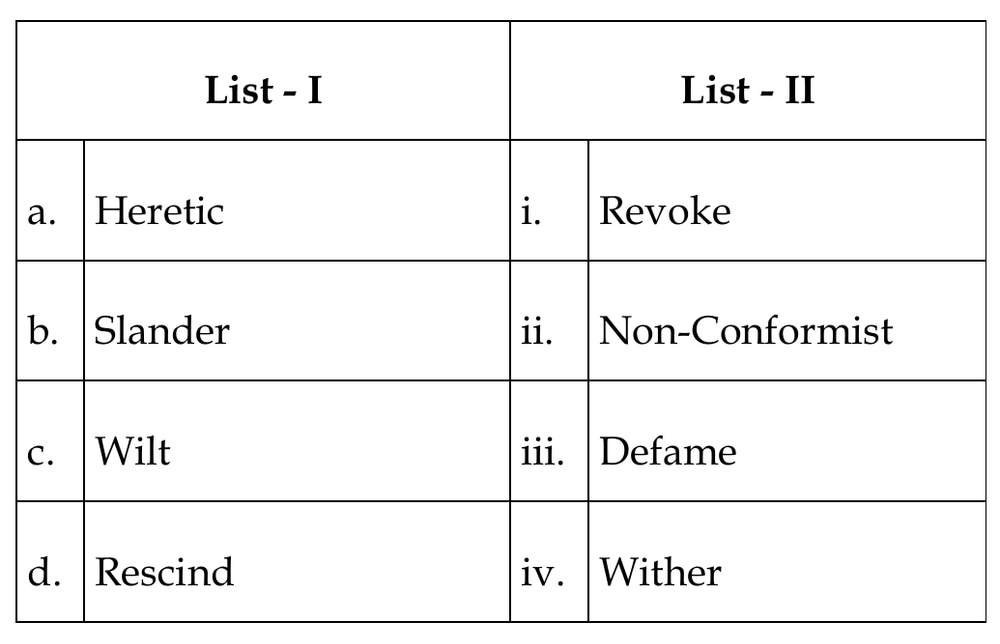
Choose the correct answer from the options given below :
- A.
a-ii, b-iii, c-iv, d-i
- B.
a-iii, b-i, c-ii, d-iv
- C.
a-iv, b-iii, c-i, d-ii
- D.
a-i, b-ii, c-iv, d-iii
Correct answer: A
Solution
Concept: A synonym-matching item is solved by fixing the precise dictionary sense of each List-I word and then choosing the List-II word that carries the closest sense. The mapping must also be one-to-one (bijective), so every List-II word is used exactly once and none is left over.
Heretic means a person who holds a belief or opinion that goes against established religious or social doctrine. The List-II word carrying that sense is Non-Conformist, a person who does not follow accepted norms or conventions.
Slander means to make a false spoken statement that damages a person’s reputation. The List-II word carrying that sense is Defame, to harm someone’s reputation with untrue claims.
Wilt means to lose freshness, firmness, or vigour, as a drooping plant does. The List-II word carrying that sense is Wither, to shrivel and lose vitality.
Rescind means to officially cancel or annul a law, order, or agreement. The List-II word carrying that sense is Revoke, to officially withdraw or cancel something.
Cross-check: Non-Conformist, Defame, Wither, and Revoke are each used exactly once, so nothing is repeated or left over and the mapping is a complete one-to-one match. The parts of speech agree as well — the noun Heretic pairs with the noun Non-Conformist, while Slander, Wilt, and Rescind are taken as verbs and pair with the verbs Defame, Wither, and Revoke.
List - I word
Closest List - II synonym
Heretic
Non-Conformist
Slander
Defame
Wilt
Wither
Rescind
Revoke
Result: the complete matching is Heretic – Non-Conformist, Slander – Defame, Wilt – Wither, Rescind – Revoke, i.e. a-ii, b-iii, c-iv, d-i.
- A.
- Q193.RSSB 2025
‘चौमासा’ इस समस्त पद में कौन-सा समास है ?
- A.
अव्ययीभाव
- B.
द्वंद्व
- C.
द्विगु
- D.
बहुव्रीहि
Correct answer: C
Solution
समास वह प्रक्रिया है जिसमें दो या अधिक पद मिलकर एक नया सार्थक पद बनाते हैं और उनके बीच का संबंधसूचक (विभक्ति) शब्द लुप्त हो जाता है। समास के छह प्रमुख भेद हैं — अव्ययीभाव, तत्पुरुष, कर्मधारय, द्विगु, द्वंद्व और बहुव्रीहि। इनमें से द्विगु समास वह होता है जिसमें पूर्वपद संख्यावाचक (गणनावाचक) विशेषण होता है और पूरा समस्त पद किसी समूह, समुदाय या समाहार (collection) का बोध कराता है।
'चौमासा' पद का विग्रह करने पर यह 'चार मासों (महीनों) का समूह/समाहार' अर्थ देता है। यहाँ पूर्वपद 'चौ' (चार) एक संख्यावाचक विशेषण है और उत्तरपद 'मासा' (मास) है। पूरा पद वर्षा-ऋतु के चार महीनों के इसी समूह का बोध कराता है — ठीक उसी प्रकार जैसे 'नवरात्र' नौ रात्रियों के समूह का और 'त्रिभुज' तीन भुजाओं की आकृति का बोध कराता है। अतः यह द्विगु समास की कसौटी पर पूर्णतः खरा उतरता है।
अव्ययीभाव समास होने के लिए पूर्वपद का अव्यय होना आवश्यक है, जबकि यहाँ पूर्वपद 'चौ' एक संख्यावाचक विशेषण है, अव्यय नहीं।
द्वंद्व समास में दोनों पद स्वतंत्र रूप से प्रधान होकर 'और' के भाव से जुड़ते हैं, जबकि 'चौमासा' में ऐसे दो स्वतंत्र प्रधान पद नहीं जुड़े हैं।
बहुव्रीहि समास में समस्त पद किसी तीसरे बाह्य अर्थ/व्यक्ति का बोध कराता है, जबकि 'चौमासा' स्वयं चार महीनों के समूह का ही बोध कराता है, किसी बाहरी अर्थ का नहीं।
इसलिए विकल्पों में से द्विगु समास ही सही वर्गीकरण है, जो RSSB पटवारी 2025 (शिफ्ट 1) की आधिकारिक उत्तर कुंजी से भी पुष्ट होता है।
- A.
- Q194.RSSB 2025
‘उपजाऊ’ शब्द का विलोम शब्द है :
- A.
उपार्जन
- B.
उर्वरा
- C.
बंजर
- D.
हरित
Correct answer: C
Solution
हिंदी व्याकरण में विलोम शब्द (प्रतिलोम/विपरीतार्थक शब्द) वह शब्द होता है जो किसी दिए गए शब्द के ठीक विपरीत या विरुद्ध अर्थ को व्यक्त करता है, जैसे— अच्छा-बुरा, ऊँचा-नीचा आदि।
‘उपजाऊ’ शब्द का प्रयोग उस भूमि के लिए होता है जिसमें अच्छी फसल पैदा हो सकती है, अर्थात् जो भूमि उपज देने में सक्षम है। इसके ठीक विपरीत अर्थ को व्यक्त करने वाला शब्द ‘बंजर’ है, जो ऐसी भूमि के लिए प्रयुक्त होता है जिसमें कोई फसल या वनस्पति उत्पन्न नहीं होती। इस प्रकार ‘उपजाऊ’ का विलोम शब्द ‘बंजर’ है।
दिए गए अन्य विकल्पों पर विचार करने पर:
उर्वरा — यह शब्द भी भूमि की उपजाऊ प्रकृति को ही दर्शाता है, अतः यह ‘उपजाऊ’ का पर्यायवाची शब्द है, विलोम नहीं।
उपार्जन — इसका अर्थ ‘प्राप्त करना अथवा कमाना’ है; इसका भूमि की उर्वरता से कोई शब्दार्थ संबंध नहीं है।
हरित — इसका अर्थ ‘हरे रंग का’ है; यह भूमि की वनस्पति अथवा रंग से संबंधित है, उसकी उपज-क्षमता से नहीं।
अतः शब्द-कोश एवं मानक हिंदी व्याकरण के अनुसार ‘उपजाऊ’ का सही विलोम शब्द ‘बंजर’ है।
- A.
- Q195.RSSB 2025
‘जिसकी तुलना न हो’ इस वाक्यांश के लिए एक शब्द होगा :
- A.
असाधारण
- B.
अतुलनीय
- C.
निराला
- D.
अत्यन्त सुन्दर
Correct answer: B
Solution
अवधारणा
हिंदी में 'वाक्यांशों के लिए एक शब्द' विषय के अंतर्गत किसी विस्तृत वाक्यांश के स्थान पर उसके ठीक उसी अर्थ को दर्शाने वाला एक सटीक शब्द प्रयुक्त किया जाता है। ऐसे प्रश्नों को हल करने के लिए पहले वाक्यांश का मूल भाव पहचानें, फिर उस भाव से मेल खाने वाले शब्द के उपसर्ग, प्रत्यय और अर्थ की जाँच करें।
प्रयोग
दिया गया वाक्यांश है — 'जिसकी तुलना न हो'। विकल्पों में दिए गए शब्द 'अतुलनीय' की रचना 'अ' (निषेधसूचक उपसर्ग) और 'तुलनीय' (तुलना + ईय, अर्थात तुलना करने योग्य) के मेल से हुई है, जिसका शाब्दिक अर्थ है — 'जिसकी तुलना न की जा सके'। यह अर्थ दिए गए वाक्यांश से पूर्णतः मेल खाता है।
तुलनात्मक विश्लेषण
असाधारण — इसका भाव है 'सामान्य स्तर से भिन्न या विशिष्ट', जो तुलना-रहित होने के भाव से अलग है।
निराला — इसका भाव है 'परंपरागत ढंग से हटकर, अनोखा', जो सीधे तौर पर तुलना के संदर्भ को व्यक्त नहीं करता।
अत्यन्त सुन्दर — यह केवल रूप-सौंदर्य की अधिकता दर्शाता है, तुलना की असंभवता से इसका कोई संबंध नहीं है।
अतः दिए गए विकल्पों में से केवल 'अतुलनीय' शब्द ही वाक्यांश 'जिसकी तुलना न हो' के भाव को पूर्णतः व्यक्त करता है, इसलिए सही उत्तर 'अतुलनीय' है।
- A.
- Q196.RSSB 2025
‘दादा बड़ा ना भैया सबसे बड़ा रुपैया’ लोकोक्ति का सही अर्थ पहचानिए।
- A.
दादा बड़े हैं भैया छोटे हैं।
- B.
रुपया ही सब कुछ है।
- C.
दादा के पास बड़ा रुपया है।
- D.
आजकल पैसा कुछ भी नहीं है।
Correct answer: B
Solution
अवधारणा — लोकोक्ति एक पूर्ण, स्वतंत्र वाक्य के रूप में प्रचलित लोक-कथन है जो अपने शाब्दिक अर्थ से आगे बढ़कर कोई सामान्य सत्य या व्यावहारिक सीख व्यक्त करती है। मुहावरे के विपरीत (जो एक वाक्यांश है और वाक्य में ढलकर प्रयोग होता है), लोकोक्ति अपने आप में पूरा वाक्य होती है और इसका भावार्थ शब्दशः अनुवाद से नहीं, बल्कि उसके निहित संदेश से समझा जाता है।
प्रयोग — इस लोकोक्ति के शब्द हैं: "न दादा बड़ा है, न भाई बड़ा है, सबसे बड़ा तो रुपैया है।" शब्दशः यह दादा और भाई की तुलना जैसा प्रतीत होता है, पर लोक-व्यवहार में इसका प्रयोग तब होता है जब यह बताना हो कि व्यावहारिक जीवन में रिश्ते-नाते चाहे कितने भी बड़े हों, असली प्रभाव और सम्मान तो धन का ही होता है — अर्थात रिश्तों से बढ़कर रुपये (धन) की सर्वोच्चता जताई जाती है।
तुलना — विकल्पों की तुलना उनके अपने कथ्य के आधार पर:
"दादा बड़े हैं भैया छोटे हैं" — यह केवल दादा और भाई की आयु/कद की पारिवारिक तुलना बताता है और लोकोक्ति में आए "रुपैया" शब्द की कोई भूमिका इसमें सम्मिलित नहीं होती।
"दादा के पास बड़ा रुपया है" — यह लोकोक्ति को एक सामान्य लोक-सत्य के बजाय दादा नामक किसी विशेष व्यक्ति की धन-राशि के बारे में एक तथ्यात्मक कथन के रूप में पढ़ता है।
"आजकल पैसा कुछ भी नहीं है" — यह धन के महत्वहीन/निरर्थक होने की बात करता है, जबकि लोकोक्ति के शब्द स्पष्टतः रुपये को "सबसे बड़ा" बता रहे हैं।
परिणाम — अतः इस लोकोक्ति का भावार्थ है कि रिश्तों से बढ़कर धन ही सर्वोपरि है, अर्थात "रुपया ही सब कुछ है।"
- A.
- Q197.RSSB 2025
'हवा हो जाना' मुहावरे का सही अर्थ होगा :
- A.
भाग जाना
- B.
भूल हो जाना
- C.
देखते रहना
- D.
हँसी उड़ना
Correct answer: A
Solution
मुहावरा (Idiom) भाषा का वह वाक्यांश होता है, जिसका प्रयोग शब्दों के शाब्दिक अर्थ से हटकर एक विशेष, प्रचलित लाक्षणिक अर्थ में किया जाता है। हिंदी में 'हवा हो जाना' मुहावरे का प्रचलित अर्थ है – किसी स्थान से बहुत जल्दी और अचानक चले जाना अथवा ग़ायब हो जाना।
प्रश्न में इसी मुहावरे 'हवा हो जाना' का सही अर्थ पूछा गया है। मानक हिंदी मुहावरा-कोशों के अनुसार यह मुहावरा 'भाग जाना' अथवा 'झटपट चल देना' के अर्थ में प्रयुक्त होता है, इसलिए दिए गए विकल्पों में से 'भाग जाना' इसका सही अर्थ है।
शेष विकल्पों की तुलना उनके अपने अर्थ के आधार पर:
'भूल हो जाना' – यह वाक्यांश किसी कार्य में त्रुटि या ग़लती हो जाने की स्थिति को दर्शाता है, अचानक चले जाने से इसका कोई संबंध नहीं है।
'देखते रहना' – यह किसी घटना या दृश्य को निष्क्रिय रूप से लगातार देखते रहने की क्रिया को व्यक्त करता है।
'हँसी उड़ना' – यह किसी व्यक्ति या बात का उपहास/मज़ाक उड़ाए जाने के भाव को व्यक्त करने वाला एक भिन्न मुहावरा है।
अतः 'हवा हो जाना' मुहावरे का सही अर्थ 'भाग जाना' है।
- A.
- Q198.RSSB 2025
निम्नलिखित में ‘गृह’ शब्द का पर्यायवाची नहीं है :
- A.
नक्षत्र
- B.
भवन
- C.
आलय
- D.
घर
Correct answer: A
Solution
पर्यायवाची (समानार्थी) शब्द वे शब्द होते हैं जिनका अर्थ किसी मूल शब्द के अर्थ के समान होता है; दो शब्दों की तुलना के लिए यह देखना आवश्यक है कि दोनों एक ही अर्थ-वर्ग से संबंधित हों।
'गृह' शब्द का प्रमुख अर्थ है 'निवास/रहने का स्थान'। दिए गए चार विकल्पों के अर्थ की तुलना 'गृह' के इसी अर्थ से करने पर:
नक्षत्र — आकाश में स्थित तारा-समूह अथवा तारामंडल को दर्शाता है; इसका संबंध खगोल विज्ञान व ज्योतिष से है।
भवन — बड़ी इमारत या निवास हेतु बनाई गई संरचना के अर्थ में प्रयुक्त होता है।
आलय — निवास अथवा आश्रय-स्थल के अर्थ में प्रयुक्त होता है (जैसे शिवालय, देवालय में प्रत्यय रूप में भी)।
घर — व्यक्ति के निवास स्थान को दर्शाने वाला मूल हिंदी शब्द है।
भवन, आलय और घर — तीनों निवास-स्थान के अर्थ में एक ही अर्थ-वर्ग में आते हैं, जबकि नक्षत्र का अर्थ-क्षेत्र भिन्न (खगोलीय) है। अतः सही उत्तर 'नक्षत्र' है, क्योंकि दिए गए विकल्पों में यह अकेला शब्द है जो 'गृह' के अर्थ-वर्ग से मेल नहीं खाता।
- A.
- Q199.RSSB 2025
निम्नांकित में शुद्ध लिखित शब्द को पहचानिए।
- A.
ऋषि
- B.
रीषी
- C.
ऋषी
- D.
रिषि
Correct answer: A
Solution
अवधारणा: मानक हिंदी वर्तनी में दो नियम प्रासंगिक हैं — (1) संस्कृत-मूल के इ-कारांत पुल्लिंग शब्द (जैसे कवि, मुनि, रवि, ऋषि) अंत में सदैव ह्रस्व इ की मात्रा लेते हैं, दीर्घ ई की नहीं। (2) ऋ स्वर — चाहे शब्द के आरंभ में स्वतंत्र वर्ण ऋ के रूप में हो (जैसे ऋषि में) या किसी व्यंजन के साथ आश्रित मात्रा ृ के रूप में (जैसे कृषि, दृष्टि, वृद्धि में) — कभी भी व्यंजन र और किसी इ/ई मात्रा के मेल से नहीं बदला जाता।
प्रयोग: शब्द "ऋषि" में दोनों नियम लागू होते हैं — यह स्वतंत्र वर्ण ऋ से आरंभ होता है (व्यंजन र से नहीं), और इ-कारांत शब्द होने के कारण अंत में ह्रस्व इ की मात्रा लेता है (दीर्घ ई नहीं)। अतः वर्ण ऋ + व्यंजन ष + ह्रस्व इ के मेल से शुद्ध रूप "ऋषि" बनता है।
तुलना — प्रत्येक विकल्प की वर्ण-संरचना:
ऋषि — वर्ण ऋ + ष + ह्रस्व इ: ऊपर बताए दोनों नियमों का पालन करता है।
रीषी — व्यंजन र + दीर्घ ई मात्रा (दो बार): ऋ के स्थान पर र का प्रयोग करता है, और अंत में दीर्घ ई होने से इ-कारांत नियम का भी पालन नहीं करता।
ऋषी — वर्ण ऋ + ष + दीर्घ ई: आरंभ में वर्ण ऋ का प्रयोग सही ढंग से हुआ है, परंतु अंत में दीर्घ ई होने से इ-कारांत नियम का पालन नहीं करता।
रिषि — व्यंजन र + ह्रस्व इ मात्रा (दो बार): इ-कारांत नियम का पालन करता है, परंतु आरंभ में वर्ण ऋ के स्थान पर र का प्रयोग करता है।
परिणाम: चारों विकल्पों में से केवल "ऋषि" दोनों वर्तनी नियमों (वर्ण ऋ का सही प्रयोग तथा इ-कारांत अंत) को पूरा करता है, इसलिए यही शुद्ध वर्तनी है।
- A.
- Q200.RSSB 2025
Read the given information carefully and answer the following question :
‘X + Y’ means ‘X is wife of Y’.
‘X – Y’ means ‘X is daughter of Y’.
‘X ÷ Y’ means ‘X is sister of Y’.
‘X # Y’ means ‘Y is mother of X’.
If A – B ÷ C # D + E, then A is E’s :
- A.
Grand-son
- B.
Grand-daughter
- C.
Son-in-law
- D.
Son
Correct answer: B
Solution
A coded blood-relation puzzle uses symbols in place of relationship words. Following the standard convention for this puzzle type, each person belongs to one simple, single family: a person's spouse is treated as the co-parent of all of that person's children, and anyone described as a sibling is assumed to share the same two parents, unless the puzzle explicitly states otherwise (for example, a step-relation or half-sibling). The method is always the same: replace each symbol with the relation it stands for, note the gender it fixes for the person on the left, then link the relations end to end to find how the two named people are connected.
'A – B' means A is daughter of B, so A is female and one generation below B.
'B ÷ C' means B is sister of C, so B and C are siblings in the same generation.
'C # D' means D is mother of C, so D is female and one generation above C.
'D + E' means D is wife of E, so E is D's husband and, therefore, C's father.
Since B is C's sibling, D and E are the parents of B as well as of C.
Since A is the daughter of B, and B is a child of D and E, A belongs two generations below D and E, linked through B.
E is male (D's husband) and A is female (fixed in the first step), so A's link to E, formed two generations apart through a child (B), matches only the female grandchild relation — ruling out a relation formed by marriage (son-in-law) or a one-generation direct-child relation (son). So A is E's grand-daughter.
- A.