UPSC EPFO Exam Pattern: CRT Syllabus, Negative Marking and Interview Weightage
UPSC's 2025 notice fixed the EPFO CRT at two hours with a one-third penalty per wrong answer, listed nine syllabus areas and set a 75:25 CRT-to-interview merit split.
KnowledgeGate Team
Exam prep & CS education
Updated 24 Jul 20265 min read
Search for the UPSC EPFO exam pattern and you will meet several conflicting tables giving a question count, a raw total and a subject-wise weightage. Almost none of that is in UPSC's own document. The 2025 Combined Recruitment Test notice fixed the duration, the medium, the marking rule, nine syllabus areas and a 75:25 final-merit split, and it left question count and subject-wise marks unstated. An EO/AO aspirant has to plan around both halves: what is settled, and what nobody can honestly forecast.
UPSC EPFO exam pattern at a glance
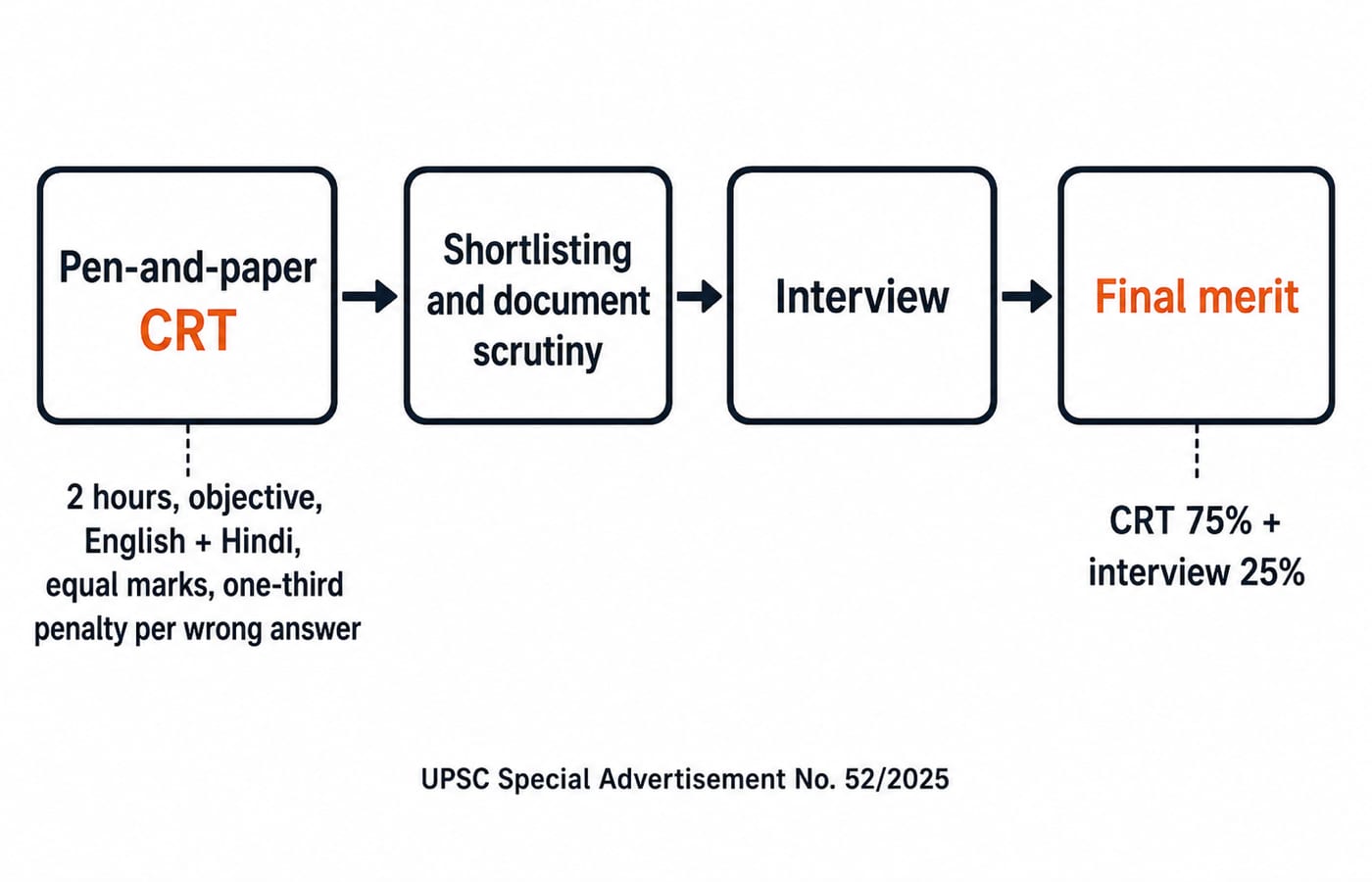
UPSC's 2025 special advertisement (No. 52/2025) set out three steps.
Stage | Official 2025 format | Role in selection |
|---|---|---|
Pen-and-paper Combined Recruitment Test (CRT) | Common written test for the advertised EO/AO and APFC posts | Used to shortlist candidates |
Document scrutiny | Documents and eligibility of shortlisted candidates are checked | Eligible candidates proceed to interview |
Interview | Conducted after scrutiny | Combined with CRT performance for final merit |
One CRT served both Enforcement Officer/Accounts Officer and Assistant Provident Fund Commissioner, so the two posts sat the same paper and parted company only at shortlisting and interview. If you are writing SSC CGL alongside this, expect a different shape of exam there: SSC CGL Tier Structure: Tier 1 and Tier 2 Explained walks through its two-tier route.
CRT format: duration, language and marking rule
The UPSC Recruitment Special Advertisement No. 52/2025 specified a two-hour pen-and-paper CRT with objective multiple-choice questions in English and Hindi. Every question carried equal marks. A wrong answer attracted a penalty equal to one-third of that question's marks; an unattempted question attracted no penalty.
The advertisement did not state a total question count, a raw CRT total or a section-wise time limit. If a pattern table gives you those numbers for 2025, it is carrying them over from somewhere else. Build your attempt strategy on the marking rule, which is stated, not on a total that is not.
In the exam hall, blind guessing has a cost. Leaving a doubtful item blank does not reduce your score.
Negative marking worked out: what one wrong answer costs
UPSC did not publish the paper's mark scale, so work the rule on a 10-question mini-set worth 3 marks per item. Say you get 7 correct, 2 wrong and 1 unattempted.
Correct marks = 7 x 3 = 21.
Penalty per wrong answer = 3 x 1/3 = 1.
Total penalty = 2 x 1 = 2.
Net score = 21 - 2 = 19 marks.
On that 3-mark item, a correct answer adds 3, a wrong one removes 1, and a blank moves nothing. Two wrong answers just erased two-thirds of a correct one, which is why accuracy beats attempt count. Mark a doubtful question only after you have eliminated an option or two, and leave the ones you cannot narrow.
The nine official CRT syllabus areas
The 2025 advertisement listed these nine broad areas:
No. | Official syllabus area |
|---|---|
1 | General English and workman-like use of words |
2 | Indian culture, heritage and freedom movements |
3 | Developmental issues and present trends in the Indian economy |
4 | Governance and the Constitution of India |
5 | General science and basic computer applications |
6 | Elementary mathematics, statistics and general mental ability |
7 | Industrial relations, labour laws and social security in India |
8 | Principles of accountancy, auditing and insurance |
9 | Current events of national and international importance |
For planning, group the nine into five buckets: language; society, economy and governance; quantitative and general aptitude; the EPFO-role domain of areas 7 and 8; and current affairs. UPSC does not group them this way, so keep all nine headings on your tracker and use the buckets only to schedule study blocks. Aspirants running both exams can set this against SSC CGL Syllabus Areas: Tier 1 and Tier 2 Coverage, which spreads a very different subject set across two tiers.
Subject weightage: what UPSC specifies and what it does not
The 2025 advertisement gives every CRT question equal marks but publishes no subject-wise counts or marks. No official percentage table assigns fixed weightage to labour laws, accountancy, English, mathematics or another listed area.
With no official split to weight against, start from a broad diagnostic week and let your own results move the hours afterwards. Twelve hours might go like this:
Preparation area | Hours |
|---|---|
Industrial relations, labour laws and social security | 2 |
Accountancy, auditing and insurance | 1.5 |
Mathematics, statistics and mental ability | 1.5 |
English | 1 |
Economy | 1 |
Governance and Constitution | 1 |
Culture and freedom movements | 1 |
Science and computers | 1 |
Current events | 1 |
Mixed test and error-log review | 1 |
Total | 12 |
After the diagnostic, redistribute those hours by your own accuracy and time per question, area by area. When a coaching table calls one area high weightage, check whether it cites the advertisement; for 2025 it cannot, because UPSC published no subject-wise split at all.
Interview stage and the 75:25 final-merit calculation
For final merit, the 2025 advertisement assigned 75% weightage to the CRT and 25% to the interview. On its 100-mark interview scale, the minimum level of suitability was 50 for General/EWS, 45 for OBC and 40 for SC/ST. UPSC fixes these per recruitment, so read them from the advertisement that governs your own cycle.
Suppose you finish at 68 on a 100-point CRT scale and are marked 60 in the interview. The composite then works out as:
CRT contribution = 68 x 0.75 = 51.
Interview contribution = 60 x 0.25 = 15.
Composite score = 51 + 15 = 66/100.
Three-quarters of the final merit is settled before you walk into the interview room, which is why CRT accuracy repays more effort than late interview polish. The interview is still a gate, though: fall under your category's suitability mark and the composite never gets computed for you.
Short version and the next preparation step
Under the 2025 notice, remember five points:
The CRT was a two-hour pen-and-paper test.
Its objective questions were available in English and Hindi.
Questions carried equal marks, with a one-third penalty for each wrong answer.
UPSC listed nine broad syllabus areas without an official subject-wise split.
CRT and interview performance were combined in a 75:25 ratio.
Build a nine-row syllabus tracker, take one mixed diagnostic, and record attempted, correct, wrong, blank, net score and minutes used. Redistribute your next 12 hours around the weaknesses it exposes.
If you are still choosing between government exams, Govt Job Exam Preparation Courses is the place to compare them. There is no EPFO-specific programme in the catalogue; the closest overlap is Aptitude for GATE Exam - Complete Course, which drills the elementary mathematics, statistics and mental ability of syllabus area 6 and nothing else on the list. Read the current UPSC recruitment advertisement before you lock the plan; each cycle republishes its own scheme.
Keep learning
SSC MTS Eligibility and Selection Process: Age, Qualification and Stages
Check your qualification date and birth-date window before planning preparation. This dated SSC MTS example explains age relaxation, the two CBE sessions and Havaldar's additional physical tests.
Updated 5 Oct 20264 min readSSC CGL
SSC CHSL Cutoff Trends: Compare Results and Set a Target Score
Compare the right CHSL result rows before choosing a practice target. Work through a historical benchmark, a personal buffer and two mock-test blocks to decide what to improve next.
Updated 30 Sep 20264 min readSSC CGL
SSC CGL Cutoffs Explained: Compare Tiers, Posts and Categories
A practical test for deciding whether two SSC CGL cutoff figures are genuinely comparable, with completed-result examples and a worksheet for rejecting mismatched rows.
Updated 19 Aug 20265 min readSSC CGL
SSC CGL Mock Analysis: Build an Error Ledger That Guides Every Revision
Turn each useful mock error or delay into evidence, a focused drill, a retest date, and a clear decision to close or reopen the row.
Updated 17 Aug 20265 min readSSC CGL