SSC CGL Post Duties and Posting Patterns: A Preference Guide
Compare SSC CGL posts by duty family, eligibility, posting uncertainty and personal fit. Use the worked scoring method to build an order you would genuinely accept.
KnowledgeGate Team
Exam prep & CS education
Updated 15 Aug 20266 min read
You may recognise titles such as Assistant Section Officer, Inspector of Income Tax, Auditor and Assistant Enforcement Officer, yet not know what the work feels like or where an appointment could lead. SSC's applicable notice and option form control the list and the selection rules; the user departments control duties and postings. No post is best for everyone, so a workable order scores each option against your own constraints instead of copying a prestige list.
Related reading: SSC CGL post ordering and SSC CGL cutoff targets.
1. Read the current SSC list before comparing post names
One title can appear against several offices or cadres. Compare post plus department or cadre. CGLE 2025 documents included Assistant or Assistant Section Officer in listed offices, Inspector of Income Tax in CBDT, Auditor in listed audit or accounts offices, and Assistant Enforcement Officer in the Enforcement Directorate. Offices, cadres and post codes shift between cycles, so take the names you will actually order from the current notice.
Build four columns: post code | exact post title | department or cadre | hard requirements. Copy them from the current notice, corrigenda and option form; only those carry codes the form will accept. Age, attempt and qualification limits are worked through in the SSC CGL eligibility guide, and the SSC CGL category holds the stage-wise preparation material for the same exam.
2. Group duties by work family, then verify the department
Most CGL posts fall into five work families, and the family tells you more about your day than the title does:
Secretariat and assistant work runs on files, noting, drafting and inter-desk coordination, as in Assistant Section Officer posts in the listed ministries.
Tax and inspection work mixes desk scrutiny of returns and records with verification that takes you outside the office, as with Inspector of Income Tax in CBDT.
Audit and accounts work turns on records, vouchers, reconciliation and written observations, the daily material of Auditor posts in listed audit or accounts offices.
Investigation and enforcement work combines case files, checks, fieldwork and coordination with other agencies, as in Assistant Enforcement Officer at the Enforcement Directorate.
Statistics and data work covers collection, compilation and analysis feeding the department's own reporting.
For each family ask three questions: What will I produce most days? How much public or field contact comes with it? What changes with a new office, charge or posting? The family sets the expectation; the employing department's own material settles the detail, not a job title or one serving officer's video.
3. Posting pattern means four different things
Separate cadre or department, first city, transfer liability and day-to-day seat. A post does not guarantee a city, permanent desk, field unit or home-state appointment.
SSC's CGLE 2025 final-vacancy document says SSC does not collect state-wise or zone-wise vacancies and directs candidates to user departments for that information. Check the current cycle's equivalent document.
Rewrite loose shorthand before it hardens into a decision. ASO = Delhi forever becomes ASO in [exact department]; location not assumed; cadre and transfer rules still to verify. Inspector of Income Tax = home state becomes CBDT post; region, charge and transfer position unverified.
4. Apply hard filters before giving any post a score
Pass every option through four yes-or-no gates, in this order:
Educational eligibility
Age or category eligibility
Physical or medical standard, where notified
Disability suitability or skill-test condition, where notified
If an applicable answer is No or Unverified, keep the post out. SSC's CGLE 2024 option notice told candidates to verify physical and medical standards before submitting preferences, warning that a selected candidate who failed them could lose the appointment. Standards are notified per post and per cycle, so read your own cycle's figures and never carry over measurements, exemptions or conditions. City, prestige and promotion hearsay stay outside this pass.
5. Worked example: turn personal priorities into a ranking
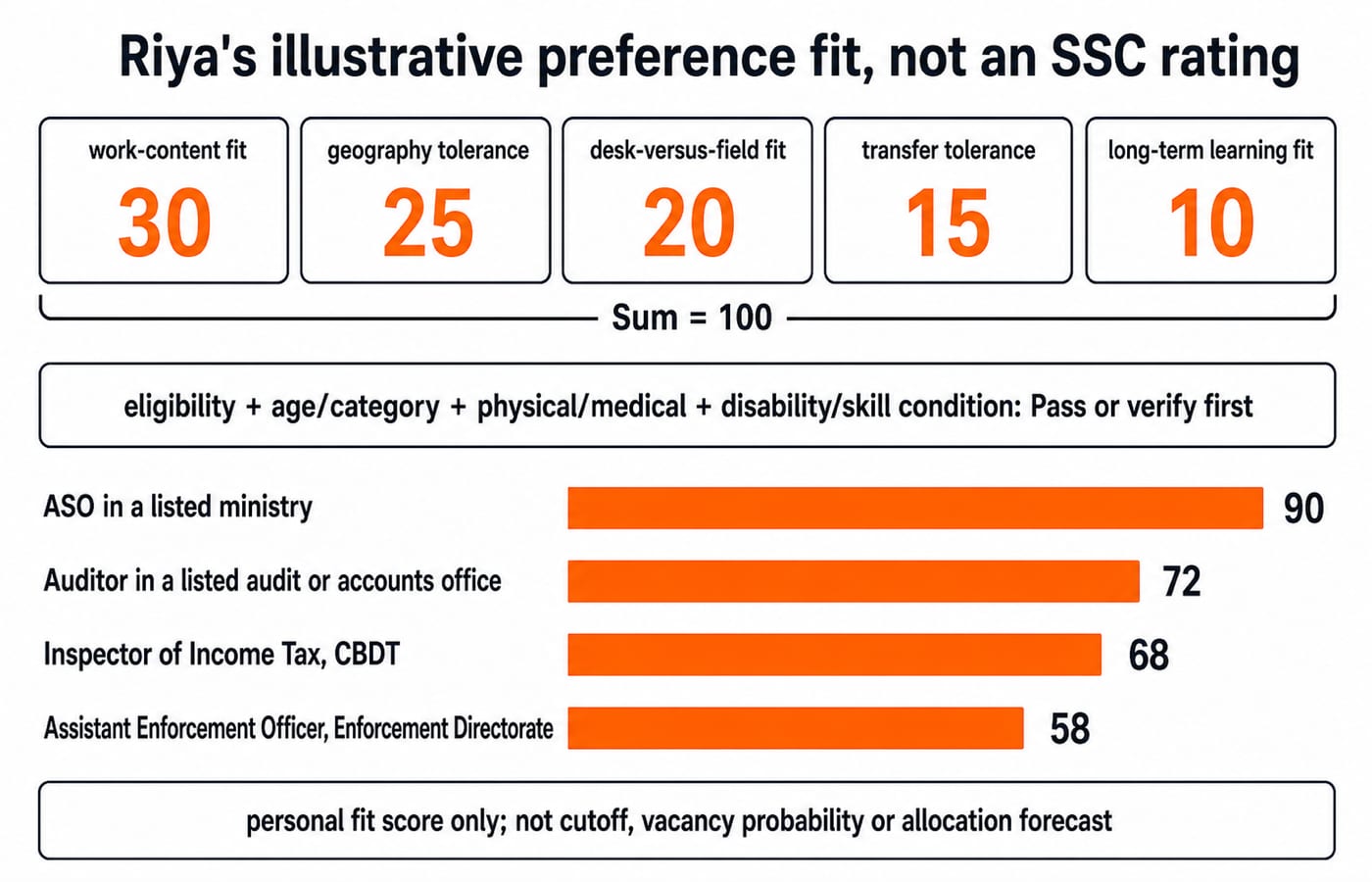
Riya checks the current documents and assumes all four choices pass. Her weights total 100: work-content fit 30, geography tolerance 25, desk-versus-field fit 20, transfer tolerance 15 and long-term learning fit 10. Personal-fit scores run from 1 to 5.
Choice | Five scores in weight order | Calculation | Fit score |
|---|---|---|---|
ASO in a listed ministry | 5, 4, 5, 4, 4 |
| 90 |
Auditor in a listed audit or accounts office | 3, 4, 4, 4, 3 |
| 72 |
Inspector of Income Tax, CBDT | 4, 3, 3, 3, 4 |
| 68 |
Assistant Enforcement Officer, Enforcement Directorate | 4, 2, 2, 2, 5 |
| 58 |
For ASO, 150 + 100 + 100 + 60 + 40 = 450, then 450 ÷ 5 = 90. Other totals are 360 ÷ 5 = 72, 340 ÷ 5 = 68 and 290 ÷ 5 = 58. Her order is ASO 90 > Auditor 72 > Inspector of Income Tax 68 > Assistant Enforcement Officer 58. These are personal-fit numbers, not post quality, cutoffs, vacancy odds or seniority. Set the weights honestly before you score: a candidate who wants field exposure would weight the same five headings differently and finish with a different order.
6. Merit-cum-preference makes the order consequential
The applicable SSC notice controls allocation. In the CGLE 2024 notice, final selection used Tier II performance and exercised post preferences. Once the first available preference was allotted according to merit, lower options were not considered. Preferences were final for that cycle, and each notice states the rule in its own words, so read your cycle's clause before you order anything.
Riya submits P1 ASO, P2 Auditor, P3 Inspector of Income Tax, P4 Assistant Enforcement Officer. Here P1 is unavailable but P2 is available. P2 is allotted, so P3 and P4 are not reached. If the lower-fit Assistant Enforcement Officer post were available at P1, her order would lead there. No marks or cutoffs are needed.
7. Convert research into a submission-ready preference sheet
Use seven columns: preference number | current post code | exact post and department | hard gates checked | work-family notes | posting questions still open | official source and date.
Example: P2 | [copy current code] | Auditor, [copy current office] | all gates checked | records, scrutiny and audit work to verify | first posting and transfer policy open | current SSC option form + department page, checked [date]. Keep brackets until verified. Never invent a code.
Remove options you would refuse, recheck corrigenda, confirm standards and match the sheet against your scoring table. Follow the option form's live submission instructions and keep any acknowledgement it lets you save. The SSC CGL preference-order guide goes further into the ordering questions once your hard gates are settled.
8. Short version: choose the work you can live with
Follow: current official list -> hard filters -> duty-family research -> posting questions -> weighted fit score -> final ordered options. The best preference is not a universal prestige ranking. It is the highest eligible option you would genuinely accept.
Start at ssc.gov.in for the applicable notice, corrigenda and option instructions. A preference sheet only matters if you clear the stages that put you in the merit list, so the SSC CGL Tier 1 course is where the ordering work turns into marks.
Keep learning
SSC MTS Eligibility and Selection Process: Age, Qualification and Stages
Check your qualification date and birth-date window before planning preparation. This dated SSC MTS example explains age relaxation, the two CBE sessions and Havaldar's additional physical tests.
Updated 5 Oct 20264 min readSSC CGL
SSC CHSL Cutoff Trends: Compare Results and Set a Target Score
Compare the right CHSL result rows before choosing a practice target. Work through a historical benchmark, a personal buffer and two mock-test blocks to decide what to improve next.
Updated 30 Sep 20264 min readSSC CGL
SSC CGL Cutoffs Explained: Compare Tiers, Posts and Categories
A practical test for deciding whether two SSC CGL cutoff figures are genuinely comparable, with completed-result examples and a worksheet for rejecting mismatched rows.
Updated 19 Aug 20265 min readSSC CGL
SSC CGL Mock Analysis: Build an Error Ledger That Guides Every Revision
Turn each useful mock error or delay into evidence, a focused drill, a retest date, and a clear decision to close or reopen the row.
Updated 17 Aug 20265 min readSSC CGL