SSC CGL PYQ Analysis: Build Your Subject Priority Map
Use your own verified past-paper work to rank four subject lanes, budget one study week and update the order after a fresh diagnostic.
KnowledgeGate Team
Exam prep & CS education
Updated 13 Aug 20266 min read
Many SSC CGL aspirants prioritise a subject because it feels difficult or a weightage graphic circulates, without checking where their own hours and marks actually go. Your past-paper attempts already hold that answer. Rank the four lanes by the review load each one leaves behind, budget a 12-hour week against those ranks, then retest on unseen questions and let the order change. Pattern, marks and section rules stay with the notification at ssc.gov.in. The course material behind each lane sits on the SSC CGL Exam Preparation page.
Use PYQs as evidence about your preparation, not a prediction machine
Three claims get tangled the moment you open a past paper: what the official notice fixes, what that paper actually contained, and what you should revise next. A home audit answers only the third. A topic that keeps reappearing in your own wrong column earns another look from you; it forecasts nothing about the next paper, because three or four papers is far too small a sample to forecast from.
Label saved papers or response records P1, P2 and P3; note any printed cycle or shift and retain the source URL or file provenance. Verify items through official publications or documented primary records. Mark memory-based reconstructions unverified and exclude them from recurrence claims, even when coaching pages repeat them. Use the SSC CGL Tier 1 Paper Analysis: Topic-wise Distribution to organise, not predict.
Build one clean 120-item baseline before ranking subjects
Candidate A deduplicates source-verifiable items from at least three labelled past papers and selects 30 per lane: Quantitative Aptitude, General Awareness, English and Reasoning. That gives 4 x 30 = 120 items. Thirty per lane is what makes one lane's review count directly comparable with another's; an unequal split would not.
Use these columns: paper ID, source URL/file, subject lane, topic tag, outcome C/W/S, guessed correct Y/N, time in seconds, error cause, repair action and retest date. C means correct, W wrong and S skipped. Assign one cause: concept, method selection, calculation, reading, recall or time decision. A guessed correct stays in review because reasoning is not reproducible.
KnowledgeGate carries over 800 SSC CGL practice questions, which is where the unseen sets come from once your baseline is fixed. A practice-bank count tells you how much you can drill, never how the paper is weighted.
Worked example: calculate the four subject queues
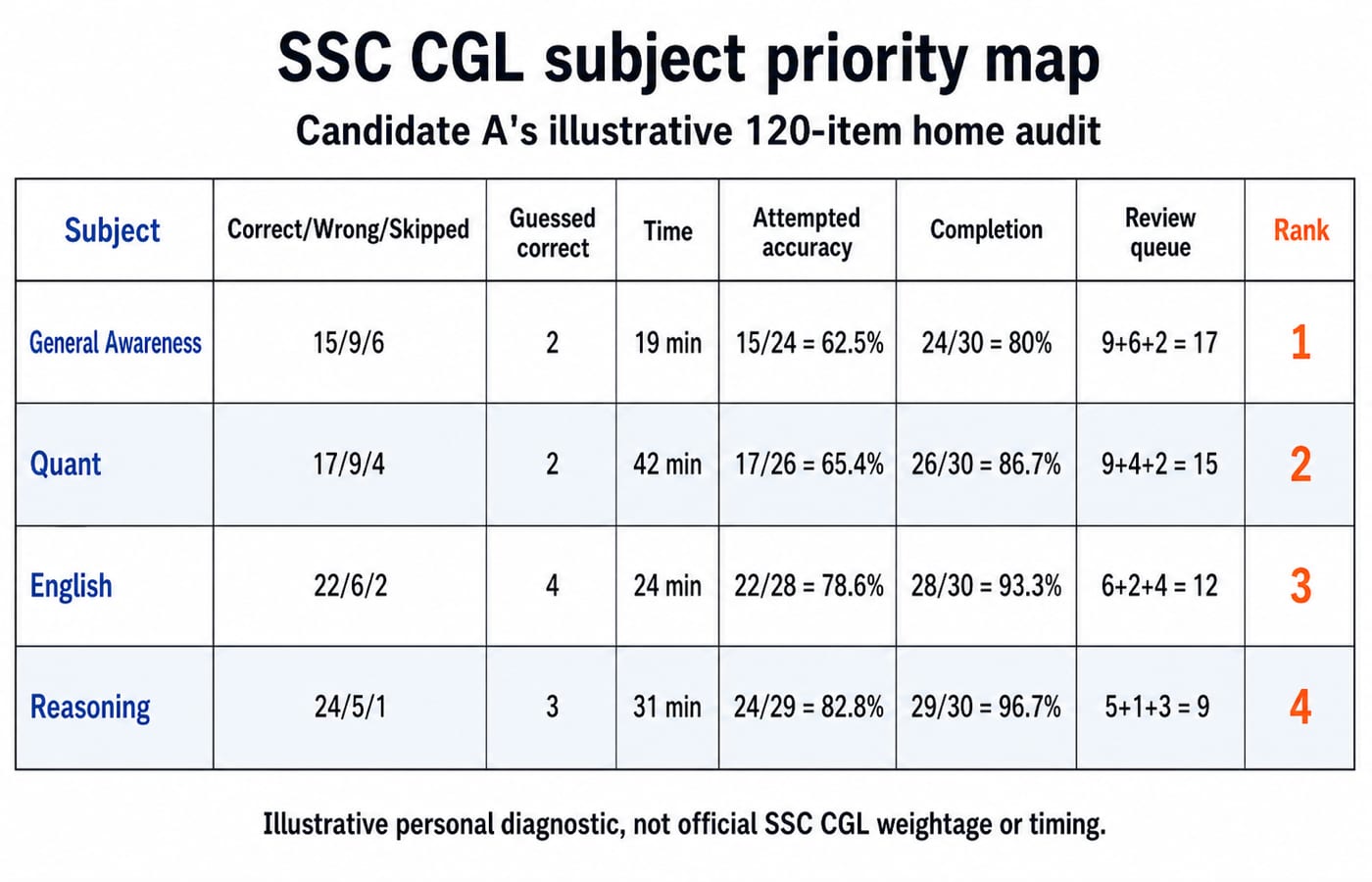
Candidate A's 120 items came out like this, one aspirant's home-study record:
Subject | Correct/Wrong/Skipped | Guessed correct | Time | Review queue |
|---|---|---|---|---|
General Awareness | 15/9/6 | 2 | 19 min |
|
Quant | 17/9/4 | 2 | 42 min |
|
English | 22/6/2 | 4 | 24 min |
|
Reasoning | 24/5/1 | 3 | 31 min |
|
Define review queue = wrong + skipped + guessed correct. The combined load is 17 + 15 + 12 + 9 = 53, so the first priority order is General Awareness, Quant, English, Reasoning.
Attempted accuracy and completion add context. General Awareness gives 15/24 = 62.5% and 24/30 = 80%; Quant, 17/26 = 65.4% and 26/30 = 86.7%; English, 22/28 = 78.6% and 28/30 = 93.3%; Reasoning, 24/29 = 82.8% and 29/30 = 96.7%. The queue captures uncertainty and avoidance alongside wrong answers.
Turn 53 review items into a realistic 12-hour week
Set aside 720 minutes, including 60 for contingency. Allocate active 660 by the 53-item queue: General Awareness 660 x 17/53 = 211.7, Quant 660 x 15/53 = 186.8, English 660 x 12/53 = 149.4 and Reasoning 660 x 9/53 = 112.1. Round to blocks of 210, 185, 150 and 115 minutes. Check: 210 + 185 + 150 + 115 + 60 = 720 minutes = 12 hours.
Split each block three ways:
General Awareness:
105 concept-recall repair + 65 fresh questions + 40 review = 210.Quant:
90 + 55 + 40 = 185.English:
75 + 45 + 30 = 150.Reasoning:
55 + 35 + 25 = 115.
Use unseen fresh questions because repetition may test answer memory. For Tier 1 concept gaps, use SSC CGL Tier 1 Complete Preparation.
Drill from subject rank to the error families that caused it
A subject rank is still too coarse to act on. Candidate A's General Awareness queue is Polity 5 + History 4 + General Science 4 + Geography 2 + current-affairs recall 2 = 17. Quant is percentages 4 + algebra 4 + geometry 3 + time and work 2 + calculation slips 2 = 15. These are personal error tags, not SSC topic frequencies.
For one percentage card, a value rises from 800 to 920. Write increase = 920 - 800 = 120, then 120/800 x 100 = 15%. In reverse, 920 falling to 800 is 120/920 x 100 = 13.04%, not 15%. Tag the error wrong denominator and record the base rule, because the same slip repeats across profit and loss, discount and data interpretation.
Clear a family only after two correctly solved unseen questions, with methods stated, at least 48 hours apart; recognition or guessing does not count.
Retest on fresh questions and let the map change
Retest with another balanced 30 unseen items per lane. General Awareness records 21 correct, 6 wrong, 3 skipped, 2 guessed correct, so 6 + 3 + 2 = 11. Quant records 23, 5, 2, 1, so 5 + 2 + 1 = 8. English records 23, 5, 2, 2, so 5 + 2 + 2 = 9. Reasoning records 25, 4, 1, 2, so 4 + 1 + 2 = 7.
General Awareness falls 17 to 11, Quant 15 to 8, English 12 to 9, and Reasoning 9 to 7. The new order is General Awareness 11, English 9, Quant 8, Reasoning 7. English moves above Quant because its uncertainty clears more slowly. The SSC CGL Mock Test Strategy: Turn Mocks Into Marks uses the same solve-review-repair discipline. Review wrong, skipped and guessed-correct items, then update from fresh evidence.
Run the map as a six-week loop
Week 1 uses 120 minutes for source checks and setup, 360 for the baseline, 180 for review and tagging, and 60 for ranking: 120 + 360 + 180 + 60 = 720. Weeks 2 and 3: 660 active minutes plus 60 contingency each. Week 4 uses 240 fresh mixed attempt + 240 review + 180 repair + 60 re-ranking = 720.
Week 5 follows the new queue. Its 11 + 9 + 8 + 7 = 35 items receive General Awareness 205 minutes, English 170, Quant 150 and Reasoning 135, plus 60 contingency. Check: 205 + 170 + 150 + 135 + 60 = 720. Week 6 uses 210 mixed timed home set + 270 review + 180 targeted repair + 60 next-cycle planning = 720. Anchor the six weeks to your own calendar. If a notification lands mid-loop, finish the week you are in and re-rank at its end rather than abandoning the queue.
The short version: absorb missed days and take the next action
Recovery rules:
Miss one 75-minute session: use 60 contingency, then cut 15 from lowest-priority fresh practice, not due review.
Miss two: move the remaining 90 to next week, not a 150-minute catch-up.
Lose a week: extend the phase; never force
12 + 12 = 24 hoursinto seven days.
Do not mistake guesses for mastery, copies for repeated PYQs, subject rank for topic frequency, or a faster home attempt for a real exam score. Keep the source and cause columns filled in; they are what make the next audit quicker than this one.
Next 60 minutes: spend 15 on source/outcome columns, 30 on a verified ten-question slice without notes, and 15 classifying wrong, skipped and guessed-correct responses. Use Tier 1 Complete Preparation for the concept repair; when Tier 2 becomes the live hurdle, SSC CGL Tier Structure: Tier 1 and Tier 2 Explained sets out what changes there. Retest and update the map.
Keep learning
SSC MTS Eligibility and Selection Process: Age, Qualification and Stages
Check your qualification date and birth-date window before planning preparation. This dated SSC MTS example explains age relaxation, the two CBE sessions and Havaldar's additional physical tests.
Updated 5 Oct 20264 min readSSC CGL
SSC CHSL Cutoff Trends: Compare Results and Set a Target Score
Compare the right CHSL result rows before choosing a practice target. Work through a historical benchmark, a personal buffer and two mock-test blocks to decide what to improve next.
Updated 30 Sep 20264 min readSSC CGL
SSC CGL Cutoffs Explained: Compare Tiers, Posts and Categories
A practical test for deciding whether two SSC CGL cutoff figures are genuinely comparable, with completed-result examples and a worksheet for rejecting mismatched rows.
Updated 19 Aug 20265 min readSSC CGL
SSC CGL Mock Analysis: Build an Error Ledger That Guides Every Revision
Turn each useful mock error or delay into evidence, a focused drill, a retest date, and a clear decision to close or reopen the row.
Updated 17 Aug 20265 min readSSC CGL