SSC CGL Mock Analysis: Build an Error Ledger That Guides Every Revision
Turn each useful mock error or delay into evidence, a focused drill, a retest date, and a clear decision to close or reopen the row.
KnowledgeGate Team
Exam prep & CS education
Updated 17 Aug 20265 min read
A mock score says what happened, but it does not tell you what to study tomorrow. A useful analysis converts every important error or delay into a named repair drill, a retest date, and a closure rule. Set up the attempt with a consistent mock test strategy, then start the analysis in the same sitting, while the paper is still fresh in your head.
1. Record evidence before looking at the total score
Use these ledger columns exactly: question reference, topic, result, time, confidence (1-3), error class, evidence, repair drill, retest date, and status. Prefix each topic with its SSC CGL Tier 1 area, shortened however you like: reasoning, general awareness, quantitative aptitude, or English. A quantitative aptitude concept gap and an English misread do not deserve the same repair time. Do not write “careless” as an error class. It does not reveal what to repair.
Spend 10 minutes marking every wrong, skipped, or unusually slow item. Then spend up to 35 minutes re-solving those items without a timer or answer key. Preserve the first method beside the untimed second method. Close a clean correct answer. Keep it open only if its method was unsafe or its time exceeded your own benchmark.
2. Sort every flagged item into one of four action queues
Use four evidence-based classes:
Concept gap: still incorrect during the untimed re-solve.
Rushed or misread: correct untimed, but the first attempt dropped a condition, reversed or mislabelled a relation, or made an arithmetic slip.
Unsupported guess: selected without a written rule or elimination evidence.
Slow-but-correct: correct, but slower than the personal benchmark. This example uses 90 seconds, not an official section limit.
Classify in that order. Check the untimed answer first, then inspect the original working for a reading or execution break, a defensible path, and finally time. The common SSC CGL mistakes are broad warnings; the ledger turns them into question-level actions.
3. Worked example: classify one 40-question SSC CGL practice mock
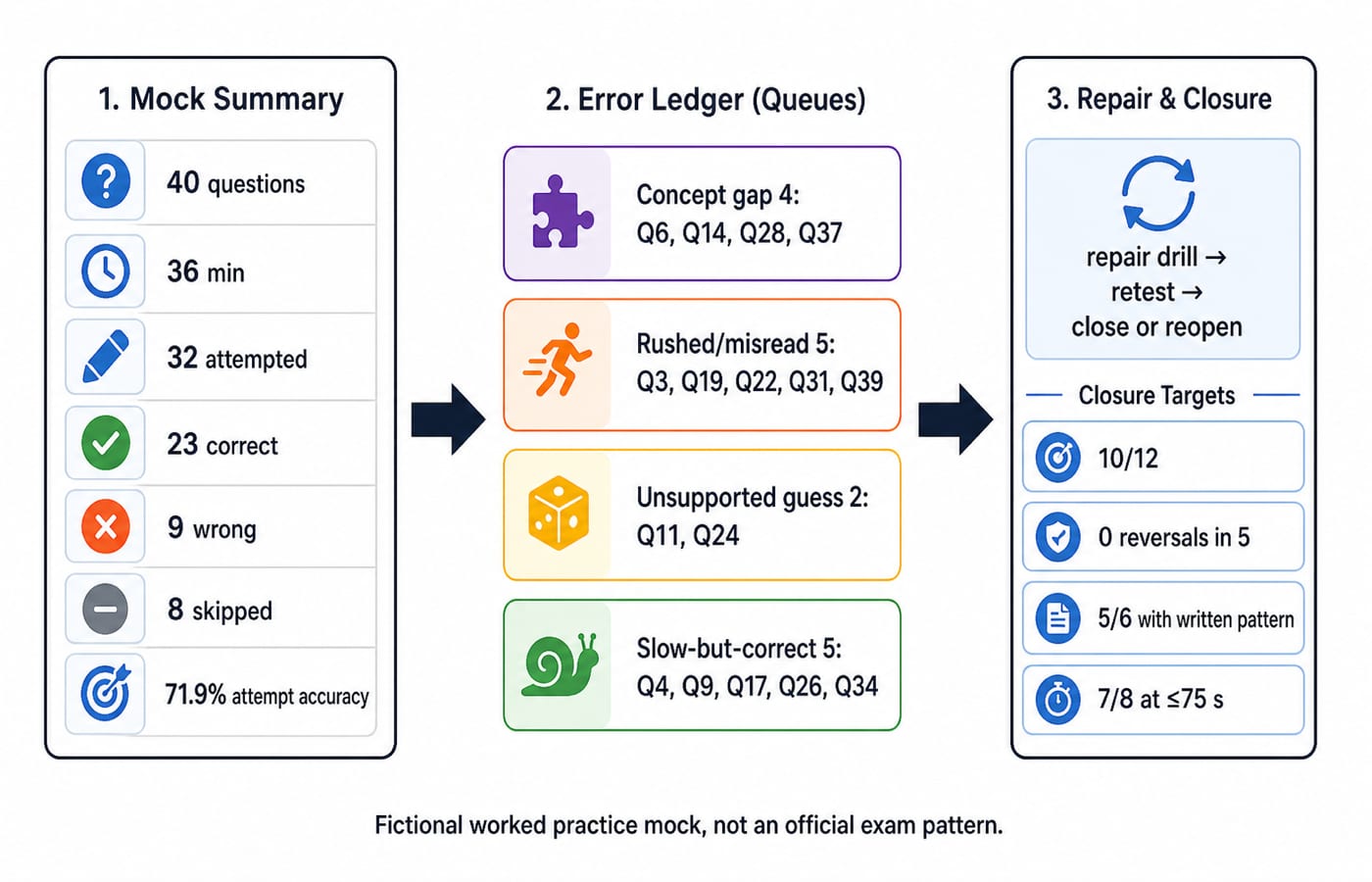
These figures come from one learner's self-set practice mock, not an SSC paper, so the 40-question size and the 36-minute limit are personal conditions rather than an official pattern. The learner sees 40 questions in 36 minutes, attempts 32, gets 23 correct and 9 wrong, and skips 8. Attempt accuracy is 23/32 x 100 = 71.875%, reported as 71.9%. Track that accuracy rather than a marks total, because the negative-marking rule that turns attempts into marks is fixed by the official notification at ssc.gov.in.
All 40 are accounted for: 18 clean correct, 5 slow-but-correct (Q4, Q9, Q17, Q26, Q34), 9 wrong, 2 concept-gap skips (Q28, Q37), and 6 deliberate skips. The wrong answers become 2 concept gaps (Q6, Q14), 5 rushed or misread (Q3, Q19, Q22, Q31, Q39), and 2 unsupported guesses (Q11, Q24). The four queues therefore hold 4, 5, 2, and 5 rows, giving 16 open rows. One row from each queue shows the format.
question reference | topic | result | time | confidence (1-3) | error class | evidence | repair drill | retest date | status |
|---|---|---|---|---|---|---|---|---|---|
Q6 | quantitative aptitude / successive percentages | wrong | 82 s | 3 | concept gap | wrote +5%; untimed result still wrong | 12 successive-change questions | after 48 hours | open |
Q19 | reasoning / verbal analogy | wrong | 34 s | 2 | rushed or misread | relation reversed | 10 relation-label drills | Day 5 | open |
Q24 | reasoning / number series | wrong | 9 s | 1 | unsupported guess | no written pattern | 6 written-pattern items | Day 5 | open |
Q9 | quantitative aptitude / work rates | correct | 138 s | 3 | slow-but-correct | valid but slow method | 8 LCM-based drills | Day 5 | open |
4. Replace “revise this topic” with a measurable repair drill
Q6 raised a value of 120 by 25% and then cut the result by 20%, so 120 x 1.25 = 150, then 150 x 0.80 = 120. Equivalently, 120 x 1.25 x 0.80 = 120, so the net change is 0%, not the learner's +5%. Assign 12 successive-change questions in 18 minutes. Require 10/12, then 3/4 on a fresh retest after 48 hours.
For Q19, BOOK:AUTHOR :: SONG:COMPOSER runs work then creator, and the learner marked COMPOSER:SONG, which keeps the right pair but reverses its direction. Assign 10 relation-label drills, require 9/10, then zero reversals in a 5-question retest. For Q24, the differences in 3, 8, 15, 24, 35, ? are 5, 7, 9, 11, then 13, so the answer is 48. Require a written pattern and 5/6 similar items. For Q9, 1/12 + 1/18 = 3/36 + 2/36 = 5/36, so the time is 36/5 = 7.2 days. Assign 8 LCM-based rate drills; close at 7/8, each correct within 75 seconds.
5. Run a seven-day repair and retest cycle
After the mock, use 45 minutes to re-solve and tag. Then follow this cycle:
Day | Work |
|---|---|
1 | 25 minutes: 12 successive-change questions in 18 minutes, then 7 minutes rechecking each two-step multiplication |
2 | 20 minutes, 10 analogy relation drills; 5-minute reading checklist |
3 | 25 minutes: 6 number-series items with every pattern written, then the 4-question successive-change retest that falls 48 hours after Day 1 |
4 | 20 minutes, 8 work-rate items |
5 | 25-minute mixed retest, 12 questions: 4 percentage, 3 analogy, 3 series, 2 work-rate |
6 | 30-minute buffer for one missed session |
7 | Another 40-question practice mock under the same personal conditions |
Shift one unfinished drill into Day 6. Never double the next day's volume, and leave a row open when its threshold is missed. Use the last 60 days revision and mock plan as the wider planning companion.
6. Compare error movement across SSC CGL mocks, not one headline score
For the next mock, set personal repair targets: concept gaps 4 -> 2 or fewer, rushed or misread 5 -> 2 or fewer, unsupported guesses 2 -> 1 or fewer, and slow-but-correct items 5 -> 2 or fewer. These are learner targets, not expected SSC scores.
Across three mocks, concept-gap counts of 4, 3, 2 average (4 + 3 + 2)/3 = 3. Rushed counts of 5, 4, 2 average 11/3 = 3.67.
error class | Mock 1 | Mock 2 | Mock 3 | three-mock average | next drill |
|---|---|---|---|---|---|
concept gap | 4 | 3 | 2 | 3 | successive-change set |
rushed or misread | 5 | 4 | 2 | 3.67 | condition-check drill |
A repeated Q6-type error reopens its row even if the total mock result rises.
7. Short version and the next preparation step
Re-solve, classify, assign one measurable drill, retest against a threshold, then close or reopen. Keep the same ledger categories for at least three mocks before changing them. Tier 1 learners can follow the SSC CGL Tier 1 course, while Tier 2 learners can use the SSC CGL Tier 2 course. The wider SSC CGL preparation path connects both stages.
Keep learning
SSC MTS Eligibility and Selection Process: Age, Qualification and Stages
Check your qualification date and birth-date window before planning preparation. This dated SSC MTS example explains age relaxation, the two CBE sessions and Havaldar's additional physical tests.
Updated 5 Oct 20264 min readSSC CGL
SSC CHSL Cutoff Trends: Compare Results and Set a Target Score
Compare the right CHSL result rows before choosing a practice target. Work through a historical benchmark, a personal buffer and two mock-test blocks to decide what to improve next.
Updated 30 Sep 20264 min readSSC CGL
SSC CGL Cutoffs Explained: Compare Tiers, Posts and Categories
A practical test for deciding whether two SSC CGL cutoff figures are genuinely comparable, with completed-result examples and a worksheet for rejecting mismatched rows.
Updated 19 Aug 20265 min readSSC CGL
SSC CGL Post Duties and Posting Patterns: A Preference Guide
Compare SSC CGL posts by duty family, eligibility, posting uncertainty and personal fit. Use the worked scoring method to build an order you would genuinely accept.
Updated 15 Aug 20266 min readSSC CGL