SSC CGL Cut Offs Explained: Reading Category-wise Tier 1 and Tier 2 Numbers to Set a Target Score
A cutoff is an outcome, not a permanent pass mark. Learn how category, post, vacancies and normalization shape it, then build a personal target with a safety margin.
KnowledgeGate Team
Exam prep & CS education
Updated 25 Jul 20265 min read
Every SSC CGL aspirant asks, “What was last year's cutoff?” The answer can quietly mislead you because a cutoff is not a fixed pass mark. It changes with vacancies, paper difficulty, category and post.
The useful question is different: what does the released cutoff mean for your own category and target post, and what safety margin should you prepare above it? An old cutoff cannot predict the next one, but it can be turned into a target you train against.
Related reading: SSC CGL tier structure and post preference choices.
What a cutoff actually is in SSC CGL
A cutoff is the marks line at which the last qualifying or selected candidate sits for a particular stage, category and, where relevant, post. It is produced by the competition for available vacancies. It is not one universal number that every candidate must cross.
That is why cutoffs move. If the vacancy mix changes, the pool competing for each post changes. If a paper is harder or easier, the score distribution changes. Category-wise reservation and post requirements create further lines within the same cycle.
Treat a previous cutoff as evidence about one completed recruitment cycle, not as a promise. The SSC CGL tier structure is worth reading first if the relationship between the stages is not yet clear.
SSC CGL Tier 1 and Tier 2 cutoffs are not the same number
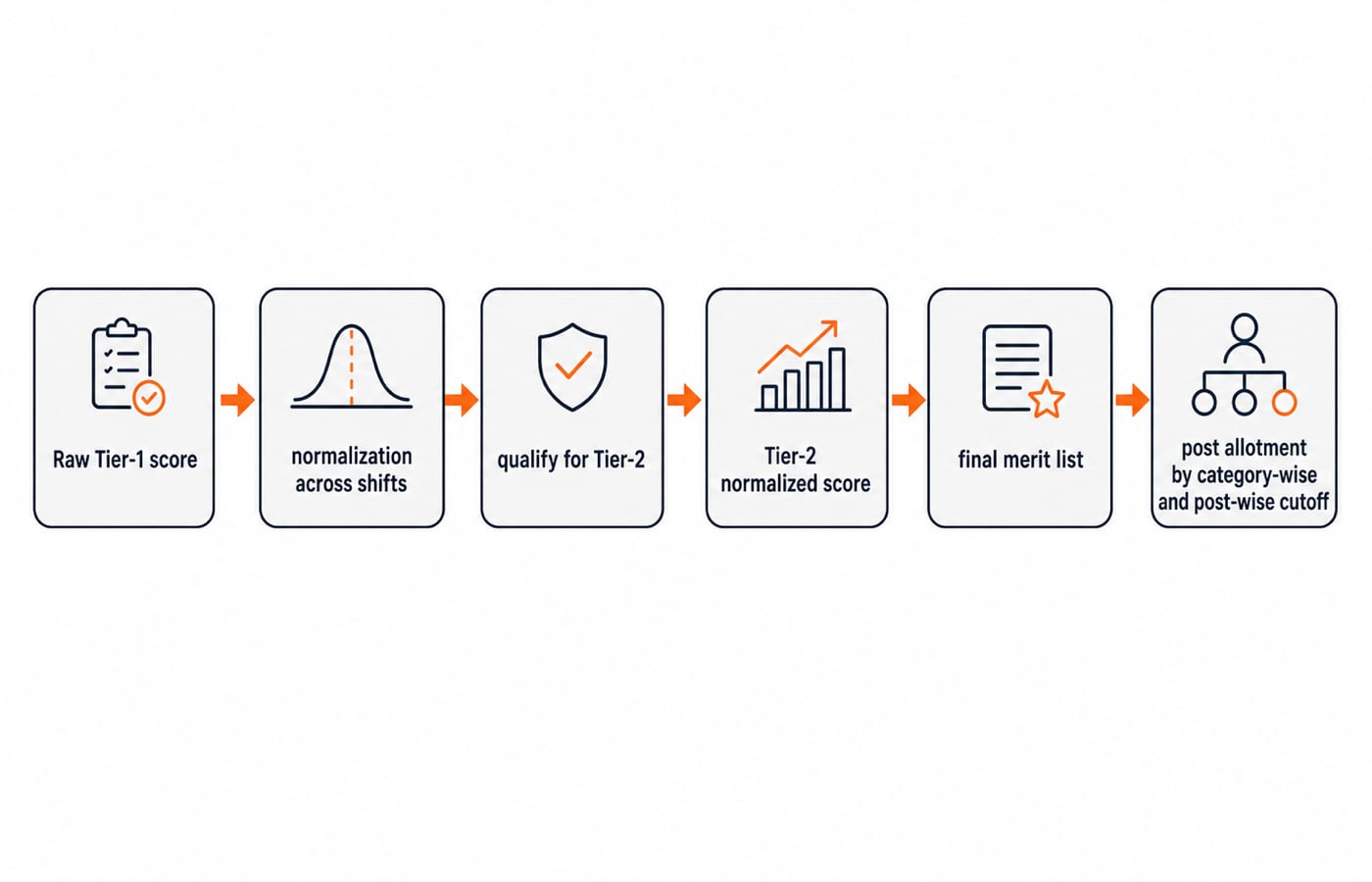
A cutoff means different things at different stages, so the first thing to settle about any number you are shown is which stage produced it. A Tier 1 cutoff is a screening line: it decides who continues, and it is read category-wise, because no post has been allotted at that point. A Tier 2 or final cutoff sits on the score that decides merit, which is why the post-wise lines you actually care about belong to that stage.
This distinction prevents a common planning mistake. Clearing the Tier 1 line only keeps you in the process. It does not by itself secure a final post. Your preparation must therefore build enough speed for screening while developing the deeper accuracy needed for final merit.
Do not copy the structure from a forwarded image or an old coaching message. The current notification and the released result documents on the official SSC portal are where you confirm any exact mark, section split or negative-marking rule before planning around it.
Reading cutoffs category-wise and post-wise
Start with the category that applies to your application. SSC result documents commonly separate lines for UR, EWS, OBC, SC, ST, PwD and ESM candidates. A general-category candidate should benchmark against the UR line, while a candidate applying under another valid category should use that category's line.
Next identify the post, not merely the examination. An Inspector role and an Assistant role can close at different levels because vacancies, demand, requirements and candidate preferences differ. A single headline such as “SSC CGL cutoff” can hide these post-wise differences.
Your preference order matters because allotment works through merit, eligibility, available vacancies and the preferences you submitted. The guide to setting SSC CGL post preferences explains why a copied preference list is as risky as a copied target score.
Use this reading order whenever a result is released:
Check the recruitment cycle and stage named in the document.
Find your category line.
Separate screening cutoffs from final selection cutoffs.
Locate the post-wise line for the role you actually want.
Read the accompanying notes for qualifying modules or post-specific requirements.
Normalization across shifts and what it does to your score
When an examination is conducted across multiple shifts, scores are normalized so that candidates who sat different papers are compared on one basis. Your raw score is therefore not necessarily the score that gets measured against the cutoff.
Two things follow for planning. Do not compare raw marks across shifts as though every paper were identical, and do not write off an attempt because your shift felt tougher, since the adjustment exists for exactly that situation. When you set a target, set it against the normalized score reported in the result, not the raw total you counted from an answer key. SSC's released method and result remain the authority for any given cycle.
Turning a cutoff into a target score
Build a target as a method, not as a prediction. Let:
Cbe the official previous-cycle final cutoff for your category and target post.Mbe the safety margin you choose for uncertainty around difficulty, vacancies and competition.Tbe your working target.
Then:
T = C + M
The margin is not an official figure. It is a planning buffer. A cautious aspirant can test several margins in mocks and choose one that is demanding but repeatable.
Now back-calculate the attempt quality required to reach T. Let A be attempts, X be correct answers, G be marks gained per correct answer and P be the positive magnitude of the penalty per wrong answer. Wrong answers are A - X, so:
Net score = XG - (A - X)P
Set that equal to the working target:
XG - AP + XP = T
Collect the terms containing X:
X(G + P) = T + AP
Therefore:
X = (T + AP) / (G + P)
Use the current cycle's official marking rules for G and P. This calculation tells you whether an attempt target demands unrealistic accuracy. If it does, improve topic coverage and question selection rather than simply increasing attempts.
Record C, M, T, attempts and accuracy after every mock. Your target then becomes a training instrument, not a number pinned above the desk.
What not to do with cutoffs
Do not chase a leaked or forwarded figure. Use the released SSC result and notice for the correct cycle.
Do not ignore normalization. Raw marks from different shifts are not a clean merit comparison.
Do not stop at the category line. Check the stage and the target post as well.
Do not ignore preference order. A target is meaningful only when connected to the posts you would actually accept.
Do not prepare exactly to the old line. Build a margin because the next vacancy and difficulty mix can change.
The short version and your next step
An SSC CGL cutoff is category-wise, stage-specific, vacancy-driven and often post-wise. Read the official completed-cycle number for your category and target post, add a personal margin, and convert the result into an accuracy and attempt plan.
Then turn the plan into practice. Use the SSC CGL Tier 1 course for the screening base, the complete SSC CGL preparation bundle for the wider journey, and the government-jobs catalogue for connected preparation. Our question bank also carries more than 850 SSC CGL previous-year questions, which is where a target score turns into repeatable mock performance.
Keep learning
SSC MTS Eligibility and Selection Process: Age, Qualification and Stages
Check your qualification date and birth-date window before planning preparation. This dated SSC MTS example explains age relaxation, the two CBE sessions and Havaldar's additional physical tests.
Updated 5 Oct 20264 min readSSC CGL
SSC CHSL Cutoff Trends: Compare Results and Set a Target Score
Compare the right CHSL result rows before choosing a practice target. Work through a historical benchmark, a personal buffer and two mock-test blocks to decide what to improve next.
Updated 30 Sep 20264 min readSSC CGL
SSC CGL Cutoffs Explained: Compare Tiers, Posts and Categories
A practical test for deciding whether two SSC CGL cutoff figures are genuinely comparable, with completed-result examples and a worksheet for rejecting mismatched rows.
Updated 19 Aug 20265 min readSSC CGL
SSC CGL Mock Analysis: Build an Error Ledger That Guides Every Revision
Turn each useful mock error or delay into evidence, a focused drill, a retest date, and a clear decision to close or reopen the row.
Updated 17 Aug 20265 min readSSC CGL