UP LT Grade vs KVS/NVS: Choose Your CS Teaching Route
Choose a Computer Science teaching route by checking the current notice first, then comparing mobility, school setting, preparation overlap and mock evidence.
KnowledgeGate Team
Exam prep & CS education
Updated 26 Jul 20266 min read
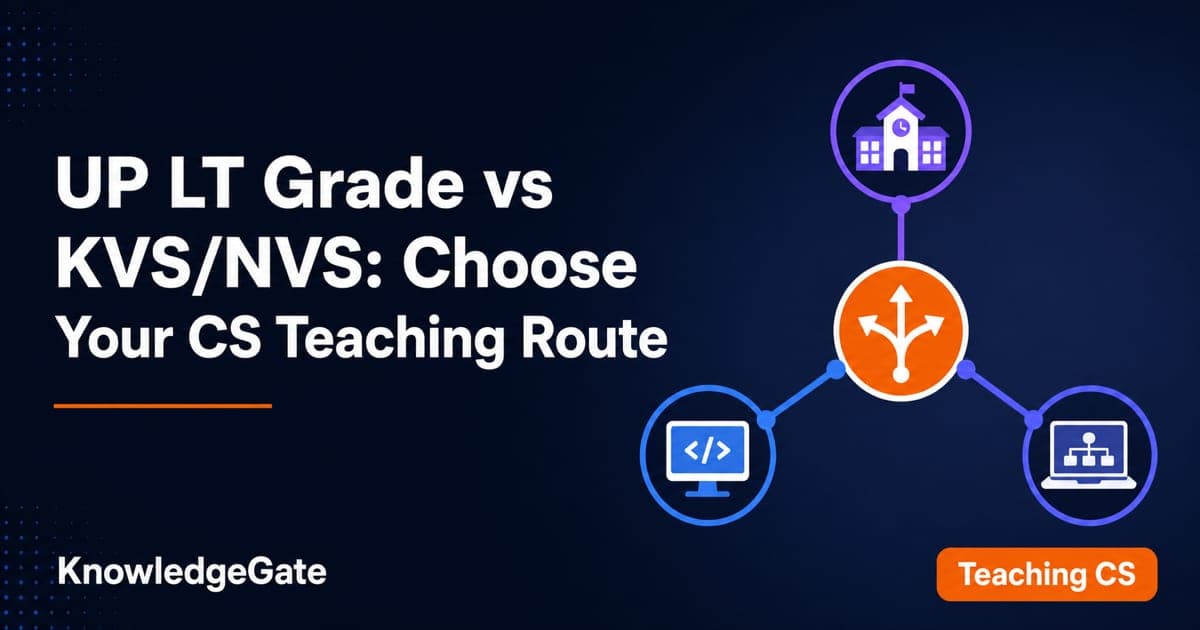
A Computer Science candidate weighing UP LT Grade against KVS and NVS is choosing between a state route and two central-school routes that differ in recruiting body, mobility, school setting and eligibility wording. Filter them in that order: eligibility on the current advertisement, then mobility and setting, then the CS core you can reuse, then the route-specific work, then your own diagnostic accuracy. The first two filters settle most cases, and neither of them is academic.
UP LT, KVS and NVS: three recruiters, three working lives
UP LT Grade: recruited by UPPSC for Assistant Teacher (LT Grade) posts in Uttar Pradesh government secondary schools. This is a state route, so postings stay within Uttar Pradesh, and recent cycles have expected working knowledge of Hindi in Devanagari script.
KVS: Kendriya Vidyalaya Sangathan recruits for Kendriya Vidyalayas, central day schools spread across India that primarily serve children of transferable central-government employees. Teachers carry all-India transfer liability, so the school you join is not the school you retire from.
NVS: Navodaya Vidyalaya Samiti recruits for Jawahar Navodaya Vidyalayas, fully residential co-educational schools, typically one per district and mostly in rural locations. Teachers generally live on campus and take on residential duties such as hostel supervision and evening study, which is a different working day, not just a different address.
Fit decides this more often than merit does: two candidates with identical Computer Science preparation belong on different routes when one can move anywhere and the other cannot leave the district. Use the wider teaching CS exams comparison when DSSSB, EMRS, RSSB and other state routes are also on your list.
Eligibility is a line-by-line gate, not a degree-name guess
Read eligibility line by line in the current advertisement rather than guessing from your degree name. One difference is procedural and worth knowing before you start reading: UPPSC advertises UP LT Grade on its own, while KVS and NVS teaching posts went out together in the 2025 drive, as a single combined notification on the official CBSE recruitment listing, amended three times by corrigendum inside the following month. So the central pair is one document to track for both, and its amendments matter as much as the original.
The exact post and subject wording, and which degrees and branches that route accepts as Computer Science.
Any minimum percentage, and the conversion rule the notice applies to a CGPA.
Whether B.Ed or another teaching qualification is mandatory at that post level.
Whether CTET is required, and for which post level.
Age limits on the notified cut-off date, plus the relaxation your category carries.
The certificates you must already hold on the dates the notice names.
Treat every row as a gate: one failed requirement removes that route for the cycle, and no amount of preparation buys it back. Where the advertisement is silent or ambiguous, the answer is in the detailed notice, a corrigendum or the official FAQ, and never in an assumption that it will be fine.
Mobility and school setting can overturn an eligibility yes
Mobility is where these routes genuinely diverge, and it belongs at the top of the filter rather than the bottom. UP LT keeps your career inside Uttar Pradesh; KVS means accepting transfers anywhere in India; NVS adds campus residence on top of that. A hard geographic or family constraint outweighs every preparation argument you could make against it.
A candidate who cannot leave Uttar Pradesh has no real KVS or NVS option regardless of preparation, and a candidate set on central-government service should not default to the state route out of habit. The KVS and NVS Computer Science explainer goes further into how those two central routes examine the subject.
Reuse the CS core, but verify the edges route by route
The live UP LT Grade Computer Science course maps Digital Logic, Discrete Mathematics, Computer Organisation, DSA, C, OOP, OS, DBMS, Networks, Software Engineering, Web Technology, System Analysis, Information Security and Cyber Laws, and Computer Graphics. That is what the course teaches; tick it against the notified syllabus for the cycle you actually sit.
Programming, DSA, DBMS, operating systems, networks and computer organisation form a shared core that recurs across CS teaching exams, so work there transfers between routes. Build a three-column ledger: the topic, which routes' current material names it, your own mastery. The edges are where an assumed overlap breaks, so check pedagogy sections, general papers and route-specific additions against each route's own syllabus.
Split your week between the shared core and route-specific work
Whatever weekly time you actually have, split it roughly three to one to one: three parts on the shared core, one part on the route-specific layer you are currently chasing, one part on redoing past errors. On ten honest hours that is six, two and two; on twenty it is twelve, four and four. Keep the ratio stable from week to week: do not delete a route after one bad day, and do not borrow from next week to patch this one. When a week collapses, cut the route-specific slot first and never the error slot, because the core is the part that keeps its value whichever route opens.
Use diagnostics to expose the adaptation cost
Create three short self-made diagnostic sets: one on the shared core, one on UP LT-specific topics and one on KVS/NVS-specific material. Read the gap between them, not the absolute numbers. If the core set sits well clear of both route sets, the core is not your problem and the cheaper route is the one whose extra layer you already score higher on. If all three land together, the core still owes you work and neither route is ready to be chosen. Repair the weakest layer first, and redo every error without notes.
These are your own sets, so treat the numbers as a repair list rather than a score. Once eligibility is settled, the UP LT Grade Test Series adds timed UP LT practice on top of them. It is UP LT practice only, so KVS and NVS work stays with the shared core and those routes' own material.
Match the route to your constraints, and be ready to wait
A UP-based candidate who wants to stay in the state will usually prepare UP LT first, keeping KVS and NVS warm as backups rather than treating them as inferior routes. A candidate who accepts all-India movement, and residential life in the NVS case, should compare KVS and NVS first without discarding UP LT. A candidate missing a mandatory qualification, such as B.Ed where the notice requires it, has no route this cycle until that gap closes. If that is you, the next piece of work is a qualification calendar rather than a study plan: establish exactly which certificate is missing and when the next window to earn it opens.
The short answer and the next action
Confirm every mandatory eligibility row.
Reject routes that violate a real mobility or setting constraint.
Mark the six-topic shared core.
Price the adaptation in weekly study hours.
Use diagnostic accuracy to choose the first preparation route.
Choose UP LT first when the UPPSC notice confirms you and a UP-focused path fits. Choose KVS or NVS first when its notice confirms you and all-India mobility, or residential campus life in the NVS case, fits. Keep the other eligible route warm through the shared core.
Read the UPPSC, KVS and NVS portals and the official combined KVS and NVS recruitment listing before anything else. Once eligibility is confirmed, the UP LT Grade preparation category is the structured next step.
Keep learning
UP LT Grade CS Weightage: Rank What to Revise First
Stop treating topic weightage as a marks forecast. Rank five unfinished CS topics on breadth, prerequisite reach and sourced recurrence, then split 18 revision hours across them.
Updated 7 Aug 20265 min readUP LT Grade
UP LT Grade CS PYQs: A Topic-Wise Practice System
Stop solving previous papers once and forgetting the mistakes. This system indexes every question by concept, schedules three attempts and turns each error into a measurable repair task.
Updated 5 Aug 20266 min readUP LT Grade
UP LT Grade Eligibility and Exam Pattern: Verify Your Subject Route
Read the Computer subject route correctly, check three hypothetical profiles, calculate the 2025 age boundary, and turn the notified paper structure into a practice plan.
Updated 2 Aug 20264 min read87 viewsUP LT Grade
UP LT Grade Computer Science Syllabus: A Prerequisite-First Study Map
Turn the official UPPSC Computer Science syllabus into a practical study sequence, with worked checks, an eight-week overlay and a coverage diagnostic.
Updated 31 Jul 20265 min readUP LT Grade