UP LT Grade Computer Science 14-Week Study Plan for Working Aspirants
A realistic weekly system for candidates preparing beside a degree, job or teaching workload. It turns 14 weeks into planned study, recovery and review.
KnowledgeGate Team
Exam prep & CS education
Updated 28 Jul 20266 min read

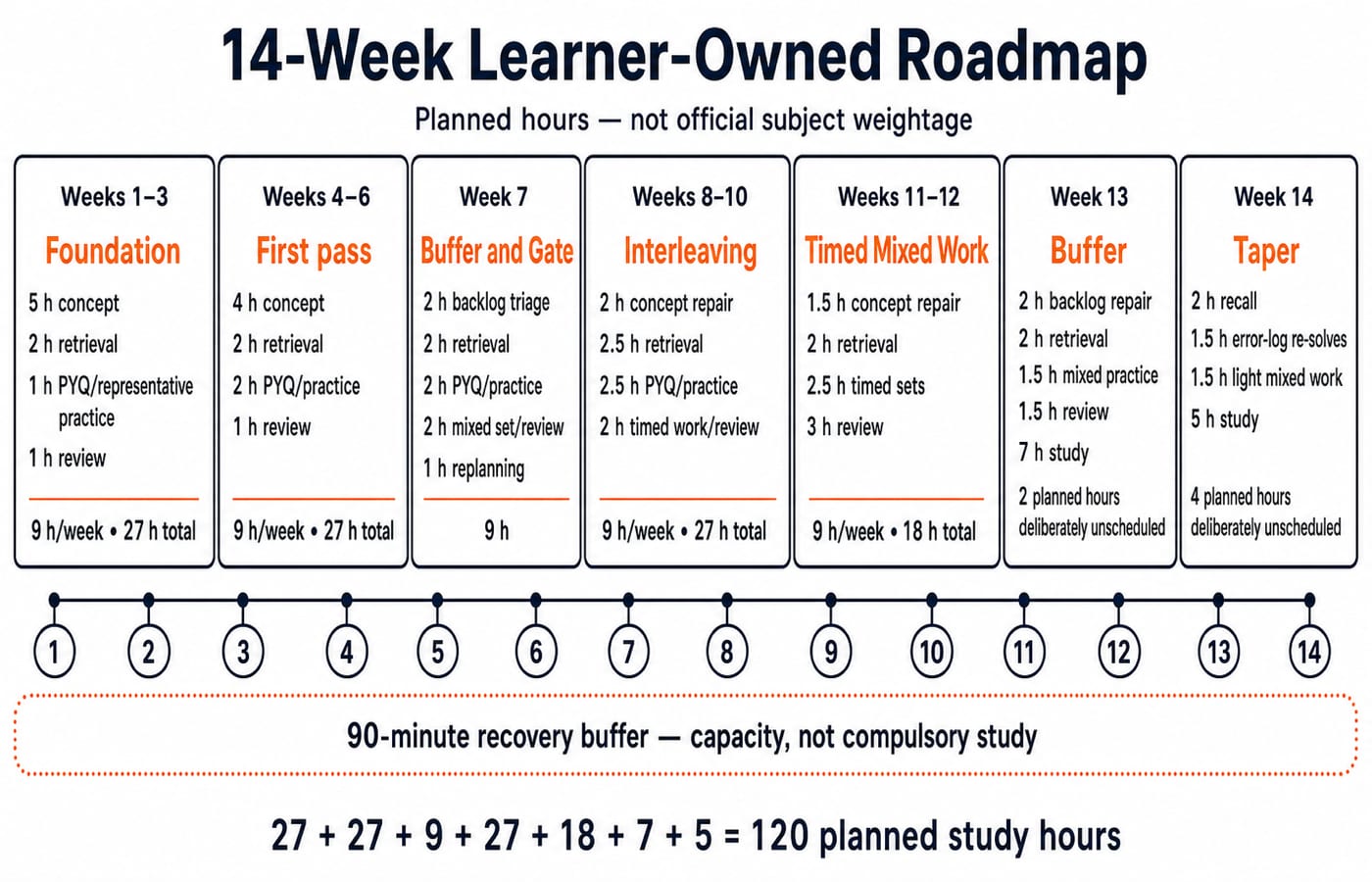
Preparing beside a degree, job or teaching workload is a consistency problem. Fourteen weeks look generous until missed evenings create backlog, videos replace retrieval and timed work slips into the final fortnight. This plan uses 9 weekly hours plus a separate 90-minute recovery buffer, alternating concepts, retrieval and PYQs. Week 7 consolidates, Week 13 adds another buffer and Week 14 is lighter. Across the fourteen weeks that comes to 120 planned study hours.
1. Before Week 1, fix the official boundary and take a baseline
Make a one-page source sheet before scheduling anything. From the applicable notice, advertisement and syllabus on the UPPSC official website, record the exact qualification wording, official syllabus headings, stated selection stages, current dates and source URL. Mark unverified fields as unresolved; never fill them from memory, coaching pages or later-dated documents.
Eligibility and preparation readiness are separate. Use the UP LT Grade Teacher Exam Preparation category for live exam-specific learning routes. If comparing teaching roles, read Teaching Recruitment (Computer Science) first. Once committed, build a diagnostic from five official-syllabus areas. Equal bucket sizes are your planning choice, not official subject weightage.
2. Build a nine-hour week that survives a missed evening
Plan 60 minutes each Monday to Friday (5 hours), 2 hours 30 minutes Saturday and 1 hour 30 minutes Sunday. That is 9 planned hours; the optional 90-minute recovery window raises maximum capacity to 10.5 hours but is not compulsory study.
Use Monday and Wednesday for concepts; Tuesday and Thursday for closed-book retrieval and changed questions. Use Friday for PYQs or representative syllabus-matched questions and error logging. Saturday runs a long concept-question-review loop; Sunday holds a mixed set, review and next-week plan. Split each evening into 35 minutes of learning or solving, 20 minutes of recall or re-solving, and 5 minutes of logging.
If Thursday's 60 minutes and Saturday's 150 minutes disappear, the loss is 210 minutes. Recover 90 in the buffer, carry 60 minutes of highest-priority repair forward, and drop 60 minutes of low-priority fresh coverage. A 12.5-hour next week only moves the failure.
3. Weeks 1-3: diagnose and repair the foundation
Each week uses 5 hours concept + 2 hours retrieval + 1 hour PYQ or representative practice + 1 hour review = 9 hours. Across three weeks, that is 27 hours. Select buckets only after reading the official syllabus; a school-level Computer Science paper usually spreads across programming fundamentals, data structures, operating systems, databases and computer networks, but take your five from the notice, not from that sketch. The UP LT Grade Assistant Teacher Computer Science course is an optional structured coverage route, not syllabus or paper-pattern evidence.
Take an untimed illustrative 50-question diagnostic, ten per bucket. Results of 7/10, 5/10, 8/10, 4/10 and 7/10 total 31/50 = 62% clean output. With 14 wrong and 5 blank, attempts are 50 - 5 = 45, so attempted accuracy is 31/45 x 100 = 68.9%. Repair the 4/10 and 5/10 buckets first. End Week 3 with changed questions, not memorised repeats.
4. Weeks 4-6: finish a first pass and make retrieval visible
Shift each week to 4 hours concept + 2 hours retrieval + 2 hours PYQ or syllabus-matched practice + 1 hour review = 9 hours, another 27-hour phase. Finish complete concept-question-review loops instead of touching many areas lightly. Friday includes re-solving, not answer-key reading.
Build a 24-prompt retrieval deck from current-syllabus notes. Mix definitions, contrasts, traces, outputs, diagram labels and one changed-value problem. On Day 0, 13/24 = 54.2%. On Day 2, 17/24 = 70.8%. On Day 7, 20/24 = 83.3%. Keep the four unresolved prompts in the next cycle; move the other twenty to weekly review.
A completed chapter must leave a one-page recall sheet, at least ten closed-book prompts and a short changed-question set. A final video without those outputs is exposure, not completion.
5. Week 7: use the first buffer as a decision gate
Week 7 adds no compulsory chapter. Allocate 2 hours each to backlog triage, retrieval, PYQ/practice and mixed-set review, plus 1 hour replanning = 9 hours.
Suppose syllabus mapping leaves four repairs: process scheduling, 45 minutes; normalisation, 75; networking, 90; old-note rewrite, 120. The backlog is 45 + 75 + 90 + 120 = 330 minutes. The 120-minute budget handles the first two exactly. Carry networking only if a fresh diagnostic exposes it; discard the cosmetic rewrite. A learner-owned 40-question gate with 30 correct, 6 wrong and 4 blank gives 36 attempts. Attempted accuracy is 30/36 = 83.3%; clean output is 30/40 = 75%. The 6 wrong and 4 blanks set Week 8 priorities, not a cutoff.
6. Weeks 8-10: interleave PYQs, recall and targeted repair
Use 2 hours concept repair + 2.5 hours retrieval + 2.5 hours PYQ or representative practice + 2 hours timed work and review = 9 hours weekly (27 hours). Prefer official previous papers provided by UPPSC. Otherwise label the set representative practice, and never treat a repeated topic as a prediction.
In one 30-question syllabus-matched set, suppose you get 21 correct, 6 wrong and 3 blank. Attempts are 30 - 3 = 27. Attempted accuracy is 21/27 x 100 = 77.8%, while clean output is 21/30 x 100 = 70%.
Classify the nine non-correct outcomes: 2 concept, 2 recall, 2 process and 3 time or blank. At 20 minutes per concept error, 10 per recall error, 10 per process error and 15 per blank, the repair bill is 40 + 20 + 20 + 45 = 125 minutes, or 2 hours 5 minutes. Replace part of the next concept block with it; do not add overtime.
7. Weeks 11-14: time mixed work, preserve the second buffer and taper
Weeks 11-12 use 1.5 hours concept repair + 2 hours retrieval + 2.5 hours timed mixed sets + 3 hours review = 9 hours each. Unless an official notice supplies real conditions, label timing learner-owned. Give every timed minute one review minute. Use Teaching Exam Mock Strategy for CS Papers for the attempt-review-repair loop and the UP LT Grade Test Series only as an optional organised practice route.
Compare two custom 50-question sets. Set A has 39 correct, 7 wrong and 4 blank: 46 attempts, 39/46 = 84.8% attempted accuracy, and 39/50 = 78% clean output. Set B has 41 correct, 6 wrong and 3 blank: 47 attempts, 41/47 = 87.2% attempted accuracy, and 41/50 = 82% clean output. Compare process, not selection chances. Never calculate an official net score without a verified marking rule.
Week 13 caps study at 7 hours, leaving 2 unscheduled. Week 14 caps at 5 hours for recall, error-log re-solves and one light mixed set. Start no new full chapter. Build exam-day administration only from current UPPSC instructions and omit anything unverified.
8. The 14-week plan and its one decision rule
One rule holds the plan together: when a week breaks, repair before you cover. Take back what the buffer allows, carry the highest-priority repair into the next week, and delete an equal block of fresh coverage instead of adding hours. Applied across the seven phases above, that is 27 + 27 + 9 + 27 + 18 + 7 + 5 = 120 planned study hours, with the recovery buffers spent only when a week actually breaks.
Now open the applicable UPPSC syllabus, build the one-page source sheet, choose five diagnostic buckets and schedule the first five 60-minute sessions. Use structured teaching or organised timed practice only to remove planning friction; the hours, the error log and the repairs stay yours.
Keep learning
UP LT Grade CS Weightage: Rank What to Revise First
Stop treating topic weightage as a marks forecast. Rank five unfinished CS topics on breadth, prerequisite reach and sourced recurrence, then split 18 revision hours across them.
Updated 7 Aug 20265 min readUP LT Grade
UP LT Grade CS PYQs: A Topic-Wise Practice System
Stop solving previous papers once and forgetting the mistakes. This system indexes every question by concept, schedules three attempts and turns each error into a measurable repair task.
Updated 5 Aug 20266 min readUP LT Grade

UP LT Grade Eligibility and Exam Pattern: Verify Your Subject Route
Read the Computer subject route correctly, check three hypothetical profiles, calculate the 2025 age boundary, and turn the notified paper structure into a practice plan.
Updated 2 Aug 20264 min read87 viewsUP LT Grade

UP LT Grade Computer Science Syllabus: A Prerequisite-First Study Map
Turn the official UPPSC Computer Science syllabus into a practical study sequence, with worked checks, an eight-week overlay and a coverage diagnostic.
Updated 31 Jul 20265 min readUP LT Grade