UP LT Grade CS Weightage: Rank What to Revise First
Stop treating topic weightage as a marks forecast. Rank five unfinished CS topics on breadth, prerequisite reach and sourced recurrence, then split 18 revision hours across them.
KnowledgeGate Team
Exam prep & CS education
Updated 7 Aug 20265 min read
You have five unfinished Computer Science subjects and eighteen hours before the revision week starts. Search results will hand you a weightage table with a confident percentage against every topic and nothing behind the number. The useful question is narrower: of the five you have not finished, which one earns the next hour? Three things you can count yourself answer it, syllabus breadth, prerequisite reach, and how often a topic turns up in papers whose source file you can actually open. Weight those three 4, 3 and 2, and the revision order falls out of your own data instead of someone else's guess. The UP LT Grade preparation page covers the exam end to end.
1. Treat weightage as a revision decision, not a marks prediction
Keep three ideas separate:
What the commission sets: marks, question counts and sectional splits come from the notification, never from inference.
What past papers show: only papers whose source file you can name and open, counted one paper at a time.
What you revise next: the only one of the three that is yours to calculate, and you calculate it from your own counts.
A percentage you half-remember from a forum thread is not evidence, and neither is a coaching handout that cites nothing. If you cannot point at the document a number came from, keep it out of your plan. The current notification at uppsc.up.nic.in is where a marks split, question count, negative-marking rule or stage list is settled, and it is the only place worth quoting one from.
The UP LT Grade Computer Science syllabus breakdown gives the unit list Sheet A is built from, which saves you transcribing it by hand. Do not carry a syllabus or a pattern across from another teaching exam; the subject lists diverge more than the exam names suggest.
2. Build a two-sheet evidence base before scoring anything
Sheet A, the syllabus map, has: topic, unfinished subunits, downstream topics unlocked, last revised, and current confidence out of 5. Count syllabus lines or subunits, not chapter or lesson length.
Sheet B, the PYQ log, has: paper ID, source URL/file, source status, topic, question form, correct/incorrect, and notes. Only an official or documented primary source adds to recurrence. An unverified coaching-memory question contributes zero.
Candidate R's log looks like this after five sourced papers. The IDs are placeholders for whatever papers you can actually open, so use your own.
Topic | Papers where the topic appeared |
|---|---|
C and Data Structures | P1, P2, P4, P5 |
DBMS | P1, P2, P3, P4, P5 |
Operating Systems | P1, P3, P4, P5 |
Computer Networks | P2, P4, P5 |
Software Engineering | P2, P5 |
The UP LT Grade Test Series gives you timed attempts to log alongside those papers. Keep the two streams apart in Sheet B: a mock tells you about yourself, a past paper tells you about the exam, and only the second one moves R.
3. Score breadth, prerequisites and verified recurrence on one scale
Cap three inputs at 5:
B: 1 for one unfinished mapped subunit, 5 for five or more.P: 1 for no downstream dependency, 5 for four or more dependent groups.R: 0 to 5 appearances across five verified paper IDs.
Show the underlying counts, then calculate:
Priority = 4B + 3P + 2R, with a maximum of 4(5) + 3(5) + 2(5) = 45.
Breadth gets four points for wider exposure, prerequisites get three for work they unlock, and recurrence gets two so PYQs inform without predicting.
Two safeguards are worth adding: subtract 5 from any topic already at 5/5 confidence, and break ties by the older last revised date.
4. Worked example: rank five UP LT Grade CS topics
Candidate R's raw counts sit in brackets, so every score can be checked back against the two sheets.
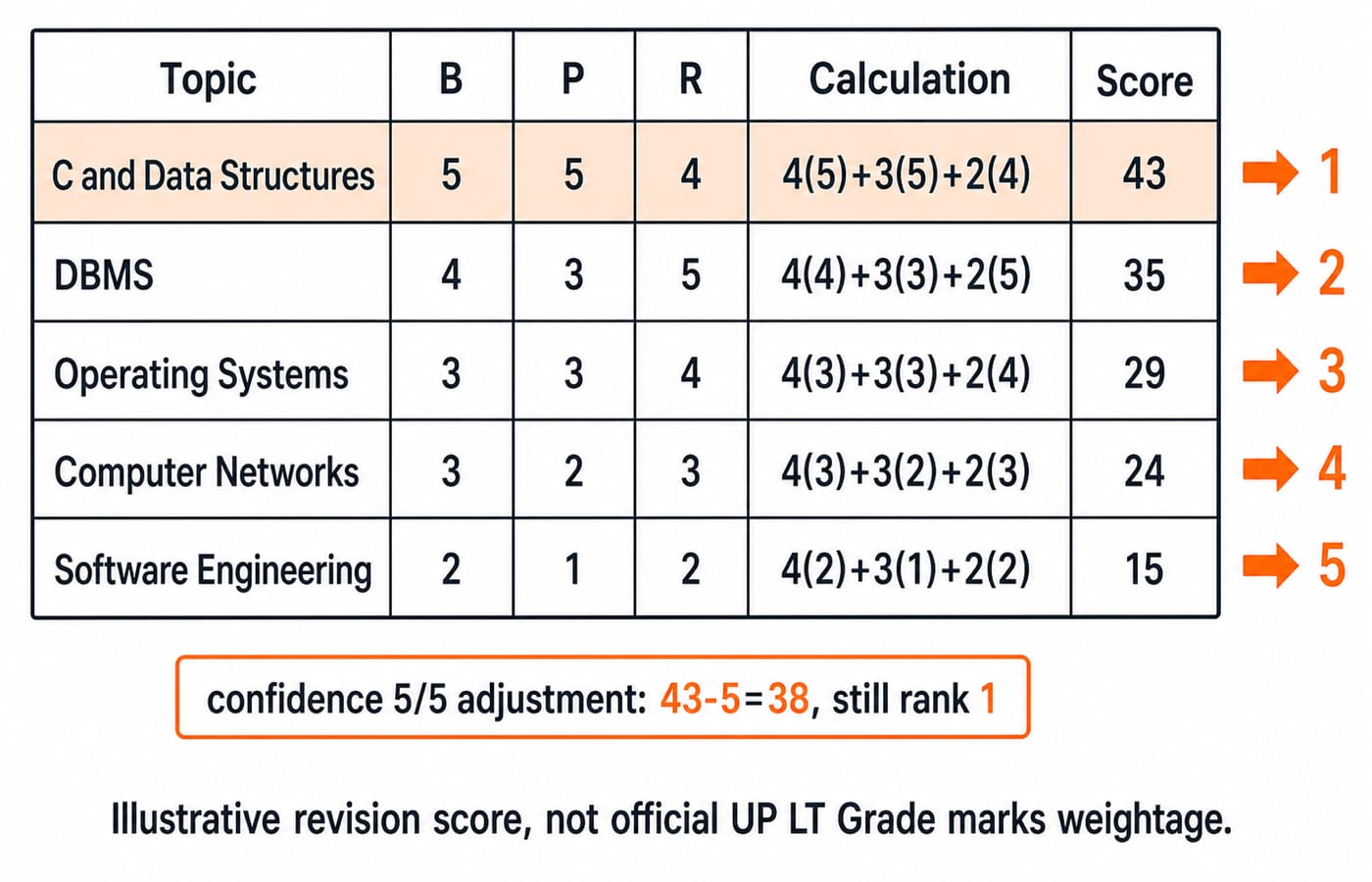
Rank | Topic | B (unfinished subunits) | P (dependent groups) | R (paper IDs) | Calculation | Score |
|---|---|---|---|---|---|---|
1 | C and Data Structures | 5 (5+) | 5 (4+) | 4 |
| 43 |
2 | DBMS | 4 (4) | 3 (2) | 5 |
| 35 |
3 | Operating Systems | 3 (3) | 3 (2) | 4 |
| 29 |
4 | Computer Networks | 3 (3) | 2 (1) | 3 |
| 24 |
5 | Software Engineering | 2 (2) | 1 (0) | 2 |
| 15 |
Order: 1 C and Data Structures (43), 2 DBMS (35), 3 Operating Systems (29), 4 Computer Networks (24), 5 Software Engineering (15). DBMS has the highest recurrence, but C and Data Structures has greater breadth and prerequisite reach.
At C and Data Structures confidence 5/5, 43-5=38, still above DBMS at 35. If its original score were 39, 39-5=34, putting DBMS first at 35.
5. Convert the scores into an 18-hour revision queue
The scores total 43+35+29+24+15=146. Allocate 18 hours proportionally:
Topic | Raw calculation | Raw time | Usable plan |
|---|---|---|---|
C and Data Structures |
| 5.30 hours | 5 hours |
DBMS |
| 4.32 hours | 4 hours |
Operating Systems |
| 3.58 hours | 4 hours |
Computer Networks |
| 2.96 hours | 3 hours |
Software Engineering |
| 1.85 hours | 2 hours |
The rounded queue totals 18 hours. Split blocks 60% for concept repair, 25% for source-tagged practice and 15% for error-log recall. Five hours becomes 3 hours, 1 hour 15 minutes and 45 minutes.
Concept repair is the slow half, and the UP LT Grade Assistant Teacher 2025 (CS) Course already sequences it topic by topic; your syllabus map decides which of those topics you sit through this week. A low rank means deferred, not unimportant.
6. Audit the plan so PYQ patterns do not become superstition
Audit four traps:
Duplicate reposts as separate papers: show paper ID and source, then deduplicate.
A recalled question as verified: mark it
unverified, soRgains zero.Ranking only by recurrence: keep
B,PandRvisible.Lesson volume as syllabus breadth: count mapped syllabus subunits, not lessons.
Candidate R gets 13 of 20 DBMS questions correct, so 13/20=65%; Operating Systems is 16/20=80%. This does not rewrite recurrence. It updates confidence and error categories for next week.
Log every mock attempt against the same topic labels you use in Sheet A, and the confidence column maintains itself week by week. If your PYQ log is still thin, UP LT Grade CS PYQs: A Topic-Wise Practice System covers building the topic index and the spaced rounds that fill it.
7. Re-rank every seven days and take the next concrete step
Saturday: record completed subunits and errors. Sunday: verify new paper sources, update B, P, R, confidence and last-revised date, then rebuild the 18-hour queue. Split a missed three-hour block into 90 minutes on each of the next two days. Do not double one day.
The short version: source your papers, score B, P and R, revise in descending order, then recalculate on Sunday. None of it needs a weightage percentage, which is the point. When the commission publishes an official marks split, it refines the R column and leaves the other two untouched.
Use the course to rebuild concepts and the test series for timed application. Let your own counts decide what comes first.
Keep learning
UP LT Grade CS PYQs: A Topic-Wise Practice System
Stop solving previous papers once and forgetting the mistakes. This system indexes every question by concept, schedules three attempts and turns each error into a measurable repair task.
Updated 5 Aug 20266 min readUP LT Grade
UP LT Grade Eligibility and Exam Pattern: Verify Your Subject Route
Read the Computer subject route correctly, check three hypothetical profiles, calculate the 2025 age boundary, and turn the notified paper structure into a practice plan.
Updated 2 Aug 20264 min read87 viewsUP LT Grade
UP LT Grade Computer Science Syllabus: A Prerequisite-First Study Map
Turn the official UPPSC Computer Science syllabus into a practical study sequence, with worked checks, an eight-week overlay and a coverage diagnostic.
Updated 31 Jul 20265 min readUP LT Grade

UP LT Grade Computer Science 14-Week Study Plan for Working Aspirants
A realistic weekly system for candidates preparing beside a degree, job or teaching workload. It turns 14 weeks into planned study, recovery and review.
Updated 28 Jul 20266 min readUP LT Grade