UP LT Grade Computer Science Syllabus: A Prerequisite-First Study Map
Turn the official UPPSC Computer Science syllabus into a practical study sequence, with worked checks, an eight-week overlay and a coverage diagnostic.
KnowledgeGate Team
Exam prep & CS education
Updated 31 Jul 20265 min read
The UP LT Grade Computer Science syllabus can look like one long, flat list. That makes it tempting to jump from SQL to pointers to networking while the prerequisite underneath is still weak. A prerequisite-first order fixes that: foundations, then programming, then systems, then databases, with pedagogy-linked revision running over all four. The official UPPSC syllabus stays the authority on what is in scope, and every line of it survives the regrouping. If you are still comparing recruitments, first read Which Teaching CS Exam Should You Target?
Freeze the official UPPSC syllabus before reorganising it
Start with the applicable advertisement, syllabus appendix and later corrigenda on the UPPSC official portal. Put every line in a five-column ledger: exact official line | practical block | prerequisite | study status | source page. The last column earns its place when a corrigendum lands, because you can re-check the changed line against the page you copied it from.
Filled in, two rows read number systems | foundations | none | amber | appendix page ref and database transactions | databases | relational model | red | appendix page ref. Every official line gets a row, including the ones that fit none of the four subject blocks; send those to a bucket called official remainder so they cannot quietly disappear. The UP LT Grade category page collects the rest of the UP LT preparation material.
Block one: number systems and logic before memorised facts
Order foundations as data representation and number systems, Boolean reasoning and digital logic, discrete structures, then computer organisation. Representation supports logic, logic supports circuits, and circuits clarify registers, memory and instruction flow.
Check readiness with two complete steps. Convert decimal 45 to binary 101101, since 32 + 8 + 4 + 1 = 45. Pad and group it as 0010 1101, which gives hexadecimal 2D. Next take F(A,B,C) = Σm(1,3,5,7). Each listed minterm has C = 1, while A and B cover all combinations, so F = C. Do not accept a quoted answer without the reasoning.
Block two: programming before algorithms
Inside programming, the order runs control flow and functions, arrays and pointers, data structures, complexity and algorithms, then object-oriented or language-specific material. Tracing is unreliable while indexing, mutation or function calls remain uncertain.
Binary-search the zero-indexed array [3, 7, 11, 18, 25, 31, 42] for 25. Start at low=0, high=6. Then mid=3, value 18, so set low=4. Next mid=5, value 31, so set high=4. Finally mid=4, value 25: found at index 4 after three comparisons. The shrinking interval illustrates O(log n) search, but one trace does not prove the bound.
Mark this block complete only when you can trace a supplied program, write a short solution, and state its time and space cost.
Block three: operating systems and networks as causal chains
Operating systems, networking, security, software engineering, web technologies and system-analysis topics belong in the systems block. Learn each as a causal chain: process state to scheduling to waiting time, address to routing to delivery, and requirement to design to test. Holding the chain is what keeps a systems question answerable once the exact fact has slipped.
Let P1 and P2 arrive at time 0, with bursts 5 and 3, and Round Robin quantum 2. The timeline is P1 0-2, P2 2-4, P1 4-6, P2 6-7, P1 7-8. Completion times are 8 and 7. Waiting time is completion minus arrival minus burst, so P1 waits 8-0-5=3 and P2 waits 7-0-3=4. If you cannot reproduce this trace, keep the topic amber.
Block four: DBMS from relational model to transaction
In databases, study the relational model and keys, then dependencies and normalisation, then SQL, then transactions, concurrency and recovery. Query-first study disconnects schema and dependency questions.
For Student(id, name, score) with (1, 'Asha', 78), (2, 'Ravi', 64) and (3, 'Meera', 91), run SELECT name FROM Student WHERE score >= 75 ORDER BY score DESC;. The output is Meera, then Asha. Ravi is filtered because 64 < 75; Meera leads because 91 > 78.
Solve eight mixed database items: green at 7/8 or 8/8, amber at 5/8 or 6/8, and red from 0/8 to 4/8. Re-solve a red block after repairing it, because one attempt is not evidence either way.
Computer Science pedagogy as a revision method
Pedagogy-linked revision means understanding each concept well enough to explain, diagnose and correct it clearly. That is also the fastest revision available, because a concept you can diagnose in a learner is a concept you can no longer half-remember.
Use a four-part teach-back: a five-minute explanation, one board example, one likely misconception, and one diagnostic question. A learner claims A + 1 = A. Test A=0: 0+1=1. Test A=1: 1+1=1. Thus A+1=1. Now ask, What is A·0? The answer is 0 for both Boolean values. The Computer Science Pedagogy for Teacher Exams guide works through more of these misconceptions.
Put the syllabus blocks into an eight-week order
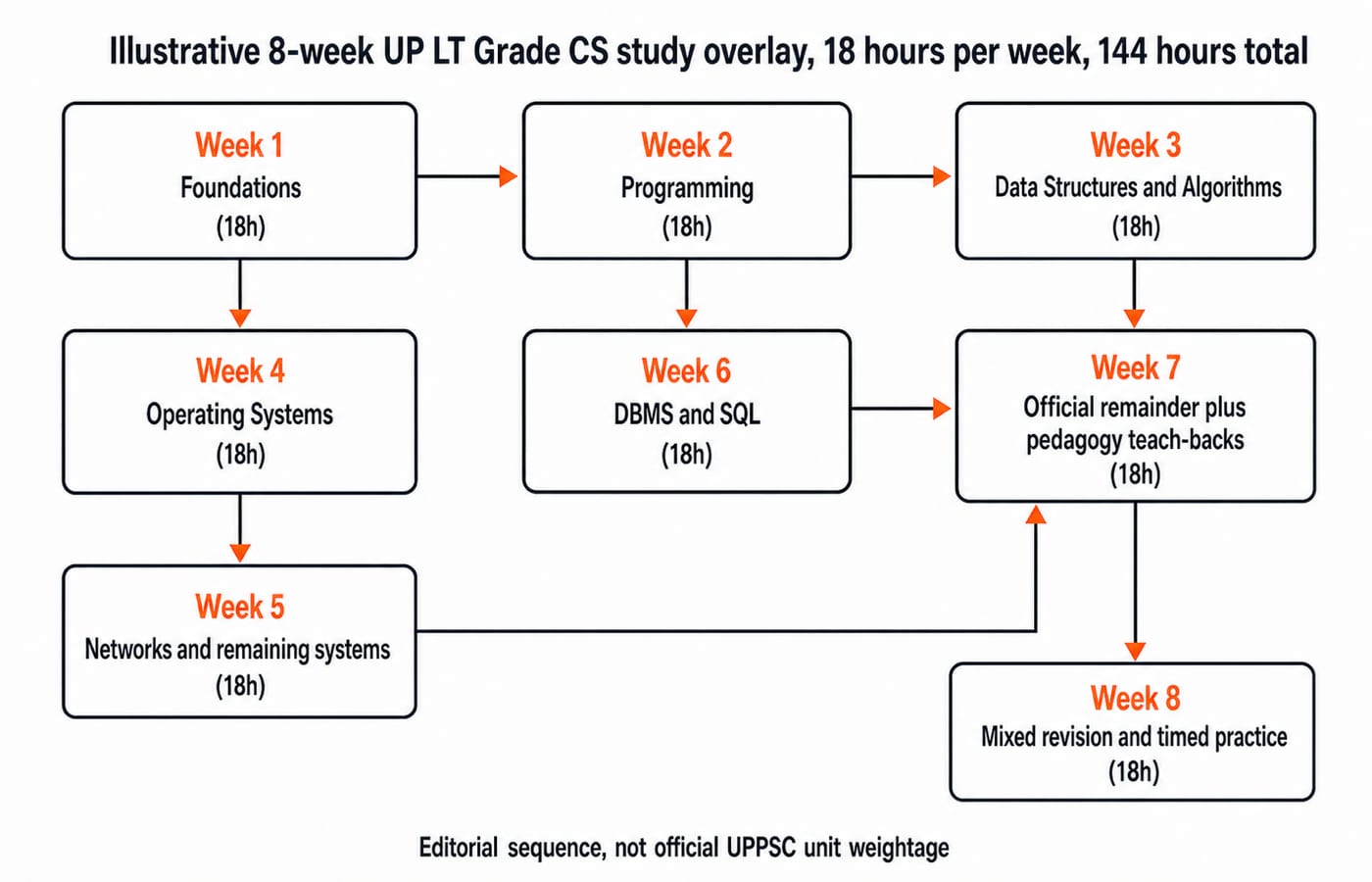
At 18 hours per week, eight weeks give 8 × 18 = 144 hours. Use Week 1 for foundations, Week 2 for C and programming logic, Week 3 for data structures and algorithms, Week 4 for operating systems, Week 5 for networks and remaining systems, Week 6 for DBMS and SQL, Week 7 for official remainder and pedagogy teach-backs, and Week 8 for mixed timed practice. Eight weeks is the compressed pass; at nine or ten hours a week, stretch the same order over fourteen weeks rather than dropping a block.
Study six days. Daily, 100 minutes of concepts plus 50 minutes of worked questions plus 30 minutes of error-log repair equals 180 minutes, or 3 hours. Use the seventh day to recover a missed prerequisite before advancing. The UP LT Grade Assistant Teacher Computer Science course offers structured syllabus coverage, lectures, PYQs and topic or full-length testing.
Prove coverage, then switch to mixed practice
Build a 50-item diagnostic with ten items each for foundations, programming, systems, databases, and official remainder or pedagogy-linked retrieval. Scores of 8, 7, 4, 8, 6 total 33/50, but systems at 4/10 is the result that drives revision. Repair it first.
The KnowledgeGate bank carries over 200 UP LT Grade questions, so use them to retest the block you have just repaired rather than to sample the whole syllabus at once. Re-check the ledger, repair the weakest block, complete mixed timed practice, then use the UP LT Test Series for exam-oriented practice.
Keep learning
UP LT Grade CS Weightage: Rank What to Revise First
Stop treating topic weightage as a marks forecast. Rank five unfinished CS topics on breadth, prerequisite reach and sourced recurrence, then split 18 revision hours across them.
Updated 7 Aug 20265 min readUP LT Grade
UP LT Grade CS PYQs: A Topic-Wise Practice System
Stop solving previous papers once and forgetting the mistakes. This system indexes every question by concept, schedules three attempts and turns each error into a measurable repair task.
Updated 5 Aug 20266 min readUP LT Grade

UP LT Grade Eligibility and Exam Pattern: Verify Your Subject Route
Read the Computer subject route correctly, check three hypothetical profiles, calculate the 2025 age boundary, and turn the notified paper structure into a practice plan.
Updated 2 Aug 20264 min read87 viewsUP LT Grade
UP LT Grade Computer Science 14-Week Study Plan for Working Aspirants
A realistic weekly system for candidates preparing beside a degree, job or teaching workload. It turns 14 weeks into planned study, recovery and review.
Updated 28 Jul 20266 min readUP LT Grade