UP LT Grade CS PYQs: A Topic-Wise Practice System
Stop solving previous papers once and forgetting the mistakes. This system indexes every question by concept, schedules three attempts and turns each error into a measurable repair task.
KnowledgeGate Team
Exam prep & CS education
Updated 5 Aug 20266 min read
Many candidates solve UP LT Grade Computer Science papers in year order, check the score and move on. A week later, the same paging, SQL or C-language mistake returns. Filing each question under one concept, then attempting it on Day 0, Day 2 and Day 7 and recording why it was missed, turns a stack of papers into a finite repair list. Previous papers teach the concepts that repeat; they do not predict the next paper.
Build a topic index before solving another full paper
Collect only questions you can trace to a named paper or to the UPPSC site. Give each item a question ID, year or source label, and one primary concept. Why PYQs Beat Buying Another Question Bank explains why sorting should precede collecting more material.
Make the sheet's top level the full subject spine, not just the blocks you already like solving. The UP LT Grade Assistant Teacher Computer Science course splits that syllabus into thirteen blocks: Digital Logic and Circuits with Discrete Mathematical Structures, Computer Organization and Architecture, Data Structures and Algorithms, Problem Solving through C Programming, Object Oriented Techniques, Operating Systems, Database Management Systems, Computer Networks, Software Engineering, Internet Technology and Web Design, System Analysis and Design, Information Security and Cyber Laws, and Computer Graphics. Blocks still empty after a batch are the ones to hunt for next.
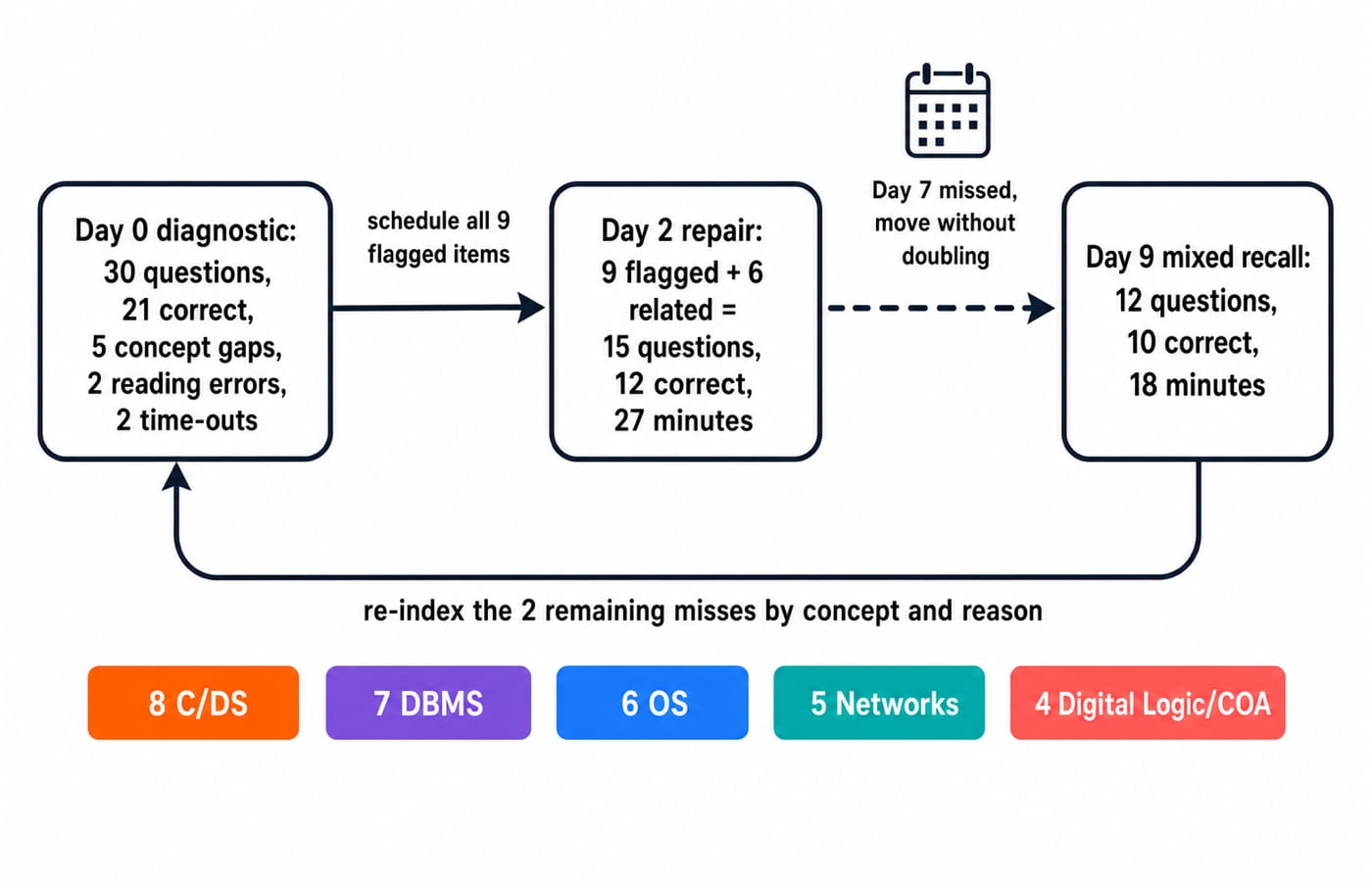
Take a 30-question batch: C Programming and Data Structures 8, DBMS 7, Operating Systems 6, Computer Networks 5, and Digital Logic or Computer Organisation 4. Split where useful: those 6 OS items could become CPU scheduling 2, processes and synchronisation 2, and memory management 2. Recount your own split every time you add a batch; these numbers move.
Use these spreadsheet columns exactly:
Question ID | source/year | subject | concept family | first-attempt result | time | miss code | next review | one-line repair
Keep the sheet target-specific. The Govt Teaching Jobs category helps separate UP LT Grade preparation from other teaching recruitments.
Use a six-week, 12-hour model that survives missed days
This weekly clock totals twelve hours, with Sunday deliberately short because Sunday carries the audit rather than new questions.
Day | Study time |
|---|---|
Monday, Tuesday, Thursday, Friday | 90 minutes each |
Wednesday | 2 hours |
Saturday | 3 hours |
Sunday | 1 hour |
Four 90-minute blocks give 360 minutes. Adding 120, 180 and 60 gives 720 minutes, or 12 hours. In each 90-minute block, spend 15 minutes on recall, 50 on new PYQs, 20 on correction and 5 scheduling the next review: 15 + 50 + 20 + 5 = 90 minutes.
In Weeks 1 and 2, index questions and take untimed diagnostics. In Weeks 3 and 4, repair weak families through spaced re-solves. In Weeks 5 and 6, use mixed timed sets and a weekly review. When a whole chapter rather than one question is the gap, relearn that block before adding more PYQs to the sheet.
If Wednesday's 120-minute block is lost, move 60 minutes onto Sunday after the audit and carry the other 60 into next week's lowest-priority new-question block. Do not create a four-hour punishment session or cancel a review.
Solve every concept family in three spaced rounds
Round 1, Day 0: Solve without notes for an honest diagnostic.
Round 2, around 48 hours: Closed-book re-solve each wrong, guessed or slow item, plus one related item per weak idea.
Round 3, Day 7: Use an unlabelled mixed set. If Day 2 is missed, review on Day 3 and shift the seven-day review accordingly. Do not combine the rounds.
For example, a learner attempts 30 indexed questions on Day 0 and gets 21 correct. The 9 flagged items are 5 concept gaps, 2 reading errors and 2 time-outs. On Day 2, the learner solves those 9 plus 6 related questions, getting 12 of 15 correct in 27 minutes. After missing Day 7, the learner takes a 12-question mixed set on Day 9 and gets 10 correct in 18 minutes. Improvement means fewer repeated error reasons, not merely a higher score.
Turn one paging miss into a repair task
Work one memory-management item end to end:
A system has a 32-bit byte-addressable logical address, a page size of 4 KB and a single-level page table. Each page-table entry is 4 bytes. What is the page-table size?
A. 1 MB
B. 2 MB
C. 4 MB
D. 8 MB
Work from units. 4 KB = 4 x 1024 bytes = 2^12 bytes, so the offset uses 12 bits. The page number uses 32 - 12 = 20 bits, giving 2^20 page-table entries. Therefore:
2^20 entries x 4 bytes per entry = 2^20 x 2^2 bytes = 2^22 bytes = 4 MB
Option C is correct. Suppose the learner chose A in 95 seconds by reading the 2^20 entries as 2^20 bytes and never multiplying by the 4-byte entry size. The repair is: "PTE size multiplies the number of entries; page size determines offset bits."
After 48 hours, the learner re-solves it closed-book correctly in 72 seconds. After seven days, it appears in a mixed set and is solved in 54 seconds with units shown. The reasoning and unit chain matter more than memorising option C.
Record the exact reason for every miss
Use five codes: CK for missing concept knowledge, FM for a wrong formula or mapping, RD for a missed condition, TM for time-management failure, and GS for an unsupported guess. "Silly mistake" prescribes no repair.
Question | Concept | Result | Time | Code | Exact reason | One-line repair | Review |
|---|---|---|---|---|---|---|---|
OS-PG-04 | memory management | wrong, A | 95 s | FM | read entries as bytes | write | Day 2 |
DB-SQL-03 | GROUP BY/HAVING | guessed correct | 80 s | GS | could not explain group filtering | write one query with | Day 2 |
CN-IP-02 | subnetting | unanswered | 150 s | TM | expanded every binary bit | practise | next day |
Every row needs a one-sentence repair and measurable retest. For CK, relearn the concept and answer one check question. For FM, derive the mapping and apply it. For RD, underline conditions before re-solving. For TM, use a stop rule. For GS, explain why three alternatives fail. A guessed correct answer stays in the review queue.
Move to mixed timed sets only when ready
Set a progression rule you can check: move a family into mixed practice after two reviews at 80 per cent or better, with no repeated CK or FM. An OS family at 8 of 10 on Tuesday and 9 of 10 on Saturday moves forward. A DBMS family at 7 of 10 stays in repair.
Build a 15-question mixed set with 5 OS, 5 DBMS and 5 Networks questions under a 24-minute cap. If 11 are complete at minute 16, mark the remaining four and apply a 90-second stop rule. Review by family, OS 5/5, DBMS 3/5 and Networks 4/5, not only the 12/15 total, so the DBMS weakness remains visible.
When family-level sets are stable, use Teaching Exam Mock Strategy: Cadence and Review Plan to extend this analysis to full tests. A full test measures performance; topic-family repair between tests improves it.
Run a Sunday audit and choose the next week's work
Use the 60-minute Sunday block deliberately: 15 minutes to update due reviews, 15 to count misses by code, 20 to re-solve the week's two most repeated errors, and 10 to choose two weak families for next week. If DBMS produced 4 of 7 misses and 3 were FM, assign two DBMS repair blocks before adding Networks questions.
When the audit exposes weak basics, schedule a fundamentals block instead of treating each miss as isolated. Before you trust any topic list, including your own sheet, check the live official UPPSC website for the current cycle's syllabus, pattern and paper access.
The short version
Index by concept, diagnose on Day 0, repair around 48 hours, mix around Day 7, and let the error reason select the next task. Build a 30-question sheet today. For scheduled exam-style practice, use the UP LT Grade test series and keep the same error log after each test.
Keep learning
UP LT Grade CS Weightage: Rank What to Revise First
Stop treating topic weightage as a marks forecast. Rank five unfinished CS topics on breadth, prerequisite reach and sourced recurrence, then split 18 revision hours across them.
Updated 7 Aug 20265 min readUP LT Grade

UP LT Grade Eligibility and Exam Pattern: Verify Your Subject Route
Read the Computer subject route correctly, check three hypothetical profiles, calculate the 2025 age boundary, and turn the notified paper structure into a practice plan.
Updated 2 Aug 20264 min read87 viewsUP LT Grade

UP LT Grade Computer Science Syllabus: A Prerequisite-First Study Map
Turn the official UPPSC Computer Science syllabus into a practical study sequence, with worked checks, an eight-week overlay and a coverage diagnostic.
Updated 31 Jul 20265 min readUP LT Grade

UP LT Grade Computer Science 14-Week Study Plan for Working Aspirants
A realistic weekly system for candidates preparing beside a degree, job or teaching workload. It turns 14 weeks into planned study, recovery and review.
Updated 28 Jul 20266 min readUP LT Grade