Universities and Learning Programmes for Teaching Exams: Types, Modes and Solved Examples
Separate university status, delivery mode and programme purpose with a repeatable method, then test it on five UGC NET-style classification cases.
KnowledgeGate Team
Exam prep & CS education
Updated 2 Oct 20265 min read
Exam questions often mix the legal type of a university, the delivery mode of a programme, and the programme's purpose as if all three belonged to one list. The result is confusion between labels such as State, open, and professional. Use a three-layer method instead, then apply it to five fixed cases. Higher Education System belongs to the general Paper 1 context, while subject knowledge belongs to Paper 2; UGC NET Paper 1 vs Paper 2 maps that distinction.
Universities and learning programmes: separate three layers first
One case can carry one label from each of three layers.
Layer | Question to ask | Typical labels |
|---|---|---|
Institution status | How was the institution established or declared? | Central, State, Private, Institution Deemed to be University |
Delivery mode | How does teaching principally reach the learner? | Conventional face-to-face, ODL, online |
Programme orientation | What is the programme designed to teach? | General, oriental or traditional, professional, technical, skill-based, value, environmental |
An institution established by an Act of Parliament and teaching an on-campus B.A. is Central + conventional + general. Central is its status, conventional its mode, and general its programme orientation.
Formal, non-formal and informal education answer a different question: how learning is organised. Types of Education and NEP 2020 owns that distinction and NEP policy mechanisms; the three layers here classify an institution's legal status, delivery mode and programme orientation.
University types in India: establishment route is the decisive cue
Exam label | Establishment route | Cue in a question | What the label does not tell you |
|---|---|---|---|
Central University | Established or incorporated under a Central Act | Act of Parliament | Delivery mode |
State University | Established or incorporated under a State Act | State Legislature | Whether it is conventional or open |
Private University | Established through a State Act with a private sponsoring body and ordinarily unitary | State Act + private sponsor | It is not automatically deemed-to-be |
Institution Deemed to be University | Declared under Section 3 of the UGC Act, 1956, on UGC advice | Section 3 declaration | It is not created by renaming a private university |
Under the UGC Act, 1956, Section 2(f) defines a university, while Section 3 provides the declaration route for an Institution Deemed to be University. The Section 3 cue is decisive.
Open, affiliating, unitary, and residential describe function or organisation, not statutory status. A university can be both State and open.
Learning programmes: classify mode separately from purpose
Scheduled campus teaching is conventional or face-to-face mode.
Structured self-learning material and learner support, with teacher and learner physically separated, indicate Open and Distance Learning (ODL).
Teaching and learning through an online platform indicate online mode.
Digital notes in a campus course do not automatically make that programme online.
For orientation, B.A. History is general; a Sanskrit or classical-language programme is oriental or traditional; M.B.A. is professional; and B.Tech. is technical. A 12-week data-entry certificate is skill-based, an ethics module is value education, and an environmental-studies module is environmental education. Programme orientation and programme recognition are separate checks.
For ODL and online study, UGC and its Distance Education Bureau require checking institution + programme + mode + academic session. Institution recognition alone does not prove programme entitlement.
Universities in higher education: the chronology worth retaining
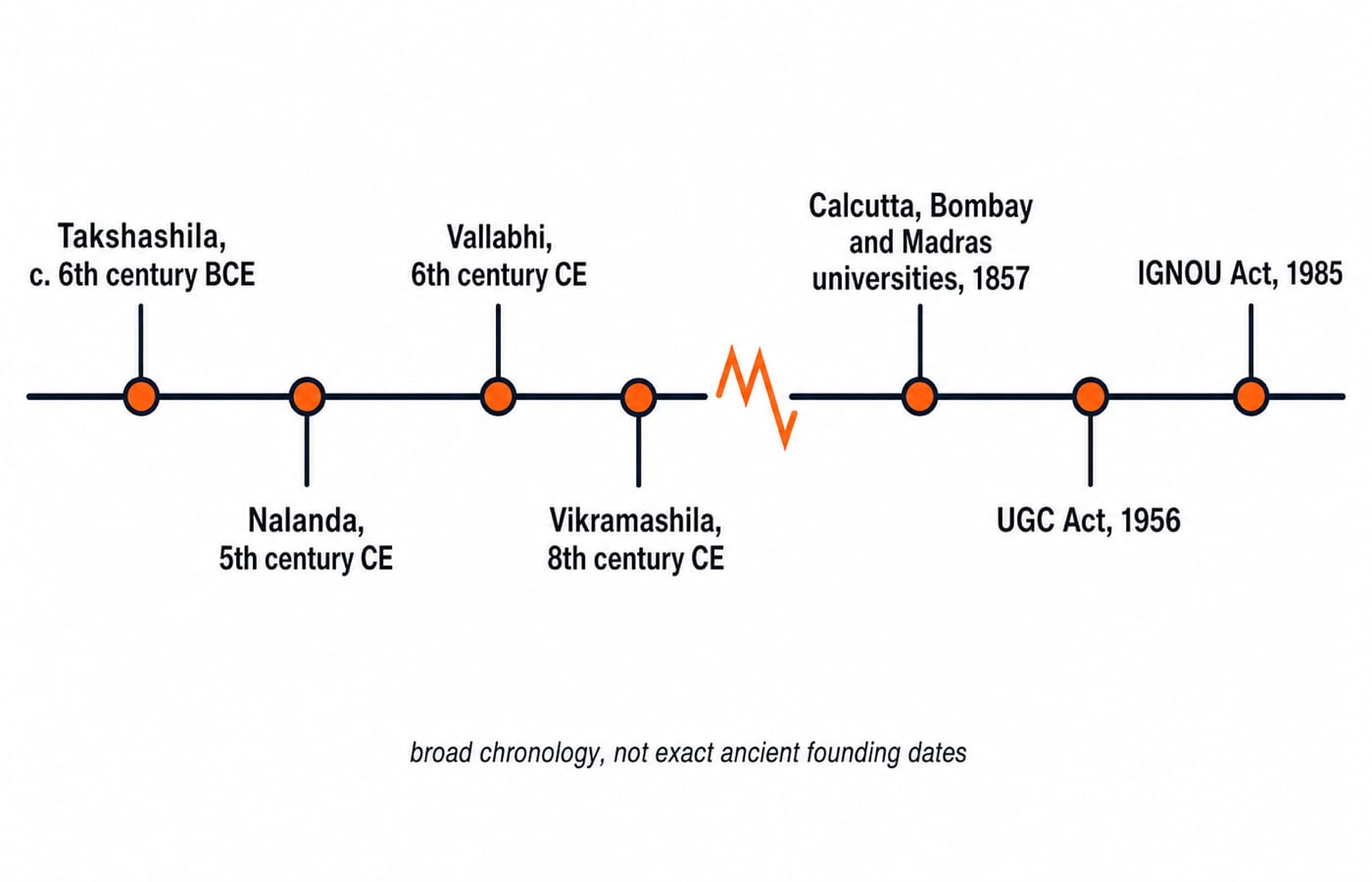
Retain this broad chronology: Takshashila, traditionally around the sixth century BCE; Nalanda, fifth century CE; Vallabhi, sixth century CE; Vikramashila, eighth century CE. These centres combined scholarship, debate, teacher-led study, and residential learning, unlike modern statutory universities.
Modern milestones are the Calcutta, Bombay, and Madras universities in 1857; the UGC Act, 1956; and the IGNOU Act, 1985, a landmark for open learning. For chronology questions, keep these statutory milestones separate from the ancient centres above.
Universities and learning programmes: solve five classification cases
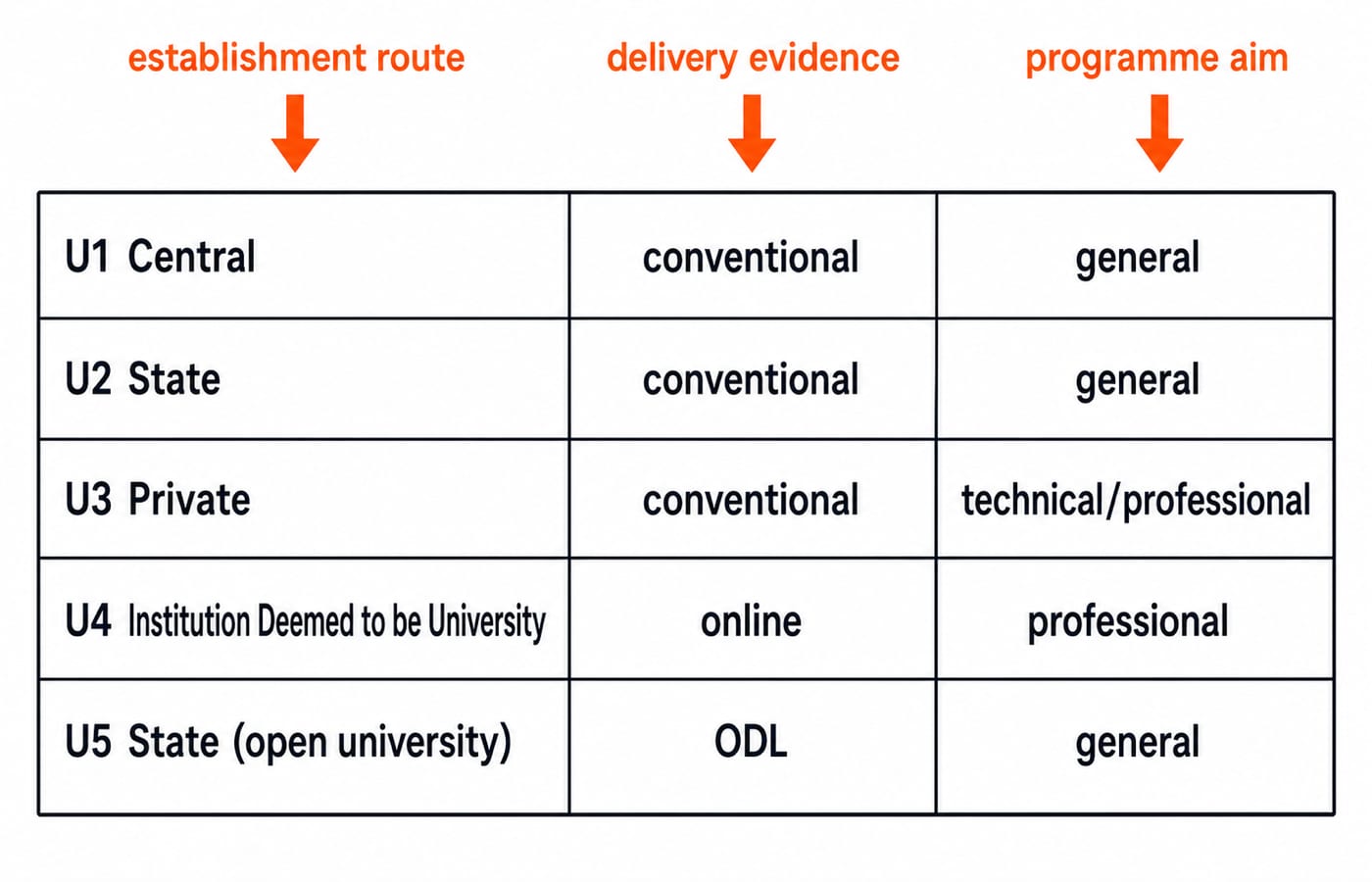
Each case combines an establishment route, a delivery mode, and a programme orientation:
U1: created by an Act of Parliament; on-campus B.A. History.
U2: created by a State Legislature; state-funded, affiliating institution; on-campus M.A. Economics.
U3: created through a State Act with a private sponsoring body; unitary institution; on-campus B.Tech.
U4: declared under Section 3 of the UGC Act, 1956; online M.B.A.
U5: created by a State Act as an open university; M.A. Sociology delivered through ODL.
Apply the same three questions each time.
U1: Parliament route gives Central; campus delivery gives conventional; B.A. History gives general.
U2: State Legislature gives State; campus delivery gives conventional; M.A. Economics gives general. Affiliating is organisational, not a fifth legal class.
U3: State Act plus private sponsor gives Private; campus delivery gives conventional; B.Tech. gives technical.
U4: Section 3 declaration gives Institution Deemed to be University; platform delivery gives online; M.B.A. gives professional. Classification does not prove current programme entitlement.
U5: State Act gives State; the open-university description and stated delivery give ODL; M.A. Sociology gives general. Its legal type is not "ODL university".
Case | Institution status | Delivery mode | Programme orientation |
|---|---|---|---|
U1 | Central | conventional | general |
U2 | State | conventional | general |
U3 | Private | conventional | technical |
U4 | Institution Deemed to be University | online | professional |
U5 | State (open university) | ODL | general |
How teaching exams test universities and learning programmes
Common question forms include:
Route matching: match the establishment route to the university type.
Chronology: order institutions or milestones.
Scenario classification: identify both statutory status and delivery mode.
Section distinction: separate the Section 2(f) definition from the Section 3 declaration.
Recognition check: spot an assertion that treats institution recognition as automatic programme recognition.
Rapid checks: State Act + private sponsor means Private University, not Institution Deemed to be University. The ancient order is Takshashila -> Nalanda -> Vallabhi -> Vikramashila. U5 is State + ODL, not a "distance university" legal type.
The current NTA UGC-NET syllabus and bulletin place Higher Education System in Paper 1 and are the source to confirm current syllabus or pattern details. UGC NET Computer Science syllabus areas covers the Paper 2 subject side. For other recruitment exams, use these notes only when the current syllabus names higher education, universities, or learning programmes.
Universities and learning programmes: traps that lose easy marks
Wrong shortcut | Why it fails | Replacement test |
|---|---|---|
Open is a fifth legal university type | It mixes function with legal status | Ask which Act or declaration created it |
Deemed means private | Section 3 status is a distinct route | Look for the Section 3 cue |
Online and ODL are interchangeable | They are separately described modes | Inspect the delivery evidence |
A recognised university means every distance programme is recognised | UGC/DEB recognition is specific to programme, mode, and session | Verify institution, programme, mode, and session |
For 30-second elimination, underline the establishment cue, circle delivery, and box the programme aim. In U4, underline Section 3, circle online, and box M.B.A./professional.
If the syllabus also tests teaching methods, read Computer Science pedagogy for teacher exams. Pedagogy and higher-education classification are different units.
The short version and the next step
Recall: Who established or declared the institution? How is the programme delivered? What is the programme designed to teach? U1 is Central, U2 State, U3 Private, U4 deemed-to-be, and U5 State open. Classify their modes separately.
For a structured plan, continue with the NTA UGC NET Paper 1 Course. Otherwise, revise the U1-U5 matrix and retest it tomorrow.
Keep learning
सामान्य अशुद्धियाँ (Samanya Ashuddhiyaan): Complete Hindi Grammar Notes for CTET and TET Exams
Learn to identify and correct Hindi word-form, agreement, pronoun and redundancy errors through exact examples, a worked MCQ and a scored diagnostic.
Updated 6 Oct 20266 min readCTET & UPTET
National Education Policy (NEP) 2020 Notes for Teaching Exams: 5+3+3+4, Reforms and MCQ Traps
Build an exam-ready map of NEP 2020, from the age-stage structure to pedagogy, language, PARAKH, B.Ed. routes and reliable distractor elimination.
Updated 26 Sep 20265 min readCTET & UPTET
Miscellaneous Pedagogy Topics for Teaching Exams: Complete Notes and Worked Examples
Turn a loose syllabus label into a five-part concept map, then use classroom evidence to distinguish sound pedagogy from attractive but incomplete options.
Updated 25 Sep 20266 min readCTET & UPTET
Mental Health and Life Skills for Teaching Exams: Complete Notes, Examples and Traps
Revise mental health, ten life skills and counselling approaches through clear contrasts, classroom examples and fast option-elimination rules.
Updated 23 Sep 20265 min readCTET & UPTET