Ancient Universities for Teaching Exams: Takshashila, Nalanda, Vallabhi and Vikramshila
Confusing ancient centres by location, date or patron can spoil an otherwise easy match. Build four source-backed cards, solve an original matching item, and revise with a 12-card loop.
KnowledgeGate Team
Exam prep & CS education
Updated 8 Sep 20266 min read
Takshashila, Nalanda, Vallabhi and Vikramshila are easy to recall but easy to swap by location, period, institutional character or patronage. Separate them with a five-field note, a matching problem and a recall loop. Ancient centres of higher learning belong only in syllabi that name this area, so confirm your current official syllabus. For the paper-level distinction, see UGC NET Paper 1 versus Paper 2 for Paper 1 orientation.
Related reading: Vedic education and Higher education institutions.
Start with the four-name anchor
The Ministry's National Education Policy 2020 page names these four among major institutions of ancient India. The policy groups them together but gives no common founding model, curriculum or admission process.
Source labels differ. UNESCO calls Taxila a Buddhist centre of learning and Nalanda a monastic and scholastic institution. UGC uses universities and seats of higher learning. Bihar Tourism calls Vikramshila an ancient university and centre of learning. Keep the familiar exam label, but note how each source describes the institution.
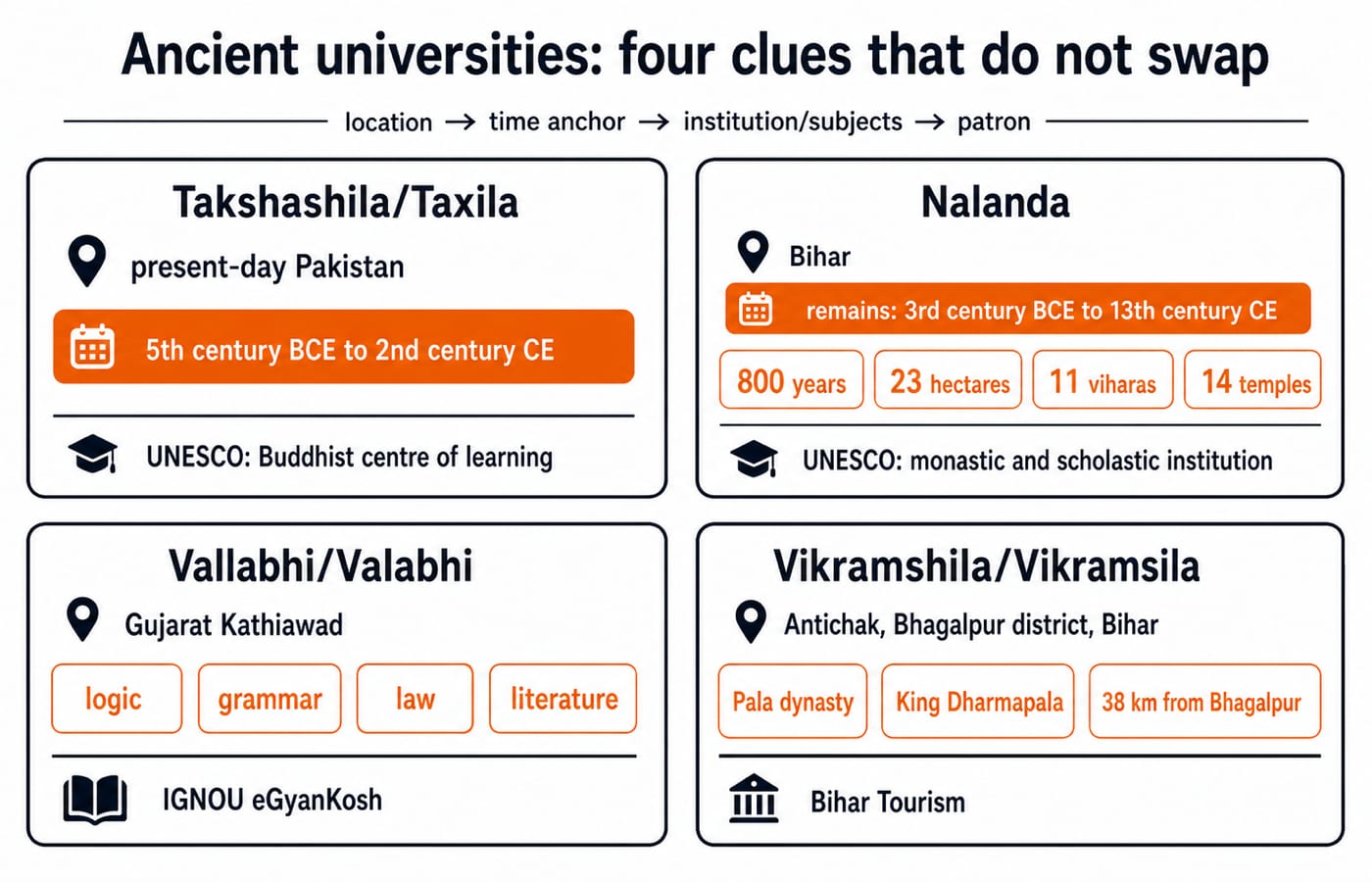
Use: name and spelling variant | present-day location | source-backed time anchor | institutional clue | sourced patron or subject clue. Store Takshashila/Taxila, Vallabhi/Valabhi and Vikramshila/Vikramsila as spelling pairs, not separate institutions.
Takshashila or Taxila: place, period and learning clue
According to UNESCO's Taxila page, Taxila is in Rawalpindi district, Punjab province, Pakistan. UNESCO identifies it as an important Buddhist centre of learning from the 5th century BCE to the 2nd century CE. The wider site also records Persian, Greek and Central Asian influences.
Takshashila/Taxila | present-day Pakistan | 5th century BCE to 2nd century CE as a Buddhist centre of learning | UNESCO
Keep present-day location separate from a historical-cultural label. UNESCO gives a learning span, not one exact founding year or ruler.
Original statement check
Statement I: UNESCO describes Taxila as an important Buddhist centre of learning from the 5th century BCE to the 2nd century CE.
Statement II: Taxila is in present-day Bihar.
Options: (A) Both are correct; (B) only Statement I is correct; (C) only Statement II is correct; (D) both are incorrect.
Answer: (B). Statement I follows UNESCO; Statement II confuses Taxila with Nalanda or Vikramshila.
Nalanda Mahavihara: archaeological span is not a founding date
UNESCO's Nalanda Mahavihara page places it in Bihar. Its archaeological remains date from the 3rd century BCE to the 13th century CE, and UNESCO describes 800 years of organised knowledge transmission. This range is not a founding date.
The 23-hectare property includes remains of 11 viharas and 14 temples. Here, viharas are residential and educational buildings. Store 23 hectares | 11 viharas | 14 temples, not unlabelled counts.
Nalanda's source-backed details are:
Nalanda Mahavihara | Bihar | remains from 3rd century BCE to 13th century CE | 800 years of organised knowledge transmission | 23 hectares, 11 viharas, 14 temples
UGC Genesis supports the broader seat-of-learning description and records learners arriving from beyond the country. Student totals, library-storey counts and destruction stories need separate evidence.
Vallabhi and Vikramshila: subjects versus patronage
IGNOU eGyanKosh Unit 16 places Vallabhi near Gujarat Kathiawad and names logic, grammar, law and literature among its subjects:
Vallabhi/Valabhi | Gujarat Kathiawad | logic + grammar + law + literature | IGNOU
The cited IGNOU unit gives Vallabhi's location and subjects, not its dynasty, founder or exact span. Bihar's Vikramshila page places the ruins at Antichak in Kahalgaon subdivision, 38 km from Bhagalpur. It links the centre to the Pala dynasty and King Dharmapala:
Vikramshila | Antichak, Bhagalpur district, Bihar | Pala dynasty | Dharmapala
Anti-swap rule: Vallabhi means Gujarat plus four subjects; Vikramshila means Bihar plus Pala and Dharmapala.
Each institution has a location, a time anchor, an institutional or subject clue and a source
Institution | Present-day location | Source-backed time anchor | Institutional or subject clue | Source | Best recall key |
|---|---|---|---|---|---|
Takshashila/Taxila | Present-day Pakistan | 5th century BCE to 2nd century CE learning span | Buddhist centre of learning | UNESCO | Period + location |
Nalanda | Bihar | Remains from 3rd century BCE to 13th century CE, with 800 years of knowledge transmission | Monastic and scholastic institution | UNESCO | 23 hectares + 11 viharas + 14 temples |
Vallabhi/Valabhi | Gujarat Kathiawad | Not specified in IGNOU Unit 16 | Logic, grammar, law, literature | IGNOU | Western location + subjects |
Vikramshila/Vikramsila | Antichak, Bhagalpur district, Bihar | Pala dynasty | Centre of learning established by Dharmapala | Bihar Tourism | Patron + location |
Compare in this order: location -> source-backed time anchor -> institution or subjects -> sourced patron. This avoids forcing a single date onto sources that give different kinds of evidence.
UGC Genesis provides the shared seat-of-learning frame for Nalanda, Taxila and Vikramsila; NEP 2020 provides the four-name set. Institution-specific sources provide dates and curricula.
Fully worked matching example
Solve this item from the evidence clusters above.
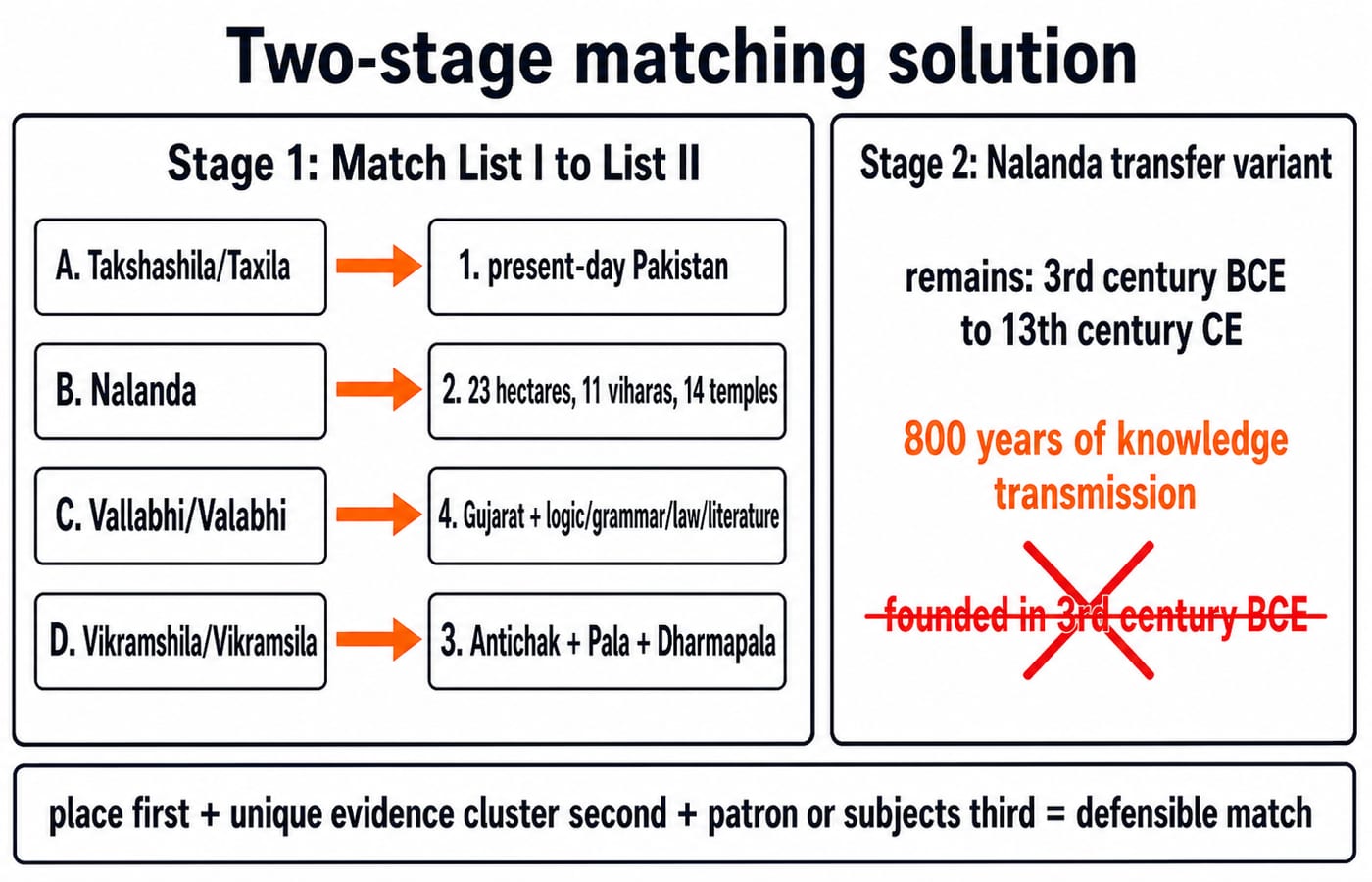
List I: (A) Takshashila; (B) Nalanda; (C) Vallabhi; (D) Vikramshila.
List II:
Present-day Pakistan, important Buddhist centre of learning from the 5th century BCE to the 2nd century CE
Bihar site with 23 hectares, 11 viharas and 14 temples in the surviving property
Antichak in Bhagalpur district, associated with the Pala dynasty and King Dharmapala
Gujarat Kathiawad centre where logic, grammar, law and literature are named subjects
Options: (i) A-1, B-2, C-4, D-3; (ii) A-2, B-3, C-1, D-4; (iii) A-4, B-1, C-3, D-2; (iv) A-3, B-4, C-2, D-1.
Solve in four passes:
Present-day Pakistan locks Takshashila to A-1.
The
23, 11, 14cluster locks Nalanda to B-2.Gujarat and four subjects lock Vallabhi to C-4.
Antichak, Pala and Dharmapala lock Vikramshila to D-3.
Thus option (i), A-1, B-2, C-4, D-3, is correct.
Transfer variant: replace item 2 with Bihar monastic and scholastic site whose remains date from the 3rd century BCE to the 13th century CE and where UNESCO describes 800 years of organised knowledge transmission. The answer remains B-2. The range dates remains, not a one-year foundation event.
Question forms and traps to repair
Possible forms include institution-location or institution-patron matching, chronology from a supplied span, statement pairs, and identification from subjects or archaeological numbers. Give each practice answer a source-backed reason. Check the official UGC NET site before using current unit wording, marks, question counts, cycles or syllabus statements.
Why it happens | What goes wrong | What to do instead |
|---|---|---|
All four are grouped under ancient India | Takshashila becomes Bihar | Write |
An archaeological range is read as one event | 3rd century BCE becomes Nalanda's exact foundation year | Write |
Patron clues are swapped | Vallabhi becomes Dharmapala's institution | Reserve |
Number labels are dropped | 23, 11 and 14 become student or classroom counts | Store |
Teaching exams are treated as one syllabus | Every exam is assumed to test this identically | Check each recruiting body's official syllabus |
Use UGC NET common mistakes to build an error log. CTET, State TETs, UGC NET and recruitment examinations do not share one syllabus or pattern.
The short version and your next study move
Takshashila -> present-day Pakistan -> 5th century BCE to 2nd century CE centre-of-learning spanNalanda -> Bihar -> remains from 3rd century BCE to 13th century CE -> 800 yearsVallabhi -> Gujarat Kathiawad -> logic, grammar, law, literatureVikramshila -> Antichak, Bhagalpur -> Pala dynasty -> DharmapalaNEP 2020 supplies the four-name set; institution-specific official sources supply the detailed clues
Build 12 cards: 4 name-location, 4 name-unique-clue and 4 source-language. Attempt them in order, shuffle for round 2, then retest errors plus each error's most confusable card.
For 9 correct out of 12, 9 / 12 = 3 / 4 = 75% and 12 - 9 = 3 cards remain. Label each location, time-anchor, patron/subject or source-wording, then rewrite it in the five-field format.
KnowledgeGate practice includes higher education and ancient universities. Treat an item as a previous-year question only when it carries an exam and year attribution. Use the NTA UGC NET Paper 1 course for structured learning, the UGC NET Paper 1 test series for timed practice, and the NET category for broader choices.
Now redraw the comparison board, solve the match without looking, and verify disputed facts against the attributed source.
Keep learning
सामान्य अशुद्धियाँ (Samanya Ashuddhiyaan): Complete Hindi Grammar Notes for CTET and TET Exams
Learn to identify and correct Hindi word-form, agreement, pronoun and redundancy errors through exact examples, a worked MCQ and a scored diagnostic.
Updated 6 Oct 20266 min readCTET & UPTET
Universities and Learning Programmes for Teaching Exams: Types, Modes and Solved Examples
Separate university status, delivery mode and programme purpose with a repeatable method, then test it on five UGC NET-style classification cases.
Updated 2 Oct 20265 min readCTET & UPTET
National Education Policy (NEP) 2020 Notes for Teaching Exams: 5+3+3+4, Reforms and MCQ Traps
Build an exam-ready map of NEP 2020, from the age-stage structure to pedagogy, language, PARAKH, B.Ed. routes and reliable distractor elimination.
Updated 26 Sep 20265 min readCTET & UPTET

Miscellaneous Pedagogy Topics for Teaching Exams: Complete Notes and Worked Examples
Turn a loose syllabus label into a five-part concept map, then use classroom evidence to distinguish sound pedagogy from attractive but incomplete options.
Updated 25 Sep 20266 min readCTET & UPTET