सामान्य अशुद्धियाँ (Samanya Ashuddhiyaan): Complete Hindi Grammar Notes for CTET and TET Exams
Learn to identify and correct Hindi word-form, agreement, pronoun and redundancy errors through exact examples, a worked MCQ and a scored diagnostic.
KnowledgeGate Team
Exam prep & CS education
Updated 6 Oct 20266 min read
Everyday speech can make an incorrect Hindi form look familiar, while teaching exams expect the standard written form. सामान्य अशुद्धियाँ include both word-form and sentence-construction errors. Within CTET & UPTET Teaching Eligibility Test Prep, the effective sequence is a four-check method, one fully worked correction, then an eight-item diagnostic.
सामान्य अशुद्धियाँ: separate word errors from sentence errors
Start by deciding which layer contains the error. Do not change a whole sentence merely because one part looks unusual.
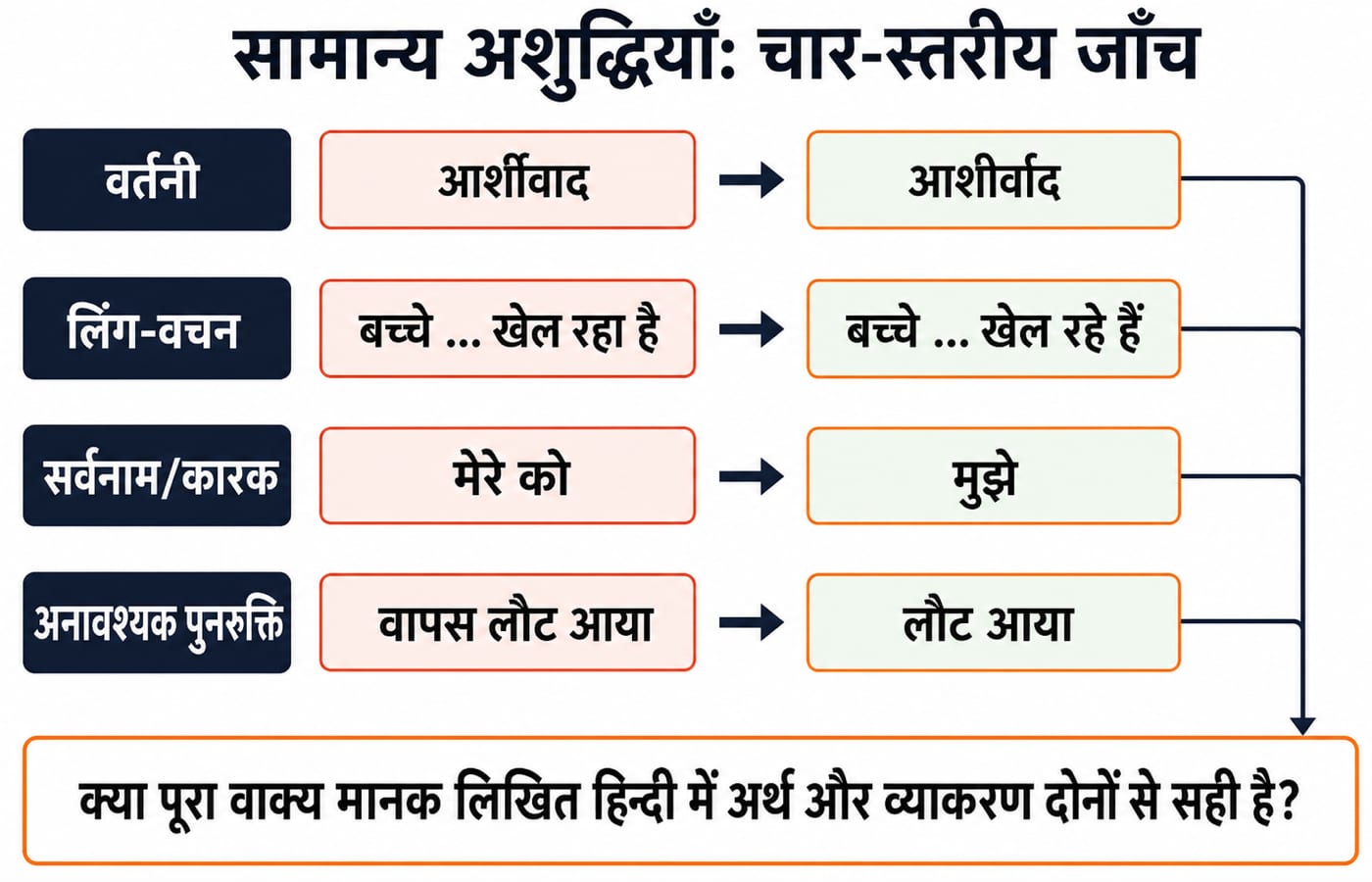
error layer | what to check | अशुद्ध | शुद्ध |
|---|---|---|---|
spelling and letter order | मात्रा, वर्ण-क्रम या संयुक्ताक्षर | आर्शीवाद | आशीर्वाद |
gender or number agreement | संज्ञा और क्रिया का मेल | बच्चे मैदान में खेल रहा है। | बच्चे मैदान में खेल रहे हैं। |
pronoun or case form | सर्वनाम और कारक-चिह्न | मेरे को हिन्दी आती है। | मुझे हिन्दी आती है। |
redundancy | एक ही अर्थ की अनावश्यक पुनरावृत्ति | वह वापस लौट आया। | वह लौट आया। |
Follow the checks in order: the suspicious word itself, the noun's gender and number, the pronoun or postposition, then the verb and any repeated meaning. A sentence can contain more than one error, so do not stop after the first correction.
शब्द-स्तर की अशुद्धियाँ: मात्रा, वर्ण-क्रम और संयुक्ताक्षर
Learn these pairs as whole visual forms, because speech often does not reveal the spelling; each correct form has a reason you can hold onto, such as a sandhi join, a consonant cluster, or a maatra.
अशुद्ध → शुद्ध | changed cluster | why this form is standard |
|---|---|---|
आर्शीवाद → आशीर्वाद | र्शी → शीर् | आशीः + वाद, the visarga hardens to र, so र attaches after शी as शीर्, never before it. |
उज्जवल → उज्ज्वल | ज्जव → ज्ज्व | उत् + ज्वल, त् assimilates to ज, producing the three-part conjunct ज्ज्व. |
स्वास्थ → स्वास्थ्य | स्थ → स्थ्य | It comes from स्वस्थ + य, so the abstract noun must end in स्थ्य, not bare स्थ. |
अत्याधिक → अत्यधिक | त्या → त्य | अति + अधिक, इ + अ fuse to short य, so त्य carries no ा. |
परिक्षा → परीक्षा | रि → री | परि + ईक्षा, the joined vowel is long ई, so the form is परी, not परि. |
पुरुस्कार → पुरस्कार | रुस् → रस् | पुरः + कार, the visarga becomes स before क, and no उ appears after र, producing पुरस्. |
कवियत्री → कवयित्री | विय → वयि | The feminine of कवि is क-व-यि-त्री, with the इ-maatra on य, so the correct form is कवयित्री. |
लिंग-वचन की अशुद्धियाँ: make every agreement link explicit
Agreement questions become simpler when you underline the controlling noun before looking at the verb.
सीता ने तीन पुस्तकें खरीदा।becomesसीता ने तीन पुस्तकें खरीदीं।Hereपुस्तकेंis feminine plural, so the completed-action form isखरीदीं.बच्चे मैदान में खेल रहा है।becomesबच्चे मैदान में खेल रहे हैं।Hereबच्चेis masculine plural, so the verb closes asरहे हैं.पानी ठंडी है।becomesपानी ठंडा है।Hereपानीis masculine singular, soठंडा हैis required.लड़की और लड़का खेल रही है।becomesलड़की और लड़का खेल रहे हैं।In standard written Hindi, this mixed coordinated group is handled as masculine plural, so the verb isरहे हैं.
A common trap is to change only the auxiliary. बच्चे मैदान में खेल रहा हैं। is still wrong. Both parts must agree with बच्चे, giving खेल रहे हैं। Carry the controlling noun's agreement value to every linked word before selecting an option.
सर्वनाम, कारक और आदरसूचक रूप: choose the formal written construction
अशुद्ध | शुद्ध | check |
|---|---|---|
मेरे को हिन्दी आती है। | मुझे हिन्दी आती है। | pronoun plus postposition |
वह मेरे से बड़ा है। | वह मुझसे बड़ा है। | pronoun plus postposition |
आप कहाँ जा रहा है? | आप कहाँ जा रहे हैं? | respectful agreement |
मैंने उससे कहा कि तुम बैठो। | मैंने उससे कहा कि वह बैठे। | person consistency in indirect speech |
मेरे को and मेरे से are common in everyday speech, but a formal correction asks for the standard oblique pronouns मुझे and मुझसे. A regional form is not defective speech; the question simply asks for the standard written register.
आप always takes plural-respect agreement, so both the main verb and the auxiliary go plural: आप कहाँ जा रहे हैं?. Check the referent, the respect level, and then the verb; for example, आप कल आएगा। corrects to आप कल आएँगे।
In indirect speech, the कि-clause must keep the same person the main clause already fixed. In मैंने उससे कहा कि तुम बैठो।, the listener is already third person, shown by उससे, so switching to the second-person तुम बैठो breaks person consistency; the embedded clause stays third person with a subjunctive verb: मैंने उससे कहा कि वह बैठे।
सामान्य अशुद्धियाँ worked example: solve all constraints, not one word
Intended meaning: each learner must write exactly one answer clearly.
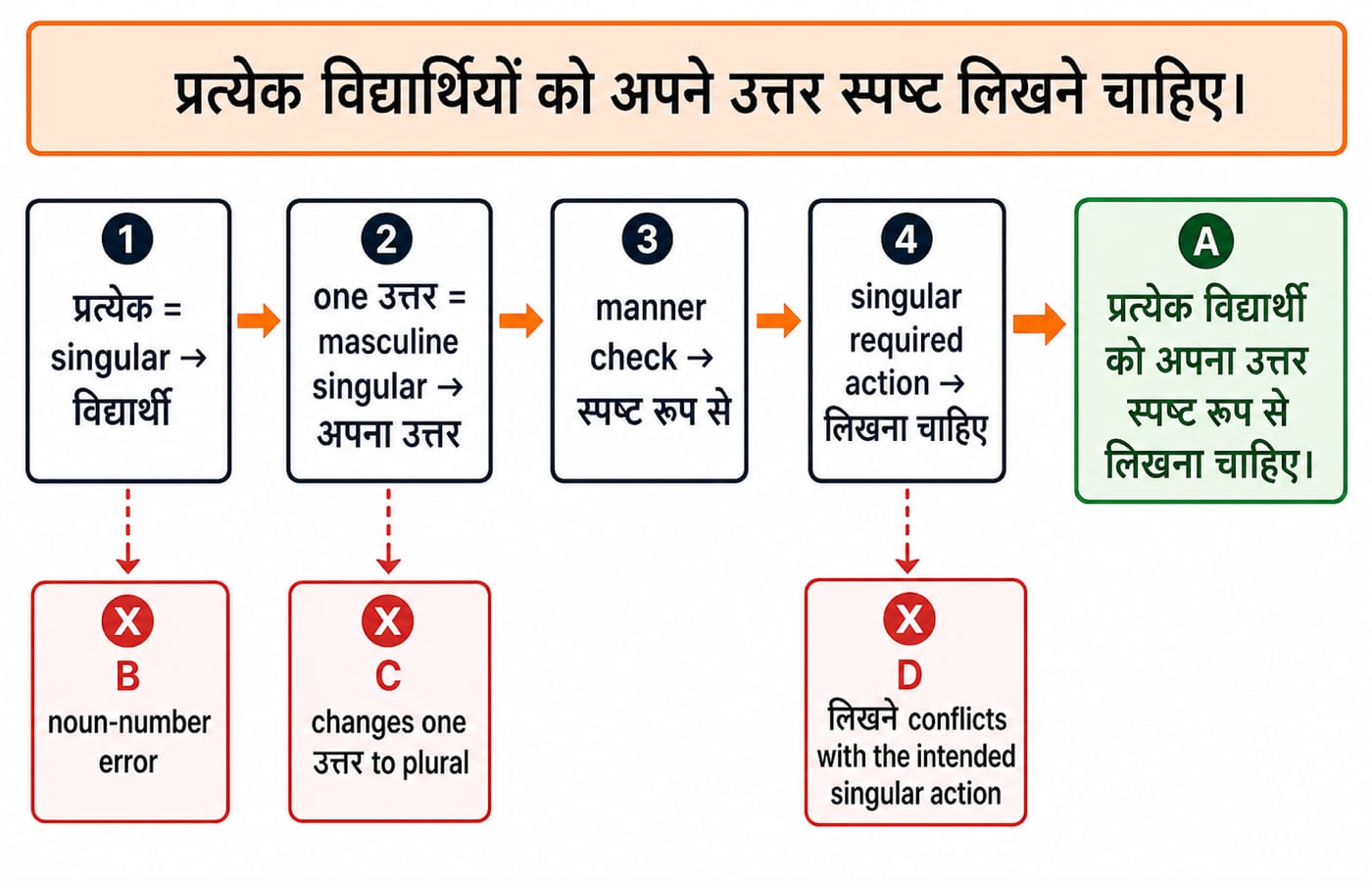
Stem: प्रत्येक विद्यार्थियों को अपने उत्तर स्पष्ट लिखने चाहिए।
(A)
प्रत्येक विद्यार्थी को अपना उत्तर स्पष्ट रूप से लिखना चाहिए।(B)
प्रत्येक विद्यार्थियों को अपना उत्तर स्पष्ट रूप से लिखना चाहिए।(C)
प्रत्येक विद्यार्थी को अपने उत्तर स्पष्ट रूप से लिखने चाहिए।(D)
प्रत्येक विद्यार्थी को अपना उत्तर स्पष्ट रूप से लिखने चाहिए।
Solve it in four passes. First, प्रत्येक imposes a singular distributive reading, so the noun is विद्यार्थी. Second, exactly one masculine singular उत्तर selects अपना उत्तर. Third, the standard adverbial expression is स्पष्ट रूप से. Fourth, the singular required action closes with लिखना चाहिए. Therefore option (A) is correct.
Option (B) keeps the noun-number error प्रत्येक विद्यार्थियों. Option (C) changes the intended one answer into a plural construction. Option (D) keeps लिखने चाहिए, which conflicts with the intended singular action. The correct sentence satisfies all four constraints, not merely the first visible one.
सामान्य अशुद्धियाँ traps: redundancy, context and over-correction
Remove repeated meaning only when both elements do the same job.
कृपया करके बैठिए।becomesकृपया बैठिए।वह वापस लौट आया।becomesवह लौट आया।केवल पाँच छात्र ही आए।becomes eitherकेवल पाँच छात्र आए।orपाँच छात्र ही आए।In a formal correction question, eitherकेवलorहीcan carry the limiting meaning.
Change only the element whose rule fails, then reread the corrected sentence to confirm the meaning. For mixed sets combining संधि, समास, vocabulary and comprehension, use Multi-Topic General Hindi: Worked Set and Trap Guide. In सामान्य अशुद्धियाँ, keep the correction loop to spelling, agreement, pronouns, case forms and redundancy.
Teaching-exam practice: an eight-item diagnostic and evidence-led revision
Give yourself one point for each item.
Choose
आर्शीवाद/आशीर्वाद.Choose
उज्जवल/उज्ज्वल.Choose
स्वास्थ/स्वास्थ्य.Correct
बच्चे मैदान में खेल रहा है।Correct
सीता ने तीन पुस्तकें खरीदा।Correct
मेरे को हिन्दी आती है।Correct
प्रत्येक विद्यार्थियों को अपना उत्तर लिखना चाहिए।Remove the redundant element from
वह वापस लौट आया।
Answer key: (1) आशीर्वाद; (2) उज्ज्वल; (3) स्वास्थ्य; (4) बच्चे मैदान में खेल रहे हैं।; (5) सीता ने तीन पुस्तकें खरीदीं।; (6) मुझे हिन्दी आती है।; (7) प्रत्येक विद्यार्थी को अपना उत्तर लिखना चाहिए।; (8) वह लौट आया।
Interpret the score as evidence:
8/8: revise after 48 hours.
6-7: redo only the missed error types tomorrow.
4-5: rebuild the four-row classification table.
0-3: relearn the word-form, agreement and pronoun sections before another timed set.
Practise three tasks in rotation: select the standard form, correct a sentence, and identify the error layer. For current CTET structure or language-section specifics, consult an already-issued Information Bulletin on the official CTET website. For a wider revision system, use CTET Language I & II: A Scoring Strategy.
सामान्य अशुद्धियाँ short version: build a correction loop
Use one compact loop: word form -> noun gender/number -> pronoun/postposition -> verb and repeated meaning.
Keep a four-column error log, dating each new row.
date | incorrect form | corrected form | reason |
|---|---|---|---|
day 1 | आर्शीवाद | आशीर्वाद | वर्ण-क्रम |
day 1 | बच्चे मैदान में खेल रहा है | बच्चे मैदान में खेल रहे हैं | लिंग-वचन |
day 1 | मेरे को | मुझे | सर्वनाम/कारक |
Log a row only for errors you actually miss, then re-test those exact rows in your next session; the goal is to recognise which constraint controls each correction, not to memorise every sentence.
Primary-level aspirants can continue through CTET Paper 1 Course 2026, a structured path with Paper 1 language coverage, practice questions, and recorded learning; upper-primary aspirants can use CTET Paper 2 Course 2026 for the corresponding Paper 2 coverage.
Keep learning
Universities and Learning Programmes for Teaching Exams: Types, Modes and Solved Examples
Separate university status, delivery mode and programme purpose with a repeatable method, then test it on five UGC NET-style classification cases.
Updated 2 Oct 20265 min readCTET & UPTET

National Education Policy (NEP) 2020 Notes for Teaching Exams: 5+3+3+4, Reforms and MCQ Traps
Build an exam-ready map of NEP 2020, from the age-stage structure to pedagogy, language, PARAKH, B.Ed. routes and reliable distractor elimination.
Updated 26 Sep 20265 min readCTET & UPTET

Miscellaneous Pedagogy Topics for Teaching Exams: Complete Notes and Worked Examples
Turn a loose syllabus label into a five-part concept map, then use classroom evidence to distinguish sound pedagogy from attractive but incomplete options.
Updated 25 Sep 20266 min readCTET & UPTET

Mental Health and Life Skills for Teaching Exams: Complete Notes, Examples and Traps
Revise mental health, ten life skills and counselling approaches through clear contrasts, classroom examples and fast option-elimination rules.
Updated 23 Sep 20265 min readCTET & UPTET