

CTET Eligibility, Paper 1 vs Paper 2, and Lifetime Certificate Validity
Understand which CTET paper matches your teaching goal, how eligibility is verified, and why a lifetime certificate still does not guarantee appointment.
KnowledgeGate Team
Exam prep & CS education
Updated 6 Nov 20264 min read
CTET eligibility, paper choice, certificate validity and recruitment eligibility are four different decisions, but they are often collapsed into one. The relevant qualifications determine whether you may apply, the classes you intend to teach determine whether Paper I, Paper II or both is appropriate, and qualifying CTET does not itself secure a job. The central distinction is simple: CTET is an eligibility test, not a recruitment appointment. The CTET & UPTET Teaching Eligibility Test Prep page is the broader preparation route.
CTET explained: the eligibility test and the job are not the same thing
CBSE conducts the Central Teacher Eligibility Test under the Ministry of Education's mandate, according to the official CTET site. It supplies an eligibility credential for covered appointments, not selection for a vacancy.
The chain is:
Meet the applicable qualification rules.
Qualify the CTET paper for the intended teaching level.
Apply separately when an eligible recruiting body advertises a post.
The recruiting agency then checks its own rules, documents and merit process. CBSE cautions that permission to sit CTET neither verifies eligibility nor creates a right to appointment.
CTET eligibility: who can sit and who finally verifies it
CTET eligibility is not simply "graduation plus B.Ed." CBSE points candidates to NCTE minimum qualifications and the relevant recruitment rules.
Check in this order:
Identify the teaching level and paper.
Match your academic and teacher-training qualifications to the current NCTE rule.
Check the relevant recruitment rules.
Keep documents for the appointing authority's verification.
The teaching level chooses the paper; the qualification route decides whether the application is valid. CTET Eligibility 2026: Qualification Routes and What to Verify Officially details the qualification matrices, B.Ed edge cases and route-specific checks. Paper choice must stay inside the route those checks confirm.
CTET Paper 1 vs Paper 2: choose by the classes you intend to teach
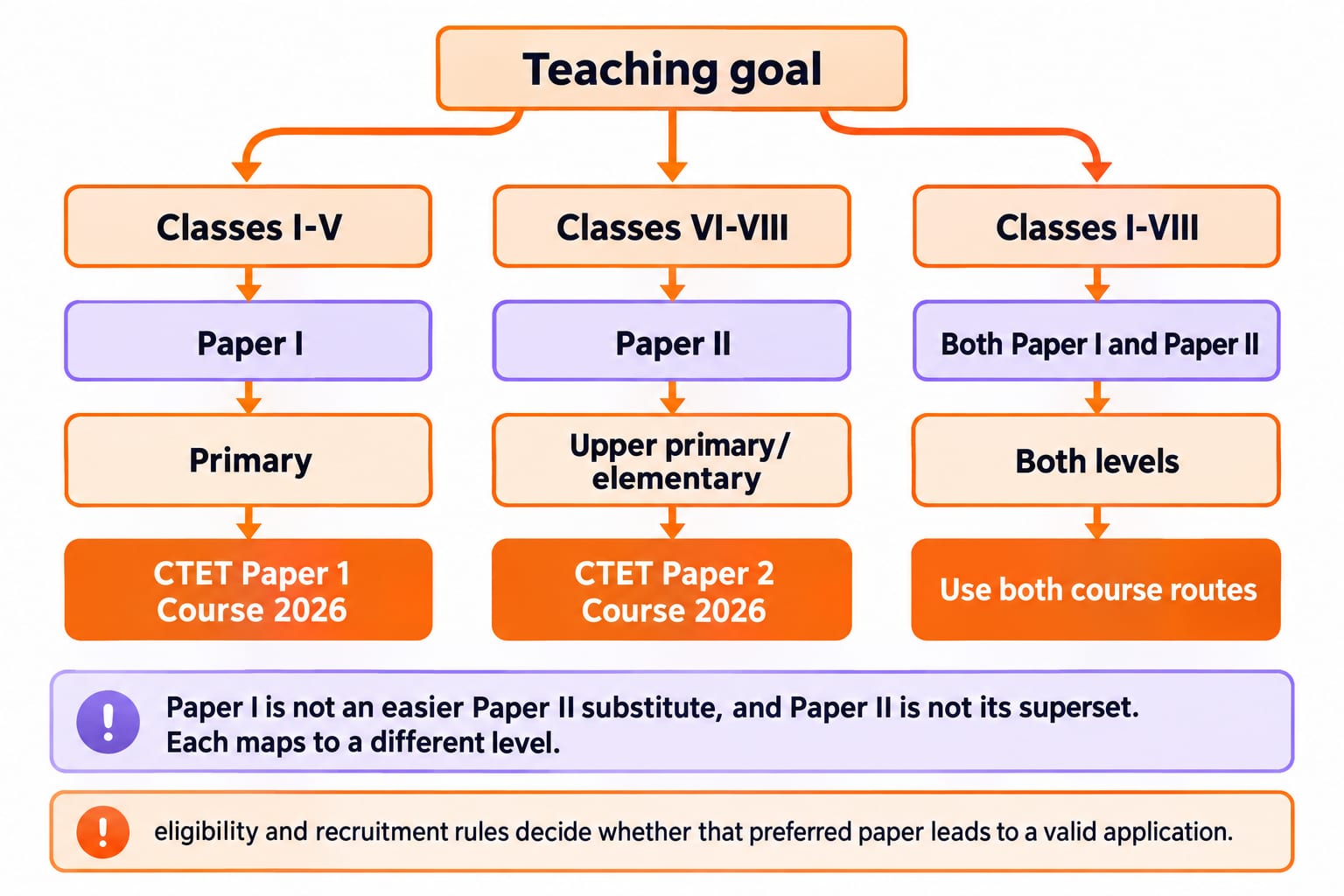
The current CBSE Information Bulletin maps papers to levels as follows:
Teaching goal | Paper | Level | Course route |
|---|---|---|---|
Classes I-V | Paper I | Primary | |
Classes VI-VIII | Paper II | Upper primary/elementary | CTET Paper 2 Course 2026 |
Classes I-VIII | Both Paper I and Paper II | Both levels | Use both course routes |
Paper I is not an easier Paper II substitute, and Paper II is not its superset. Each maps to a different level. CTET Paper 1 vs Paper 2: Which to Attempt compares the detailed syllabus and preparation trade-offs; eligibility and recruitment rules decide whether that preferred paper leads to a valid application.
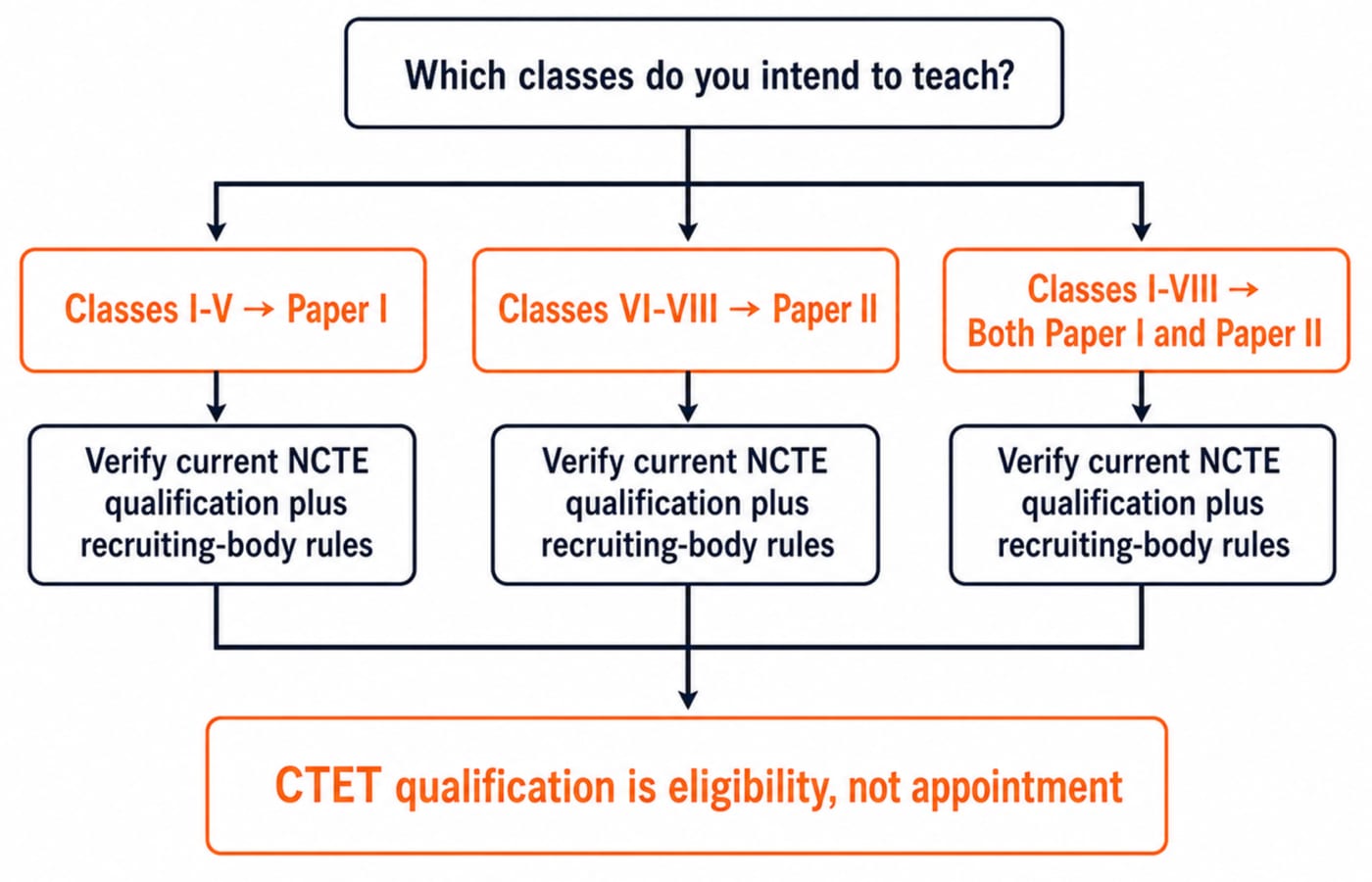
CTET paper-choice examples: follow the teaching goal
Neha targets Class IV in Classes I-V, so she chooses Paper I.
Imran targets Class VII Mathematics in Classes VI-VIII, so he chooses Paper II and its Mathematics and Science route.
Kavya targets Class III and Class VII. They cross both bands, so she needs both papers, subject to each role's qualification and recruitment rules.
Paper I cannot cover Class VII, which belongs to the VI-VIII band. The correction is Paper II, not reinterpreting Paper I. These examples select papers, not academic eligibility.
CTET certificate validity: lifetime does not mean appointment
CBSE's 21 June 2021 notice and current bulletin give the CTET certificate lifetime validity for all categories. The bulletin permits unlimited attempts, including another attempt to improve the score. CTET Qualifying Marks and Certificate Validity details qualifying thresholds, concessions and score-improvement decisions. Lifetime validity answers expiry only; paper coverage and recruitment eligibility remain separate checks.
A candidate who qualified Paper I in 2022 and applies for a Classes I-V vacancy in 2028 still has a valid certificate. The agency nevertheless checks current qualification, category, document and selection rules.
Question | Answer |
|---|---|
Certificate validity | Lifetime |
Paper coverage | Only the level qualified |
Job eligibility | Rechecked against advertised recruitment rules |
Lifetime answers "Is it still valid?" It does not answer "Must I be appointed?"
After qualifying CTET: use the result in the right context
Retain the official marks statement and certificate. Find vacancies matching your level, read the recruiter's rules, and submit the CTET document as one part of the application.
The bulletin describes central-government and other school contexts where CTET applies. State and local recruiters may use their own TET or adopt CTET, so CTET is not sufficient everywhere. Choosing between CTET and a State TET is a separate acceptance question, and neither route overrides the relevant official notification.
CTET eligibility and paper choice: the short version
Check current NCTE and recruiter qualifications.
Classes I-V -> Paper I.
Classes VI-VIII -> Paper II.
Both levels -> both papers.
The certificate has lifetime validity, but appointment requires separate recruitment.
As non-official advice, a Paper II candidate with 12 hours can use 2 hours CDP + 1.5 Language I + 1.5 Language II + 4 subject block + 2 mixed questions + 1 error review = 12. In an 8-hour week, protect 4 hours for the subject block and 1 for review. Split the remaining 3 proportionally: 1.2 CDP + 0.9 Language I + 0.9 Language II = 3 hours.
Use the teaching-eligibility category linked in the opening to reach the course for your paper. If you sit both papers, study common CDP and language work once, then keep distinct subject-practice blocks.
Go deeper with the full courseCTET Paper 1 2026 — प्राथमिक शिक्षक (कक्षा 1–5)
Keep learning
CTET Qualifying Marks and Certificate Validity
Understand the CTET pass threshold, how category concessions are applied, why the certificate lasts for life, and when another attempt is worth taking.
Updated 29 Oct 20265 min readCTET & UPTET
CTET vs State TET: Acceptance, Validity and Which One to Take
Choose CTET, a State TET, or both by checking where each certificate is accepted. Use worked examples to turn your target vacancies into a practical study route.
Updated 9 Nov 20265 min readCTET & UPTET
CTET Syllabus: Paper 1 and Paper 2 Section-by-Section Study Map
Choose the correct CTET paper, map every section into content and pedagogy tasks, and use worked examples plus a seven-day diagnostic to set priorities.
Updated 16 Nov 20265 min readCTET & UPTET
CTET Syllabus 2026 Decoded: Paper 1 and Paper 2 Subject-wise Topics and Weightage
The CTET 2026 syllabus decoded subject by subject: Paper 1 and Paper 2 section structure, subject-wise topics, and the pedagogy vs content mark split, mapped to the official CBSE bulletin and to our course coverage.
Updated 29 Oct 20264 min readCTET & UPTET