Child Development for Teaching Exams: CTET and TET Pedagogy Notes with Examples
Build a usable concept map of child development, then apply it to classroom evidence through examples, assessment choices and a worked fraction case.
KnowledgeGate Team
Exam prep & CS education
Updated 9 Sep 20266 min read57 views

Aspirants often memorise Piaget, Vygotsky and development principles, then lose marks when the ideas become a classroom situation. Moving from behaviour to a defensible pedagogical response involves using a compact concept map and applying it to a worked case. Child Development and Pedagogy is named directly in CTET and TET-style syllabi. UGC NET and individual recruitments may test adjacent Teaching Aptitude, but their notifications are not interchangeable, as this UGC NET Paper 1 versus Paper 2 guide explains.
1. Growth, development and learning: build the base
Growth mainly describes quantitative physical change. Development is broader change in physical, cognitive, language, emotional and social functioning. Suppose an observation record shows a nine-year-old moving from 128 cm to 132 cm in height, from 42 to 63 correctly read words per minute, and from identifying 1 to 3 key ideas in a passage. The height change illustrates growth; the reading changes illustrate development and learning. These are observations, not universal milestones.
Development is continuous and broadly sequential. Responses often move from general to specific, but children and domains progress at different rates. The domains also interact. Maturation may create readiness, while opportunity, practice, feedback and social interaction shape what a learner can currently do.
2. Piaget, Vygotsky and Kohlberg as classroom decision lenses
Lens | Core construct | Classroom clue | Useful teacher response | Common trap |
|---|---|---|---|---|
Piaget | Conservation | Two rows have 6 counters each. One is spread from 12 cm to 24 cm, and the learner says it has more. | Count, rearrange and compare concrete materials. | Treating an age band as a diagnosis. |
Vygotsky | Zone of proximal development, social interaction and scaffolding | A more knowledgeable other gives 3 prompts; the learner succeeds after prompt 2. | Remove prompts on a parallel task and check independence. | Giving help without fading it. |
Kohlberg | Reasoning behind a moral choice | “I will share so the teacher does not punish me” differs from “I will share because equal turns make the rule fair.” | Ask why the learner chose the action. | Judging reasoning from the visible action alone. |
Piaget highlights manipulation, Vygotsky supported participation and fading help, and Kohlberg the reason behind a choice. They are tools, not rigid labels or complete accounts of every child.
3. Heredity, environment and socialisation work together
Development is not a contest between heredity and environment. Biological dispositions interact with nutrition and health, language exposure, relationships, teaching opportunities and the wider cultural setting. One factor never justifies an inference of fixed ability.
Socialisation also has several agents. Parents or caregivers shape home language practices. Peers develop negotiation during group work. Teachers influence confidence through feedback. Communities shape expectations about participation. These influences can reinforce or constrain one another. Two children of the same age may need different entry points towards the same learning goal. The goal can remain common while the route varies. In an exam scenario, first gather evidence and adjust support before attaching a label.
4. Intelligence, language, gender and inclusion
Intelligence is multidimensional and responsive to context, not a permanent label from one performance. A multilingual learner may understand a concept before expressing it fluently in the test language, so language output alone cannot establish understanding.
Bias must be tested against evidence. If a teacher runs 10 tool demonstrations but calls boys 8 times and girls 2 times, the correction is to rotate demonstrator, recorder and reporter roles, then track participation. It is not to claim an innate interest difference.
Equality gives everyone the same provision; equity adjusts access. A visual model, extra processing time or a peer-supported first attempt can improve access without lowering the objective. Inclusion is more than physical placement, and one error cannot diagnose a disability. Formal identification needs appropriate evidence and process. General child-development principles guide access, while subject pedagogy determines the teaching representation.
5. Learning, motivation, errors and assessment
Child-centred teaching assumes that learners construct meaning, learn socially and bring prior conceptions. An error can reveal the current model and guide the next explanation. Passive copying or punishment-first responses hide that evidence.
Assessment for learning changes ongoing teaching. A 5-item exit ticket used tomorrow to regroup learners and reteach one misconception is formative. Assessment of learning records achievement, such as a 20-item end-unit test. Item count does not decide the category; the purpose and use of evidence do.
Motivation and emotion affect participation. Specific feedback such as “your denominator model is correct; now compare the numerators” points to a next action. Ability labels such as “smart” or “weak” do not.
6. Worked classroom case: from 2/7 to independent fraction addition
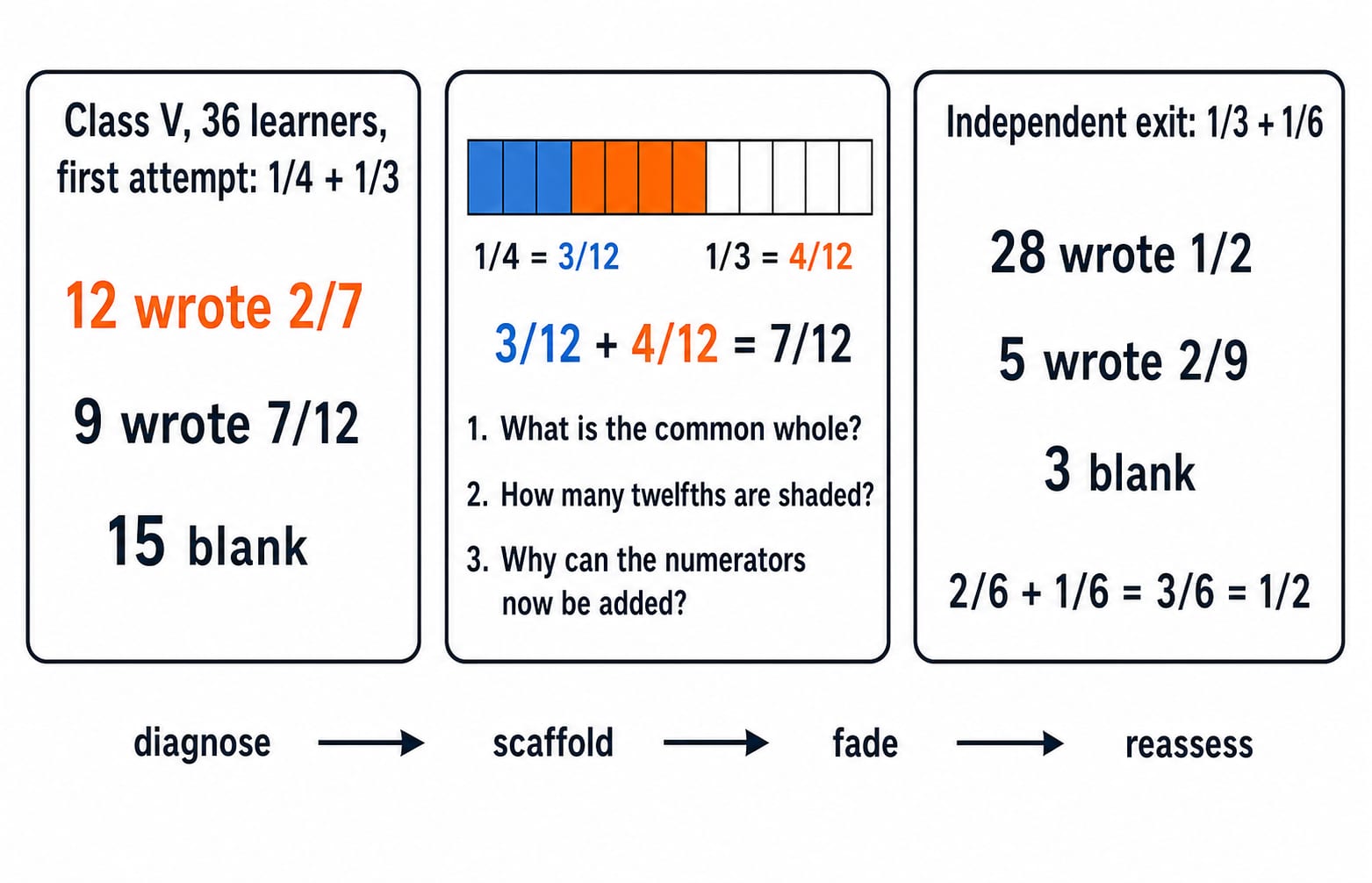
In Class V, 36 learners first answer 1/4 + 1/3 = ?. Twelve write 2/7, 9 write 7/12, and 15 leave it blank. The three groups total 36. The 2/7 response is evidence of a rule, add numerator to numerator and denominator to denominator, not evidence of laziness.
Working in pairs, learners take a 12-cell strip. They convert 1/4 = 3/12 and 1/3 = 4/12, shade 3 cells blue and 4 orange, then combine them: 3/12 + 4/12 = 7/12. The teacher asks 3 prompts: “What common-sized parts do we need?”, “How many twelfths does each fraction make?”, and “What does the numerator count now?” The strip supports concrete representation, pair talk supports social learning, and the prompts provide scaffolding and formative evidence.
The strip is then removed for 1/3 + 1/6 = ?. Twenty-eight learners write 1/2, 5 write 2/9, and 3 leave it blank, again totalling 36. Check the answer: 1/3 = 2/6, so 2/6 + 1/6 = 3/6 = 1/2. The movement from 9 correct initial responses to 28 correct exit responses informs the next teaching decision. It does not prove permanent mastery for every learner.
7. How teaching exams turn the concepts into questions
The official CBSE CTET February 2026 Information Bulletin specified Child Development and Pedagogy as compulsory in both papers, with 30 MCQs carrying 30 marks in each. It described Paper I items for ages 6 to 11 and Paper II for ages 11 to 14, including diverse learners, interaction and facilitation. The syllabus grouped the area into Child Development, Inclusive Education, and Learning and Pedagogy. Confirm the current bulletin for your cycle.
Questions may ask for a principle, theory match, child-centred response, assessment purpose or rejection of a deterministic claim. For 2/7, elicit the learner's rule and use equivalent-fraction representations rather than repeat or punish.
State TET, NET and recruitment patterns vary. Classify every miss as a concept, scenario-reading or response-choice error, then use a teaching-exam mock test strategy to correct it. For recruitment preparation including Teaching Aptitude and Pedagogy, the DSSSB Section A course is a relevant route.
8. High-frequency traps, the short version and the next step
Trap: growth equals development. Correction: growth is mainly quantitative physical change; development spans several interacting domains.
Trap: rigid stage-age cut-offs. Correction: use stages as broad patterns, then examine the learner’s actual evidence.
Trap: heredity versus environment. Correction: treat biological dispositions and experience as interacting influences.
Trap: fixed intelligence. Correction: interpret performance in context and seek evidence across tasks.
Trap: equality equals equity. Correction: keep the learning goal while adjusting access and support.
Trap: error equals carelessness. Correction: infer the learner’s current rule before choosing the next representation.
Trap: punishment first. Correction: diagnose, scaffold and reassess independently.
Trap: format determines purpose. Correction: classify assessment by how the evidence is used, not by item count.
Trap: inclusion lowers goals. Correction: change the route or support, not the objective.
Use one revision rule: Observe the evidence -> identify the developmental or learning principle -> choose the least labelling, most diagnostic and supportive teacher action -> reassess independently.
Turn each theory into a classroom clue and teacher action, then practise. Use NTA UGC NET Paper 1 for adjacent Teaching Aptitude and Govt Teaching Jobs to compare recruitments.
Keep learning

सामान्य अशुद्धियाँ (Samanya Ashuddhiyaan): Complete Hindi Grammar Notes for CTET and TET Exams
Learn to identify and correct Hindi word-form, agreement, pronoun and redundancy errors through exact examples, a worked MCQ and a scored diagnostic.
Updated 6 Oct 20266 min readCTET & UPTET

Universities and Learning Programmes for Teaching Exams: Types, Modes and Solved Examples
Separate university status, delivery mode and programme purpose with a repeatable method, then test it on five UGC NET-style classification cases.
Updated 2 Oct 20265 min readCTET & UPTET

National Education Policy (NEP) 2020 Notes for Teaching Exams: 5+3+3+4, Reforms and MCQ Traps
Build an exam-ready map of NEP 2020, from the age-stage structure to pedagogy, language, PARAKH, B.Ed. routes and reliable distractor elimination.
Updated 26 Sep 20265 min readCTET & UPTET

Miscellaneous Pedagogy Topics for Teaching Exams: Complete Notes and Worked Examples
Turn a loose syllabus label into a five-part concept map, then use classroom evidence to distinguish sound pedagogy from attractive but incomplete options.
Updated 25 Sep 20266 min readCTET & UPTET