

B.Ed Entrance Exam Syllabus and Pattern: An 8-Week Phased Plan
Build a B.Ed entrance plan around your state's active bulletin, then use a worked diagnostic and a 96-hour schedule to turn weak areas into weekly study decisions.
KnowledgeGate Team
Exam prep & CS education
Updated 4 Nov 20265 min read
“B.Ed entrance exam” does not mean one uniform paper. A generic syllabus list can make you prepare the wrong section or practise with the wrong marking assumptions. The safer approach is to extract your active pattern, diagnose four recurring skill baskets, and complete a realistic eight-week, 96-hour plan. Your state's active official bulletin controls every exact section, question count, time limit, scoring rule, and language choice.
1. B.Ed Entrance Exam Syllabus: Build a State-Specific Source Sheet
Keep only bulletin-named baskets. Teaching aptitude covers classroom judgement and teaching-learning. Reasoning or mental ability can include series, analogy, coding, and arrangements. Language covers comprehension, grammar, and vocabulary. General knowledge or current awareness needs static and current revision. Add areas only when the bulletin names them.
Create a source sheet with these columns:
State or exam | Conducting authority | Active bulletin date | Section names exactly as printed | Questions or marks | Duration | Marking or penalty | Medium | Checked on |
|---|---|---|---|---|---|---|---|---|
Your target | Verify | Verify | Verify | Verify | Verify | Verify | Verify | Date checked |
Use the current official bulletin first, official corrigenda second, and preparation resources only for learning and practice. A blank cell means “verify”, never “copy another state's value”.
2. B.Ed Entrance Exam Pattern: Translate the Bulletin Into Preparation Decisions
Turn a verified row into action. Named sections define your buckets. The official time limit sets simulation length. A notified penalty means you must track attempted accuracy, while the official medium tells you which language version to practise.
Keep a pattern card:
Field | Your verified value |
|---|---|
My exam | [fill from bulletin] |
Official notice date | [verify] |
Sections | [copy exactly] |
Total questions and total time | [verify] |
Marks per correct and penalty per wrong | [verify] |
Language | [verify] |
Last rechecked | [date] |
Use the 60-question diagnostic and 80-question sets as training units, then scale both to the sections and timing in your bulletin.
3. B.Ed Entrance Diagnostic: A Fully Worked 60-Question Audit
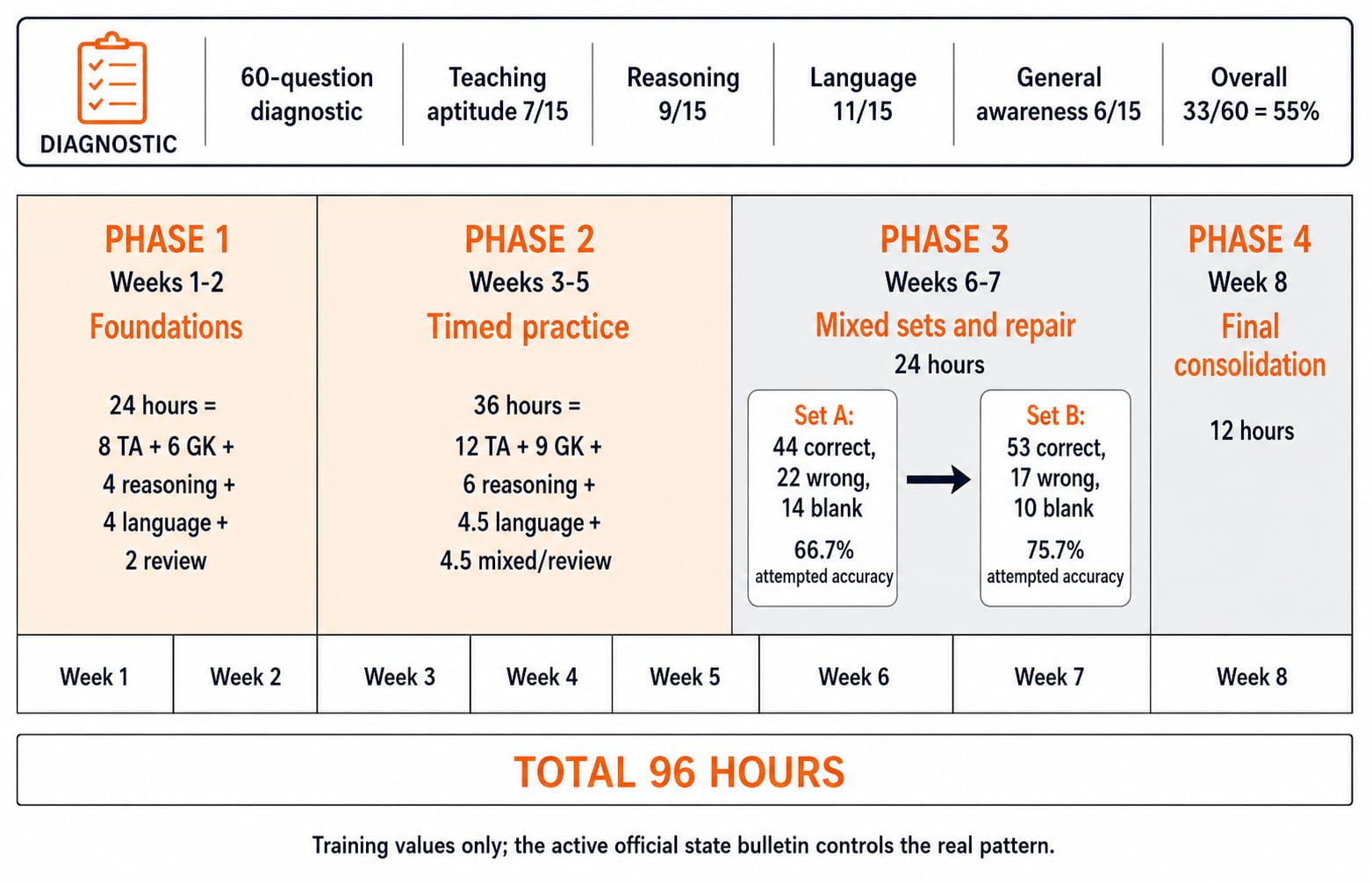
Begin with 15 training questions in each basket. Suppose the result is teaching aptitude: 7 correct, 6 wrong, 2 blank; reasoning: 9 correct, 4 wrong, 2 blank; language: 11 correct, 3 wrong, 1 blank; and general awareness: 6 correct, 5 wrong, 4 blank.
The totals are 33 correct + 18 wrong + 9 blank = 60. Correct rates are:
Teaching aptitude: 7/15 = 46.7%
Reasoning: 9/15 = 60%
Language: 11/15 = 73.3%
General awareness: 6/15 = 40%
Overall: 33/60 = 55%
Do not convert these results into marks without your official scoring rule. For the first 12-hour week, protect 4 hours for teaching aptitude, give the weakest general-awareness basket 3 hours, reasoning 2 hours, language 1.5 hours, and error review 1.5 hours. Use Aptitude for Placements: A 30-Day Practice Routine only as a transferable daily-practice model.
4. B.Ed Entrance Plan, Weeks 1-2: Build Foundations in 24 Hours
Study 12 hours per week for two weeks, so 12 x 2 = 24 hours. Allocate 8 hours to teaching aptitude, 6 to general awareness, 4 to reasoning, 4 to language, and 2 to error-log repair. The check is 8 + 6 + 4 + 4 + 2 = 24.
Produce something testable from every block. Make a one-page teaching-aptitude map of learner, teacher, methods, assessment, and classroom-situation cues. Group solved reasoning examples by question family. Build a comprehension error sheet plus grammar and vocabulary cards. For general awareness, maintain a static-topic checklist and dated current-notes page. End each block with five closed-book questions and explain why every wrong option is wrong.
The Aptitude Courses for Exams & Placements category supports overlapping aptitude practice, while teaching aptitude and general awareness remain separate B.Ed study blocks.
5. B.Ed Entrance Plan, Weeks 3-5: Convert Concepts Into Timed Practice
Across three weeks, 12 hours per week x 3 = 36 hours. Each week gets 4 hours for teaching aptitude, 3 for general awareness, 2 for reasoning, 1.5 for language, and 1.5 for mixed practice and review. Across the phase, that is 12 + 9 + 6 + 4.5 + 4.5 = 36 hours.
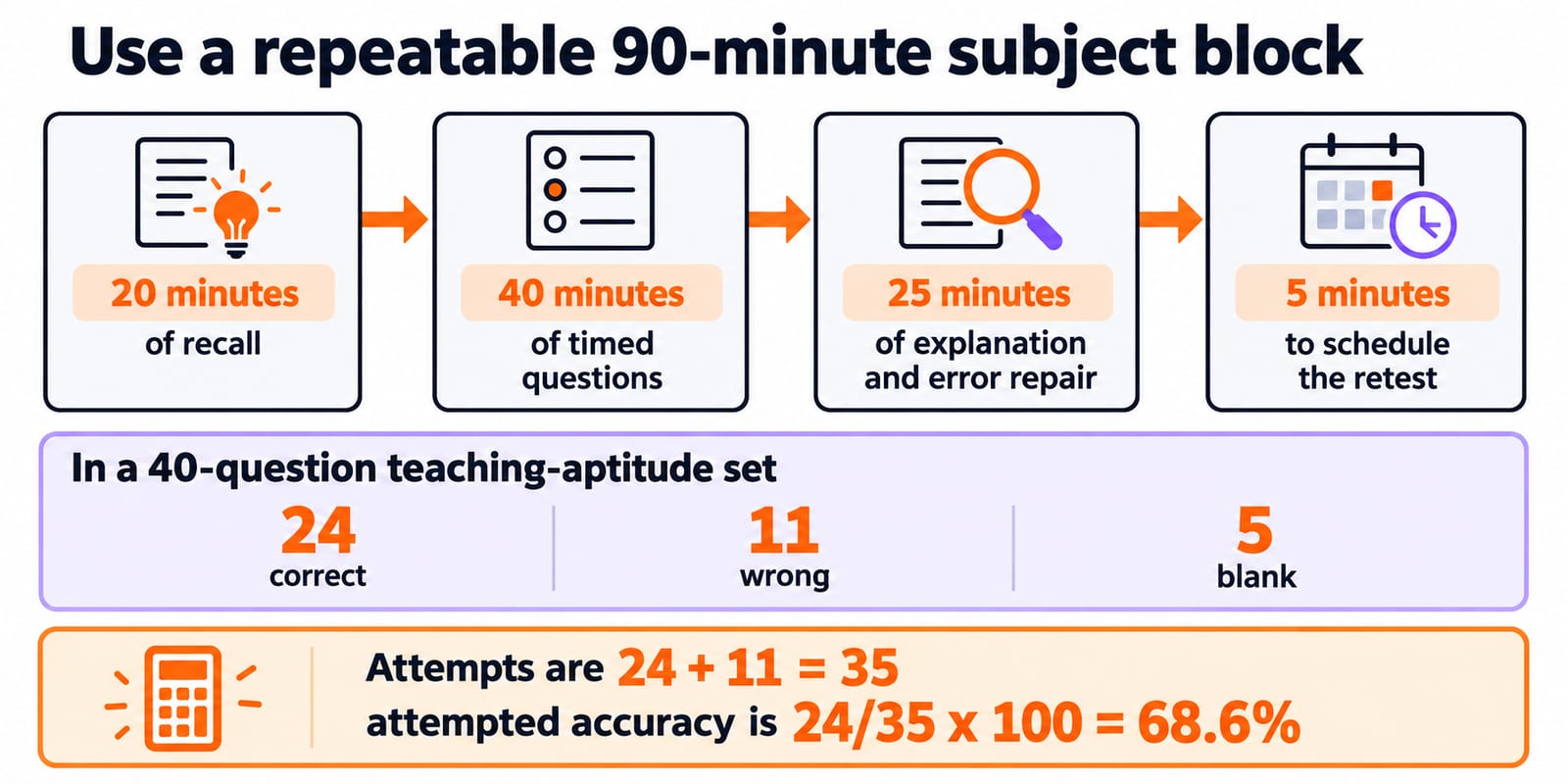
Use a repeatable 90-minute subject block: 20 minutes of recall, 40 minutes of timed questions, 25 minutes of explanation and error repair, then 5 minutes to schedule the retest. In a 40-question teaching-aptitude set, suppose you get 24 correct, 11 wrong, and 5 blank. Attempts are 24 + 11 = 35, so attempted accuracy is 24/35 x 100 = 68.6%. Next, explain why those 11 distractors looked plausible, not merely add another set.
CTET Language I & II: A Scoring Strategy provides comprehension and language-practice mechanics. Set the duration, section order and scoring from your B.Ed bulletin.
6. B.Ed Entrance Plan, Weeks 6-7: Mixed Sets, Accuracy and Error Repair
Weekly: 12 hours. Two 80-question mixed sets at 90 minutes each take 3 hours; analysis 3; teaching-aptitude repair 2; general-awareness repair 1.5; reasoning repair 1; language repair 1; spaced retest 0.5. That is 3 + 3 + 2 + 1.5 + 1 + 1 + 0.5 = 12 hours, and 24 across two weeks. Resize the sets and timing whenever your bulletin uses a different pattern.
Set A gives 44 correct + 22 wrong + 14 blank = 80. Attempts are 44 + 22 = 66, attempted accuracy is 44/66 = 66.7%, and correct rate is 44/80 = 55%. For Set B, 53 correct + 17 wrong + 10 blank = 80. Attempts are 70, attempted accuracy is 53/70 = 75.7%, and correct rate is 53/80 = 66.25%. The gain is nine more correct with five fewer wrong, not a guessed cutoff.
Use CTET Mock Test Strategy That Raises Scores for its error-analysis loop, then rebuild the set length and timing from your B.Ed bulletin.
7. B.Ed Entrance Plan, Week 8: Consolidate and Recover Missed Days
The final 12 hours include two 80-question mixed simulations at 90 minutes each, using 3 hours. Written analysis takes 3, repair of the two largest error buckets takes 3, and language plus general-awareness rapid revision takes 2. Use 1 hour to recheck the active bulletin, corrigenda, and exam-day instructions. The total is 3 + 3 + 3 + 2 + 1 = 12 hours.
If you miss one 90-minute block, split it into three 30-minute repair blocks over the next three study days. Do not double the next day.
After a lost week, use an 84-hour rescue plan = 20 foundation + 30 timed-practice + 22 mixed-set and repair + 12 final-consolidation hours. Remove repeated note-making and extra untimed drills first. Preserve error analysis, spaced retests, teaching-aptitude practice, and the final official-source check.
8. B.Ed Entrance Exam Preparation: The Short Version and Next Step
Identify the exact state exam.
Read its active official bulletin.
Copy its real sections and marking rules.
Run the 60-question diagnostic.
Complete the 24 + 36 + 24 + 12 = 96-hour plan.
Change allocation only when section evidence improves.
Match practice-set sizes to the verified sections and timing on your pattern card. For organised quantitative aptitude, reasoning, and verbal-ability practice, use Aptitude Course for Placement. You still need your own B.Ed bulletin, teaching-aptitude preparation, general-awareness work, and B.Ed-pattern mocks.
Go deeper with the full courseCTET Paper 1 2026 — प्राथमिक शिक्षक (कक्षा 1–5)
Keep learning
UP TGT English Preparation: A 12-Week Plan for Working Aspirants
Fit literature, grammar and mock review around your working week. Use a diagnostic, a recovery slot and clear adjustment rules to build a sustainable English preparation routine.
Updated 30 Oct 20265 min readGovt Exam Strategy
MCA Entrance Logical Reasoning: A 6-Week Speed-Building Practice Plan
Build reasoning speed without rushing accuracy. This six-week plan moves from a measured baseline to pattern cards, mixed drills, error repair and missed-day recovery.
Updated 30 Oct 20267 min readMCA Entrance

CTET Eligibility for Engineering Graduates: B.Tech, B.Ed and D.El.Ed Rules
A B.Tech is only one part of a CTET qualification route. See how B.Ed, D.El.Ed, graduation and post-graduation marks affect Paper I and Paper II.
Updated 12 Nov 20264 min readCTET & UPTET

CG Pre B.Ed Exam: Eligibility, Paper Pattern and College Allotment
Check how qualification marks affect eligibility for the two-year B.Ed route, understand the paper's five sections, and see why merit rank and college choices both matter during allotment.
Updated 29 Oct 20264 min readGovt Exam Strategy