

Factors Affecting Teaching for Teaching Exams: Complete Notes and Worked Classroom Example
Learn to classify teacher, learner, material, method, classroom and wider-context factors, then apply them to a complete classroom diagnosis.
KnowledgeGate Team
Exam prep & CS education
Updated 1 Nov 20265 min read

Teacher, learner and environment factors look easy. Scenarios mix them and demand a direct cause or best response. For CTET and UPTET preparation, classify the factor, diagnose the cause, and choose the response through the Govt Teaching Eligibility Tests category.
Meaning of Factors Affecting Teaching
A factor changes teaching’s planning, delivery, reception or evaluation. Conditions can help, but good teachers, motivated learners and suitable materials never guarantee learning.
Use six groups: teacher, learner, content and material, method and facilities, classroom environment, and institutional plus wider context. Labels may differ. Follow the clue and the nearest decision it changes. Weak explanation concerns the teacher; missing prerequisites, the learner; an unreadable diagram, material; unavailable equipment, facilities; fear of ridicule, climate; and no practice period, the institution.
Teacher-Related Factors: Knowledge, Pedagogy and Disposition
Content knowledge supports accuracy. Pedagogy shapes sequencing, questioning, assessment and remediation. Communication governs the language, pace and representations learners meet. Subject expertise alone can still miss a misconception.
Planning, experience, reflection, motivation, expectations, fairness, emotional regulation and adaptability also matter. Experience becomes expertise when tested against learner evidence. If 18 of 40 learners write 24 for both perimeter and area, replace the label “careless” with a task: trace the boundary and cover the surface. Their work reveals the confusion and guides the next representation.
Learner-Related Factors: Readiness, Prior Knowledge and Motivation
Learner factors include prior knowledge, readiness, language, attention, health, confidence, interest, motivation, pace, learning needs and practice. One response shows present performance, not ability.
Curiosity, relevance and competence can sustain intrinsic motivation; feedback, recognition or a goal can initiate effort. Choose support that builds participation and self-regulation. Language background, disability or socio-economic context may indicate an access need, never a fixed ceiling.
Content, Support Material, Method and Facilities
Content varies in difficulty, abstraction, relevance, accuracy, sequence and prerequisite load. Compare a formula alone with a path from boundary and surface, to a grid, then to P = 2(l + b) and A = l × b. The concept stays the same; its teachability changes.
Examples, texts, diagrams, manipulatives, language, questions, discussion, demonstration, practice and feedback shape access. Material must be accurate, legible, age-appropriate and aligned with the objective.
Facilities include time, class size, seating, light, ventilation, boards, connectivity, devices and laboratory access. Ten tile kits for 40 learners allow 40 ÷ 10 = 4 per kit, or ten groups of four. Task, roles, observation and follow-up still matter. Technology is a condition, not a method.
Classroom Climate, Institution and the Wider Context
Climate covers comfort, noise, peer relations, expectations, safety and reasoned mistakes. Silence may show concentration or fear; check evidence.
Institutional factors include leadership, timetable, workload, curriculum, assessment policy, professional support, maintenance and family/specialist coordination. Compare a 35-minute period with materials ready against one losing its first 10 minutes to locating them. The second leaves 35 - 10 = 25 teaching minutes.
Language, experience, nutrition, study time and home or community support shape access. Background is not destiny. Remove barriers and vary access routes without lowering the goal.
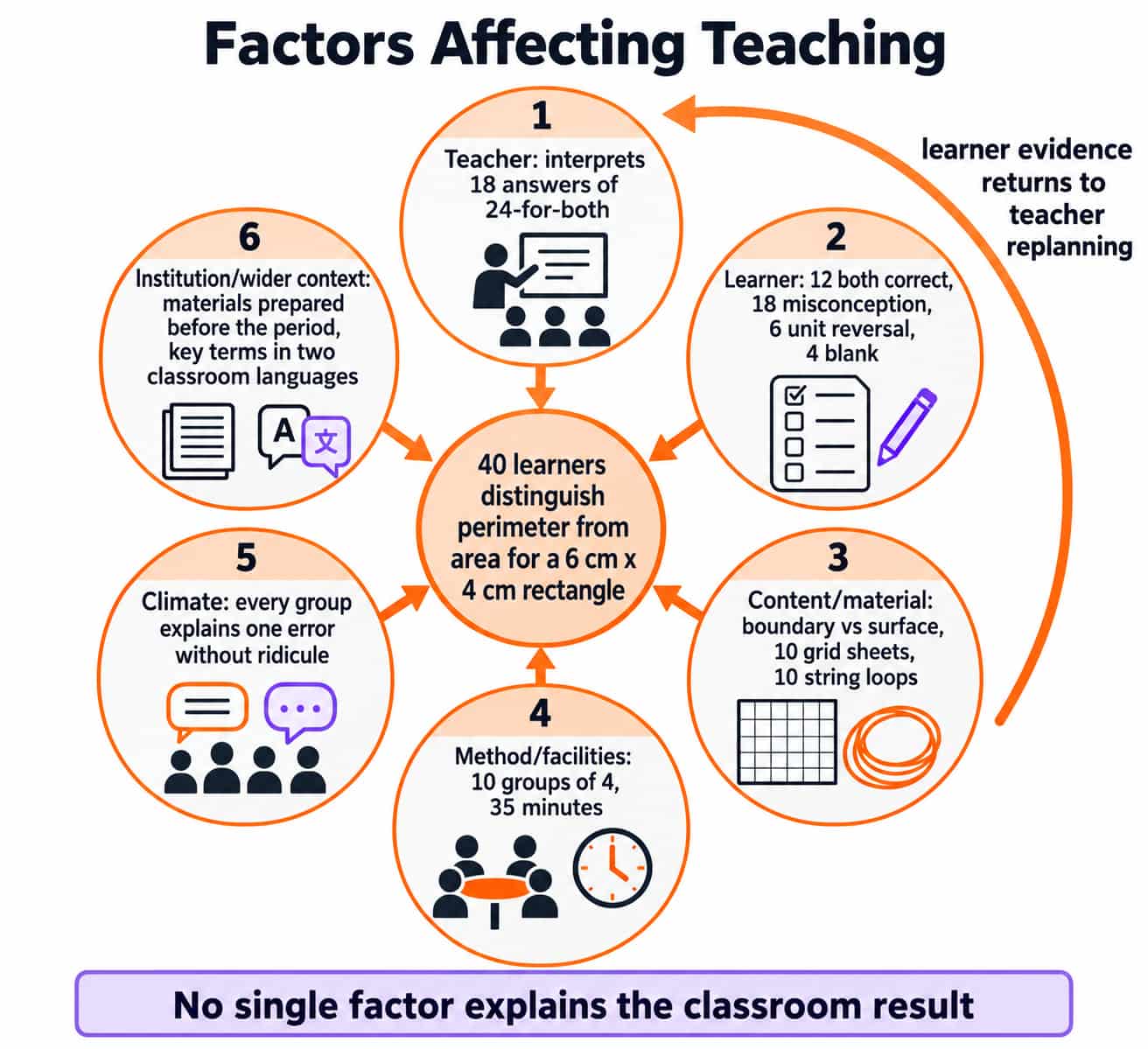
Fully Worked Example: Perimeter and Area in a Class of 40
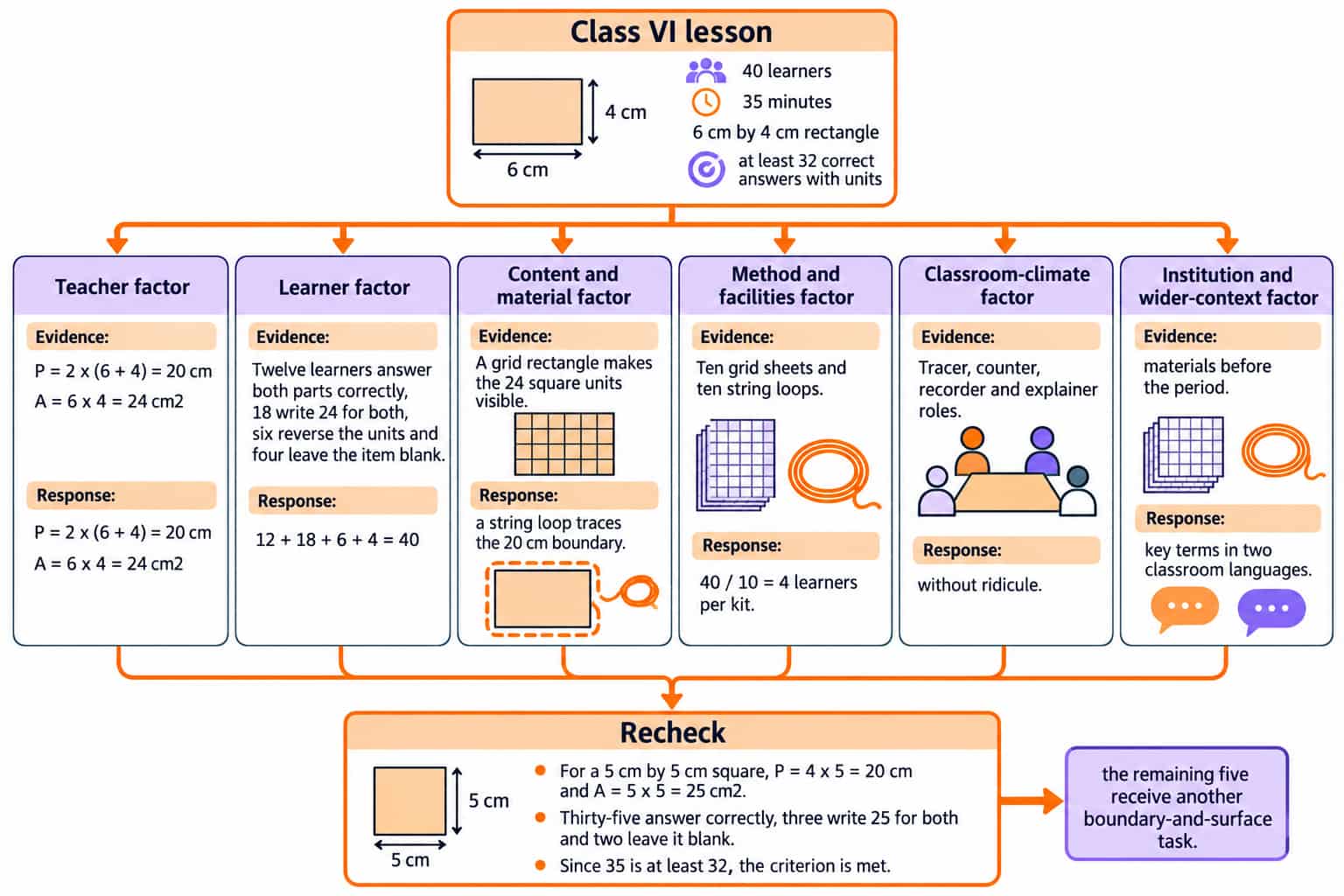
In a Class VI lesson, 40 learners have 35 minutes to distinguish perimeter from area for a 6 cm by 4 cm rectangle. The success criterion is at least 32 correct answers with units.
Teacher factor: The teacher checks the work before choosing a response. For the rectangle, P = 2 x (6 + 4) = 20 cm and A = 6 x 4 = 24 cm2. Repeating the formula would not address the observed confusion.
Learner factor: Twelve learners answer both parts correctly, 18 write 24 for both, six reverse the units and four leave the item blank. The total is 12 + 18 + 6 + 4 = 40. The pattern shows current understanding, not fixed ability.
Content and material factor: A grid rectangle makes the 24 square units visible, while a string loop traces the 20 cm boundary. The contrast connects surface, boundary, cm and cm2 to the symbols A and P.
Method and facilities factor: Ten grid sheets and ten string loops allow 40 / 10 = 4 learners per kit. Each group traces, covers, records and explains, so the materials support a defined learning action.
Classroom-climate factor: Tracer, counter, recorder and explainer roles keep all four learners involved. Each group explains one error without ridicule, which makes misconception evidence safe to share.
Institution and wider-context factor: The teacher places materials before the period and supplies the key terms in two classroom languages. Preparation protects the 35-minute lesson, while language support removes an access barrier without lowering the goal.
Recheck and next decision: For a 5 cm by 5 cm square, P = 4 x 5 = 20 cm and A = 5 x 5 = 25 cm2. Thirty-five answer correctly, three write 25 for both and two leave it blank. Since 35 is at least 32, the criterion is met; the remaining five receive another boundary-and-surface task.
No single factor explains the classroom result. The worked diagnosis links learner evidence to teacher interpretation, representation, grouping, climate, preparation and follow-up.
How Teaching Exams Turn Factors Into Questions and Traps
Three shapes recur, though no official list defines them: direct classification, scenario diagnosis and best response. Find the category, nearest factor, then an evidence-based response preserving dignity and the goal.
Eighteen area-for-both answers indicate a misconception; contrast boundary with surface. Locked tile kits indicate facilities or institutional access, not motivation. Repeating the formula after seeing the error indicates weak pedagogical diagnosis and adaptation.
Trap | Why it fails | Better test |
|---|---|---|
Qualification guarantees teaching | Knowledge alone is insufficient | What evidence guided the response? |
Poor score proves low ability | Conditions affect performance | Which barrier is visible? |
Technology guarantees engagement | Availability is not pedagogy | What task does it support? |
Silence proves healthy climate | Silence can signal fear | Is participation safe? |
Background fixes the ceiling | Context signals access needs | Which barrier can be removed? |
One factor explains everything | Factors interact | Which factor changes the nearest decision? |
Use Teaching Methods and Strategies for Teaching Exams when the question is which method to choose and sequence. Use Nature, Objectives and Characteristics of Teaching when it asks what teaching is, which outcome it seeks or which characteristics are visible. Here the task is narrower: identify which of six conditions changed the nearest teaching decision. Use current official material for exact sections, marks and question counts.
Quick Revision and the Next Study Step
Revise: teacher → learner → content/material → method/facilities → classroom climate → institution/wider context. Ask: What is described? What evidence exists? Which decision changes first? What respectful action addresses the barrier? What evidence shows whether it worked?
Use the factors-affecting-teaching questions in KnowledgeGate's teaching-aptitude practice area for drill, not as a guide to official weightage. Classify the clue, then reject the less direct categories.
Choose the CTET Paper 1 course for primary-level preparation or the CTET Paper 2 course for upper-primary preparation, according to your intended teaching level and current official eligibility requirements.
Go deeper with the full courseCTET Paper 1 2026 — प्राथमिक शिक्षक (कक्षा 1–5)
Keep learning

Physical Security Assets and Risk Factors: Worked Audit, Controls and Exam Traps
Follow a fictional college server-room audit from asset inventory to residual risk. Calculate four priorities, test power continuity, and avoid common exam traps.
Updated 6 Nov 20266 min readUGC NET Computer Science

Principles of English Language Teaching: CTET Notes with Classroom Examples
Turn language-teaching principles into classroom decisions. Follow a library timetable lesson, understand purposeful error correction, and practise matching an activity to its learning objective.
Updated 18 Nov 20265 min readCTET & UPTET

Inclusive Education and Special Needs for Teaching Exams: Concepts, Classroom Cases and MCQ Traps
Learn to separate inclusion from integration and accommodation from modification. Then apply a barrier-to-support method to classroom scenarios and MCQs.
Updated 8 Nov 20266 min readCTET & UPTET

Learning Theories for Teaching Exams: Complete Notes with Classroom Examples
Build a usable map of major learning theories, then apply it to classroom cases involving fractions, reinforcement, observation, morality, identity and language.
Updated 7 Nov 20265 min readCTET & UPTET