AMCAT Verbal Module: Diagnose Grammar, Vocabulary and Reading Errors
Turn one mixed verbal practice set into a diagnosis: measure attempts, tag every lost mark by cause, drill the causes that repeat and retest on a matched set.
KnowledgeGate Team
Exam prep & CS education
Updated 12 Aug 20266 min read
A verbal score shows that marks were lost, not the cause. One mixed set, four cause tags and one repair drill per tag turn that score into a short list of things to fix.
AMCAT Superset's Verbal Ability module runs three families: grammar (subject-verb agreement, tenses, articles, prepositions, modals, active and passive voice), vocabulary (synonyms, antonyms, root words, idioms, commonly confused pairs) and reading comprehension with critical reasoning. The baseline below splits 30 questions evenly across those three, so every lost mark lands in a family you can drill. Counts, timings and thresholds here are yours to set; confirm the live section structure in your AMCAT invite. For how AMCAT compares with its neighbours, see AMCAT, CoCubes, eLitmus: Aptitude Tests Compared.
Run a 30-question baseline before adding more practice
Use exactly 10 grammar, 10 vocabulary and 10 reading questions. Set a 35-minute cap: 8 minutes each for grammar and vocabulary, 16 for reading and 3 for review. Record attempted, correct, wrong, skipped and minutes. Attempted accuracy is correct / attempted x 100; coverage is attempted / total x 100.
Bucket | Correct | Wrong | Skipped | Attempted | Accuracy | Coverage |
|---|---|---|---|---|---|---|
Grammar | 6 | 2 | 2 | 8 | 6/8 = 75.0% | 8/10 = 80.0% |
Vocabulary | 5 | 5 | 0 | 10 | 5/10 = 50.0% | 10/10 = 100% |
Reading | 6 | 3 | 1 | 9 | 6/9 = 66.7% | 9/10 = 90.0% |
Overall | 17 | 10 | 3 | 27 | 17/27 = 63.0% | 27/30 = 90.0% |
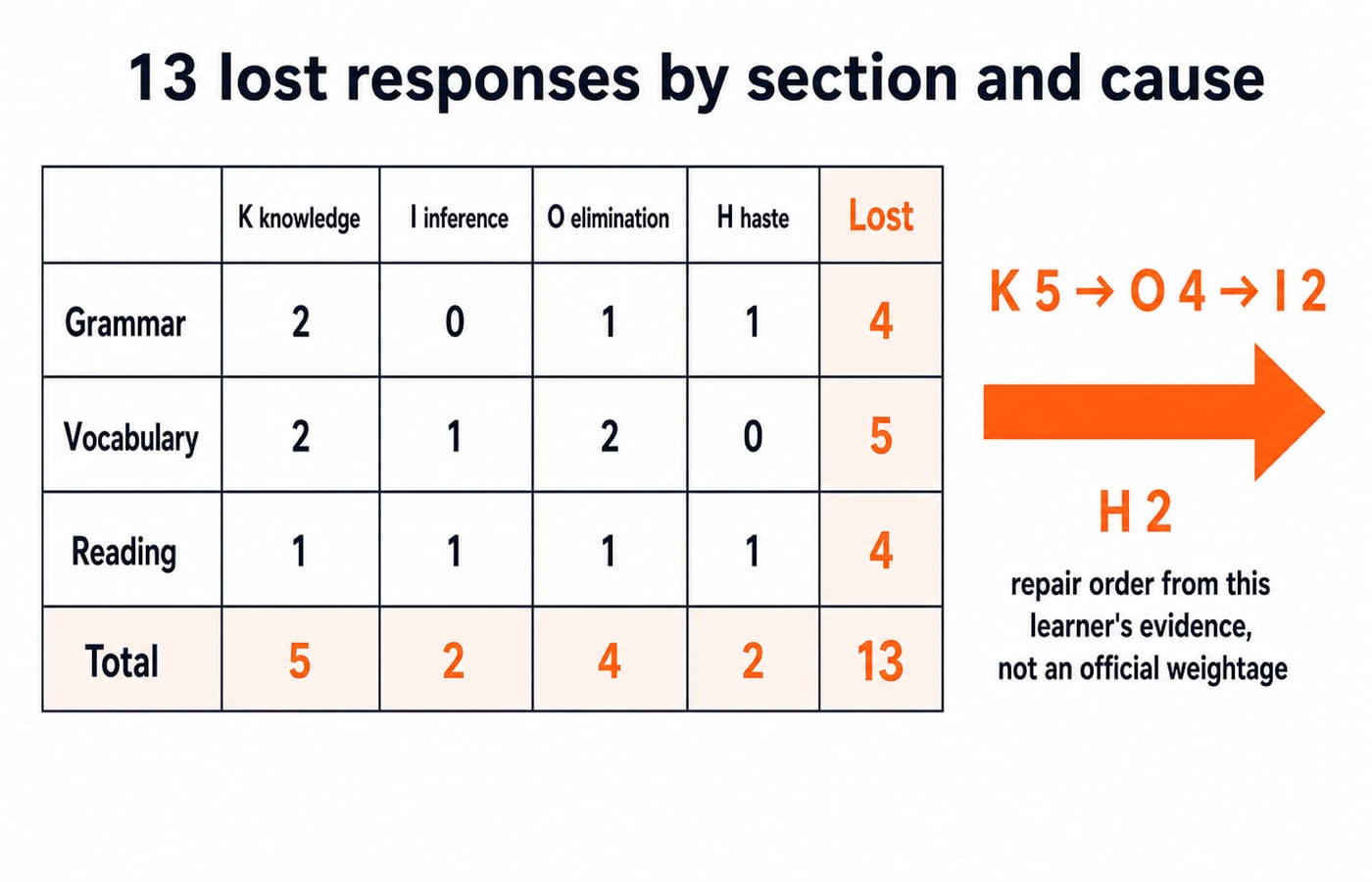
Inspect 13 wrong or skipped responses for knowledge, inference, elimination or haste.
Tag every lost mark by cause, not merely by chapter
Give every wrong or skipped item one tag:
K: missing language knowledge, such as an unknown word or grammar rule.I: failure to use evidence or make a supported inference.O: option elimination failure even though the rule, meaning or evidence was available.H: haste or time, only when you can solve the item immediately after the set.
Also record one proof note and one repair action. For this baseline, grammar gives G3=K, G8=O, G9=K, G10=H; vocabulary gives V1=K, V4=K, V6=O, V8=I, V10=O; reading gives R2=I, R5=O, R9=K, R10=H. Therefore, K=5, I=2, O=4, H=2, and 5+2+4+2=13.
The exact G3 log row is: chosen A | correct B | tag K | proof: could not state the either-or/neither-nor agreement rule | repair: six subject-verb agreement contrasts.
Repair grammar with rule recall and contrast pairs
Consider: Neither the recruiter nor the candidates was prepared for the rescheduled interview.
Options: A. was prepared, B. were prepared, C. has prepared, D. being prepared. B is correct. With neither...nor, the verb agrees with the nearer subject. If you cannot state the rule, tag K. If you know it but keep A, tag O.
Underline the controlling subject before checking these six contrasts:
Neither the analysts nor the manager was available.
Neither the manager nor the analysts were available.
Each of the reports has a summary.
The report, along with two annexures, is complete.
A list of shortlisted candidates is attached.
The candidates who cleared the round are waiting.
After 24 hours, retest on four new sentences. At 3/4 correct, move the rule to mixed practice. Otherwise, write two singular-plural contrast pairs and retest.
Repair vocabulary through meaning, contrast, collocation and context
Try this question: The panel's feedback was candid: it named every weakness without softening the criticism. What does candid most nearly mean? Options: A. indirect, B. frank, C. hostile, D. uncertain.
B, frank, is correct. Named every weakness without softening restates directness. Use K if candid is unknown, I if you miss the restatement and O if you know candid = frank but switch to hostile.
Make one four-field card: word: candid; plain meaning: frank and direct; contrast: candid, not evasive; collocation and sentence: candid feedback; The interviewer gave candid feedback on my answer. Add exactly 8 words from your baseline.
After 48 hours, retest with 6 context sentences containing the same 8 words. Retire the set at 5/6 correct. Return each miss to the log.
Repair reading by separating fact, inference and overreach
Read this mini-passage:
A firm replaced a three-hour classroom induction with six 20-minute recorded modules. Completion rose from 72% to 91%, but support tickets from new hires rose from 40 to 68 in the first month. The firm then added a live question session. Tickets fell to 46 while completion remained at 90%.
Which conclusion is best supported?
A. Short recorded modules remove the need for live support.
B. Adding a live question session preserved most of the completion gain while reducing support demand.
C. Recorded induction caused every support ticket.
D. Classroom induction is always better than recorded learning.
B is supported. Completion remains at 90%, close to 91%, while tickets fall by 68 - 46 = 22. A fails because 46 tickets show continued support need. Importantly, 46 is not below the original 40, only below 68.
Choosing A or D after finding the figures is O; failing to combine 90% with 46 tickets is I; not knowing preserved can be K. Repair with 5 short passages. Before viewing options, write one fact, supported inference and tempting overreach for each.
Use a three-pass elimination routine across all verbal questions
First, predict. Second, mark each option supported, contradicted or not proved. Third, identify the decisive word.
For the reading example, predict: Q&A kept completion high and reduced tickets. A is contradicted by 46 remaining tickets; C is not proved; D is not proved.
Run the same three passes on the candid item. Predict direct. Then indirect and uncertain are contradicted by named every weakness without softening; hostile is not proved, because naming faults is not the same as attacking; the decisive phrase is without softening.
Try: Each of the revised schedules ___ a separate approval code. Options: have, has, are having, were. Predict a singular present verb. Eliminate have and were for agreement or tense. Eliminate are having because it does not fit the stated possession. Select has. If you reach has only after seeing the key, it is not an H recovery.
Do 10 elimination questions: 4 grammar, 3 vocabulary and 3 reading. In round one, clean reasons outrank speed.
Convert the error totals into a 14-day repair loop
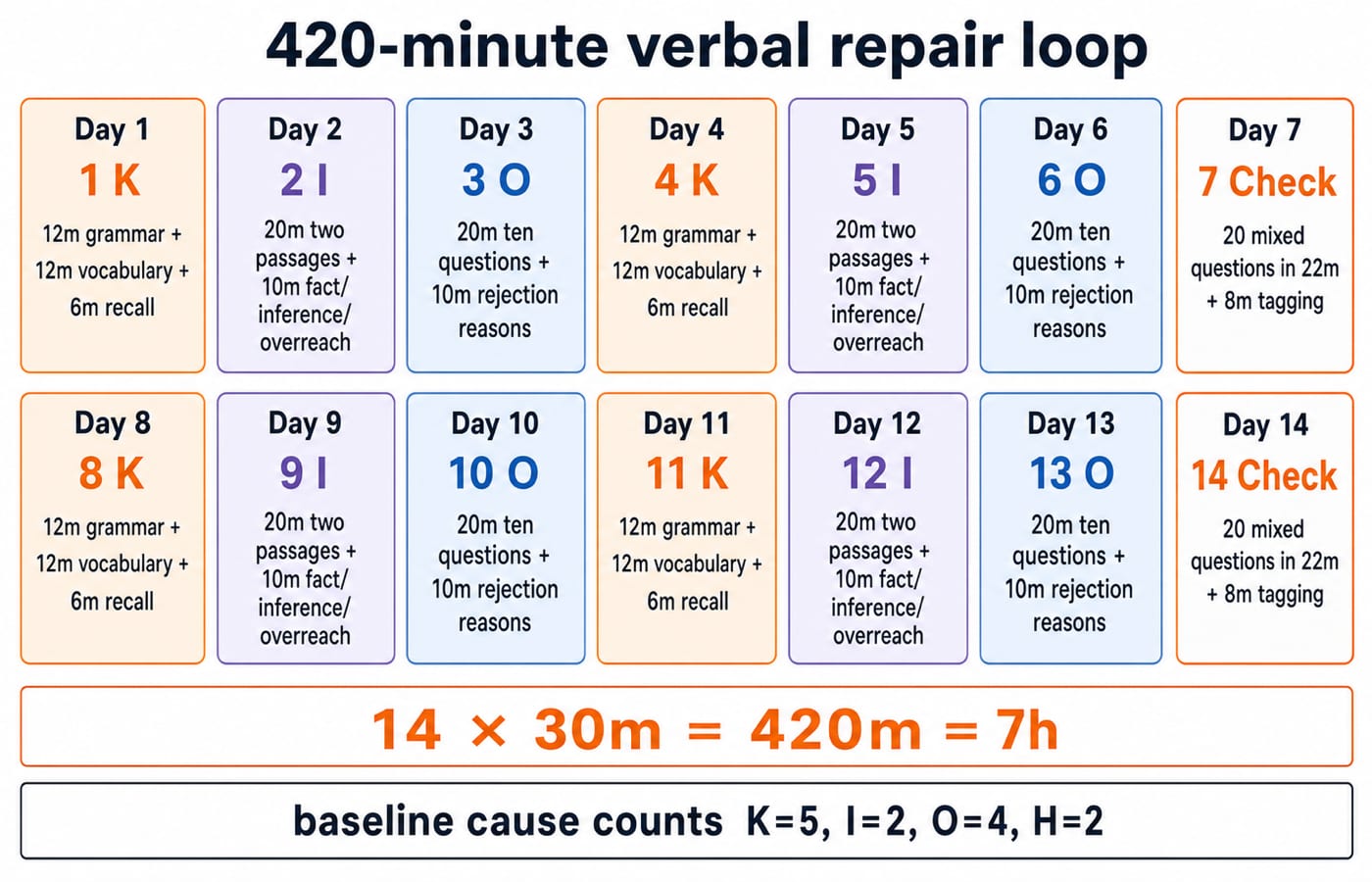
Use 30 minutes a day for 14 days: 14 x 30 = 420 minutes = 7 hours.
Days 1, 4, 8 and 11 are knowledge days: 12 minutes of grammar contrast pairs, 12 minutes of contextual vocabulary and 6 minutes of recall.
Days 2, 5, 9 and 12 are inference days: 20 minutes on two short passages and 10 minutes writing fact-inference-overreach notes.
Days 3, 6, 10 and 13 are elimination days: 20 minutes on a mixed 10-question set and 10 minutes on rejection reasons.
Days 7 and 14 are 30-minute checks: 20 mixed questions in 22 minutes, then 8 minutes to tag every loss.
K=5 and O=4 are the two largest buckets, so knowledge and elimination take four days each. Inference takes four as well, because I=2 understates it: an unbuilt inference habit costs marks on every passage, not only the two it was tagged on. The two timed checks cover H=2.
If the whole test still needs review before you drill one module, AMCAT Mock Analysis: Review an Adaptive Test Without Guesswork runs the cross-module version of this loop. The drills themselves sit in the Verbal Ability module of AMCAT Superset.
Re-test with matched questions and choose the next repair block
Repeat a 30-question set with the same 10 grammar, 10 vocabulary and 10 reading split and 35-minute cap. Baseline: 17 correct, 10 wrong, 3 skipped, 17/27 = 63.0% attempted accuracy and 27/30 = 90.0% coverage. Retest: 22 correct, 6 wrong, 2 skipped from 28 attempts, so accuracy is 22/28 = 78.6% and coverage is 28/30 = 93.3%.
If the eight wrong or skipped responses give K=3, I=1, O=3, H=1, then 3+1+3+1=8. Split the next block between knowledge and elimination instead of repeating the whole plan.
A matched retest needs questions you have not already seen. The Verbal Ability module in AMCAT Superset carries about 300 previous-year questions and more than 5,500 practice questions across those grammar, vocabulary and reading families, which is enough to keep every retest set fresh.
The short version
Measure, tag, repair, retest. For structured AMCAT-focused practice, consider AMCAT Superset. To compare nearby recruitment-exam resources, browse the IT Recruitment Exams category.
Keep learning
TCS NQT Eligibility: Check Backlogs, Gaps and Degree Rules
Use a closed TCS hiring notice as a worked checklist for degree, backlog, course-duration and academic-gap rules, then verify the current drive.
Updated 2 Sep 20264 min readIT Recruitment Exams

CoCubes Preparation Plan: Six Weeks for Campus Hiring Tests
Build a practical six-week CoCubes study plan around the modules in your own test invitation, your diagnostic results, and 72 hours of focused work.
Updated 1 Sep 20266 min readIT Recruitment Exams
eLitmus Retake Decision: Read Section Percentiles Before Testing Again
Do not retake eLitmus on disappointment alone. Use your section pattern, target-job evidence, and fresh timed practice to decide whether to go, wait, or rebuild.
Updated 30 Aug 20264 min readIT Recruitment Exams

eLitmus Mock Analysis: Diagnose Knowledge Gaps and Attempt Errors
A worked mock-review method to separate concept gaps from calculation, reading and decision errors, recover marks, and plan the next four weeks.
Updated 29 Aug 20265 min readIT Recruitment Exams