The TCS NQT Exam Structure, Explained Section by Section
The TCS National Qualifier Test is one of the widest doors into an IT career in India. Here is a clear, section-by-section breakdown of what it tests and how to prepare.
KnowledgeGate Team
Exam prep & CS education
5 Jul 20264 min read510 views
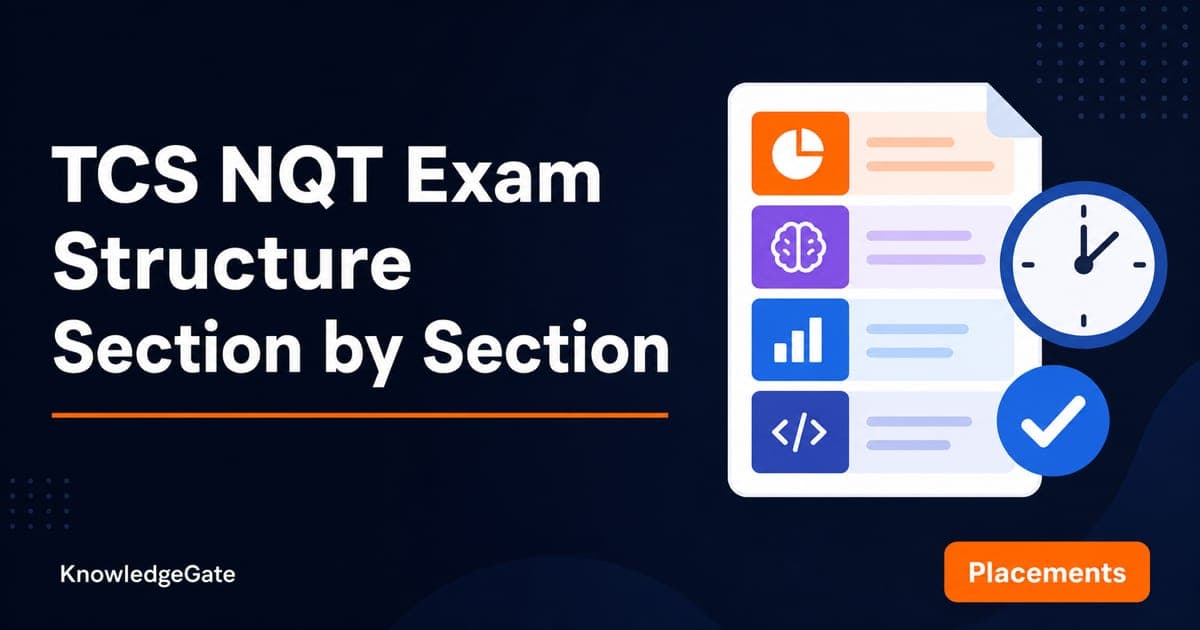
The TCS National Qualifier Test (the NQT) is one of the widest doors into an IT career in India. It is used as an entry test not only for TCS itself but as a qualifying score many other companies look at. That reach makes it worth understanding properly instead of walking in and hoping. The part most candidates get wrong is that the NQT is scored section by section, so the ability you skip practising is usually the one that decides your result.
TCS refreshes the NQT pattern periodically, so the exact question counts, time limits and sectional cut-offs move between cycles. Confirm those on the official TCS iON National Qualifier Test page before your slot. The skill mix underneath is far more stable, and that is what you can start drilling today.
Related reading: TCS NQT eligibility and TCS NQT coding questions.
The NQT in two layers: foundation abilities and programming
The NQT is a timed, sectional test taken online. The core cognitive part measures three broad abilities, and for technical roles there is a programming component on top. Think of it in two layers:
Foundation abilities: Numerical Ability, Verbal Ability, and Reasoning Ability.
Programming abilities: Programming Logic and a hands-on Coding section for candidates targeting developer roles.
Each section is timed on its own, which changes your strategy: you cannot borrow time from an easy section to rescue a hard one. Speed within each section is the whole game.
The NQT is also a qualifying test, not just a ranking one. A strong overall score is good, but many roles also look for a minimum in each section, so a lopsided profile (brilliant at coding, weak at verbal) can hold you back even with a high total. Balance is the safest strategy, which means giving your weakest section the most practice rather than the least.
Section 1: Numerical Ability
This is the classic quantitative-aptitude section: arithmetic, number properties, ratios and proportions, percentages, averages, time-speed-distance, time-and-work, permutations and combinations, probability, and data interpretation. The questions are not deeply mathematical; they reward pattern recognition and calculation speed.
The way to beat this section is volume of the right kind. Our aptitude practice covers this ground with a large topic-wise question set (the Mathematics and Aptitude area alone carries more than 5,700 practice questions), so you can drill one topic at a time until the standard patterns become instant. A focused aptitude course plus a daily practice habit is the single highest-return investment for this test.
Section 2: Verbal Ability
English is often the section technical students underestimate. It covers reading comprehension, sentence completion, error spotting, para-jumbles, synonyms and antonyms, and sometimes a spoken or typed English component depending on the cycle. Our Verbal Ability practice set runs to more than 5,300 questions, which is enough to expose you to every question style the test uses.
The trick with verbal is consistency, not cramming. Ten minutes of reading comprehension and grammar practice every day for a month beats a panicked weekend before the test.
Section 3: Reasoning Ability
Reasoning measures logical thinking under time pressure: seating arrangements, blood relations, syllogisms, series, coding-decoding, puzzles, and data sufficiency. It is the section where a calm, systematic method beats raw speed. Most mistakes here come from misreading the setup, not from bad logic. With over 3,500 reasoning questions to practise on, the goal is to build a repertoire of standard puzzle types so that on test day you recognise the shape and apply a known method.
Section 4: Programming Logic and Coding
For technical and developer roles, this is the section that separates candidates. Programming Logic tests the fundamentals: data types, control flow, functions, recursion, pointers, basic data structures, and complexity. The Coding section asks you to write and run actual programs against test cases in a language of your choice.
Preparation here is not about memorising syntax. It is about translating a problem statement into working code quickly, then getting it past the test cases. Build that muscle with daily problem-solving and a course that drills the same translation step: our Coding for Placements course works through it in C, C++, Java and Python, including the data-structures fundamentals coding rounds lean on.
How to prepare for the NQT, in order
Diagnose. Take a full-length mock to find your weakest section. A dedicated TCS NQT mock test built to the current pattern is the fastest way to get an honest baseline.
Fix the foundation sections. Numerical, verbal and reasoning respond quickly to daily topic-wise practice. Give them the first few weeks.
Build coding speed. Solve programming problems every day, and practise writing code that passes test cases under time pressure, not just on paper.
Simulate the real thing. Sectional timing changes everything, so practise with the clock on and in whole sections rather than loose question sets. Rehearse the section order you will actually face, not a generic mixed paper.
The short version: what actually clears the NQT
The NQT is not designed to fail you. It is designed to sort candidates by preparation. The students who clear it comfortably are rarely the most brilliant; they are the ones who practised the exact section patterns until they were routine. Two of those patterns, aptitude and reasoning, overlap heavily with other placement tests and even government exams, so the work compounds.
Start with a diagnostic mock, then build a daily routine. Our 30-day aptitude routine is a ready-made schedule for the foundation sections. Explore the full placement preparation catalogue to line up the courses for each part, and treat every mock as a lesson rather than a verdict.
Keep learning
Functions in C: Syntax, Parameters and Worked Examples
Learn how C declarations, calls, and definitions fit together. Compile two complete programs, follow their values, and trace composition and recursion.
Updated 6 Oct 20266 min readC Programming & Data Structures
Smart Pointers in C++: unique_ptr, shared_ptr and weak_ptr with Worked Examples
Learn who owns a C++ object, when it is destroyed, and how to choose among unique_ptr, shared_ptr, weak_ptr and a borrowed raw pointer.
Updated 1 Oct 20265 min readC Programming & Data Structures
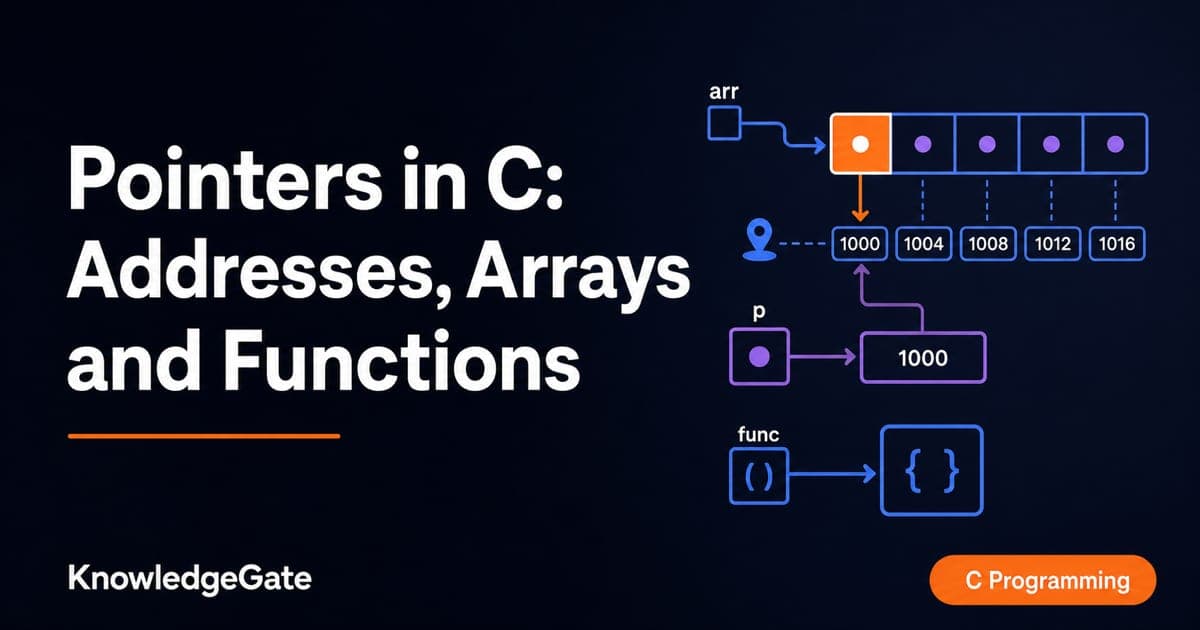
Pointers in C: Addresses, Arrays and Functions with Worked Examples
Build a practical pointer model with runnable C programs for dereferencing, arrays, swapping, dynamic memory and common tracing questions.
Updated 26 Sep 20265 min readC Programming & Data Structures
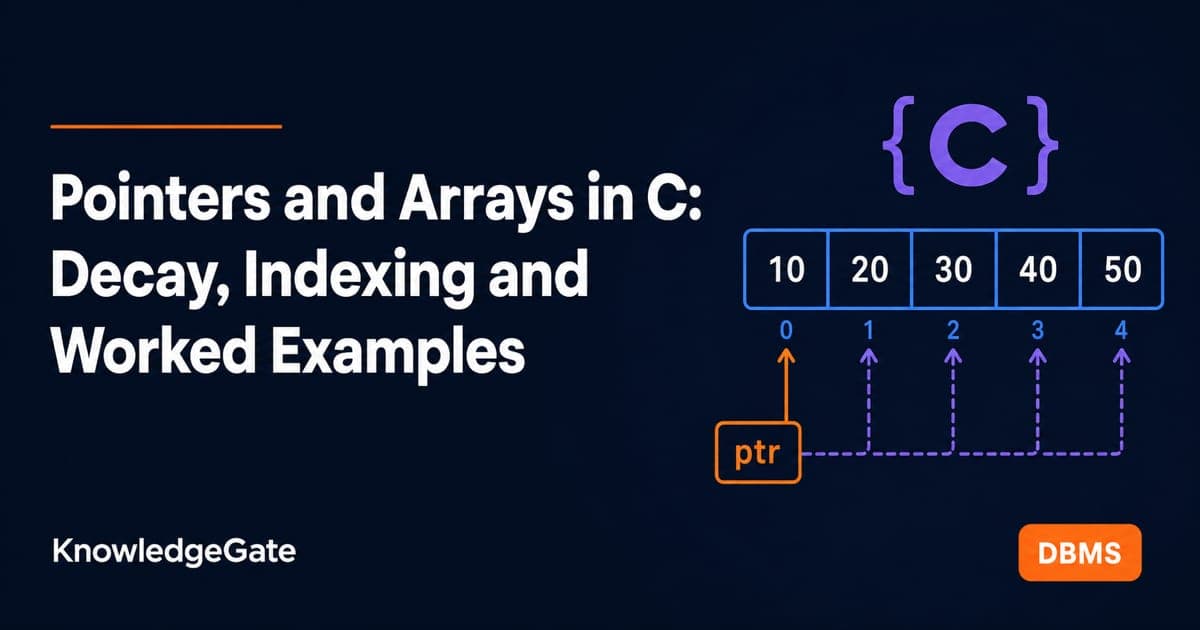
Pointers and Arrays in C: Decay, Indexing and Worked Examples
Separate arrays from pointers with runnable traces covering indexing, one-past boundaries, function parameters, two-dimensional arrays and declaration traps.
Updated 24 Sep 20265 min readC Programming & Data Structures