SRS Document Structure and Standards: A Worked Lab Booking Specification
Build a small campus lab booking SRS, turn vague statements into testable requirements, and trace each important requirement to a worked acceptance check.
KnowledgeGate Team
Exam prep & CS education
Updated 19 Sep 20266 min read
Many learners can remember the headings Introduction, Overall Description and Specific Requirements, yet cannot decide where a constraint belongs or whether “the system should respond quickly” is valid. A small campus lab-seat booking system illustrates the structure, and its requirements carry into tests. That separates document structure, requirement quality and standards history.
The lab scenario uses a hypothetical college: three rooms, three daily slots and a seven-day booking horizon. A real SRS must replace those values with stakeholder-approved limits and acceptance evidence. Exam coverage remains governed by the applicable authority's current syllabus and notice.
What an SRS is, and what a standard does not decide for you
An SRS controls what software must do, its interfaces, constraints, qualities and acceptance conditions. A business-requirements document states goals, a design specification chooses solutions, and a test plan defines verification. Technology belongs only when genuinely constrained.
The official IEEE Standards Association catalogue marks IEEE 830-1998, the historical SRS practice, as superseded by ISO/IEC/IEEE 29148:2011. The ISO catalogue identifies ISO/IEC/IEEE 29148:2018 as Edition 2, published in November 2018 and last confirmed in 2024; a third edition is under development. The 2018 edition remains the current published standard and defines requirements-engineering processes, constructs and information items rather than one compulsory contents table.
Software Requirements in Software Engineering: SRS, Elicitation and Validation with a Worked Example follows a mock-test portal from stakeholder need through elicitation, validation and change control. The lab-booking system starts from an agreed scope and tests document placement, standard context and acceptance checks.
A practical SRS structure from context to acceptance
Use this three-part spine:
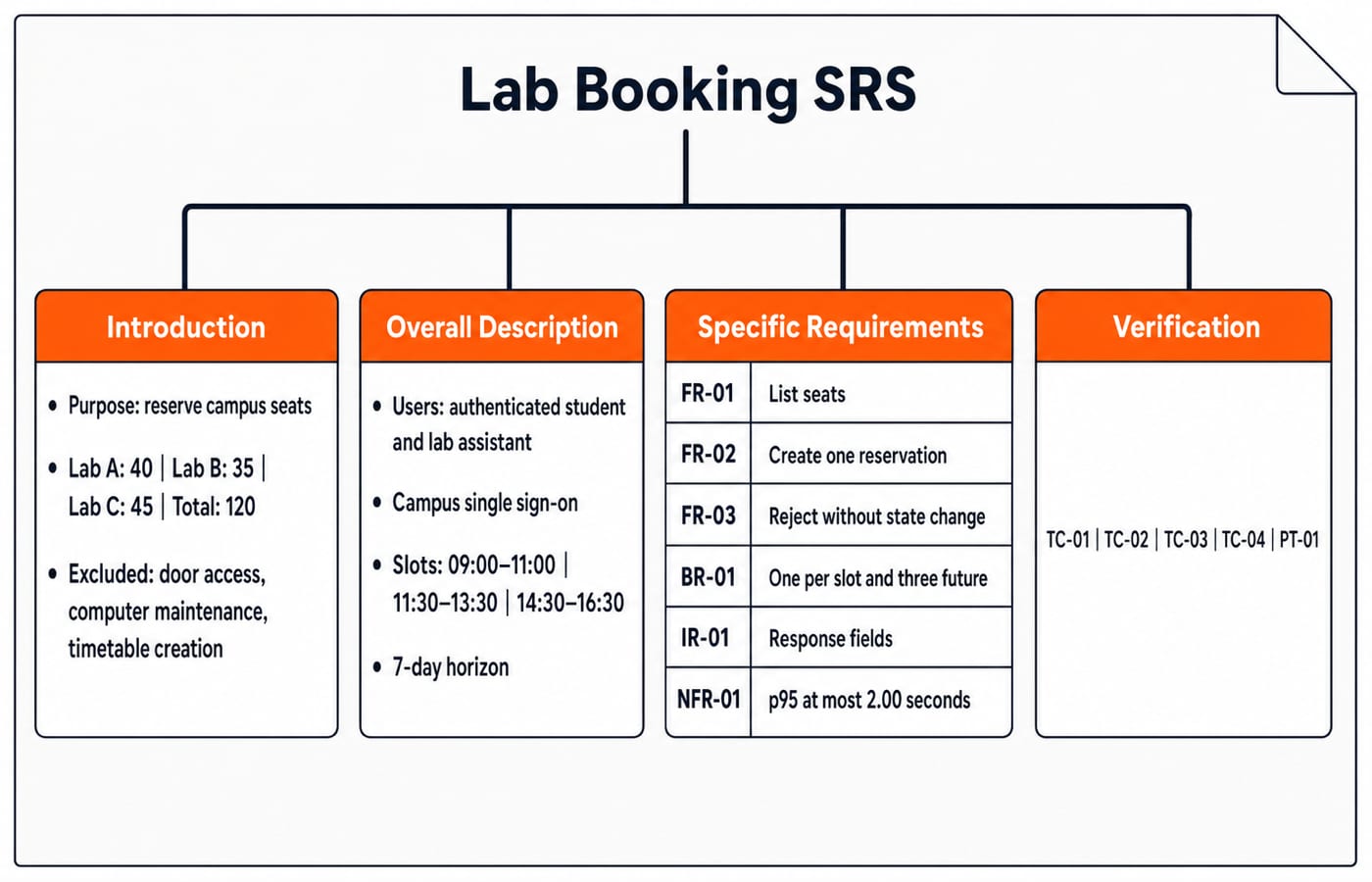
Introduction: purpose, scope, audience, definitions and references.Overall Description: product perspective, capabilities, user classes, environment, assumptions, dependencies and constraints.Specific Requirements: interfaces, functions, data, business rules, quality, error behaviour and acceptance conditions.
Add a glossary, appendices or traceability matrix when useful. Authenticated students and lab assistants are user classes. Campus single sign-on is a dependency. Three future reservations is a business rule. POST /reservations returning an identifier is an interface requirement; p95 at 2.00 seconds is performance.
Scope covers Lab A with 40 seats, B with 35, C with 45: 40 + 35 + 45 = 120. Slots are 09:00-11:00, 11:30-13:30, 14:30-16:30, with a 7-day horizon. Door access, computer maintenance and timetable creation are outside scope. The NET Courses and Test Series page is a neutral preparation hub.
Fix the scope and write the functional behaviour precisely
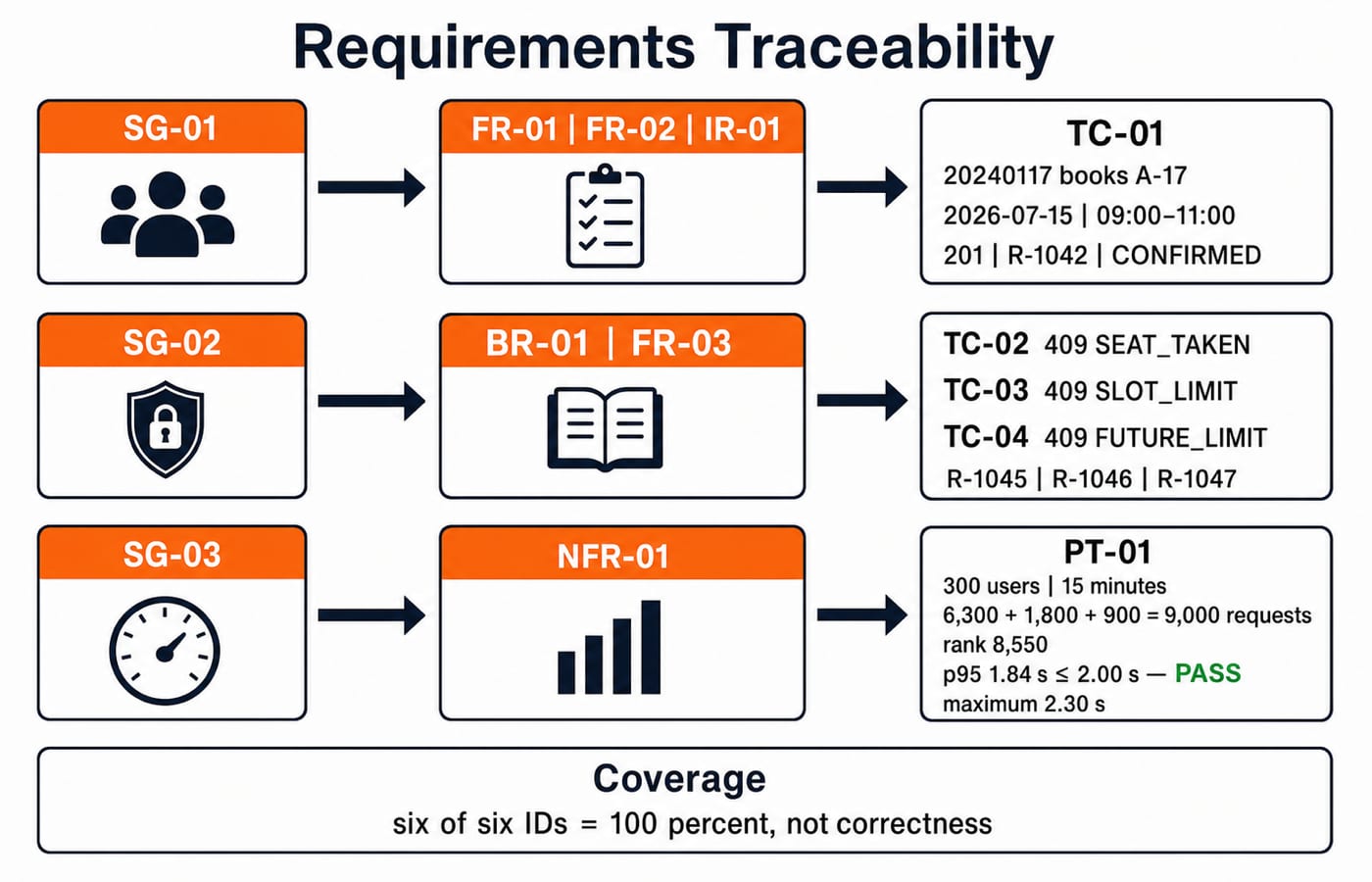
On 2026-07-15, student 20240117 selects Lab A, free seat A-17, slot 09:00-11:00. The authenticated student has no same-slot booking and 0 active future reservations. Success returns HTTP 201, R-1042, CONFIRMED; the seat becomes unavailable and the count becomes 1.
FR-01: when an authenticated student selects a lab, one of the three supported slots and a date within the7-day horizon, the system shall display the available seat identifiers.FR-02: when the chosen seat is available and the BR-01 limits are satisfied, the system shall create exactly one reservation with a unique identifier.BR-01: one student may hold at most1active reservation in a given slot and at most3active future reservations across all slots.FR-03: if the seat or either limit fails, the system shall create no reservation, shall leave availability unchanged and shall return exactly one reason code:SEAT_TAKEN,SLOT_LIMITorFUTURE_LIMIT.
IR-01 makes success observable through reservationId, studentId, labId, seatId, start, end, status: R-1042, 20240117, A, A-17, 2026-07-15T09:00:00+05:30, 2026-07-15T11:00:00+05:30, CONFIRMED. Rejection returns HTTP 409, one FR-03 code and no reservation identifier.
Turn vague quality claims into atomic, verifiable requirements
“The system should quickly let students book suitable nearby seats” is defective. Should weakens obligation; quickly, suitable, nearby lack measures; behaviour and performance are bundled; load and failure results are missing. FR-01 to FR-03 and BR-01 separate behaviour. Performance is separate:
NFR-01: During a 15-minute workload with 300 concurrent authenticated users and 9,000 completed requests, comprising 6,300 availability lookups, 1,800 booking attempts and 900 cancellations, the nearest-rank 95th-percentile server response time across the completed requests shall be at most 2.00 seconds.
A complete performance requirement names the workload, measurement window, user population, measurement boundary and percentile method. Those fields create an objective pass-or-fail boundary; a real project must baseline their values from stakeholder and operational evidence.
Ask whether each requirement is necessary, singular, unambiguous, complete, consistent, feasible, verifiable, traceable and free of accidental design. FR-02 must enforce both BR-01 maxima; FR-01's 7 days must match the calendar. Headings cannot supply missing rejection and state preservation.
Verify the worked specification and build traceability
Run four functional fixtures:
Test | Fixture and expected result |
|---|---|
| Success returns |
|
|
|
|
|
|
For PT-01, 6,300 + 1,800 + 900 = 9,000. Nearest-rank p95 is ceil(0.95 x 9,000) = 8,550. Sorted positions 8,549, 8,550, 8,551 hold 1.83 s, 1.84 s, 1.85 s; maximum is 2.30 s. P95 is 1.84 s and passes 1.84 <= 2.00. A percentile target need not cover every response.
Traceability is exact:
Goal | Requirements | Tests |
|---|---|---|
|
|
|
|
|
|
|
|
|
Coverage is 6 / 6 x 100 = 100%, although links do not prove correctness. Extending 7 to 14 days in LAB-CR-07 affects scope, FR-01, date selector and boundary test, not the per-slot rule.
Common SRS structure and specification traps
Treating an SRS as design freezes solutions. Use MongoDB with three replicas is wrong when the need is measurable durability, unless technology is constrained with rationale. Tailor templates while preserving information and traceability.
Happy-path-only writing ignores double claims, same-slot conflicts and rejection state changes. State preconditions, alternate outcomes, codes and invariants. Replace should, user-friendly, adequate, normally, etc. and unexplained real time with shall, conditions, units and limits.
Verification checks conformance; validation checks the real need. Even 100% coverage and p95 1.84 s cannot expose an omitted user class or wrong horizon.
How objective and descriptive questions test SRS knowledge
Questions may ask you to place a statement, separate requirement from design, rewrite vagueness, find inconsistency, or read traceability and acceptance calculations.
Routine: identify goal and boundary; classify context, function, interface, rule, quality or constraint; add condition, obligation and measurable result; inspect success and failure; link a test. Use the nearest-rank percentile method. The IBPS SO IT Officer Software Engineering Professional Knowledge Guide places SRS questions within broader software-engineering preparation. Exam-specific frequency and weightage still come from the current official notification.
The short version and the next study step
Remember: an SRS records observable needs and constraints. Introduction sets purpose and scope. Overall Description sets context. Specific Requirements state functions, interfaces, rules and qualities. Important requirements need verification. Traceability connects goals, requirements, tests and changes. Standards cannot make vague content precise.
Reconstruct it: 40 + 35 + 45 = 120; explain SLOT_LIMIT; calculate rank 8,550; separate p95 1.84 s from maximum 2.30 s; change 7 to 14 days and list affected artefacts.
For structured teaching, continue with the NTA-UGC-NET Paper 2 Complete Course. When you are ready to practise, use the NTA UGC NET Paper 2 Test Series.
Keep learning

ICT in Education MCQs: 12 Solved Questions on Digital Learning Tools
Solve 12 ICT in Education MCQs, then use clear explanations and a five-layer model to separate files, tools, platforms and public initiatives.
Updated 3 Oct 20268 min readUGC NET Computer Science
Requirements Elicitation Techniques and Use Case Development: Worked Library Example
Follow a fictional library reservation from interviews and observation through testable requirements, a UML use-case model, UC-07, and acceptance checks.
Updated 28 Sep 20266 min readUGC NET Computer Science

Quality Factors: McCall’s and ISO 9126 Models with a Worked Scoring Example
Build both quality models around one maintainability audit. This guide maps their vocabulary, calculates McCall-style and ISO-style scores, and ends with exam-focused checks.
Updated 25 Sep 20265 min readUGC NET Computer Science

Cohesion and Coupling MCQs: 10 Solved Questions on Functional Independence
Practise 10 solved MCQs on cohesion, coupling, functional independence, module dependencies, and the distinctions that make closely matched options easier to separate.
Updated 24 Sep 20267 min readUGC NET Computer Science