Software Process Models in Software Engineering: How to Choose with a Worked Example
Compare the classic software process models, then choose between them with a fully computed 24-week project matrix.
KnowledgeGate Team
Exam prep & CS education
Updated 31 Jul 20266 min read73 views
Waterfall, V-model, incremental, prototyping, Spiral and Agile are harder to distinguish in a project scenario than to define. They only separate cleanly once a specific project is scored against them, with weights on the criteria where they genuinely differ.
No model is universally best. What decides it is requirement stability, the cost of learning something late, technical risk, the assurance and traceability the work must leave behind, and how often users need working software.
Related reading: Agile process model MCQs and software engineering fundamentals.
Software process, lifecycle and process model are not the same
A software process creates and evolves software. A lifecycle runs from need through operation and maintenance. A process model organises the work.
A common chain is communication -> planning -> modelling -> construction -> deployment and feedback. Waterfall largely sequences these activities, incremental development packages them into releases, iterative development revisits a solution, Spiral centres them on risk, and Agile uses short feedback cycles.
Semester papers ask this as a straight definition question, and the trap is treating the three as synonyms: the process does the work, the lifecycle spans the whole product life including maintenance, and the model arranges the process activities. The Semester and College Exam Courses run through the core CS subjects in which that vocabulary is marked.
Waterfall and V-model: sequential control and planned verification
Waterfall uses baselined stages with limited planned backtracking. In a 10-week payroll module, requirements take weeks 1 and 2, design 3 and 4, implementation 5 to 7, testing 8 and 9, and deployment week 10. A tax-rule change found in week 8 crosses the signed requirements baseline and needs impact analysis.
The V-model maps user requirements to acceptance testing, system requirements to system testing, architecture to integration testing, and module design to unit testing. For R7: lock an account after 5 failed logins, its acceptance test performs exactly five failures and confirms the lock.
Both suit stable requirements, traceability and assurance, but not frequent discovery. Waterfall is not obsolete, and the V-model cannot prevent every defect.
Prototyping, incremental and iterative models support different learning
A prototype explores uncertainty and may be throwaway or evolutionary. Incremental work adds usable slices; iterative work revises a solution. A project can use both.
A 12-feature student portal has 18 weeks. Increment 1 delivers login, profile, course list and notices at week 6. Increment 2 adds attendance, assignments, submissions and grades at week 12. Increment 3 adds fees, certificates, feedback and support at week 18. Thus 4 + 4 + 4 = 12. Each release includes analysis, design, construction and testing, not one third of a Waterfall sequence.
Eight students test two attendance prototypes. Version A takes a median 7 taps and B takes 4. The team chooses B and discards unengineered code.
RAD is time-boxed and component-oriented. It needs modular scope and available people, so it does not mean every fast project.
Spiral and Agile: risk-driven cycles versus adaptive delivery
A Spiral cycle sets objectives and alternatives, reduces risks, engineers and verifies the next-level product, then plans again. Diagram radius and angle do not calculate time or budget.
Agile is a family, not one diagram. A team may plan 18 stories across three 2-week sprints of 6, but tested value and feedback matter more. Scrum and Extreme Programming are examples. A sprint is a time-box; an increment is usable output.
Choose Spiral when one risk could invalidate the project, Agile for frequent reprioritisation with accessible feedback, and incremental delivery for staged value. In a hybrid, every control should answer a real risk or assurance need.
Worked example: choose a model for a 24-week biometric attendance system
A college has 24 weeks and 12 requirements. Six administration requirements are stable; the other six concern low-light recognition, spoof detection, privacy consent, offline sync, device variation and appeals. Reviews occur every 6 weeks.
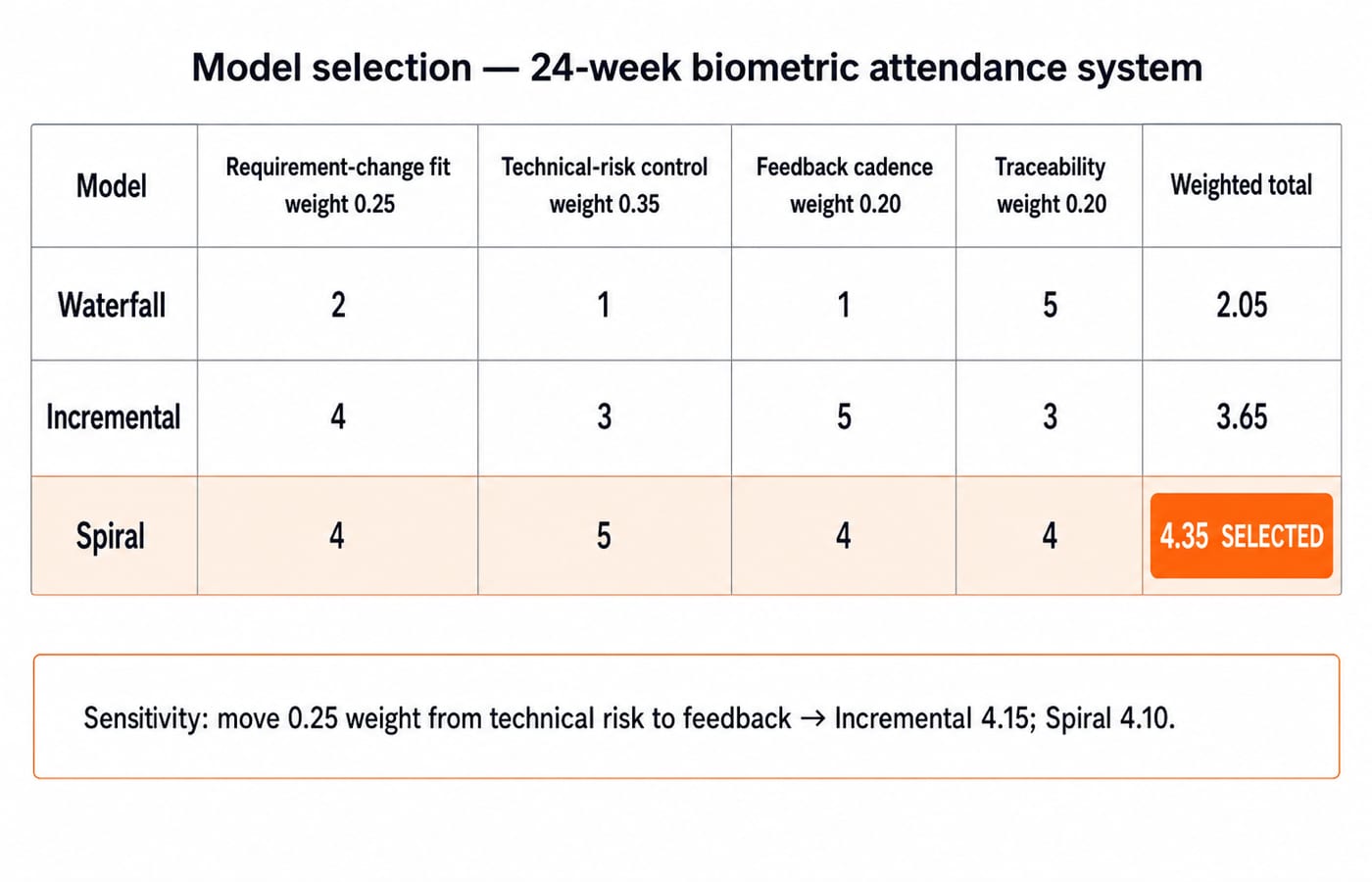
Score 1 to 5. Weights total 0.25 + 0.35 + 0.20 + 0.20 = 1.00.
Model | Change fit, 0.25 | Risk control, 0.35 | Feedback, 0.20 | Traceability, 0.20 | Weighted total |
|---|---|---|---|---|---|
Waterfall | 2 | 1 | 1 | 5 | 2.05 |
Incremental | 4 | 3 | 5 | 3 | 3.65 |
Spiral | 4 | 5 | 4 | 4 | 4.35 |
Waterfall gives 0.50 + 0.35 + 0.20 + 1.00 = 2.05. Incremental gives 1.00 + 1.05 + 1.00 + 0.60 = 3.65. Spiral gives 1.00 + 1.75 + 0.80 + 0.80 = 4.35. Spiral wins because technical risk dominates, not because it is universally superior.
Move 0.25 from risk to feedback, giving weights 0.25, 0.10, 0.45, 0.20. Totals become Waterfall 2.05, Incremental 4.15 and Spiral 4.10. Incremental leads by 0.05. The matrix structures judgement, not certainty.
Execute the first Spiral cycle and calculate risk exposure
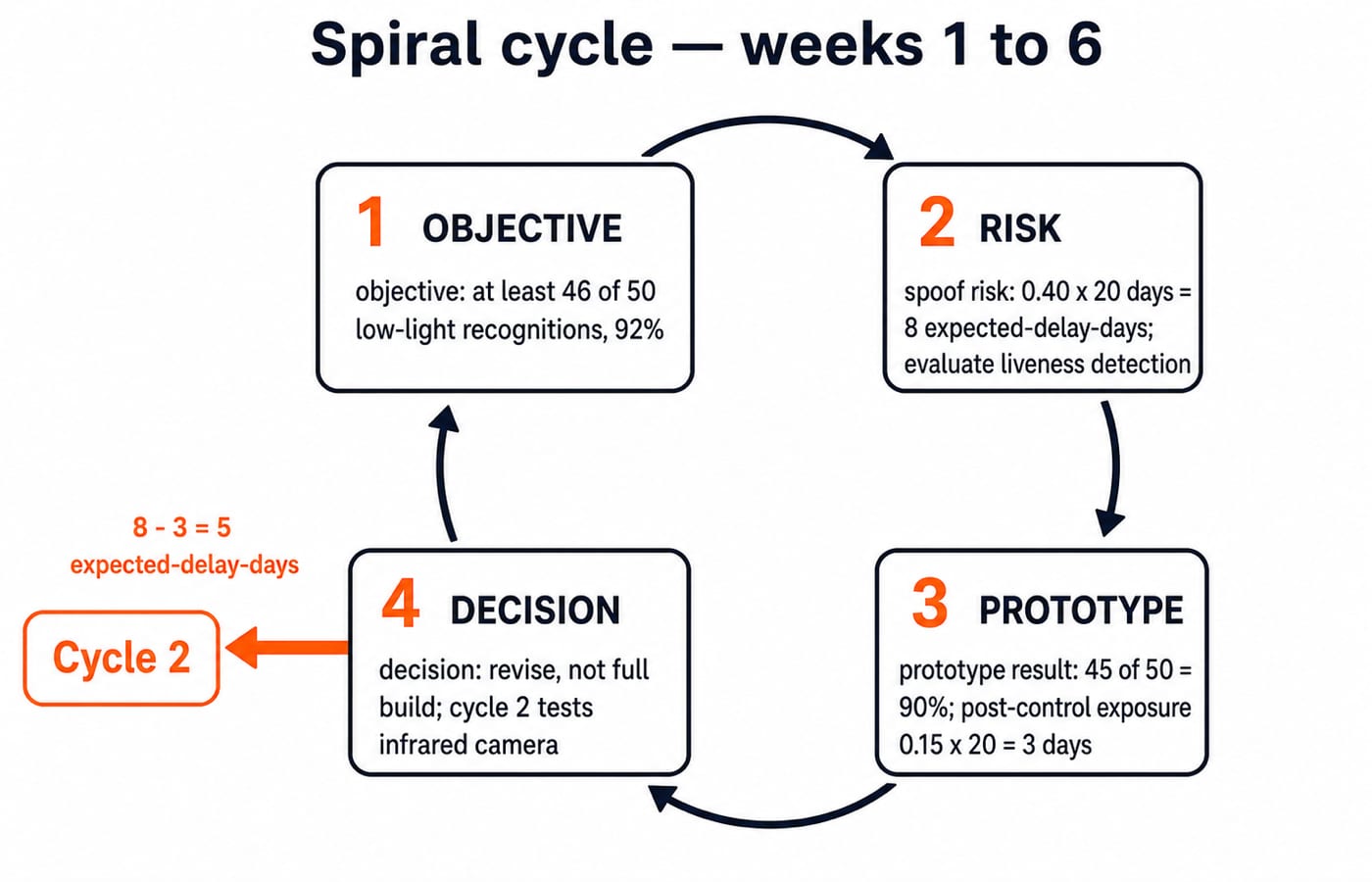
In cycle 1, week 1 sets the objective: at least 46 correct recognitions from 50 low-light samples, or 46 ÷ 50 = 92%. Weeks 2 and 3 compare camera, lighting and liveness alternatives. Week 4 builds, week 5 tests 50 samples, and week 6 reviews evidence.
Spoof acceptance has estimated probability 0.40 and impact 20 days, so exposure is 0.40 × 20 = 8 expected-delay-days. Liveness detection lowers probability to 0.15, giving 0.15 × 20 = 3. The estimated reduction is 8 - 3 = 5 expected-delay-days. That is an expected value, so it is what the control is worth on average across many projects like this one, never a guarantee that this project saves exactly five days.
The prototype achieves 45 ÷ 50 = 90%, below 92%. The team delays full construction. Cycle 2 keeps liveness detection, tests an infrared camera and repeats the benchmark.
Process model traps in exams and interviews
Trap | Why it fails | Better answer |
|---|---|---|
Waterfall means no feedback | Reviews can occur at stage boundaries | Feedback is planned and change is controlled |
A prototype is production code | Throwaway code may lack production quality | Decide whether the prototype is throwaway or evolutionary |
Incremental and iterative are identical | One adds capability, the other revises a solution | A project may use both dimensions |
Agile means no planning or documentation | Agile adapts both to current value and risk | Plan and document enough to deliver and assure the product |
Spiral suits every large project | Risk analysis adds overhead | Use it when risk reduction justifies that overhead |
Questions may match scenarios, order stages, pair V-model levels, distinguish prototypes, compare incremental with iterative work, or calculate probability × impact, such as 0.40 × 20 = 8.
IIT Guwahati's official GATE 2026 CS syllabus lists ten sections, from Engineering Mathematics through Computer Networks, and Software Engineering is not one of them. A GATE-only candidate therefore meets process models in college papers, teaching-exam papers and interviews rather than in the GATE paper. Each year's organising IIT publishes its own syllabus, so check the current one before planning around this. GATE CS Subject Weightage covers the subjects GATE does list, and UGC NET Computer Science Syllabus Areas maps the other main route for computer science candidates.
KnowledgeGate's question bank carries over 160 practice questions on Software Process Models, which is enough repetition to make the scenario-matching pattern automatic.
How to choose a software process model: the short version
Ask five questions:
How stable are the requirements?
How soon must users see working software?
Which uncertainty could invalidate the project?
How much traceability or assurance is required?
Can the team support repeated stakeholder reviews?
Stable, assurance-heavy work suggests Waterfall or V-model; staged value, incremental; discovery, prototyping or iteration; major risk, Spiral; frequent reprioritisation, Agile.
Three checks: releasing 4 + 4 + 4 features is incremental. Revising one search feature through three versions is iterative. Reducing an 8 expected-delay-day risk to 3 before committing is Spiral logic.
Now score one project with the four criteria and explain your choice in three sentences. Whichever model wins, the decisions immediately after it are structural, and Software Design in Software Engineering works through coupling, cohesion and a worked architecture. The Zero to Hero Complete CS Course offers structured study of Software Engineering and Software Process Models.
Keep learning
ICT in Education MCQs: 12 Solved Questions on Digital Learning Tools
Solve 12 ICT in Education MCQs, then use clear explanations and a five-layer model to separate files, tools, platforms and public initiatives.
Updated 3 Oct 20268 min readUGC NET Computer Science
Requirements Elicitation Techniques and Use Case Development: Worked Library Example
Follow a fictional library reservation from interviews and observation through testable requirements, a UML use-case model, UC-07, and acceptance checks.
Updated 28 Sep 20266 min readUGC NET Computer Science
Quality Factors: McCall’s and ISO 9126 Models with a Worked Scoring Example
Build both quality models around one maintainability audit. This guide maps their vocabulary, calculates McCall-style and ISO-style scores, and ends with exam-focused checks.
Updated 25 Sep 20265 min readUGC NET Computer Science
Cohesion and Coupling MCQs: 10 Solved Questions on Functional Independence
Practise 10 solved MCQs on cohesion, coupling, functional independence, module dependencies, and the distinctions that make closely matched options easier to separate.
Updated 24 Sep 20267 min readUGC NET Computer Science