IBPS SO IT Officer Software Engineering: professional knowledge topics
IBPS SO IT Officer Software Engineering: master the SDLC, process models, requirements, testing and quality for the Mains Professional Knowledge paper.
KnowledgeGate Team
Exam prep & CS education
Updated 26 Jul 20266 min read370 views
For the IBPS SO IT Officer, Mains is a Professional Knowledge paper, and one paper has to span the whole computer science core. Software Engineering is the most definitional subject on it, which makes it a fast scorer once your vocabulary is exact. The questions are rarely numerical: they hand you an activity, a scenario, or a term and ask which phase, which process model, or which testing type it belongs to. Precision with the terms, not calculation, is what earns these marks.
Software Engineering for IBPS SO IT: the software development life cycle
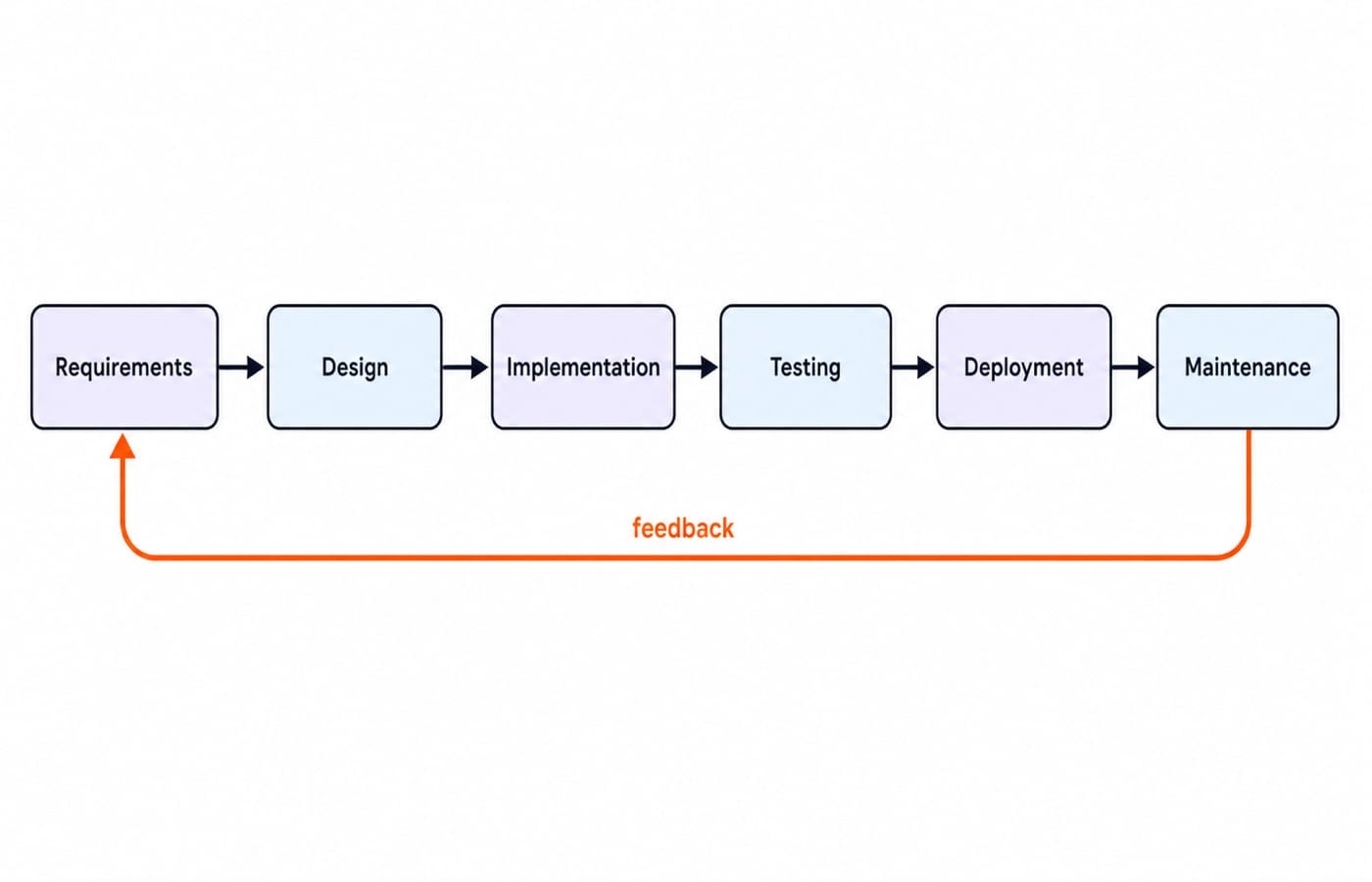
The software development life cycle (SDLC) is the sequence of phases a software product passes through. Learn the phases in order, because a common question gives you an activity and asks which phase it belongs to.
Requirement analysis: gather and record what the software must do.
Design: turn requirements into architecture and module structure.
Implementation: write the code.
Testing: verify the software against the requirements.
Deployment: release it to users.
Maintenance: fix defects and adapt to change after release.
Process models: waterfall, iterative, spiral, and agile
A process model is how the phases are arranged in time. Keep the trade-offs crisp:
Waterfall: strictly sequential, each phase completed before the next. Simple and easy to manage, but inflexible once a phase is done, so it suits stable, well-understood requirements.
Iterative and incremental: build in repeated cycles, adding function each time, which surfaces problems earlier.
Prototype model: build a quick working model to clarify unclear requirements, then refine.
Spiral model: iterative development wrapped around explicit risk analysis in each loop, suited to large, high-risk projects.
Agile: short iterations, continuous customer feedback, and working software valued over heavy documentation.
The exam likes to pair a model with the situation it fits. Waterfall for fixed requirements, prototype for fuzzy ones, spiral where risk is high, agile where change is constant.
Requirements and the SRS
Requirements split into functional requirements, what the system must do, and non-functional requirements, qualities like performance, security, and usability. They are captured in the Software Requirements Specification (SRS), the agreed contract of what will be built. A good requirement is unambiguous, complete, consistent, and verifiable, and questions often ask you to spot which quality is violated.
Design principles: cohesion and coupling
Good design is judged by two paired ideas that examiners love. Cohesion is how strongly the elements inside a single module belong together; high cohesion is good. Coupling is how dependent one module is on another; low coupling is good. The design goal is high cohesion and low coupling, because it makes modules easier to understand, test, and change without side effects. Supporting ideas are abstraction (hiding detail) and modularity (splitting a system into manageable parts).
Software metrics and estimation
Metrics put numbers on software so it can be estimated and controlled. Lines of code (LOC) and function points measure size. Cyclomatic complexity counts the independent paths through a module, which indicates how many test cases it needs. For effort estimation, the COCOMO model estimates person-months from the projected size of the software. You do not need to derive these in the exam, but you should recognise what each one measures and why it exists.
Testing: levels, types, and the terms you must know
Testing is the densest source of definitional questions, so be exact.
Levels: unit testing (one module), integration testing (modules together), system testing (the whole product), and acceptance testing (against user needs).
Black-box testing checks behaviour without seeing the code; white-box testing examines the internal logic and paths.
Verification asks whether we are building the product right (reviews, inspections), while validation asks whether we are building the right product (actual execution).
Regression testing re-runs earlier tests after a change to confirm nothing broke.
For exam recall, keep the quality chain precise: an error is a human mistake, the error introduces a defect into a work product, and when that defect executes, it causes a failure visible to the user. Also distinguish the acceptance test settings: alpha testing happens at the developer's site under controlled conditions, while beta testing is carried out by real users at their own site in the actual use environment.
Software quality, reliability, and configuration management
Quality is examined as a block of its own, so hold the distinction: testing looks for defects in a finished product, while software quality assurance (SQA) is the process discipline of reviews, standards, and audits that keeps defects from being introduced in the first place. Quality itself is described through attributes such as correctness, reliability, usability, maintainability, portability, and efficiency.
Software reliability is the probability of failure-free operation over a stated period, and it is quantified by MTTF (mean time to failure), MTBF (mean time between failures, which is MTTF plus the mean time to repair), and the failure rate. Availability follows from the same two figures, as MTTF divided by MTTF plus MTTR. Two process-quality frameworks are asked for by name: ISO 9000, a general quality-management standard, and the SEI Capability Maturity Model (CMM), which grades an organisation's process maturity on five levels, initial, repeatable, defined, managed, and optimizing.
Software configuration management (SCM) is how change is controlled. Every deliverable placed under control is a configuration item, a baseline freezes an agreed version so later change is deliberate, and change control records when, why, and by whom each change was made. Questions here describe the mechanism and ask you to name it.
Maintenance: the four types
Maintenance is the longest phase in a real product's life, and its four types are a reliable exam item. Corrective maintenance fixes defects found after release. Adaptive maintenance adjusts the software to a changed environment, such as a new operating system or hardware. Perfective maintenance improves performance or adds enhancements users ask for. Preventive maintenance restructures code to make future changes safer, for example reducing complexity before it causes bugs. A question will describe a maintenance activity and ask you to name its type, so anchor each to its trigger: a bug (corrective), a new platform (adaptive), a user request (perfective), and future-proofing (preventive).
How Software Engineering is tested in the IBPS SO IT Mains
Because the subject is definitional, the paper rewards precise recall rather than calculation: match an SDLC phase to an activity, pick the process model that fits a described situation, separate verification from validation, name a testing level or type, and classify a maintenance activity. Read the scenario before you read the options, because the wrong answers are usually the right word from the neighbouring category.
Take the commonest trap. A team walks through the design document in a review meeting, finds an inconsistency, and corrects it before any code is written. Nothing was executed, so that is verification. Change one detail, so that the customer's own staff run the release at their own offices and report the problems they hit, and it becomes validation, specifically beta testing. Run that same trial at the developer's site with the team watching, and it is alpha testing instead. The vocabulary decides the mark, not the story.
Our question bank carries over 800 Software Engineering questions, and they cluster where the exam does: testing is the largest block, then process models and design, with smaller sets on estimation, quality, requirements, and configuration management. For where this subject sits against the rest of the paper, our IBPS SO IT Officer Professional Knowledge topic map sequences all six subjects, and because this is the same computer-science core that GATE and campus placements test, the coverage in GATE Guidance by Sanchit Sir carries it further. The question count, timing, and marking of the Mains paper are set in the current notification at ibps.in, so confirm those for your cycle.
Your next step
This is a subject you master by getting the vocabulary exact, then testing yourself until the distinctions are automatic.
Prepare the core paper in the IBPS SO IT Officer Mains course, which covers Software Engineering within the professional-knowledge syllabus.
For all three stages together, use the IBPS SO IT Officer Scale-1 bundle.
Wider banking-IT preparation sits under the Banking and Insurance category.
Write out the SDLC phases from memory, match each process model to its ideal scenario, and separate verification from validation in one line each. Do that and Software Engineering becomes some of the quickest marks on the paper.
Keep learning

RBI Grade B Previous Year Analysis: Recurring Topics and Study Priorities
Use recurring topic families to choose what to revise, then let your errors decide the time allocation. Work through DI, reasoning and reading examples before building a practical weekly plan.
22 Oct 20264 min readBanking Exams
RBI Grade B Exam Pattern and Marking Scheme: Phases, Scores and Penalties
Clearing Phase I and earning final-merit marks are different jobs. Understand the General-cadre stages, section timers and score calculations before planning your next mock.
18 Oct 20265 min readBanking Exams
GST Explained for Competitive Exams: Rates, CGST vs SGST vs IGST
Separate GST rates from tax components, then work through a 1,000 rupees supply and a simple input tax credit chain. Keep dated reforms apart from the concepts you use in calculations.
Updated 14 Oct 20265 min readBanking Exams
RBI Grade B Eligibility and Selection Process: Age, Qualifications and Stages
Check your RBI Grade B General Cadre eligibility in the right order: stream, age, qualification and previous appearances. Worked examples explain the boundaries before you plan for each selection stage.
9 Oct 20265 min readBanking Exams