

Electronic Data Interchange (EDI): Document Flow, Standards and a Worked Order
Learn how EDI moves structured business documents between systems. Trace PO-7842 through acknowledgement, shipment, receipt and invoice calculations.
KnowledgeGate Team
Exam prep & CS education
Updated 9 Nov 20265 min read

Sending a PDF purchase order by email is electronic communication, but it is not automatically EDI. Electronic Data Interchange requires systems to exchange structured business documents in an agreed format that another system can process without someone re-keying the data.
Separate five parts: the business document, standard syntax, mapping or translation, transport channel and acknowledgement. In PO-7842, 120 units move through acknowledgement, shipment, receipt and invoice, exposing the fill-rate and variance calculations. UGC NET CS Exam Preparation places this EDI model alongside the wider ICT syllabus.
What EDI means, and what it does not mean
EDI is computer-to-computer exchange of structured business documents under an agreed standard and partner process. Its essentials are a document, standard representation, system transfer and partner rules. The goal is machine processing, not paper removal.
Case | Structured? | Directly machine-processable? | EDI? | Reason |
|---|---|---|---|---|
PDF purchase order attached to email | visually structured only | usually no | no | a person or separate extraction step must interpret it |
CSV file with privately agreed columns sent by SFTP | yes | yes | EDI in the broad sense | partners agreed a structured machine-to-machine format |
ASC X12 850 purchase order sent through AS2 | yes | yes | yes | standard business message plus automated transport |
JSON order sent through a private REST API | yes | yes | electronic B2B integration, but not necessarily traditional standards-based EDI | API contract and transport are partner-specific |
E-commerce covers electronic buying, selling and services. EDI is one integration mechanism within it. The NTA-UGC-NET Paper 2 course places EDI in the wider subject sequence.
Read an EDI system as five layers
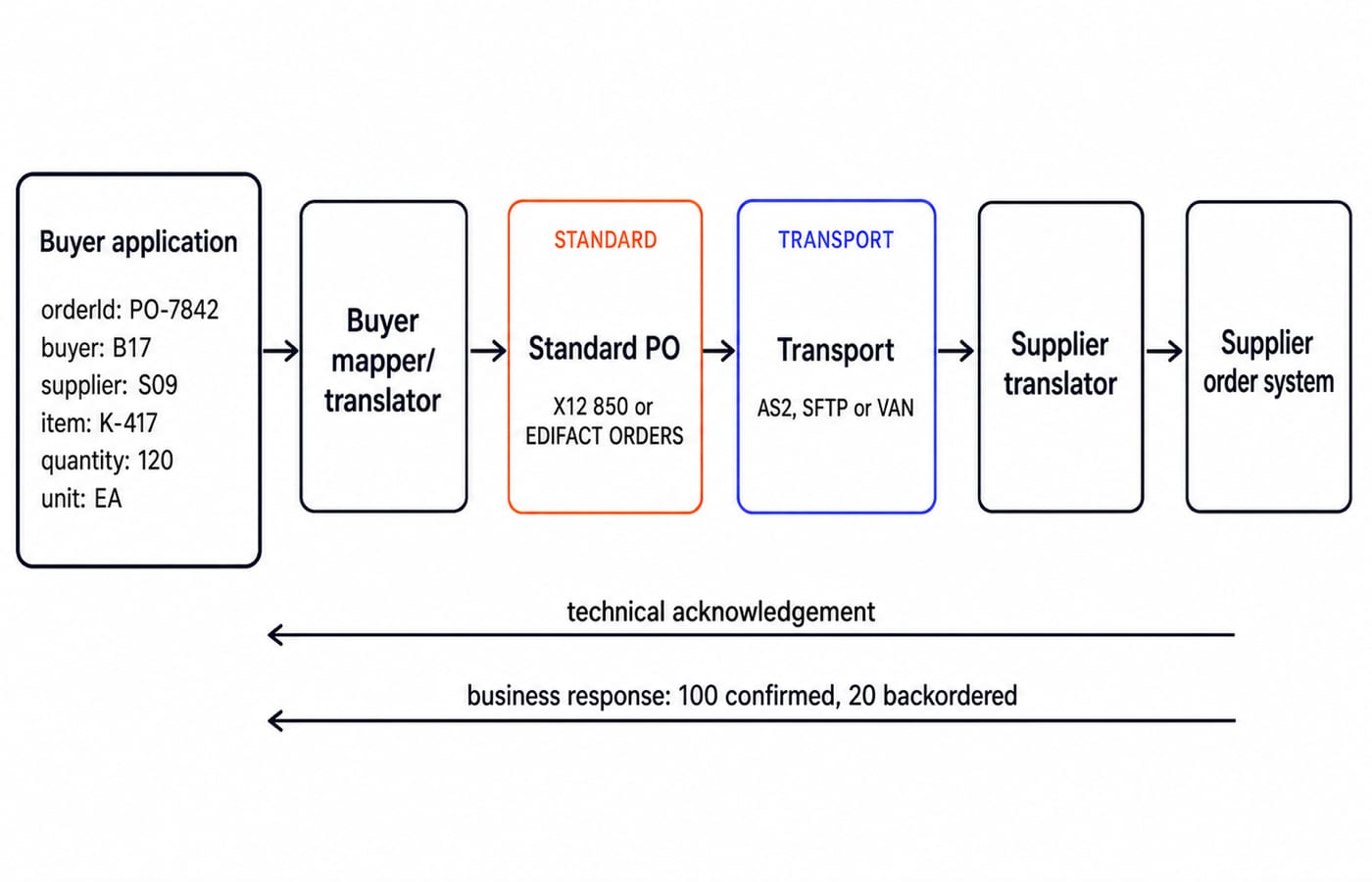
Read the flow as business application -> mapping or translator -> standard message and envelope -> transport or network -> partner translator and application. In order, the layers own data, map fields, control syntax and meaning, carry, validate and post.
The buyer stores {orderId: PO-7842, buyer: B17, supplier: S09, item: K-417, quantity: 120, unit: EA}. Its mapper builds the order. Partner, document and control IDs support routing, correlation and duplicate detection. Syntax validation checks fields, types and codes.
Widely used ASC X12 messages include 850 purchase order, 855 purchase-order acknowledgement, 856 advance ship notice and 810 invoice. Corresponding UN/EDIFACT messages are ORDERS, ORDRSP, DESADV and INVOIC. Partners need not use the same family.
Worked example: trace PO-7842 from order to invoice
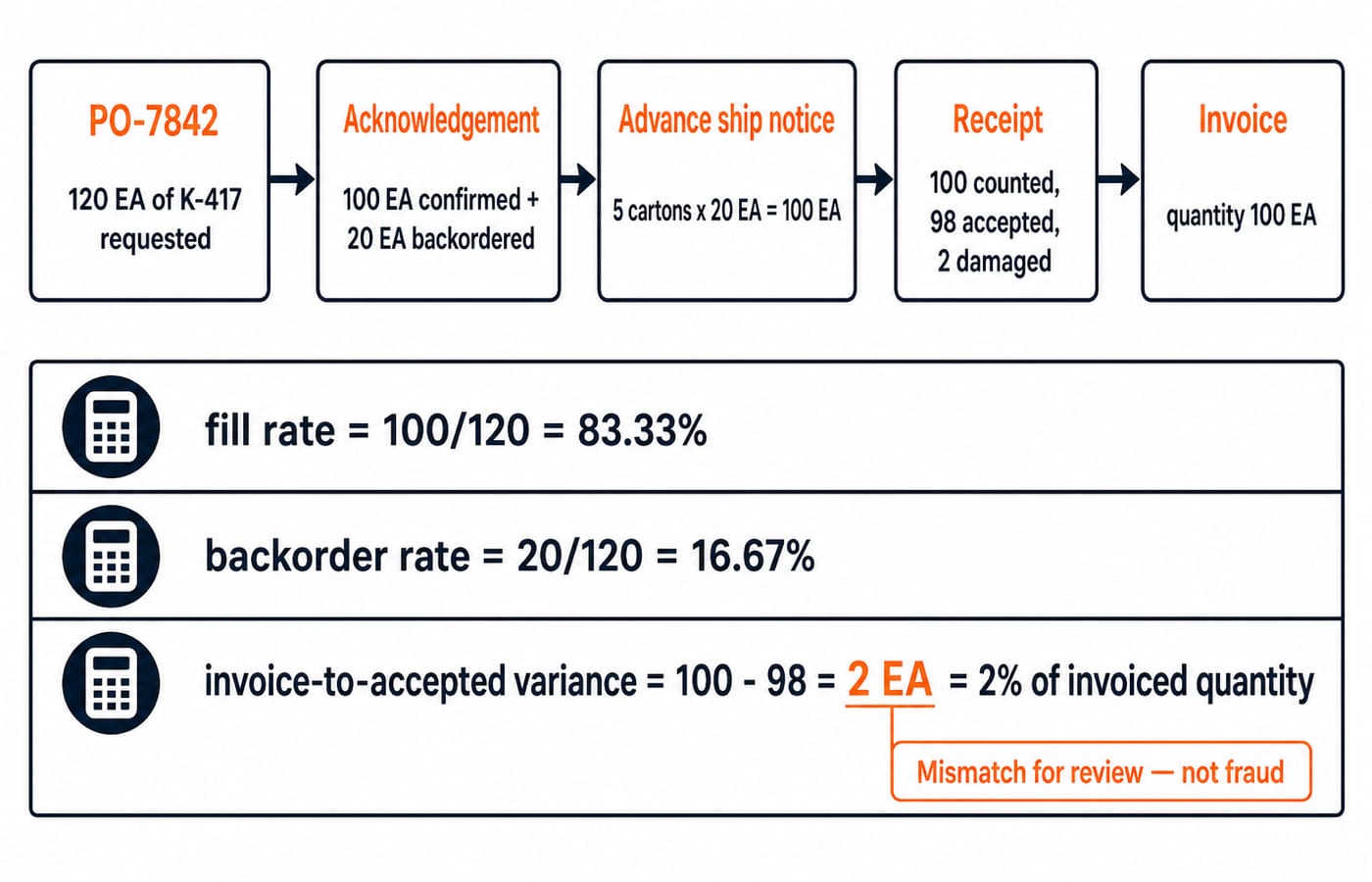
On PO-7842, B17 orders 120 EA of K-417 from S09. S09 confirms 100 EA and backorders 20. The ship notice declares 5 cartons of 20 EA. Receiving counts 100, accepts 98 and marks 2 damaged. The invoice claims 100 EA. No tolerance or workflow here is universal.
Immediate fill rate =
100 / 120 x 100 = 83.33%.Backorder rate =
20 / 120 x 100 = 16.67%.Shipment quantity =
5 x 20 = 100 EA.Physical-count match against the ship notice =
100 / 100 x 100 = 100%.Accepted share =
98 / 100 x 100 = 98%.Rejected or damaged share =
2 / 100 x 100 = 2%.Invoice-to-accepted quantity variance =
100 - 98 = 2 EA, which is2 / 100 x 100 = 2%of the invoiced quantity.
The order requests, the acknowledgement confirms or changes, the ship notice describes dispatch, the receipt records arrival and acceptance, and the invoice requests settlement. The sequence is not universal. The 2 EA mismatch enters the agreed exception process. It proves neither fraud nor which record is wrong.
Mapping, validation, envelopes and acknowledgements solve different problems
Mechanism | Question answered | Example for PO-7842 | Failure it catches |
|---|---|---|---|
mapping | where does each internal field go? |
| wrong or missing field transformation |
syntax validation | does the message obey the chosen standard and partner guide? | quantity is numeric and unit is EA | malformed or disallowed values |
envelope and control number | who sent what, to whom, and is it a duplicate? | sender B17, receiver S09, unique control ID | routing and duplicate-processing errors |
technical acknowledgement | was the message received and syntactically processed? | PO payload accepted by the receiver's EDI gateway | transport or syntax rejection |
business acknowledgement | will the supplier fulfil the request? | 100 confirmed, 20 backordered | commercial acceptance or quantity change |
A transport receipt shows arrival. A technical acknowledgement reports a processing stage. Neither means S09 accepted all 120 EA. The business response does.
If PO-7842 with control ID C00421 arrives twice, the agreed process should detect the retry instead of creating two orders. A document number alone is not always the duplicate key.
Keep standard, transport and security controls separate
A VAN is an intermediary network or mailbox. AS2 sends payloads over HTTP with agreed security and receipts. SFTP uses an SSH-protected channel. Application Layer Protocols: DNS and HTTP explains the HTTP substrate beneath AS2. It is not the document standard.
Separate four questions: X12 or UN/EDIFACT defines document representation; AS2, SFTP or a VAN carries it; mapping connects internal and standard fields; an acknowledgement reports a technical or business state.
Confidentiality protects contents, integrity detects alteration, authentication checks the party, and access control limits processing. Non-repudiation evidence supports accountability where the mechanism and legal agreement provide it. Audit logs preserve a trace. Encryption cannot fix an invalid quantity. Valid syntax can carry a business error.
Benefits, costs and definition traps
Less re-entry can reduce transcription errors. Validation rejects malformed data early, correlation speeds exceptions, and automation improves consistency. These benefits guarantee neither zero errors nor savings.
Costs include onboarding, mapping and partner-guide maintenance, testing, identifier and key operations, monitoring, exception queues and application changes. Standards reduce ambiguity, but bilateral rules remain.
EDI is structured machine exchange, not every electronic message.
A document standard is not a transport protocol.
A technical receipt is not business acceptance.
Syntax validity is not business correctness.
A VAN is an intermediary service, not the EDI document.
EDI can be batch or near-real-time, so electronic does not always mean instant.
If a question uses the word transaction, first decide whether it means a business document exchange or a database transaction.
Exam-focused EDI: core principles and practice
Questions commonly test scenario definitions, document order, message purpose, standard versus transport, acknowledgement choice, mapping failures and fulfilment calculations. The UGC NET Computer Science Syllabus Areas guide gives the broader map. Verify syllabus, marks, dates or format in the exam body's current official notice.
EDI's core principles are:
EDI exchanges structured business documents.
Mapping connects internal data to a standard.
Transport carries the message.
Acknowledgements report technical or business states.
The 2 EA mismatch in PO-7842 is an exception signal, not proof of intent or fault.
For retrieval practice, redraw the layers with 108 of 120 EA confirmed, 6 cartons of 18 EA, 105 accepted and 3 damaged. Results: fill rate 108 / 120 x 100 = 90%, backorder rate 12 / 120 x 100 = 10%, accepted share 105 / 108 x 100 = 97.22%, and, for a 108 EA invoice, variance 108 - 105 = 3 EA = 2.78% of invoiced quantity.
Recompute without looking back, then explain each acknowledgement. Use the UGC NET CS Test Series to test the distinction between document standard, transport and business response in mixed questions.
Go deeper with the full courseUGC NET Computer Science (Paper 1 + Paper 2)
Keep learning

Electronic Data Interchange (EDI) and E-Commerce: Layers, X12 Segments and Legal Validity Explained
Learn EDI from the business document to the X12 envelope, then follow it through a VAN, a 997 acknowledgment, signature verification and Indian cyber law.
Updated 26 Oct 20265 min readGATE Strategy & Roadmap

Electronic Data Interchange and E-Commerce: Secure Workflows, Cyber Law and Worked Examples
Follow purchase order PO7421 through mapping, secure transport, acknowledgements, validation, replay protection, invoicing, and audit evidence.
Updated 1 Aug 20266 min readGATE Strategy & Roadmap

SRS Document Structure and Standards: A Worked Lab Booking Specification
Build a small campus lab booking SRS, turn vague statements into testable requirements, and trace each important requirement to a worked acceptance check.
Updated 19 Sep 20266 min readUGC NET Computer Science
Behavioral and Interaction UML Diagrams: Types, Notation and a Worked Order Flow
Learn how activity, state machine, sequence and communication diagrams answer different questions by tracing the same order, payment and stock values.
Updated 30 Oct 20266 min readProgramming Languages Survey