Software Engineering Basics Explained: SDLC, Process Models and Worked Example
Learn how software engineering extends beyond coding, how major process models differ, and how to choose and apply one in a constructed student portal project.
KnowledgeGate Team
Exam prep & CS education
Updated 21 Sep 20266 min read
Knowing the names Waterfall, Spiral and Agile is not enough if you cannot explain what engineering adds beyond coding or trace a change from need to release. Software engineering connects requirements, design, implementation, quality evidence, release and maintenance through a managed process. In a six-week student portal project, changing one quiz rule affects the baseline, design, boundary tests and release notes, while payment integration needs early risk reduction. If you are revising this topic for UGC NET, start from the UGC NET Preparation Courses and Test Series.
Related reading: Estimation and scheduling and Software process models.
1. Software engineering is broader than programming
Software engineering is the disciplined planning, construction, checking, delivery and evolution of software under constraints. Programming translates design into code. Engineering also covers requirements, architecture, testing, deployment, maintenance, risk, cost and coordination. Programming remains essential, and a small script need not carry enterprise ceremony.
Keep these terms separate:
A software product is the system and associated artefacts delivered.
A project is the bounded effort that creates or changes the product.
A software process is the activities and controls used.
A process model organises their order, overlap, repetition and feedback.
A method is an activity technique, such as a requirements use case.
A tool supplies automation, such as version control.
These distinctions support project reasoning. For teaching-exam recall across SDLC phases, requirements, design and testing levels, see Software Engineering for CS Teaching Exams.
2. The SDLC connects activities to concrete artefacts
The software development life cycle is an activity map, not one compulsory sequence. It covers problem and feasibility, requirements, design, implementation, testing, deployment, operation and maintenance. Sources may split, merge or rename stages. Focus on each activity’s purpose and output.
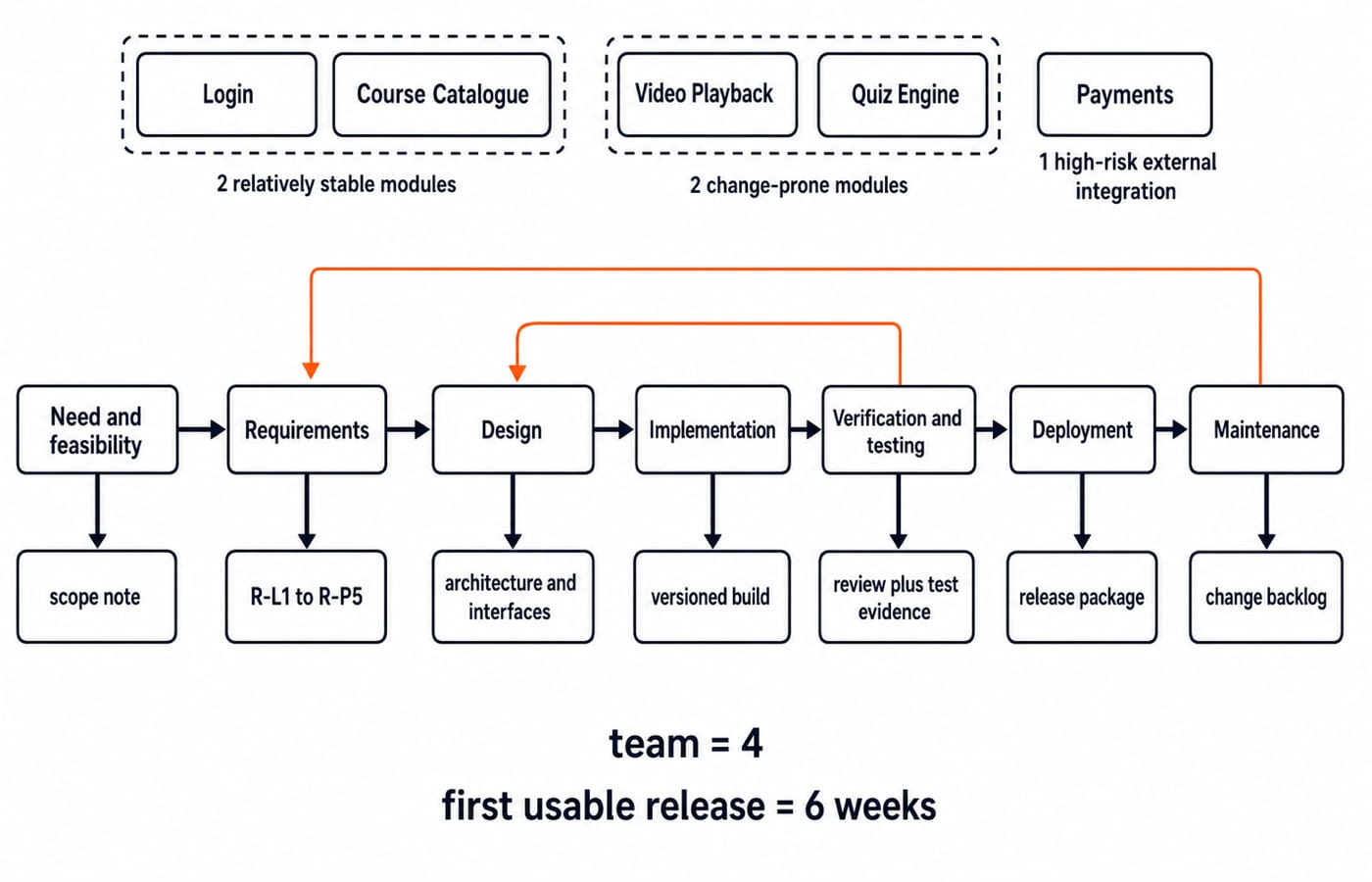
Consider a student portal with five modules: Login, Course Catalogue, Video Playback, Quiz Engine and Payments. A four-person team must produce its first usable release in six weeks. Login and catalogue requirements are relatively stable. Quiz rules and video analytics are expected to change. External payment integration is the main technical risk.
The lifecycle carries decisions through artefacts: a scope note; requirements R-L1 to R-P5; architecture and interfaces; versioned builds; review and test evidence; a release package and operating notes; then a change backlog. Each preserves a decision so later work can be checked or changed.
3. Process models change where feedback, delivery and risk occur
Process models arrange these activities differently.
Model | Organising idea | Best-fit signal | Main trap |
|---|---|---|---|
Waterfall | Phase baselines | Stable requirements | Banning feedback |
V-model | Pair development and tests | Early test planning | Memorising a diagram |
Throwaway prototype | Clarify, then discard | Uncertain requirements | Shipping it |
Evolutionary prototype | Refine into product | Learning through versions | Design debt |
Incremental | Deliver usable slices | Early capability | Unfinished slices |
Iterative | Improve a version | Refinement | Equating it with incremental |
Spiral | Risk-driven loops | Major risk | Circular Waterfall |
Agile approaches | Short adaptive cycles | Frequent feedback | Assuming no discipline |
In the V-model, user needs pair with acceptance testing, system requirements with system testing, architecture with integration testing, and module design with unit testing. Implementation sits at the bottom. Labels vary, but early test planning and corresponding levels are reliable ideas.
Incremental asks, “What capability is added?” Iterative asks, “What capability is refined?” A project can be both. Prototypes can be discarded or evolved. Spiral reduces major risks. Agile still needs design, tests and documentation. No model is universally best. Stability, risk, delivery need, stakeholder access and team capability determine fit.
4. Worked example: trace a requirement change through the SDLC
Portal requirement R-Q1 originally allows a learner to pass at a score of 60 or above and limits the learner to two attempts. A review changes the threshold to 70 and the limit to three attempts. Treat that decision as change request CR-07, then follow it through every affected artefact.
Artefact | Original baseline | After CR-07 | Evidence |
|---|---|---|---|
Requirement | R-Q1 v1: score at least 60; two attempts | R-Q1 v2: score at least 70; three attempts | Approved change record and version history |
Design | Quiz rule stores threshold 60 and limit 2 | Threshold becomes 70 and limit becomes 3 | Trace from R-Q1 v2 to the rule component |
Implementation | Pass when score is at least 60; allow another attempt while fewer than 2 have been used | Pass when score is at least 70; allow another attempt while fewer than 3 have been used | Code review references CR-07 |
Verification | Boundary tests around 60 and the second attempt | 69 fails, 70 passes; a third attempt is allowed and a fourth is blocked | Automated boundary tests |
Validation | Stakeholder sees the two-attempt flow | Stakeholder accepts the three-attempt flow and revised pass rule | Acceptance demonstration |
Release | Portal release baseline contains R-Q1 v1 | The next release note names R-Q1 v2 and CR-07 | Versioned build and release record |
Changing only the code would leave the requirement, design, tests and release record inconsistent. Changing the full trace keeps verification tied to the specification and gives validation a clear stakeholder decision to confirm.
The boundary values carry the requirement precisely. A score of 69 must fail and 70 must pass. When two attempts have already been used, the third remains available; after three have been used, a fourth is blocked.
5. Apply an incremental model to the six-week portal release
Frequent usable delivery and changing quiz rules favour an incremental dominant approach, while payment uncertainty deserves an early proof of concept. For a weighted selection method and a risk-exposure calculation, use Software Process Models in Software Engineering: How to Choose with a Worked Example. After selection, CR-07 propagates through the portal requirements, design, tests and release artefacts.
Divide the release into three complete two-week increments:
Weeks 1-2: deliver Login and Course Catalogue, and run a sandbox proof of concept for the payment provider.
Weeks 3-4: deliver Video Playback and Quiz Engine version 1 with R-Q1 v2 and its boundary tests.
Weeks 5-6: deliver Payments, cross-module integration and release hardening.
Each increment must pass its checks before becoming the next baseline. Three unfinished technical layers are not three increments. Waterfall would control CR-07 against a phase baseline, the V-model would update the mapped test levels, Spiral would centre the payment risk, and an Agile team would express the quiz change through revised acceptance criteria.
The resulting plan delivers a usable first slice, absorbs the quiz change before its increment begins and investigates payment uncertainty early. These borrowed feedback and risk-reduction practices do not change the dominant incremental classification.
6. Verification, validation and maintenance close the loop
Verification asks whether artefacts and code satisfy the specification. Review the score >= 70 rule, inspect its design mapping, and run the 69 and 70 boundary tests. Reviews, static analysis and tests provide evidence.
Validation asks whether the quiz rule and three-attempt flow meet the stakeholder’s assessment need. Demonstrations and acceptance use provide evidence.
Maintenance continues the lifecycle:
Corrective: fix a payment callback defect.
Adaptive: update the integration when the provider changes its API.
Perfective: improve video-search usability or performance.
Preventive: refactor brittle quiz-rule code before it causes failures.
Configuration management and traceability connect the rule, commit, tests and release note. A maintainer can reconstruct why 70 and 3 attempts became the baseline.
7. Common traps and how exams test the basics
Trap | What goes wrong | Correction |
|---|---|---|
Engineering equals coding | Other concerns vanish | Coding is one activity |
SDLC equals Waterfall | Activities become one model | Models arrange SDLC |
Waterfall forbids feedback | Claim becomes absolute | Feedback can occur |
Incremental equals iterative | Two ideas merge | Added versus improved |
Every prototype ships | Throwaway work disappears | Check its purpose |
Spiral repeats Waterfall | Risk disappears | Follow risk |
Agile has no documents or tests | Discipline disappears | Keep useful evidence |
Verification equals validation | Two checks merge | Specification versus need |
Questions may ask you to order activities, match artefacts, select from a scenario, pair V-model levels, distinguish cues or interpret a matrix. Uncertain payment technology with repeated risk review suggests Spiral. Usable modules every two weeks suggests Incremental.
8. Software engineering basics: the short version and next step
Recall the chain from need to requirements, design, code, evidence, release and change. A process model determines where activities repeat, overlap and accept feedback. Test traceability by changing one requirement and naming every design rule, code path, boundary test, acceptance check and release record that follows. For structured Computer Science coverage, use NTA-UGC-NET Paper 2 Complete Course. For placement-focused basics, use CS Fundamentals for Placements by Sanchit Sir.
Keep learning
ICT in Education MCQs: 12 Solved Questions on Digital Learning Tools
Solve 12 ICT in Education MCQs, then use clear explanations and a five-layer model to separate files, tools, platforms and public initiatives.
Updated 3 Oct 20268 min readUGC NET Computer Science
Requirements Elicitation Techniques and Use Case Development: Worked Library Example
Follow a fictional library reservation from interviews and observation through testable requirements, a UML use-case model, UC-07, and acceptance checks.
Updated 28 Sep 20266 min readUGC NET Computer Science
Quality Factors: McCall’s and ISO 9126 Models with a Worked Scoring Example
Build both quality models around one maintainability audit. This guide maps their vocabulary, calculates McCall-style and ISO-style scores, and ends with exam-focused checks.
Updated 25 Sep 20265 min readUGC NET Computer Science
Cohesion and Coupling MCQs: 10 Solved Questions on Functional Independence
Practise 10 solved MCQs on cohesion, coupling, functional independence, module dependencies, and the distinctions that make closely matched options easier to separate.
Updated 24 Sep 20267 min readUGC NET Computer Science