Agile Process Models MCQs: 12 Solved Questions on XP, Scrum and Adaptive Development
Solve 12 published agile process model MCQs, then use the explanations to separate Scrum roles, XP practices, adaptive planning, FDD order and agile values.
KnowledgeGate Team
Exam prep & CS education
Updated 17 Sep 20267 min read
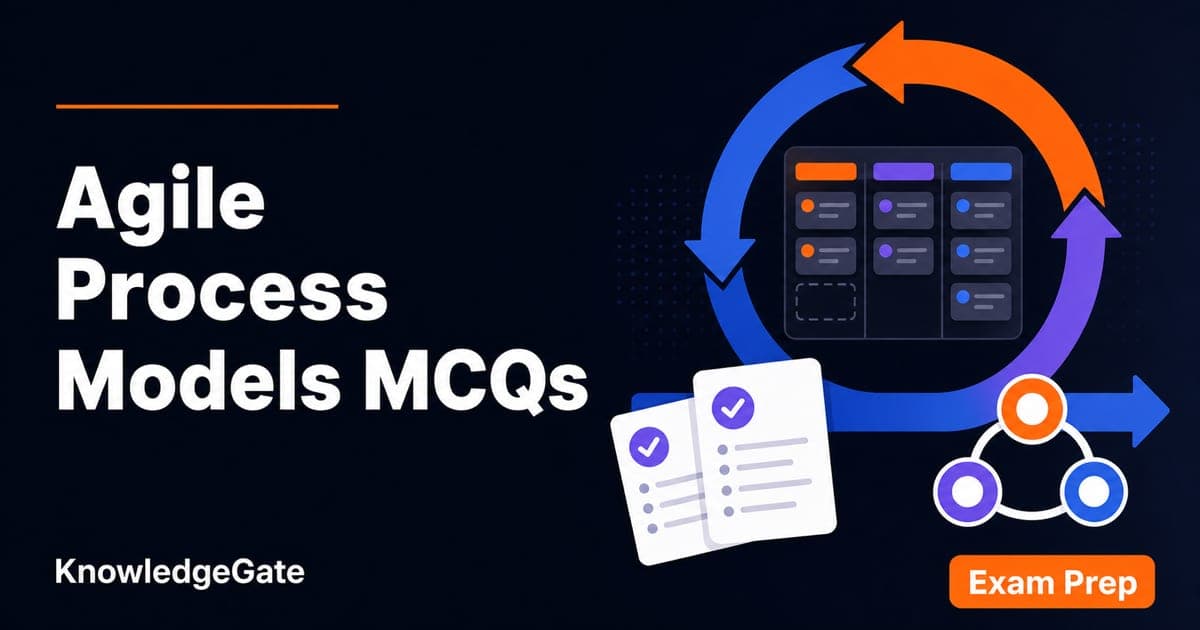
Agile MCQ distractors mix values, lifecycle traits, roles and named practices. Memorising only “iterative” can blur Scrum, XP, adaptive development, FDD and generic incremental models.
Principles, model identification, XP practices, Scrum roles and process sequences use different cues. Short increments signal adaptation, named roles and backlogs signal Scrum, while pairing and test-first development signal XP. KnowledgeGate has over 20 Agile Process Models questions for further practice through UGC NET CS Exam Preparation.
Agile, Scrum, XP and adaptive development: model cues at a glance
Model or idea | Exam cue | Do not confuse it with |
|---|---|---|
Agile values | Change, collaboration, working increments | Banning plans, contracts or documentation |
Scrum | Product Owner, backlogs, sprint | XP practices |
XP | Pairing, test-first work, CRC cards, spikes | Scrum roles |
Adaptive software development | Time-boxed release planning | An unchangeable plan |
FDD | Model, list, plan, design, build | Generic increments |
In exam mappings, adaptive development pairs with time-boxed release planning, while FDD follows the model, list, plan, design and build sequence.
Now calibrate the cues. A team has a two-week sprint, recent velocity of 13 story points, and this ordered backlog: login hardening 8, audit export 5, refund validation 3, colour-theme polish 2.
The initial forecast takes login hardening and audit export:
8 + 5 = 13points.On day 5, a new 3-point refund rule appears. Adding it would make
13 + 3 = 16, which is 3 points beyond the 13-point forecast. The Product Owner orders the product backlog; the team does not silently add all 3 points to an already full forecast.Two developers pair on login hardening and write its acceptance test before implementation. Those are XP cues.
Feedback from the time box informs the next release plan. That is the adaptive cue.
Story points are relative estimates, not hours. A 13-point forecast, Product Owner and sprint backlog suggest Scrum. Pair programming and test-first work suggest XP. Revising a time-boxed plan after feedback suggests adaptation. For the wider syllabus connection, use Software Engineering for CS Teaching Exams.
Agile MCQs 1-2: unpredictability and core principles
Question 1: managing unpredictability
How do you create agile processes to manage unpredictability?
A. Requirements gathering must be conducted very carefully.
B. Risk analysis must be conducted before planning takes place.
C. Software increments must be delivered in short time periods.
D. Software processes must not adapt to changes incrementally.
Choose the correct answer from the options given below:
A. A only
B. B only
C. C only
D. D only
Correct answer: C. C only.
Unpredictability is the cue. Short deliveries expose errors and renew planning, so C supplies feedback. A and B are upfront gates; D rejects adaptation.
Question 2: the plan is not untouchable
Which of the following is not one of the principles of agile software development method?
A. Customer involvement
B. Embrace change
C. Incremental delivery
D. Following the plan
Correct answer: D. Following the plan.
Customer involvement, change and incremental delivery preserve feedback. D is the exception because agile plans are revisable, not absent.
Agile MCQs 3-4: match the model to its identifying cue
Question 3: model and task matching
Match the Agile Process models with the task performed during the model:
Choose the correct option from those given below:
A.
B.
C.
D.
Correct answer: A. .
Scrum maps to sprint backlog, leaving A or C; FDD’s action-result-object form confirms A. The other pairs are adaptive development with time-box release plan and XP with CRC cards.
Question 4: classification versus one shared trait
Which of the following are Agile Process Models?
(A) Extreme Programming (XP)
(B) Waterfall
(C) Scrum
(D) Spiral
(E) Incremental
Choose the correct answer from the options given below:
A. (A) and (C) Only
B. (B) and (C) Only
C. (A) and (D) Only
D. (B) and (E) Only.
Correct answer: A. (A) and (C) Only.
XP and Scrum are named agile methods. Waterfall is sequential; iteration or increments do not classify Spiral or Incremental as Agile Process Models here.
XP and Scrum MCQs 5-6: practices versus framework terms
Question 5: XP activities and practices
Match the problem domains in GROUP I with the solution technologies in GROUP II
GROUP I GROUP II
(P) XP – Planning (1) tests are derived from user stories
(Q) XP – Design (2) Encourages “pair programming”
(R) XP – Coding (3) suggests the creation of “spike solutions”
(S) XP – Testing (4) Begins with the creation of a set of stories
A. P-1, Q-2, R-3, S-4
B. P-3, Q-4, R-2, S-1
C. P-3, Q-1, R-4, S-2
D. P-4, Q-3, R-2, S-1
Correct answer: D. P-4, Q-3, R-2, S-1.
XP planning starts with stories; design uses spikes; coding encourages pairing; tests derive from stories. Thus P-4, Q-3, R-2, S-1. Anchoring R-2 and S-1 leaves D.
Question 6: cycle, list, role or activity
Scrum is an agile software development method, in which, within each framework activity, work tasks occur within a process pattern called __________.
A. Sprint
B. Demo
C. Backlog
D. Scrum master
Correct answer: A. Sprint.
A sprint is the time-boxed cycle. A backlog is a list, Scrum Master a role, and demo an activity: cycle = sprint, list = backlog, role = Scrum Master.
Scrum and agile lifecycle MCQs 7-8: ownership and sequence
Question 7: product backlog ownership
A product backlog in Scrum is owned by
A. Developer
B. Product Owner
C. Scrum Master
D. Stakeholder
Correct answer: B. Product Owner.
The Product Owner manages backlog order. Developers plan delivery, the Scrum Master supports Scrum, and stakeholders give feedback. Ownership does not mean assigning implementation.
Question 8: agile process sequence
Arrange the following phases of the Agile process in the correct sequence:
(A) Design
(B) Release
(C) Testing
(D) Development
(E) Planning
Choose the correct answer from the options given below:
A. (A), (B), (D), (E), (C)
B. (A), (D), (E), (B), (C)
C. (E), (A), (D), (C), (B)
D. (E), (D), (A), (C), (B)
Correct answer: C. (E), (A), (D), (C), (B).
Translate: Planning (E), Design (A), Development (D), Testing (C), Release (B). This gives E-A-D-C-B, option C, repeated in short cycles.
Process-sequence MCQs 9-10: FDD order and agile stages
Question 9: FDD order
Arrange the following steps of Feature Driven Development (FDD) in the correct sequence:
(A) Develop an overall model
(B) Build by feature
(C) Plan by feature
(D) Design by feature
(E) Build a feature list
Choose the correct answer from the options given below:
A. (A), (C), (B), (E), (D)
B. (A), (E), (C), (D), (B)
C. (B), (A), (D), (E), (C)
D. (A), (B), (C), (E), (D)
Correct answer: B. (A), (E), (C), (D), (B).
FDD develops a model (A), lists features (E), then plans (C), designs (D) and builds (B): A-E-C-D-B.
Question 10: stage versus ongoing activity
Which of the following is NOT a stage of agile software development approach?
A. Documenting
B. Exploration
C. Maintenance
D. Planning
Correct answer: A. Documenting.
Here, exploration, planning and maintenance are stages; documenting is ongoing. A tests lifecycle vocabulary, not a documentation ban.
Agile MCQs 11-12: manifesto language and iterative builds
Question 11: reading “over” correctly
Which of the following is a fundamental principle of Agile methodology ?
A. Detailed documentation is prioritized over working software
B. Customer collaboration over contract negotiation
C. Following a fixed plan over responding to changes
D. Working software is not delivered until after the final version
Correct answer: B. Customer collaboration over contract negotiation.
B states the agile preference. A and C reverse priorities; D blocks increments. “Over” means priority during trade-offs, not banning contracts, plans or documentation.
Question 12: use every cue in the stem
Which software process model uses an iterative approach with incremental builds ?
A. V-Model
B. Spiral Model
C. Waterfall Model
D. Agile Model
Correct answer: D. Agile Model.
Iteration plus incremental builds points to Agile. Waterfall and V-Model are plan-driven; Spiral centres risk. Incremental builds separates D.
Answer-pattern recap and the next practice step
Recall: Product Owner or sprint backlog -> Scrum; pairing, CRC cards or spikes -> XP; time-box release plan -> adaptive development here; model -> list -> plan -> design -> build -> FDD; and collaboration, change or short increments -> agile values.
Score 10-12: try timed mixed practice. Score 7-9: redo missed cues. Score 0-6: rebuild the map. Next, use IBPS SO IT Officer: Software Engineering Professional Knowledge, the NTA-UGC-NET Paper - 2 complete course, or the UGC NET Computer Science and Applications Test Series.
Keep learning

ICT in Education MCQs: 12 Solved Questions on Digital Learning Tools
Solve 12 ICT in Education MCQs, then use clear explanations and a five-layer model to separate files, tools, platforms and public initiatives.
Updated 3 Oct 20268 min readUGC NET Computer Science
Requirements Elicitation Techniques and Use Case Development: Worked Library Example
Follow a fictional library reservation from interviews and observation through testable requirements, a UML use-case model, UC-07, and acceptance checks.
Updated 28 Sep 20266 min readUGC NET Computer Science
Quality Factors: McCall’s and ISO 9126 Models with a Worked Scoring Example
Build both quality models around one maintainability audit. This guide maps their vocabulary, calculates McCall-style and ISO-style scores, and ends with exam-focused checks.
Updated 25 Sep 20265 min readUGC NET Computer Science
Cohesion and Coupling MCQs: 10 Solved Questions on Functional Independence
Practise 10 solved MCQs on cohesion, coupling, functional independence, module dependencies, and the distinctions that make closely matched options easier to separate.
Updated 24 Sep 20267 min readUGC NET Computer Science