SBI PO Mains Quant Practice Plan: From Arithmetic to DI
Turn percentage, ratio and average skills into reliable DI setups. This six-week plan builds calculation control, caselet translation and set selection.
KnowledgeGate Team
Exam prep & CS education
Updated 2 Aug 20265 min read

You may solve percentage, ratio, average, profit-loss and time-work questions quickly, yet lose minutes deciding what a DI caselet means and what to calculate first. In SBI PO Mains the quantitative load sits inside Data Analysis and Interpretation rather than a separate arithmetic section, so arithmetic earns marks only through a caselet you have already translated. The six weeks below run at eight to twelve hours a week and end with you choosing sets, not only solving them.
1. Start with a two-part baseline, not another full mock
On Day 1, spend 40 minutes on 20 questions from these high-yield Bank PO quant topics. Break for 10 minutes, use 30 minutes for two five-question DI sets, then tag attempted, correct, calculation errors, setup errors and questions abandoned after two minutes. Total: 90 minutes.
The threshold here is 17 of 20, or 85%. Below it, run the Weeks 1 and 2 arithmetic block in full. At or above it, if either DI set carries two or more setup errors, shorten revision and translate more caselets into tables. Prelims speed alone does not establish Mains readiness, as this Prelims versus Mains preparation split explains.
2. Weeks 1 and 2: make arithmetic automatic
Target eight hours across six days:
Day | Work |
|---|---|
Monday to Thursday | 60 minutes daily on one core pair: percentage-ratio, averages-mixtures, profit-loss-interest, or time-work-pipes |
Friday | 90 minutes for 30 mixed questions |
Saturday | 60-minute drill, 60-minute review, 30-minute formula recall |
Sunday is a buffer. The total is 4 x 60 + 90 + 150 = 480 minutes = 8 hours.
Now turn arithmetic into a table that could appear inside DI:
Outlet | Revenue (Rs lakh) | Cost rate | Cost (Rs lakh) | Profit (Rs lakh) |
|---|---|---|---|---|
A | 240 | 75% |
|
|
B | 300 | 72% |
|
|
C | 360 | 80% |
|
|
Total revenue is 240 + 300 + 360 = 900 lakh. Cost is 180 + 216 + 288 = 684 lakh and profit is 900 - 684 = 216 lakh. The profit share is 216 / 900 x 100 = 24%. Apply percentages outlet by outlet before combining totals.
Finish with five minutes of 10% and 1% anchors, 1/8 = 12.5%, 3/8 = 37.5%, and one reverse-percentage calculation.
3. Weeks 3 and 4: translate arithmetic into DI
Use four 90-minute weekday sessions and two 120-minute weekend sessions, exactly 10 hours. A 90-minute session has 20 minutes of recall, 45 minutes for one untimed and one timed DI set, and 25 minutes to check setup before answers. Alternate tables, bar or line data, and prose caselets. Train representation, not chart decoration.
A bank receives 800 applications. Rural applications are 800 x 45% = 360; non-rural applications are 800 - 360 = 440. Non-rural women are 440 x 35% = 154, leaving 440 - 154 = 286 other non-rural applicants.
Group | Total | Women | Remaining applicants |
|---|---|---|---|
Rural | 360 | Unknown | Unknown |
Non-rural | 440 | 154 | 286 |
Keep unavailable rural cells unknown. In three passes, mark the base and unit, turn relationships into rows or equations, then calculate only what is needed.
4. Weeks 5 and 6: practise selection and recovery
Week 5 is exactly 10 hours: three 90-minute mixed days give 4.5 hours, two 75-minute repair days give 2.5 hours, and one 180-minute simulation plus review gives 3 hours. In Week 6, add two 60-minute caselet blocks only if recovery and accuracy are stable, reaching 12 hours.
On a mixed day, scan three sets for 90 seconds, choose two, and give the first a 24-minute block. Spend the remaining time on the second set and on slowdown notes.
Attempt a set when totals and units are clear, relationships fit two or three equations, and the first questions share calculations. Defer hidden bases, changing units and long dependency chains. The SBI PO Mains course carries the Data Analysis and Interpretation sets to practise this on.
After one missed day, move a 45-minute repair block to Sunday and keep the simulation. Never double tomorrow's volume. After two, repeat the week.
5. DI caselet: from raw text to three answers
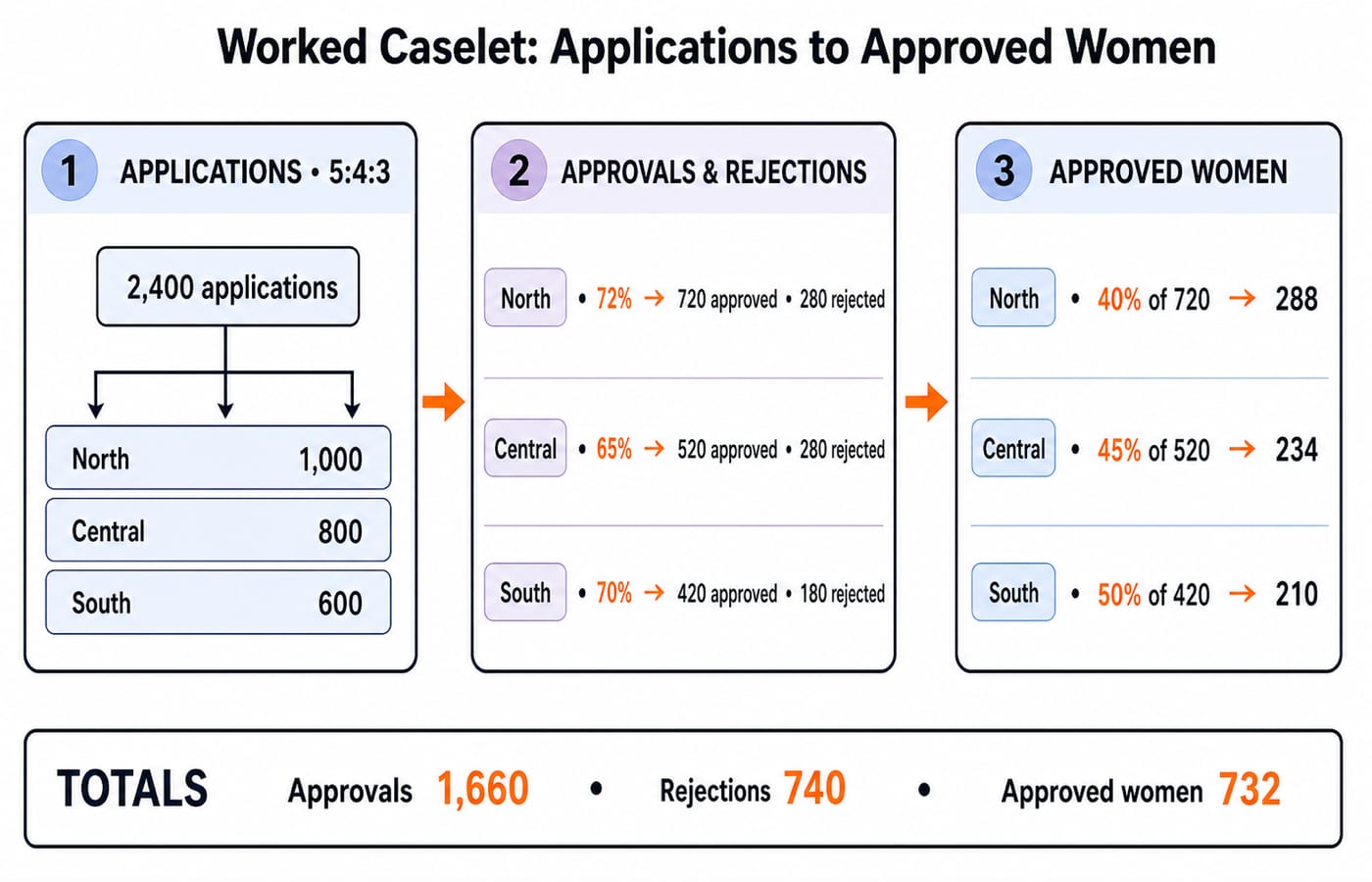
A bank processes 2,400 applications across North, Central and South in the ratio 5:4:3. Approval rates are 72%, 65% and 70%; women's shares of approvals are 40%, 45% and 50%.
There are 5 + 4 + 3 = 12 parts, so each part is 2,400 / 12 = 200.
Zone | Applications | Approvals | Rejections | Approved women |
|---|---|---|---|---|
North |
|
|
|
|
Central |
|
|
|
|
South |
|
|
|
|
Total | 2,400 | 1,660 | 740 | 732 |
Now answer three questions:
Total rejections are
2,400 - 1,660 = 740.Approved women as a percentage of all applications are
732 / 2,400 x 100 = 30.5%.A 10% relative rise in Central approvals gives
520 x 1.10 = 572, up 52. A 10 percentage-point rate rise instead gives 75%, or800 x 75% = 600approvals.
6. Quant error log: review by error type, not only score
Log seven columns: date, set or topic, selected or skipped, setup, error type, lost minutes and next repair drill. Use five labels: reading, base selection, representation, calculation and set selection.
If 24 of 30 attempts are correct, accuracy is 24 / 30 x 100 = 80%. If four errors are representation and two are calculation, use two of the next five blocks for translation and one for arithmetic repair, not 100 random questions.
Track median setup time separately. Progress includes choosing workable sets, writing fewer values and repeating fewer calculations.
7. Four correction rules when the plan stalls
Below 85% across two 20-question drills, repeat the weak arithmetic pair and postpone one DI format.
With sound arithmetic but two setup failures per set, translate three untimed caselets before restarting the timer.
If only timed accuracy falls, do one set plus full review next.
If you abandon solvable sets, repeat the 90-second scan and explain each choice.
Reject shortcuts without a base calculation, attempting every set in order, and mocks without source-error review. If Prelims arithmetic is still shaky, the SBI PO bundle covers both papers in one plan. Wider banking preparation sits under Banking and Insurance.
8. The short version and the next session
Weeks 1-2 build arithmetic at 8 hours, Weeks 3-4 translate it into DI at 10, and Weeks 5-6 add selection and timed sets at 10 to 12. Recover a miss with one buffer block, not a double session.
Take the 90-minute baseline, tag every miss, then schedule only the first seven days. Exact marks, sectional timing and stage dates come from the current notice on the State Bank of India Careers current-openings page.
Keep learning
SBI SO Cutoffs: Check Corrections and Build a Practice Target
A cutoff becomes useful only when its post, category and score basis match your comparison. Work through a real SBI correction and a hypothetical target-setting exercise to plan your next mocks.
5 Oct 20264 min readSBI Exams
SBI SO Syllabus: Section-by-Section Study Map for IT Aspirants
Build an IT/System study map around your exact SBI post. Use a historical exam table, original worked exercises and an eight-hour sample week to turn topic lists into practice.
1 Oct 20265 min readSBI Exams
SBI SO Preparation Strategy: A 12-Week Role-Specific Plan
Build an SBI SO plan around the exact Specialist Cadre Officer post you are targeting. This guide gives an 11-hour weekly calendar, diagnostics, repair loops and separate written-test and interview branches.
Updated 24 Sep 20266 min readSBI Exams
SBI SO Exam Pattern and Marking Scheme: Post-Wise Routes Explained
There is no single SBI SO paper pattern. Use this guide to identify your post's route, understand qualifying and merit components, and build a timetable from the official notice.
Updated 22 Sep 20264 min readSBI Exams