Bank PO Quantitative Aptitude: the high-yield topics to master first
The high-yield Bank PO quant topics for IBPS and SBI: data interpretation, arithmetic, number series and simplification, with a worked DI example to follow.
KnowledgeGate Team
Exam prep & CS education
Updated 14 Jul 20265 min read65 views
Quantitative Aptitude decides a large share of bank PO results, and the aspirants who clear it are rarely the fastest calculators. They are the ones who prioritised the right topics and built a systematic method for each. For IBPS PO and SBI PO the order that pays is the same: Data Interpretation first, then the arithmetic core of percentages and ratios, then the speed topics of number series, simplification and approximation.
The exact number of quant questions, the sectional timing, and any negative marking are set in the official notification, so confirm those at ibps.in or the SBI recruitment portal. KnowledgeGate's question bank carries over 6,700 quantitative-aptitude questions, so there is no shortage of practice on exactly these patterns.
Related reading: banking arithmetic and IBPS PO syllabus.
Data Interpretation: the block to master first
If you master one area first, make it Data Interpretation. It rewards a calm, systematic reading over raw speed, and it is the one area where getting fluent changes your timing across the whole section rather than on a single question.
Tables and bar graphs are the foundation. Get fluent at reading values, totals, and differences without re-checking.
Line graphs and pie charts add percentage and proportion reasoning on top.
Caselet DI, where the data is described in a paragraph rather than a chart, tests whether you can extract structure from words.
DI is not a topic you memorise; it is a skill you build by solving sets under time. The payoff is large because a single DI set carries several questions, so fluency compounds.
A worked DI caselet: three questions from one data set
Consider this caselet. A bank branch disbursed vehicle loans worth Rs 240 lakh in January. In February the amount rose by 25% from January, and in March it fell by 12% from February. In March the branch also disbursed Rs 330 lakh in home loans and Rs 206 lakh in education loans.
Three questions follow from that data, which is how a DI set actually behaves. What was the vehicle loan amount in March? What share of total March disbursements came from vehicle loans? By what percent were March home loans higher than March vehicle loans?
For the first, take each change in sequence. February vehicle loans were 240 plus 25% of 240, and 25% of 240 is 60, so February stood at Rs 300 lakh. March was 12% below February, and 12% of 300 is 36, so March vehicle loans were 300 − 36 = Rs 264 lakh.
For the second, compute the March total once and keep it: 264 + 330 + 206 = Rs 800 lakh. Vehicle loans were 264 out of 800, and 264 ÷ 800 = 0.33, so their share was 33%.
For the third, the gap between the two categories was 330 − 264 = Rs 66 lakh. The question asks how much higher home loans were, so vehicle loans are the base: 66 ÷ 264 = 0.25, which is 25% higher.
Two habits do most of the work here. Apply every successive percentage to the running value, so the 12% fall is taken on 300 and not on the original 240, which is the single most common DI trap. And compute a total once, then reuse it, instead of rebuilding it for each part. Notice too what you never had to calculate separately: the education loan figure earned its place only inside that total.
Arithmetic: the topics that recur
A cluster of arithmetic topics appears reliably across both Prelims and Mains, and they also underpin DI and word problems, so they earn their study time twice.
Percentages, the backbone of DI and profit-loss.
Ratio and proportion, and their close relative, ages problems.
Profit, loss and discount.
Simple and compound interest, directly relevant to a banking exam.
Time, speed and distance, and time and work.
Averages, mixtures and alligation.
Master percentages and ratios first, because so many other topics reduce to them. A candidate fluent in these two solves a surprising fraction of the paper faster. Our IBPS PO and SO IT exam preparation courses cover these topics alongside the rest of the banking syllabus.
Number series, simplification and approximation
These are the speed topics, the ones that reward pattern recognition and quick estimation.
Number series. Identify the rule, arithmetic, geometric, squares, cubes, or a combination, then apply it. Speed here comes from recognising common patterns instantly.
Simplification and approximation. These test calculation fluency and the judgement to round sensibly. In approximation questions, precise arithmetic is wasted effort; smart rounding is the skill.
Quadratic equations and quantity comparison, where you compare two expressions rather than compute an exact answer.
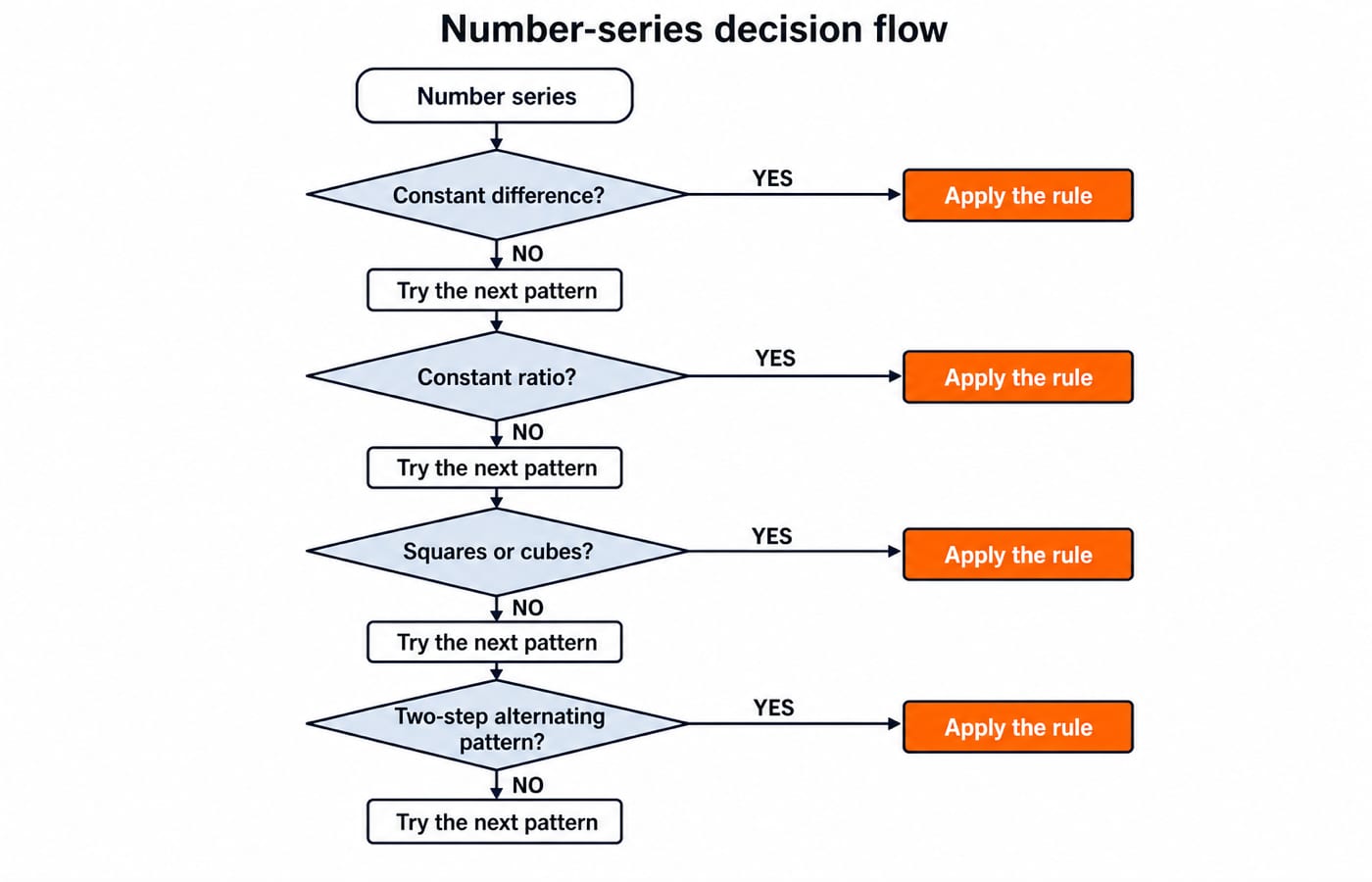
Series questions are solved by testing candidate patterns in the fixed order above, not by staring until inspiration strikes. Internalising that order is what makes these questions fast.
Building calculation speed as a habit
None of these topics pay off without underlying calculation speed, and this is the part aspirants most often neglect because it feels unglamorous. The candidates who finish the quant section on time are almost always the ones who invested in fast mental arithmetic early.
Learn tables up to at least 20, and squares and cubes of common numbers. These come up constantly inside larger problems, and pausing to compute them mid-question breaks your flow.
Practise percentage-to-fraction conversions. Knowing that 12.5% is one-eighth or that 16.67% is one-sixth turns a slow multiplication into an instant one, which matters enormously in DI.
Drill approximation deliberately. In approximation questions the examiner is explicitly rewarding sensible rounding, so treat precise calculation there as a mistake, not a virtue.
Speed built this way is quiet but decisive: it does not win you marks directly, it wins you the time to attempt more questions accurately, which is where the marks actually come from.
Bank PO quant in Prelims and Mains: what to prioritise
Prelims quant rewards speed across simpler versions of these topics; Mains quant rewards depth, heavier DI, and multi-step reasoning, and the full stage-by-stage split is worked out in Bank PO Prelims vs Mains: how to split your preparation. The prioritisation is the same for both: DI first, then core arithmetic (led by percentages and ratios), then the speed topics of series, simplification, and approximation.
Because the section is time-pressured, your goal is not to solve every question but to solve the ones you are fast and accurate on, and to recognise quickly which to skip. That judgement is itself trained by timed practice.
Your next step
Master Data Interpretation first, build fluency in percentages and ratios as the arithmetic core, and treat series, simplification, and approximation as trainable speed topics. Above all, solve under a clock and write down each intermediate value so the common percentage-base trap never catches you.
Our structured quant coverage sits inside the IBPS PO bundle and the SBI PO bundle, which cover Prelims and Mains together. Confirm the current quant pattern at ibps.in before you plan your hours.
Keep learning
Mensuration and Geometry for Competitive Exams: Formulas, Shortcuts and Solved Examples
Learn how to choose the right mensuration formula, avoid common geometry traps, and solve 2D path and 3D recasting problems step by step.
Updated 6 Oct 20266 min readAptitude & Reasoning
Age Comparison and Multiple-Condition Problems: 12 Solved MCQs
Practise 12 age-problem MCQs with equations, timelines, back-checks, relation chains, changing ratios, birth years, and family conditions.
1 Oct 20268 min readAptitude & Reasoning

True, False and Cannot Say Questions: 10 Solved Passage MCQs
Learn how to separate contradictions from missing evidence, then apply the method to 10 previous-year passage MCQs with concise, evidence-led solutions.
26 Sep 20268 min readAptitude & Reasoning
TCS Aptitude Questions: High-Yield Quant and Reasoning Topics, Solved Step by Step
Learn the first move for common quant and reasoning question families through solved examples on ratios, work, trains, data, remainders, and seating.
Updated 25 Sep 20266 min read104 viewsAptitude & Reasoning