How to Set Safer SBI Clerk Prelims and Mains Targets
A cutoff becomes useful only when its stage, cycle, State or UT, category and score basis match yours. Learn how to turn comparable records and mock scores into a practical target.
KnowledgeGate Team
Exam prep & CS education
Updated 18 Sep 20264 min read
Candidates often paste one viral “SBI Clerk cutoff” into a goal slider, despite changes by stage, cycle, State or UT, category and score basis. This method separates official facts from indicative history, adds a buffer and tests it against mocks. Use it within your SBI exam preparation.
1. SBI Clerk does not have one universal cutoff
Every figure needs four labels: Prelims or Mains, recruitment cycle, State or UT, and category. Missing one makes it unsafe evidence. Never transfer a General-category figure between States or to a reserved category.
SBI’s recent Junior Associates notice CRPD/CR/2025-26/06 makes Prelims a screening stage whose marks do not enter final merit. Final merit uses aggregate Mains performance and ranking within the relevant State or UT and category. The local-language test, where applicable, is an eligibility condition, not target marks.
Warning: Never compare Prelims with Mains, average States, or call a coaching-site table official. Check the SBI Clerk pattern and stage demands if the stage map is unclear.
2. Start with official evidence, then label every gap honestly
Start at SBI’s Current Openings page and the relevant notification, result and marks pages. The verified 2025 Prelims and Mains marks pages are candidate lookup forms, not public State-wise cutoff tables. A circulating table is not “released by SBI” unless an official notice or scorecard displays it.
Source order:
SBI notification and result or marks page.
Your official scorecard.
Secondary compilation as an indicative cross-check.
If secondary tables disagree, omit the figure instead of averaging it. Keep this sheet:
cycle | stage | State/UT | category | score basis exactly as displayed | source URL/screenshot note |
|---|
Reject rows with a different stage, location, category or scale.
3. Turn comparable cutoff history into a personal buffer
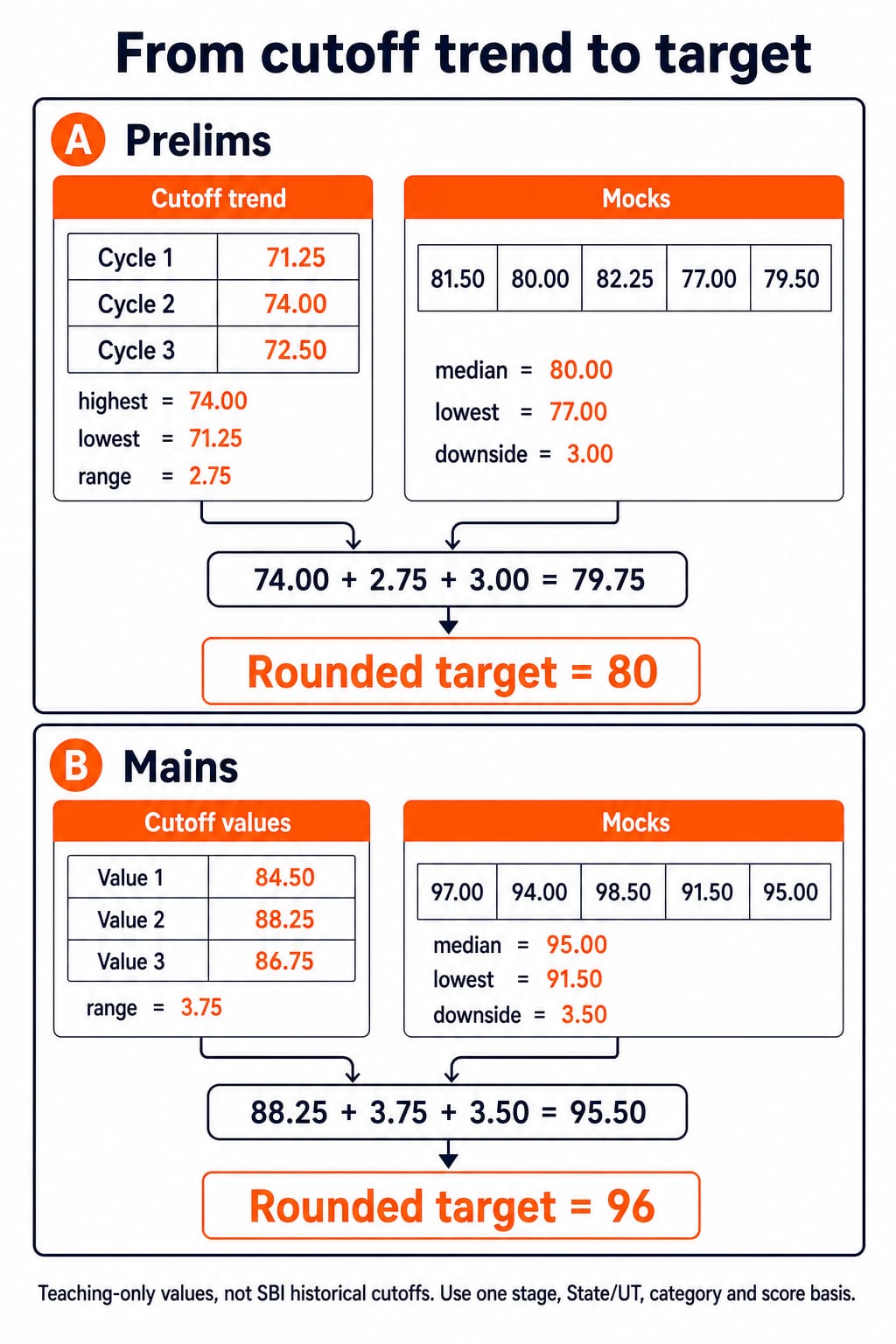
Every value below is hypothetical, for method only, not historical SBI cutoff data.
For one Prelims State, category and score basis:
Records
71.25, 74.00, 72.50: highest74.00, lowest71.25, range74.00 - 71.25 = 2.75.Mocks
81.50, 80.00, 82.25, 77.00, 79.50: median80.00, lowest77.00, downside80.00 - 77.00 = 3.00.Target =
74.00 + 2.75 + 3.00 = 79.75, rounded up to 80.
Keep Mains separate. Values 84.50, 88.25, 86.75 give range 88.25 - 84.50 = 3.75. Same-scale mocks 97.00, 94.00, 98.50, 91.50, 95.00 give median 95.00, lowest 91.50 and downside 95.00 - 91.50 = 3.50. Target = 88.25 + 3.75 + 3.50 = 95.50, rounded up to 96.
This buffer is not a guaranteed qualifying score. Retain SBI’s printed scale.
4. Convert the Prelims target into net marks, not raw attempts
The notice specifies English Language at 30 questions/30 marks/20 minutes, Numerical Ability at 35/35/20 minutes, and Reasoning Ability at 35/35/20 minutes, totalling 100 questions/100 marks/60 minutes. A wrong answer loses one-fourth of its marks; an unanswered question has no penalty.
Controlled: 89 attempts = 83 correct + 6 wrong. Net = 83 - (6 × 0.25) = 81.50, with 11 unanswered.
Aggressive: 98 attempts = 81 correct + 17 wrong. Net = 81 - (17 × 0.25) = 76.75, with 2 unanswered. Controlled clears 80; aggressive misses by 80 - 76.75 = 3.25. Prioritise accuracy and selection, not heroic attempts.
5. Build section budgets without inventing sectional cutoffs
A section budget is a private mock tool, not an SBI sectional cutoff. The notice prescribes no minimum qualifying score for individual Prelims sections and says section-wise marks are not maintained for selection.
Section | Attempted | Correct | Wrong | Net marks |
|---|---|---|---|---|
English | 26 | 24 | 2 |
|
Numerical Ability | 31 | 29 | 2 |
|
Reasoning Ability | 32 | 30 | 2 |
|
Total | 89 | 83 | 6 | 81.50 |
Improve puzzle selection under the 20-minute reasoning clock and calculation speed with arithmetic or DI accuracy. Neither supplies an official cutoff.
6. Use a five-mock readiness rule, not daily cutoff rumours
For target 80, require 4 of the latest 5 full mocks at or above 80, none below 77, and 8 or fewer wrong answers in at least 4 of 5. This is a practical rule, not SBI policy.
With 80.50, 82.00, 79.00, 83.25, 81.25, four meet 80 and the lowest is 1 below. If the wrong-answer condition passes, keep the target and repair topics behind 79.00.
With 84.00, 76.50, 81.00, 74.25, 82.00, only three meet 80; the lowest is 80 - 74.25 = 5.75 below. Volatility is the problem. Review every wrong answer, label it concept, selection or calculation error, then retest under the same section timings. Do not lower the target to make a dashboard green.
7. Reset the target only on comparable evidence
Recalculate when SBI publishes relevant notice, result or marks evidence, or when you change stage, State or UT, category or score basis. Archive the old calculation instead of blending unlike rows. If no official public table exists, say so and label secondary figures indicative.
The short version: verify labels, compare like with like, add range and mock downside, then prove the rounded target across five mocks. Keep Prelims and Mains separate because SBI treats their marks differently.
Choose your stage. The SBI Clerk Prelims course and SBI Clerk Mains course offer structured recorded lessons, question practice, previous-year questions, mocks and progress tracking.
Keep learning
SBI SO Syllabus: Section-by-Section Study Map for IT Aspirants
Build an IT/System study map around your exact SBI post. Use a historical exam table, original worked exercises and an eight-hour sample week to turn topic lists into practice.
1 Oct 20265 min readSBI Exams
SBI SO Preparation Strategy: A 12-Week Role-Specific Plan
Build an SBI SO plan around the exact Specialist Cadre Officer post you are targeting. This guide gives an 11-hour weekly calendar, diagnostics, repair loops and separate written-test and interview branches.
Updated 24 Sep 20266 min readSBI Exams
SBI SO Exam Pattern and Marking Scheme: Post-Wise Routes Explained
There is no single SBI SO paper pattern. Use this guide to identify your post's route, understand qualifying and merit components, and build a timetable from the official notice.
Updated 22 Sep 20264 min readSBI Exams
SBI Clerk Preparation Mistakes: 7 Errors and Practical Fixes
High effort can still produce weak results when the study system rewards attempts, note collection and packed timetables. This guide replaces seven common errors with practical weekly actions.
Updated 21 Sep 20265 min readSBI Exams