SBI Clerk Exam Pattern: How Section Demands Change from Prelims to Mains
See how the work changes across SBI Clerk stages, diagnose weak sections with equal mini-tests, and build a measured week that keeps mains preparation active.
KnowledgeGate Team
Exam prep & CS education
Updated 25 Jul 20266 min read
Memorising a pattern table can make SBI Clerk mains look like a longer prelims paper. It is not. Two of the three prelims sections are renamed at mains, two areas you were never tested on appear, and the foundations you already have are asked to carry heavier work. Map that change and your weekly hours stop being a guess.
Read the SBI Clerk pattern as a change in work
Recent notifications have used English Language, Numerical Ability and Reasoning Ability for prelims, then General or Financial Awareness, General English, Quantitative Aptitude, and Reasoning Ability with Computer Aptitude for mains. The exact labels, marks, question counts and sectional timing for your cycle are set by the SBI Junior Associates notification at sbi.co.in.
Prelims rewards quick recognition, selection and clean execution. Mains keeps those same foundations and asks for depth: longer reading, connected calculation, bigger reasoning sets. The useful mental model is not that every question gets harder. It is that the same three skills have to hold for longer, under more interpretation, next to two areas starting from zero.
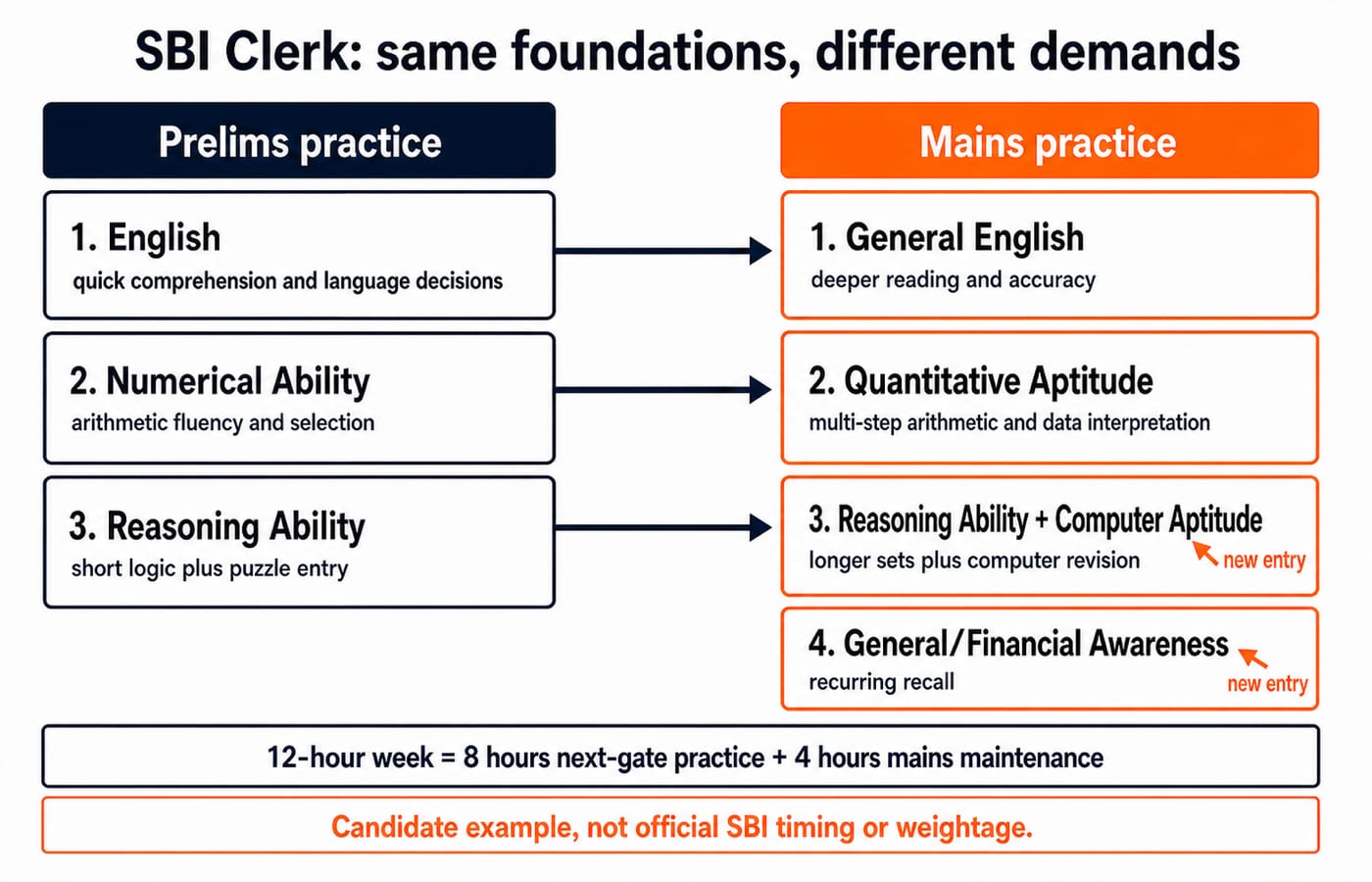
SBI Clerk prelims: use equal mini-tests to find the bottleneck
Aditi builds her own 20-question mini-test for each SBI Clerk prelims section and takes the three back to back. Equal length is the whole point: it makes the three results comparable to each other.
Skill | Attempted | Correct | Wrong | Blank |
|---|---|---|---|---|
English | 17 | 14 | 3 | 3 |
Numerical | 15 | 11 | 4 | 5 |
Reasoning | 18 | 15 | 3 | 2 |
Each row balances: correct + wrong = attempted, then attempted + blank = 20. Attempt accuracy is English 14/17 x 100 = 82.4%, Numerical 11/15 x 100 = 73.3%, and Reasoning 15/18 x 100 = 83.3%. This is attempt accuracy rather than a mark, which is exactly what a diagnostic needs: it ranks her sections against one another. Numerical is the bottleneck, so error analysis and selection come first and the other two drop to maintenance.
The foundations overlap across SBI's banking exams, so the SBI PO Prelims course is a usable source of extra arithmetic and reasoning drilling while she repairs the weak section.
English must grow into sustained reading control
Prelims needs fast sentence decisions and short-passage accuracy. Mains asks you to hold meaning across longer material, separate what a passage states from what it merely implies, and keep accuracy intact in the last ten minutes, when concentration is thinnest and rereading feels expensive.
Aditi uses a 480-word editorial-style passage: 3 minutes to label paragraph roles, 5 for 5 questions and 2 to review evidence. Thus, 3 + 5 + 2 = 10 minutes. She gets 4/5; the missed inference is plausible but unsupported. For 3 drills, she writes the supporting sentence beside each inference answer.
If she gets 9/10 on isolated grammar but 4/7 on mixed passage questions, the next block needs two passages and a review of rejected options, not more grammar.
Numerical speed must become quantitative interpretation
Arithmetic recall, estimation and the discipline of abandoning a slow item are the prelims foundations. Quantitative Aptitude keeps all three and adds data interpretation, where one table feeds four or five connected questions and a single careless total spoils the entire set. The Bank PO quantitative aptitude guide lists the topics that repay this practice most. Take a three-branch transaction table:
Sample branch | January transactions | February transactions |
|---|---|---|
A | 120 | 150 |
B | 100 | 140 |
C | 80 | 110 |
January total: 120 + 100 + 80 = 300. February total: 150 + 140 + 110 = 400. The increase is 100, measured against the January base, so (400 - 300) / 300 x 100 = 33.3%. Reversing that denominator would answer a different question. Branch B's February share is 140/400 x 100 = 35%.
Give reasoning, computer aptitude and awareness separate loops
These three behave differently enough that one shared study block serves none of them. Reasoning is a skill loop: diagram choice, clue chaining, and recognising a set that offers no usable entry. Computer Aptitude is a syllabus loop: hardware and software basics, operating-system and networking terms, office and internet fundamentals, shortcuts and security vocabulary, revised in blocks and then attempted as application questions. General or Financial Awareness is a recall loop, where the only thing that works is meeting the same items again on a schedule.
In a 7-minute drill, Aditi allows 90 seconds to find a usable chain. Set 1 gives P in position 3, R immediately right of P, and T at one end. She fixes P3-R4, tests both ends for T, and answers 4 of 5 in 6 minutes 40 seconds. Set 2 has no stable chain after 90 seconds, so she marks it and moves. This is controlled entry, not automatic abandonment.
Her awareness loop is 12 items: 6 banking or financial concepts and 6 sourced current items. She recalls 8/12 on Day 1 and 6/12 without notes on Day 4. After explaining the six misses aloud in her own words, she reaches 11/12 on Day 7. The forgetting between Day 1 and Day 4 is the loop working, not failing.
The computer loop is smaller and cheaper: 20 minutes, three times a week. One sitting revises a block of terms, the next attempts application questions on that same block, and the third mixes it with the two blocks before it. A term missed twice goes back to the front of the list. Twenty minutes is enough because the material is finite, which is what separates it from awareness.
Keep SBI Clerk mains alive with a measured weekly block
With prelims next, Aditi assigns 8 of her 12 hours to it, weighted toward what the mini-tests found: 2 hours English, 4 hours Numerical Ability and 2 hours Reasoning Ability. Check: 2 + 4 + 2 = 8 hours.
Mains maintenance takes the other four: 90 minutes quantitative or data interpretation, 60 awareness, 60 reasoning or computer aptitude and 30 English. Check: 90 + 60 + 60 + 30 = 240 minutes = 4 hours. Those four hours are not there for coverage. They exist so the two mains-only areas are not starting from zero in the week prelims ends.
If numerical accuracy rises from 73.3% to 84.0% after two review rounds but reasoning-set completion stays at 3 of 5, move 30 minutes from numerical maintenance to reasoning. Replace a missed 90-minute sitting with 30 minutes on three days: 30 + 30 + 30 = 90. The prelims versus mains preparation split works through the same rebalancing principle in more detail.
Turn the SBI Clerk pattern into the next seven days
Day 1: Obtain the current notification and handout. Mark every stage label, section and changing rule.
Day 2: Take the three equal 20-question mini-tests.
Day 3: Calculate the accuracies. Classify every wrong and blank answer.
Days 4 and 5: Complete two repairs for the weakest prelims skill.
Day 6: Complete four hours of mains maintenance across manageable sittings.
Day 7: Repeat one diagnostic and allocate the next 12 hours.
Our SBI course family is PO-labelled, and the overlap sits in the skills rather than the stage structure. Use the SBI PO Mains course for the deeper quantitative and reasoning work your own diagnostics point at.
The short version: SBI Clerk prelims wants fast control of three foundations, and mains wants those same three held at depth alongside two areas you have never sat for. The notification tells you what the paper is. Your own mini-tests tell you where the hours go.
Keep learning
SBI SO Cutoffs: Check Corrections and Build a Practice Target
A cutoff becomes useful only when its post, category and score basis match your comparison. Work through a real SBI correction and a hypothetical target-setting exercise to plan your next mocks.
5 Oct 20264 min readSBI Exams
SBI SO Syllabus: Section-by-Section Study Map for IT Aspirants
Build an IT/System study map around your exact SBI post. Use a historical exam table, original worked exercises and an eight-hour sample week to turn topic lists into practice.
1 Oct 20265 min readSBI Exams
SBI SO Preparation Strategy: A 12-Week Role-Specific Plan
Build an SBI SO plan around the exact Specialist Cadre Officer post you are targeting. This guide gives an 11-hour weekly calendar, diagnostics, repair loops and separate written-test and interview branches.
Updated 24 Sep 20266 min readSBI Exams
SBI SO Exam Pattern and Marking Scheme: Post-Wise Routes Explained
There is no single SBI SO paper pattern. Use this guide to identify your post's route, understand qualifying and merit components, and build a timetable from the official notice.
Updated 22 Sep 20264 min readSBI Exams