SBI Clerk Exam Pattern and Marking Scheme: Prelims, Mains and Score Calculation
Understand what each SBI Clerk stage does, how separate section clocks affect your attempt, and how to turn correct and wrong answers into a useful mock diagnosis.
KnowledgeGate Team
Exam prep & CS education
Updated 13 Sep 20265 min read
SBI Clerk pattern summaries often place 100 marks, 200 marks, separate section clocks and negative marking in one table without explaining their effect on an attempt. This guide maps each stage, works through a complete Prelims score, and shows how to separate speed loss from accuracy loss after a mock. All pattern and marking details below follow SBI's 11 August 2026 notice, so recheck the current notice and your call-letter instructions for your own cycle.
SBI Clerk exam pattern: know which stage screens and which stage selects
SBI's official Junior Associates advertisement, CRPD/CR/2026-27/17, specified online Prelims, online Mains and an opted local-language test where applicable. It is the source for all section, mark, timing, penalty, qualifying and selection details below.
Official stage role and KnowledgeGate preparation route | Role | Preparation route |
|---|---|---|
Prelims | Screening | SBI Clerk Prelims |
Mains | Written score used for provisional merit, with the trained-apprentice bonus where applicable | SBI Clerk Mains |
Local-language test where applicable | Qualifying condition before joining | Current SBI notice |
Phase I marks do not enter selection. Aggregate Phase II marks determine provisional merit, with the trained-apprentice bonus added for eligible candidates, subject to eligibility and the language test. The school-certificate condition exempts qualifying candidates; otherwise, the test follows provisional selection and precedes joining. The live SBI Clerk Pattern: How Sections Shift Prelims to Mains guide explains how the workload changes.
SBI Clerk Prelims pattern: three separate 20-minute clocks
The Prelims section map is:
Section | Questions | Marks | Time |
|---|---|---|---|
English Language | 30 | 30 | 20 minutes |
Numerical Ability | 35 | 35 | 20 minutes |
Reasoning Ability | 35 | 35 | 20 minutes |
Total | 100 | 100 | 1 hour |
Each section has its own clock, so unused minutes cannot move elsewhere. Since 20 minutes equals 1,200 seconds, equal time across all English questions would be 1,200 / 30 = 40 seconds per question. For Numerical Ability or Reasoning Ability, it would be 1,200 / 35 = 34.3 seconds per question, rounded to one decimal place. Real questions have unequal time costs, so these describe the clock, not an attempt target. Practise choosing, solving and skipping within each fixed window. SBI Clerk Prelims structures preparation for the same sections.
SBI Clerk Mains pattern: reconcile 190 questions, 200 marks and 160 minutes
The Mains section map is:
Section | Questions | Marks | Time |
|---|---|---|---|
General/Financial Awareness | 50 | 50 | 35 minutes |
General English | 40 | 40 | 35 minutes |
Quantitative Aptitude | 50 | 50 | 45 minutes |
Reasoning Ability and Computer Aptitude | 50 | 60 | 45 minutes |
The totals are 50 + 40 + 50 + 50 = 190 questions, 50 + 40 + 50 + 60 = 200 marks, and 35 + 35 + 45 + 45 = 160 minutes = 2 hours 40 minutes. The last row is the trap: 50 questions carry 60 marks, so a blanket one-mark-per-question formula fails in Mains. A wrong response loses one-fourth of its assigned mark, as determined by the applicable instructions. Eligible trained apprentices of SBI receive 2.5% x 200 = 5 bonus marks added to their aggregate. SBI Clerk Mains structures preparation for these four blocks.
SBI Clerk negative marking: calculate a Prelims score line by line
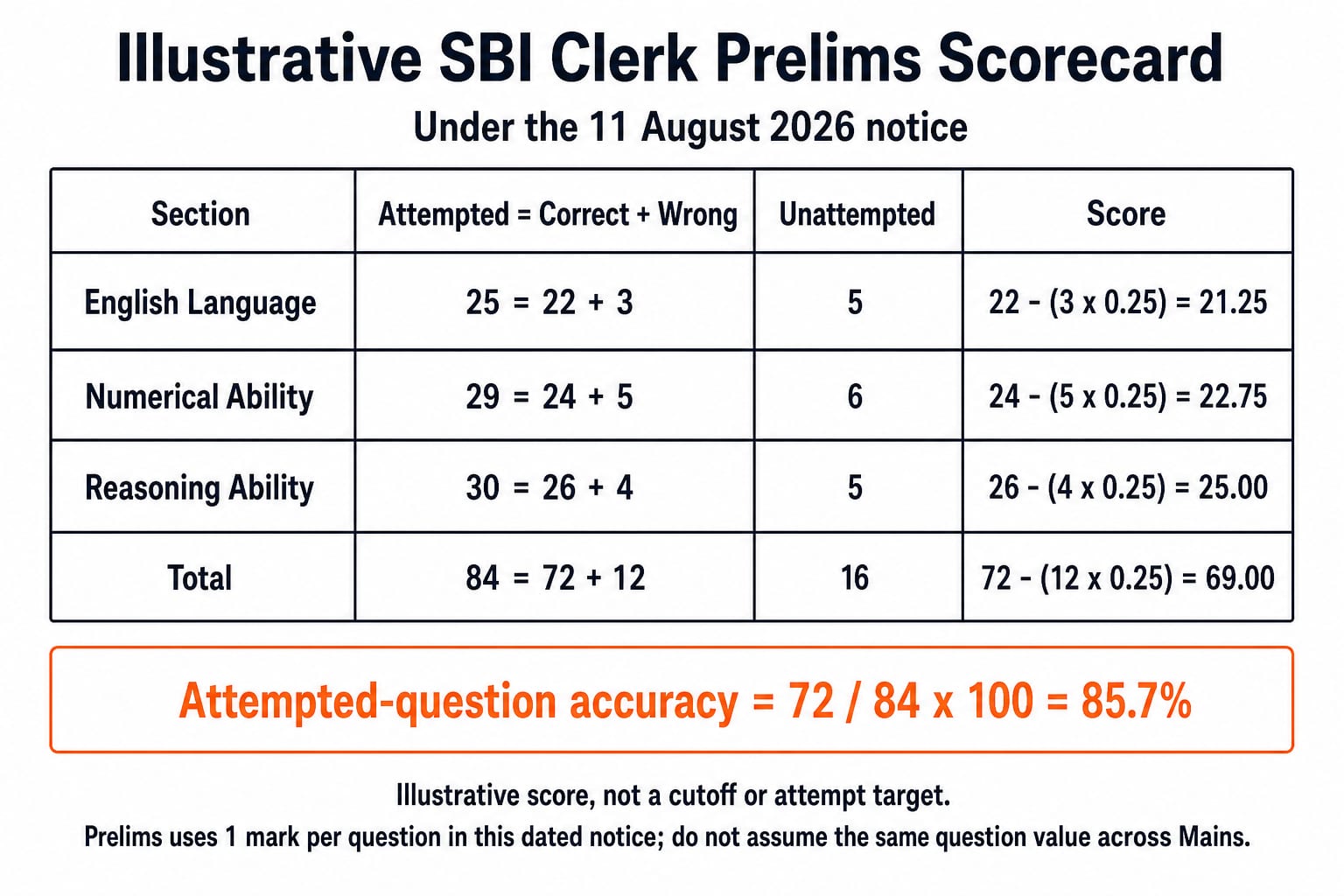
The Prelims table gives every question 1 mark. In this illustrative scorecard, each wrong response therefore deducts 1 / 4 = 0.25 mark under the one-fourth penalty rule.
Section | Attempted = Correct + Wrong | Unattempted | Score |
|---|---|---|---|
English Language | 25 = 22 + 3 | 5 |
|
Numerical Ability | 29 = 24 + 5 | 6 |
|
Reasoning Ability | 30 = 26 + 4 | 5 |
|
Total | 84 = 72 + 12 | 16 |
|
The totals cross-check: 25 + 29 + 30 = 84 attempted, 22 + 24 + 26 = 72 correct, 3 + 5 + 4 = 12 wrong, and 5 + 6 + 5 = 16 unattempted. The penalty is 12 x 0.25 = 3, so the score is 72 - 3 = 69. Attempted-question accuracy is 72 / 84 x 100 = 85.7%, rounded to one decimal place. The score of 69 is illustrative, neither a cutoff nor an attempt target.
SBI Clerk qualifying rules: do not confuse sectional clocks with sectional cutoffs
For Prelims, no minimum qualifying marks were prescribed for an individual test or the aggregate, and section-wise marks would not be maintained. Candidates were shortlisted from aggregate marks in descending order under the bank's process.
For Mains, SBI would decide the minimum aggregate qualifying percentage. No minimum qualifying marks were prescribed for individual subjects, and section-wise marks would not be maintained. That does not support a predicted cutoff, safe score or guaranteed attempt count. Separate timing is an exam-control rule, not evidence of a sectional cutoff. Prelims marks do not enter final merit; aggregate Mains marks, plus the 5-mark trained-apprentice bonus for eligible candidates, drive provisional selection, with applicable language and eligibility conditions still to be met.
SBI Clerk mock analysis: measure reach, accuracy and penalty separately
Simulate 20 minutes English + 20 minutes Numerical Ability + 20 minutes Reasoning Ability = 60 minutes, with no time transfer. Review the section rows for 30 minutes, making the full session 60 + 30 = 90 minutes.
In Numerical Ability, suppose you attempt 26 of 35 questions, with 22 correct, 4 wrong and 9 unattempted. Score is 22 - (4 x 0.25) = 21. Accuracy is 22 / 26 x 100 = 84.6%; reach is 26 / 35 x 100 = 74.3%, both rounded to one decimal place.
Classify the 9 unreached questions as deliberate skips or time losses. Classify the 4 wrong answers as concept, calculation, reading or selection errors. Higher reach with falling accuracy is not progress. Use the SBI Clerk Quant: 6-Week Calculation Speed Routine when calculation speed is the repeated constraint.
SBI Clerk exam pattern: the short version and next step
Turn the pattern into four actions:
Download the current SBI notice.
Copy its stage and section table.
Practise with the same separate clocks.
Record correct, wrong, unattempted, penalty and net score after every mock.
The SBI exam catalogue shows the Prelims and Mains learning options. Use it for preparation; the current notice and call letter govern your examination. This makes your next choice evidence-led. Now take your latest mock sheet, rebuild its score with the four columns above, and let the weakest row determine your next practice block.
Keep learning
SBI SO Syllabus: Section-by-Section Study Map for IT Aspirants
Build an IT/System study map around your exact SBI post. Use a historical exam table, original worked exercises and an eight-hour sample week to turn topic lists into practice.
1 Oct 20265 min readSBI Exams
SBI SO Preparation Strategy: A 12-Week Role-Specific Plan
Build an SBI SO plan around the exact Specialist Cadre Officer post you are targeting. This guide gives an 11-hour weekly calendar, diagnostics, repair loops and separate written-test and interview branches.
Updated 24 Sep 20266 min readSBI Exams
SBI SO Exam Pattern and Marking Scheme: Post-Wise Routes Explained
There is no single SBI SO paper pattern. Use this guide to identify your post's route, understand qualifying and merit components, and build a timetable from the official notice.
Updated 22 Sep 20264 min readSBI Exams
SBI Clerk Preparation Mistakes: 7 Errors and Practical Fixes
High effort can still produce weak results when the study system rewards attempts, note collection and packed timetables. This guide replaces seven common errors with practical weekly actions.
Updated 21 Sep 20265 min readSBI Exams