SBI Clerk Reasoning Preparation: A Timed Route from Basics to Puzzles
Build SBI Clerk reasoning with a 30-question diagnostic, a six-week seven-hour route, worked seating and floor puzzles, and a written rule for leaving a set.
KnowledgeGate Team
Exam prep & CS education
Updated 28 Jul 20267 min read
Quick inequalities and syllogisms bank early answers, but one stubborn arrangement can give that gain back. Six weeks closes both ends: accurate short topics under a shrinking clock, arrangements built from anchors rather than clue order, and a written rule for walking away from a set. The loads below are practice targets, not SBI figures; the current Junior Associates notice settles the live Clerk format. Our SBI course family sits in the banking category, and those listings are PO-labelled.
1. Take a 30-Question Baseline Before Choosing Your Attempt Order
Build a 30-question diagnostic and label each question with its source: 5 inequalities, 5 syllogisms, 5 direction, blood-relation or ranking questions, 5 coding or sequence questions, plus two 5-question arrangement sets. The even split exposes which family fails you; it is not a weightage model. Do the 20 shorts first, then both sets, noting the clock at each family's start, exit and return.
Sample: 17 correct + 6 wrong + 7 unattempted = 30. Attempts: 23/30 = 76.7%; accuracy: 17/23 = 73.9%; overall correct rate: 17/30 = 56.7%. If shorts give 15/20 but sets 2/10, full mocks are not the first repair.
Classify the 13 misses as 4 concept gaps + 3 diagram errors + 2 rushed reads + 4 time exits. Concept gaps go to Weeks 1 and 2, diagram errors to Weeks 3 and 4, rushed reads and time exits to Week 5. The Bank PO reasoning topic guide shows which families carry across both papers.
2. Run a Six-Week, Seven-Hour Plan With a Bad-Week Floor
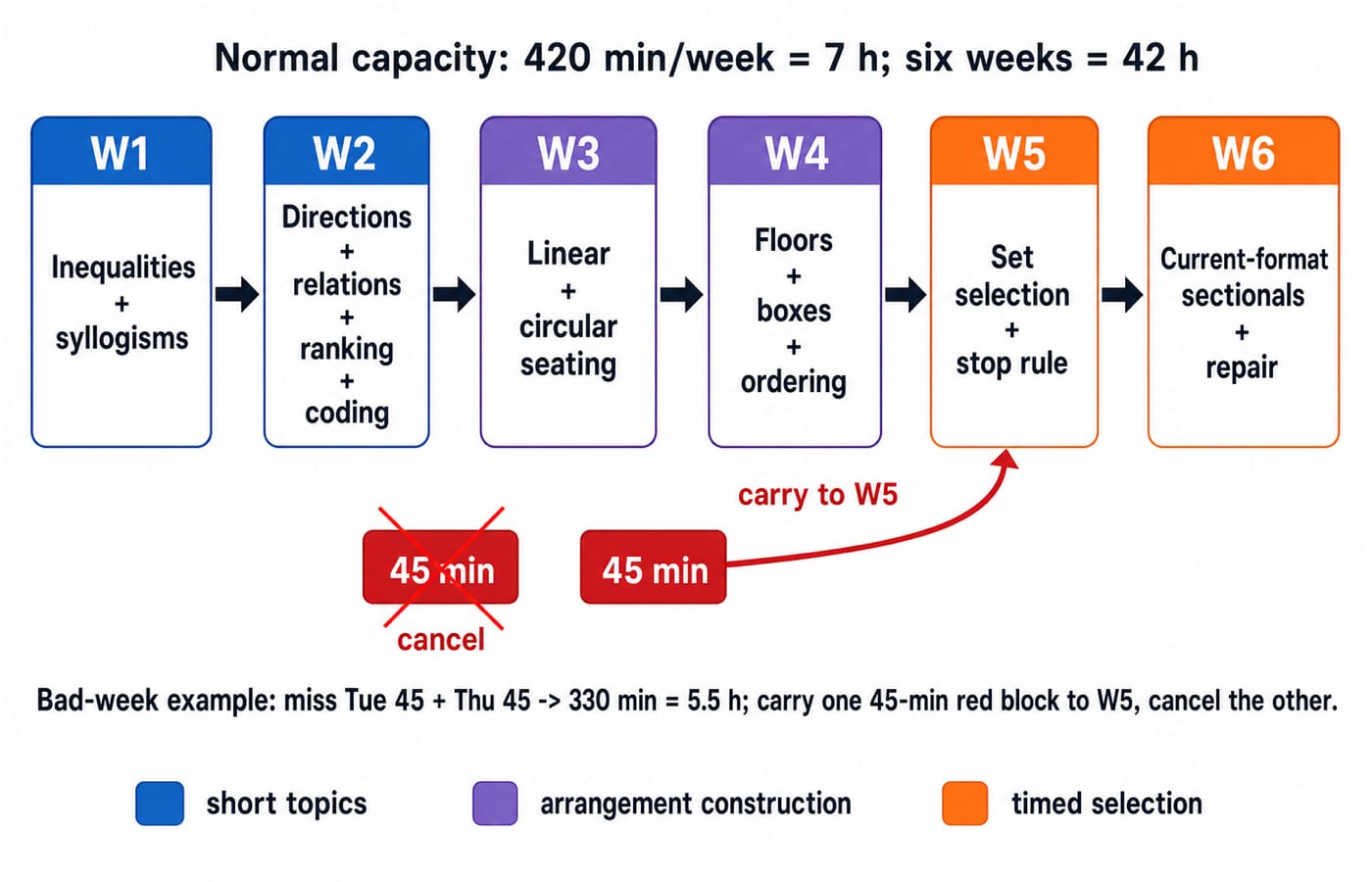
Schedule Monday, Tuesday, Thursday and Friday for 45 minutes each, Wednesday for a 30-minute error log, Saturday for 150 minutes and Sunday for 60. Thus 4 x 45 + 30 + 150 + 60 = 420 minutes = 7 hours.
The weekly jobs are: W1 inequalities and syllogisms; W2 directions, blood relations, ranking and coding; W3 linear and circular seating; W4 floors, boxes and ordering; W5 mixed-set selection and stop rules; W6 sectionals shaped after checking the current notice. Use the calendar-agnostic banking plan when dates move.
Missing Tuesday and Thursday removes 45 + 45 = 90 minutes, leaving 420 - 90 = 330 minutes = 5.5 hours. Protect Saturday's set work. Use Wednesday for the chief repair, carry only one 45-minute red-topic block into Week 5, and cancel the other. Do not create an 8.5-hour punishment week.
3. Weeks 1 and 2: Make the Short Topics Accurate Before Compressing Time
Translate, record guaranteed relations, answer, then check. For M >= N > O = P <= Q < R:
M > Ofollows fromM >= N > O.N > Qis unknown becauseN > P <= Qdoes not order them.R > Pfollows fromP <= Q < R.M > Ris unknown.
One rule covers all four: a chain settles a pair only if every link points the same way. One reversal and the pair is unknown.
For "All tellers are graduates. Some graduates are musicians. No musician is an athlete," I, some graduates are not athletes, follows. II, some tellers are musicians, and III, no teller is an athlete, do not. All neither reverses nor forces overlap.
Run the same 12-question circuit three times: 8/12 in 14 minutes, then 9/12 in 12 minutes, then 10/12 in 10 minutes, accuracy climbing as the clock tightens. Move on after two fresh 10/12 circuits with every error explained.
4. Week 3: Build Seating Arrangements From Anchors, Not Clue Order
Place ends and fixed positions first, pairs second, distance chains third, negative clues last. Do two sets untimed, timing the building and the checking separately so you know which half is slow. Once construction is stable, cap a fresh six-person set at 10 minutes.
In a north-facing row, Dev sits at an end; Esha is immediately right of Dev; Charu is second right of Aarav; Bina is immediately left of Charu; Farid is not adjacent to Aarav. Dev is at an end with someone immediately to his right, so Dev cannot be 6: Dev 1, Esha 2. Aarav, Bina and Charu are consecutive, so Aarav is 3 or 4. The branch Aarav 4, Bina 5, Charu 6 leaves Farid at 3, beside Aarav, and fails. Valid row: 1 Dev | 2 Esha | 3 Aarav | 4 Bina | 5 Charu | 6 Farid.
Checks: Bina is second right of Esha; Bina and Charu are between Aarav and Farid; Charu is immediately left of Farid. Rebuild it from blank tomorrow.
5. Week 4: Add Floors and Ordering One Variable at a Time
Move from seating to four floors, then to boxes and day orders, which are the same grid with a different axis label. Keep a second attribute (profession, colour, subject) in its own column, filled only after positions settle. Tag every clue as anchor, chain or elimination first.
Number floors 1, bottom, to 4, top. Meera is immediately above Kabir; Nitin is above Meera but not on 4; Riya is not on 1. Kabir on 2 forces Meera 3, Nitin 4, violating a clue. Kabir cannot be 3 because nothing remains above Meera. Thus 1 Kabir | 2 Meera | 3 Nitin | 4 Riya.
Checks: Riya is two floors above Meera; only Meera is between Kabir and Nitin; Nitin is immediately below Riya. Allocate 180 minutes to fresh sets, 90 to failed Week 3 diagrams, 90 to mixed basics and 60 to error replay: 180 + 90 + 90 + 60 = 420 minutes.
6. Week 5: Use a Written Stop Rule to Abandon the Wrong Set
Scan each set for 75 seconds before committing. Green means two fixed placements, or one plus a closed chain. Amber means one anchor with branches still open. Red means nothing is fixed and every placement is a guess. Attempt green first, amber if time allows, red never. Inside a set, leave if three minutes give fewer than two stable placements or more than two unresolved branches.
Try 10 shorts, one 5-question linear set and one 5-question floor-profession set. Sample: shorts 8/10 in 6 minutes; linear 4/5 in 8 minutes; floor-profession abandoned at four minutes (the 75-second scan plus three unproductive ones) with no stable placement. Result: 12 correct + 3 wrong + 5 unattempted = 20 in 18 minutes. Leaving red is the win.
Review for 35 minutes: 10 on two short errors, 10 on one linear error, and 15 rebuilding the abandoned set untimed. Next session, shuffle the set order so you judge each one fresh instead of recalling which was hard.
7. Week 6: Match Sectionals to the Current Notice, Then Review Decisions
Before a sectional, open the current Junior Associates notice or handout on the official SBI Careers page. Take section labels, question counts, marks, timing, penalties and selection rules only from there, and rebuild the mock whenever the source changes. Never carry over SBI PO figures, a previous Clerk cycle's, or the training blocks in this plan.
Analyse a training set: 21 correct + 4 wrong + 5 unattempted = 30. Attempt rate: 25/30 = 83.3%; accuracy: 21/25 = 84%; correct rate: 21/30 = 70%. Both are up on the section 1 baseline (76.7% and 73.9%). Accuracy sliding as attempts rise would mean the stop rule has gone soft.
Classify the nine misses as 2 concept errors + 1 diagram error + 1 rushed read + 5 deliberately skipped. Five deliberate skips are five decisions, not five failures: check each really was red at 75 seconds, not an amber you left too fast.
Allocate 120 minutes to current-format sectionals, 180 to analysis, 75 to the largest red topic and 45 to carry-over or buffer: 120 + 180 + 75 + 45 = 420.
8. The Short Version: Bank the Basics, Test the Puzzle, Leave on Evidence
Diagnose, stabilise the short topics, construct seating, add floors and ordering, practise selection, then take sectionals built from the current notice. Progress shows as fewer repeated errors, cleaner diagrams and earlier exits, long before it shows in a score.
A bad week may stop at 5.5 hours without debt. Give a set 75 seconds, then at most 3 unproductive minutes. Review the exit.
Take the diagnostic today and build Week 1 from its errors. The SBI PO Prelims course drills the same short-topic and puzzle families at first-stage depth, where a Clerk aspirant gets the most transfer. Save the SBI PO Mains course for after set selection is working, when harder sets earn their time instead of creating new exits.
Keep learning

SBI SO Cutoffs: Check Corrections and Build a Practice Target
A cutoff becomes useful only when its post, category and score basis match your comparison. Work through a real SBI correction and a hypothetical target-setting exercise to plan your next mocks.
5 Oct 20264 min readSBI Exams
SBI SO Syllabus: Section-by-Section Study Map for IT Aspirants
Build an IT/System study map around your exact SBI post. Use a historical exam table, original worked exercises and an eight-hour sample week to turn topic lists into practice.
1 Oct 20265 min readSBI Exams
SBI SO Preparation Strategy: A 12-Week Role-Specific Plan
Build an SBI SO plan around the exact Specialist Cadre Officer post you are targeting. This guide gives an 11-hour weekly calendar, diagnostics, repair loops and separate written-test and interview branches.
Updated 24 Sep 20266 min readSBI Exams
SBI SO Exam Pattern and Marking Scheme: Post-Wise Routes Explained
There is no single SBI SO paper pattern. Use this guide to identify your post's route, understand qualifying and merit components, and build a timetable from the official notice.
Updated 22 Sep 20264 min readSBI Exams