SBI Clerk Previous Year Analysis: Topics That Repeat, Difficulty Drift and Time Allocation
Past papers become useful when you track recurrence, solving cost and your return per minute. Build an audit sheet and a 120-minute remedial plan.
KnowledgeGate Team
Exam prep & CS education
Updated 17 Sep 20264 min read
You may have several SBI Clerk papers but still not know whether a familiar topic is important or merely memorable. Measure recurrence, difficulty drift and your return on time. Past papers guide preparation; they do not predict the next paper.
What SBI Clerk previous-year analysis can and cannot tell you
SBI does not publish a topic-level forecast. Ask three questions: Did the topic appear across several papers? Did its solving cost change? Did you earn enough correct answers for the time spent?
Keep separate Prelims and Mains worksheets because preparation shifts from quick selection to longer reading, multi-step work and larger sets. Compare four or five complete, dated papers. Record each paper or shift label and source instead of pooling unlike papers.
Exam specifications can change. Check current stages, sections, marks, question counts, timing and penalties on the SBI Current Openings page. Recent SBI notifications or handouts have specified these details, so ignore old patterns from memory.
Build a recurrence map instead of a topic list
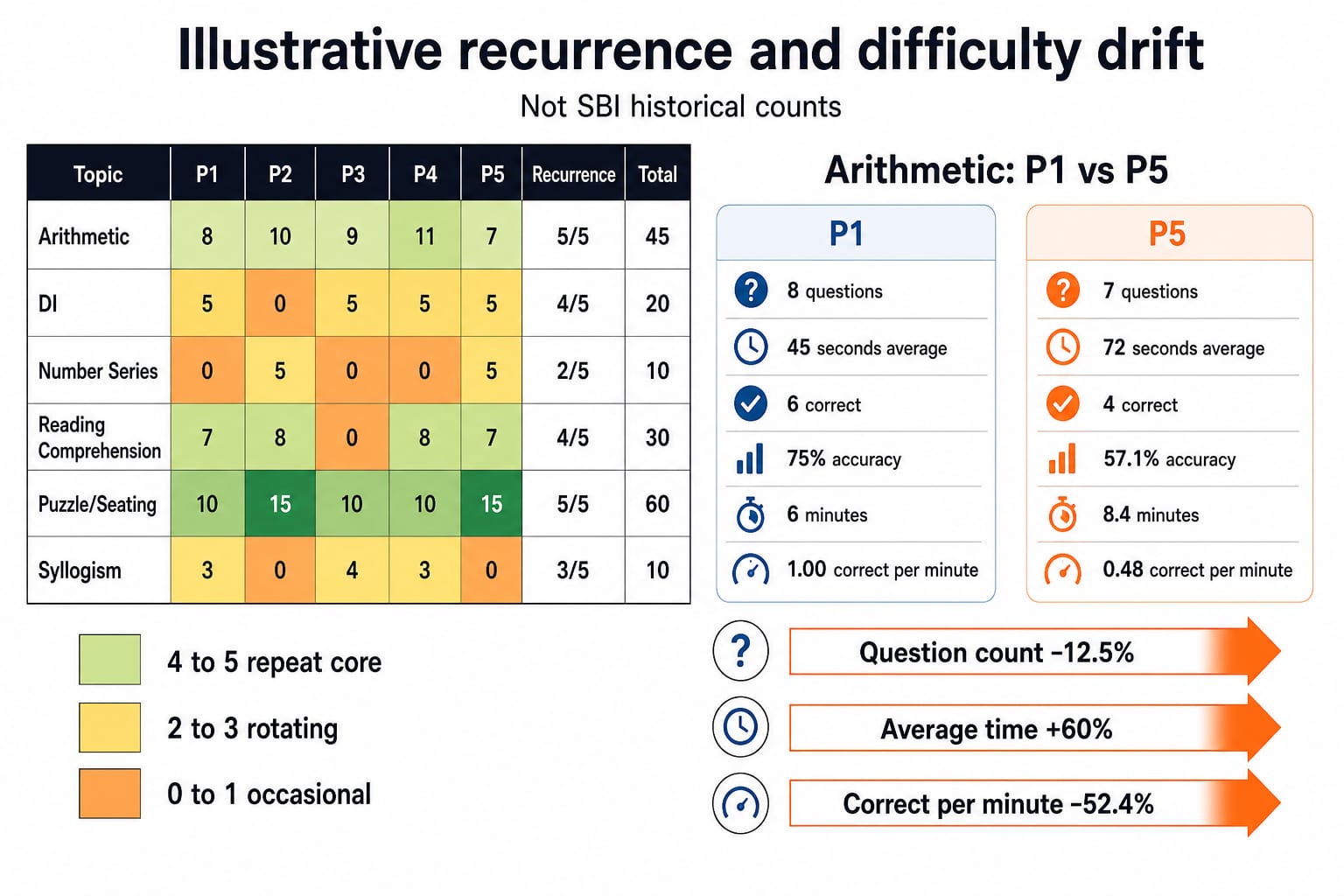
Record section, topic family, P1 to P5 counts, papers containing the topic, total questions, attempted, correct, wrong, skipped and average seconds per attempt. Recurrence is papers containing the topic divided by five, not total questions divided by five.
The following is illustrative paper-coding data, not historical SBI counts.
Topic family | P1 | P2 | P3 | P4 | P5 | Recurrence | Total |
|---|---|---|---|---|---|---|---|
Arithmetic | 8 | 10 | 9 | 11 | 7 | 5/5 | 45 |
DI | 5 | 0 | 5 | 5 | 5 | 4/5 | 20 |
Number Series | 0 | 5 | 0 | 0 | 5 | 2/5 | 10 |
Reading Comprehension | 7 | 8 | 0 | 8 | 7 | 4/5 | 30 |
Puzzle/Seating | 10 | 15 | 10 | 10 | 15 | 5/5 | 60 |
Syllogism | 3 | 0 | 4 | 3 | 0 | 3/5 | 10 |
Here, 4/5 or 5/5 is repeat core, 2/5 or 3/5 rotating, and 0/5 or 1/5 occasional. These labels describe only this sample.
Read difficulty drift before calling a topic easy or hard
For Arithmetic in P1, 8 questions × 45 seconds = 360 seconds = 6 minutes. With 6 correct answers, the return is 6 ÷ 6 = 1.00 correct answer per minute.
In P5, 7 × 72 = 504 seconds = 8.4 minutes. Four correct answers give 4 ÷ 8.4 = 0.48 correct answer per minute. The count fell from 8 to 7, or 12.5%, while average time rose from 45 to 72 seconds, or 60%. Frequency barely changed, but time return fell by about 52.4%.
Log setup, solving and checking time, abandoned sets, exit point and error cause. Compare paper-level medians rather than one grand average. Change the plan only after a pattern across several papers. One slow paper triggers review, not a rewrite.
Audit repeat families section by section
For English, track reading comprehension, cloze, error correction, fill-in-the-blanks, para jumbles, vocabulary and grammar. For Quant, separate percentages, ratios, averages, profit and loss, interest, time and work, speed and distance, number series, simplification or estimation, and table or connected-set DI. Arithmetic fluency and DI interpretation need different drills, as this SBI Clerk Quant calculation-speed routine shows.
For Reasoning, track puzzles and seating arrangements, inequalities, syllogisms, coding or sequences, direction sense, blood relations, ranking and order. Practise short-question circuits separately from arrangement-set selection with this timed SBI Clerk Reasoning route.
For Mains, add General/Financial Awareness and Computer Aptitude buckets. Check section names against the current Junior Associates notification or handout, not SBI PO figures.
Convert recurrence plus weakness into a time allocation
Suppose a candidate has 120 remedial minutes. Use priority = recurrence × (1 − diagnostic accuracy):
Arithmetic: 1.00 × (1 − 0.62) = 0.380
DI: 0.80 × (1 − 0.78) = 0.176
Number Series: 0.40 × (1 − 0.90) = 0.040
Total priority = 0.380 + 0.176 + 0.040 = 0.596. Proportional allocations are 0.380 ÷ 0.596 × 120 = 76.5 minutes, 0.176 ÷ 0.596 × 120 = 35.4 minutes, and 0.040 ÷ 0.596 × 120 = 8.1 minutes. Make a usable block of 75 minutes Arithmetic, 35 minutes DI and 10 minutes Number Series, totalling 120 minutes. This is candidate-specific training, not an official exam-time split.
For reasoning-set selection, inspect a set for 75 seconds. After three more minutes, leave if fewer than two placements are secure or more than two branches remain. One secure placement with three unresolved branches means exit and return later. This is a practice rule, not an SBI rule.
If you miss a day, use a planned buffer block later in the week instead of doubling the next session. Recalculate after the next two audited papers or sectionals, not after every bad set.
Avoid five common previous-year-analysis mistakes
Mistake | Consequence | Correction |
|---|---|---|
Counting questions without timing them | A frequent but slow topic looks more rewarding than it is | Record seconds, accuracy and correct answers per minute |
Averaging away shift difficulty | One demanding paper disappears inside the mean | Compare paper-level medians and error causes |
Mixing SBI PO and SBI Clerk evidence | The audit answers the wrong exam question | Keep exam-specific source labels |
Treating coaching drill quantities as official weightage | Practice volume becomes a false forecast | Use drills for skill building, not prediction |
Reusing an old pattern, cutoff or penalty | The plan may rest on outdated details | Check the current official source |
Every row needs a dated source label, and every conclusion must separate sample evidence from forecast. During your audit, mark any claim that cannot be traced to the sheet or current notification as unverified.
The short version and the next useful step
Map recurrence across several papers. Measure difficulty through time and accuracy. Allocate practice by multiplying recurrence by weakness. Repeated families guide preparation coverage, but do not guarantee the next paper.
For guided work on English, Numerical Ability and Reasoning, use the SBI Clerk Prelims course. For the wider Mains scope, use the SBI Clerk Mains course. Browse more Banking and Insurance preparation guides.
Audit one complete paper today, fill the three highest-priority rows, and schedule your first 120-minute remedial block with the formula above.
Keep learning
SBI SO Syllabus: Section-by-Section Study Map for IT Aspirants
Build an IT/System study map around your exact SBI post. Use a historical exam table, original worked exercises and an eight-hour sample week to turn topic lists into practice.
1 Oct 20265 min readSBI Exams
SBI SO Preparation Strategy: A 12-Week Role-Specific Plan
Build an SBI SO plan around the exact Specialist Cadre Officer post you are targeting. This guide gives an 11-hour weekly calendar, diagnostics, repair loops and separate written-test and interview branches.
Updated 24 Sep 20266 min readSBI Exams
SBI SO Exam Pattern and Marking Scheme: Post-Wise Routes Explained
There is no single SBI SO paper pattern. Use this guide to identify your post's route, understand qualifying and merit components, and build a timetable from the official notice.
Updated 22 Sep 20264 min readSBI Exams
SBI Clerk Preparation Mistakes: 7 Errors and Practical Fixes
High effort can still produce weak results when the study system rewards attempts, note collection and packed timetables. This guide replaces seven common errors with practical weekly actions.
Updated 21 Sep 20265 min readSBI Exams