SBI PO Syllabus Decoded: Section-by-Section Prelims-to-Mains Study Map
Separate SBI PO Prelims, Mains and Phase III before planning your week. This guide maps each section to practical study baskets, checked calculations and a repeatable review routine.
KnowledgeGate Team
Exam prep & CS education
Updated 20 Sep 20265 min read
Many candidates merge Prelims, Mains and older descriptive-paper lists into one intimidating SBI PO syllabus, then give every topic equal time. The better question is not only, “What is in SBI PO?”, but also, “Which stage uses this skill, and what should I learn first?” Official SBI notices control the test structure, while the linked SBI PO courses provide a practical learning order, so check the latest notice before each cycle.
1. Start with the official SBI PO stage map
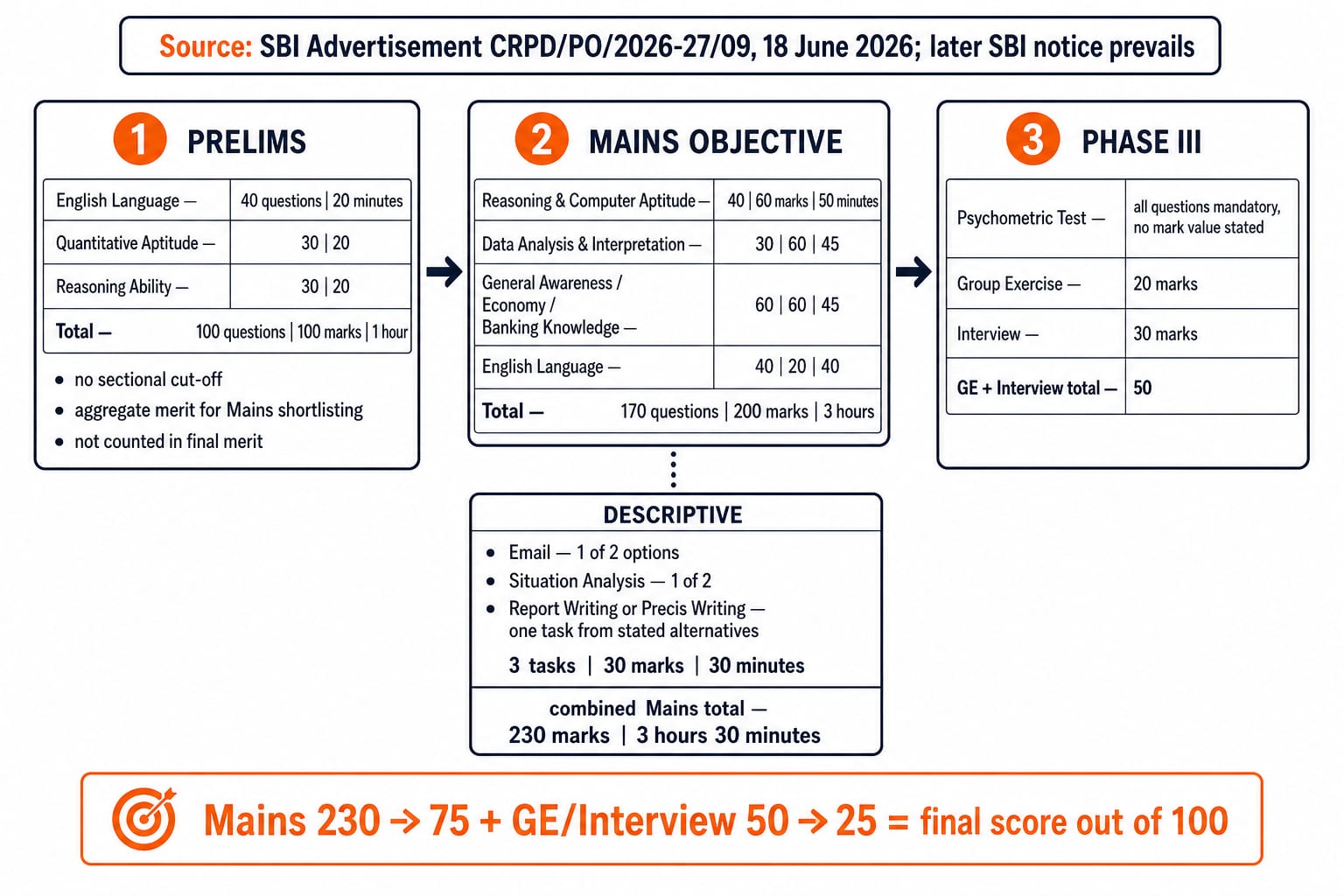
Under SBI Advertisement CRPD/PO/2026-27/09 dated 18 June 2026, Prelims has English Language, 40 questions in 20 minutes; Quantitative Aptitude, 30 in 20; and Reasoning Ability, 30 in 20. Its 100 questions carry 100 marks in one hour, with no sectional cut-off; category-wise Mains shortlisting uses aggregate Prelims marks.
The objective test has Reasoning & Computer Aptitude, 40 questions for 60 marks in 50 minutes; Data Analysis & Interpretation, 30 for 60 in 45 minutes; General Awareness / Economy / Banking Knowledge, 60 for 60 in 45 minutes; and English Language, 40 for 20 in 40 minutes. That totals 170 questions, 200 marks and three hours; a 30-mark, 30-minute Descriptive Paper follows. Use the Prelims, Mains and final-stage preparation guide.
Phase III has a mandatory psychometric profile, 20-mark Group Exercise and 30-mark Interview. Prelims is excluded from final merit; Mains 230 marks are normalised to 75, and Group Exercise plus Interview 50 marks to 25.
2. Prelims syllabus: build speed on three skill families
Treat the course as a preparation map. For English, learn parts of speech, tenses, subject-verb agreement, prepositions and conjunctions before vocabulary, comprehension, cloze, sentence correction, para jumbles and fillers. For Quant, move from speed maths and number basics to percentage, ratio, average, profit and loss, interest, mixtures, work, pipes, speed-distance-time, algebra, series, geometry and probability. For Reasoning, build inequality, syllogism, coding-decoding, relations, directions, ranking and series before arrangements, puzzles, data sufficiency and data arrangement.
Five people A, B, C, D and E face north. Centre gives C = 3; A immediately left gives A = 2; and E at the right end gives E = 5. Seats 1 and 4 remain. B cannot take an end, so B = 4 and D = 1. The order is D-A-C-B-E.
After concepts, add timed section drills through the SBI PO Prelims course.
3. Reasoning & Computer Aptitude: pair set solving with recall
The Mains section combines Reasoning and Computer Aptitude into 40 questions, 60 marks and 50 minutes. SBI specifies only the combined section, so prepare both areas. Extend Prelims foundations into longer seating, puzzle, arrangement and data-sufficiency sets.
Group Computer Aptitude as hardware and representation (logic gates, hardware, number systems); systems and data (computer organisation, operating systems, virtual memory, DBMS); networks and security (networking, internet, browsers, server-side and network security); and applications and emerging technology (cloud, IoT, MS Office, Digital India, e-governance).
A useful weekly drill is two 20-minute puzzle sets, one 20-question standalone-reasoning set and one 30-question computer-recall set. Review setup time separately from recall errors. The SBI PO Mains course provides a structured topic sequence.
4. Data Analysis & Interpretation: make arithmetic feed the set
Percentages, ratios, averages, profit and loss, interest, mixtures, work and speed are the calculation base. Practise these skills through tables, charts and caselets. Time calculation and set reading separately.
Use this training table:
Branch | Applications | Approval rate | Approvals |
|---|---|---|---|
A | 240 | 35% |
|
B | 320 | 37.5% |
|
C | 400 | 42.5% |
|
Total approvals are 84 + 120 + 170 = 374. Branch C exceeds A by 170 - 84 = 86. The B:C approval ratio is 120:170 = 12:17 after dividing both terms by 10.
If the percentages consume time, return to arithmetic. If calculation is quick but answers fail, practise representation reading. Let timed accuracy guide question selection across formats.
5. General awareness, English and current descriptive tasks
Build three editorial General Awareness lanes: banking knowledge, economy and wider general awareness. Begin with Evolution of Indian Banking, then revise institutions and terms, economy concepts and dated current developments. Rotate revision across all three lanes rather than assigning fixed topic-wise weightage.
For Mains English, retain comprehension, cloze, sentence correction, para jumbles, vocabulary and grammar, but raise the reading and editing difficulty. In “Neither the manager nor the officers was available”, the nearer subject, officers, is plural, so the verb must be were.
For the dated notice, the Descriptive Paper names Email, Situation Analysis, and either Report Writing or Precis Writing. For this cycle, replace older Essay-and-Letter plans with these task types. A practical 30-minute model gives 5 minutes to select and outline, 21 to type three responses, and 4 to revise.
6. Negative marking, qualifying gates and mock review
The notice deducts one fourth of the marks assigned to a wrong objective answer; blanks have no penalty. Prelims has no sectional cut-off. Mains requires qualification in each objective section and the Descriptive Paper, with SBI-decided cut-offs. Use the cut-offs SBI announces for the relevant cycle and category.
In a 100-item practice ledger, each worth 1 mark, attempt 78: 66 correct, 12 wrong and 22 blank. Gross score is 66; penalty is 12 × 0.25 = 3; corrected score is 66 - 3 = 63. Accuracy is 66 ÷ 78 × 100 = 84.6%, and attempt rate is 78 ÷ 100 × 100 = 78%.
If those 12 errors contain 5 calculation slips, 4 puzzle setup errors and 3 passage errors, repair them in that order. Use the SBI PO previous-year analysis guide to build a multi-paper difficulty log for practice planning.
7. The short version: turn the map into one repeatable week
A 12-hour planning model gives Quant plus DI 3 hours; Reasoning plus Computer Aptitude 3; objective plus descriptive English 2; awareness 2; and timed tests plus error review 2. Use it as a starting allocation, then adjust it from the error log.
If a difficult week leaves 7 hours, keep Quant/DI 2, Reasoning/Computer 2, English 1, awareness 1 and test review 1. Never drop review for new-topic coverage.
Copy the current stage table, place course topics under their sections, learn foundations before timed sets, and let errors move priorities. Use the Prelims course for first-stage foundations and the Mains course for objective sections plus communication practice. Return to sbi.co.in for the controlling notice.
Keep learning
SBI SO Syllabus: Section-by-Section Study Map for IT Aspirants
Build an IT/System study map around your exact SBI post. Use a historical exam table, original worked exercises and an eight-hour sample week to turn topic lists into practice.
1 Oct 20265 min readSBI Exams
SBI SO Preparation Strategy: A 12-Week Role-Specific Plan
Build an SBI SO plan around the exact Specialist Cadre Officer post you are targeting. This guide gives an 11-hour weekly calendar, diagnostics, repair loops and separate written-test and interview branches.
Updated 24 Sep 20266 min readSBI Exams
SBI SO Exam Pattern and Marking Scheme: Post-Wise Routes Explained
There is no single SBI SO paper pattern. Use this guide to identify your post's route, understand qualifying and merit components, and build a timetable from the official notice.
Updated 22 Sep 20264 min readSBI Exams
SBI Clerk Preparation Mistakes: 7 Errors and Practical Fixes
High effort can still produce weak results when the study system rewards attempts, note collection and packed timetables. This guide replaces seven common errors with practical weekly actions.
Updated 21 Sep 20265 min readSBI Exams