SBI Clerk Preparation Mistakes: 7 Errors and Practical Fixes
High effort can still produce weak results when the study system rewards attempts, note collection and packed timetables. This guide replaces seven common errors with practical weekly actions.
KnowledgeGate Team
Exam prep & CS education
Updated 21 Sep 20265 min read
High effort can still fail to improve scores when activity replaces correction. These seven SBI Clerk preparation mistakes feel productive at first. Audit them, then replace the costliest habit with one measurable action.
1. Mistake 1: Building the plan from an old pattern
Old videos and generic plans are easy to copy. They can omit a stage, misallocate time or delay a mains area.
The current notification gives 30 English Language questions, 35 Numerical Ability questions and 35 Reasoning Ability questions in prelims, with 20 minutes each. Mains has 190 questions for 200 marks over 2 hours 40 minutes, plus the specified local-language requirement where applicable. The SBI Clerk pattern explainer compares the section demands.
Pattern note: These figures and selection details come from SBI advertisement CRPD/CR/2026-27/17 dated 11 August 2026. They are current-notification facts, not permanent rules. Recheck the latest notice on SBI Careers.
Before timetabling, make a one-page source card with the advertisement number and date, stages, sections, questions, marks, timing and local-language condition. Update it after a newer notice.
2. Mistake 2: Treating raw attempts as the score
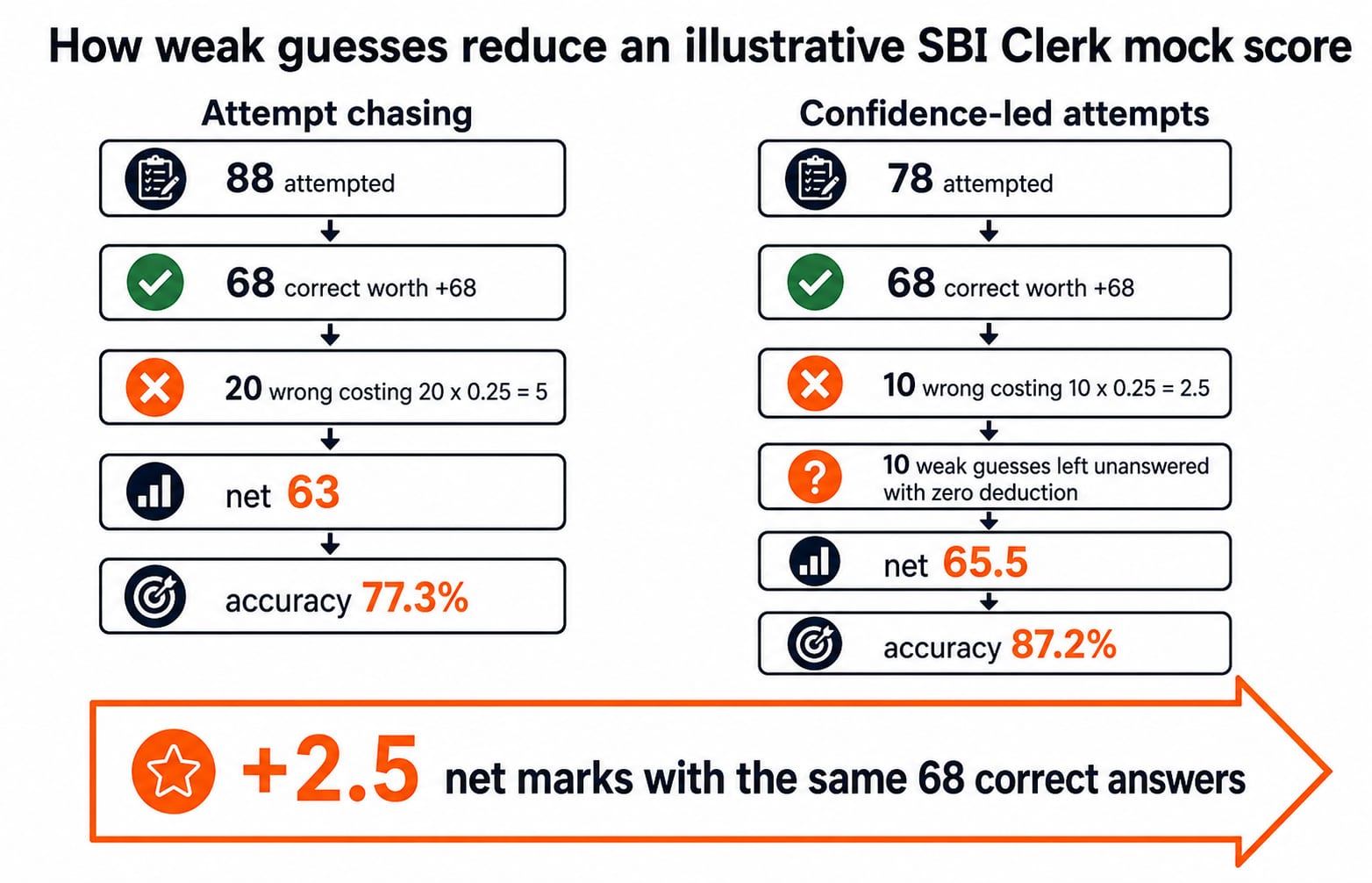
Attempts are visible immediately. Weak guesses show their cost only during analysis. With the current notification's one-fourth deduction for a wrong objective answer:
Candidate A attempts 88, with 68 correct and 20 wrong. Deduction:
20 x 0.25 = 5. Net marks:68 - 5 = 63. Accuracy:68 / 88 x 100 = 77.3%.Candidate B leaves 10 weak guesses unanswered, so attempts 78, with 68 correct and 10 wrong. Deduction:
10 x 0.25 = 2.5. Net marks:68 - 2.5 = 65.5. Accuracy:68 / 78 x 100 = 87.2%.The gain is
65.5 - 63 = 2.5net marks with 10 fewer attempts.
This practice illustration is not an SBI cut-off claim. Tag attempts A for solved and checked, B for one unresolved doubt, or C for guesswork. Next time, take A first, test B only if time permits, leave C, then compare net score, accuracy and wrong answers.
3. Mistake 3: Copying one speed target across sections
"Attempt 30 in every section" sounds measurable, but it ignores section size and personal accuracy. One learner's diagnostic mock might show:
Section | Attempts | Correct | Wrong | Accuracy |
|---|---|---|---|---|
English | 27 | 24 | 3 | 88.9% |
Numerical Ability | 28 | 22 | 6 | 78.6% |
Reasoning | 31 | 24 | 7 | 77.4% |
The accuracies are 24 / 27, 22 / 28 and 24 / 31, rounded to one decimal. One shared attempt target increases risk in the weaker sections.
Use two passes: collect short, high-confidence questions, then return to longer items when the likely gain justifies the time. Leave a puzzle after 120 seconds if no two fixed placements have emerged. Build Numerical Ability speed with the SBI Clerk Quant six-week routine, while keeping a separate accuracy rule for Reasoning.
4. Mistake 4: Taking another mock before analysing the last one
Another mock feels productive, while analysis feels slow. Yet one mock may have 20 avoidable events: 8 concept gaps, 5 poor choices, 4 calculation or reading slips, and 3 timing failures. Calling all 20 "careless" creates no correction task.
Before the next full mock, prepare two 25-question concept drills, three 10-minute set-selection scans, one 20-question slow-accuracy drill and one timed sectional replay. Use the SBI Clerk Prelims course for assigned practice. Each mock must produce an error-log update, one drill and one new decision rule.
5. Mistake 5: Preparing only for prelims
Prelims is the nearest gate, so mains work gets postponed. Under the same current notification, prelims marks are not added for selection. Final merit uses the mains aggregate, subject to the specified local-language requirement where applicable. Mains covers General or Financial Awareness, General English, Quantitative Aptitude, and Reasoning Ability with Computer Aptitude.
A 12-hour week can give 2.5 hours each to English, Numerical or Quantitative Aptitude, and Reasoning with Computer Aptitude, 2 hours to General or Financial Awareness, and 2.5 hours to a mock plus repair. Total: 2.5 + 2.5 + 2.5 + 2 + 2.5 = 12 hours. If local-language practice is needed, replace 30 minutes from a stronger block. The SBI Clerk Prelims and Mains Complete Preparation path keeps both stages visible.
6. Mistake 6: Collecting current affairs without recall
Saving notes creates visible volume without testing retrieval. Recording 15 facts daily for six days produces 15 x 6 = 90 notes. If a 40-question closed-book quiz gives 22 correct and 18 missed, accuracy is 22 / 40 x 100 = 55%. The notebook does not prove recall.
Turn the 18 misses into question-answer cards. Retest after 48 hours and after seven days. Keep a fact only when you can state the event, institution, relevant figure or term, and why it matters without notes. Measure weekly recall percentage, not pages consumed.
7. Mistake 7: Following a timetable with no recovery rule
A packed calendar looks disciplined but cannot absorb disruption. Six 2-hour blocks equal 12 hours. Missing Wednesday and Thursday removes 4 hours. Adding them to a normal 2-hour Saturday creates a 6-hour block and often another backlog.
Keep Saturday at 2 hours. Recover 150 minutes across three days: 50 minutes for the largest concept gap, 60 minutes for one timed sectional test, and 40 minutes for error review. On a disrupted day, use a 30-minute minimum: 10 minutes recall, 15 minutes targeted questions and 5 minutes updating the error log.
8. A seven-day reset for SBI Clerk preparation
Day 1: Verify the source card and audit the last two mocks.
Day 2: Repair the largest concept bucket.
Day 3: Run a slow-accuracy drill.
Day 4: Practise section-specific question selection.
Day 5: Complete a closed-book awareness quiz.
Day 6: Take one full mock using A/B/C confidence tags.
Day 7: Review it for 90 minutes, then compare net score, accuracy and error counts with Day 1.
The short checklist is: current source, net-score target, section-specific benchmarks, analysed mocks, mains time, retrieval practice and a recovery rule.
Use the Banking and Insurance Exam Preparation category to choose the relevant SBI path. Fix the highest-cost habit this week, measure the next mock, and only then move to the next one.
Keep learning
SBI SO Syllabus: Section-by-Section Study Map for IT Aspirants
Build an IT/System study map around your exact SBI post. Use a historical exam table, original worked exercises and an eight-hour sample week to turn topic lists into practice.
1 Oct 20265 min readSBI Exams
SBI SO Preparation Strategy: A 12-Week Role-Specific Plan
Build an SBI SO plan around the exact Specialist Cadre Officer post you are targeting. This guide gives an 11-hour weekly calendar, diagnostics, repair loops and separate written-test and interview branches.
Updated 24 Sep 20266 min readSBI Exams
SBI SO Exam Pattern and Marking Scheme: Post-Wise Routes Explained
There is no single SBI SO paper pattern. Use this guide to identify your post's route, understand qualifying and merit components, and build a timetable from the official notice.
Updated 22 Sep 20264 min readSBI Exams
SBI PO Syllabus Decoded: Section-by-Section Prelims-to-Mains Study Map
Separate SBI PO Prelims, Mains and Phase III before planning your week. This guide maps each section to practical study baskets, checked calculations and a repeatable review routine.
Updated 20 Sep 20265 min readSBI Exams