

Robotics Explained: Components, Degrees of Freedom, Worked Numericals and Exam Patterns
A robot is a complete sense-plan-act-feedback system, not merely an AI model or a moving machine. Learn its components, calculate a 2R arm endpoint and a differential-drive pose, then avoid common exam traps.
KnowledgeGate Team
Exam prep & CS education
Updated 1 Nov 20266 min read
Robotics questions mix links and joints with sensors, control, AI and calculations. Memorising applications does not reveal the tested layer. ICT for Teaching Exams: Fundamentals Explained owns the broader computer, internet and e-learning foundation; robotics adds a physical sense-plan-act-feedback system, a two-link arm and differential-drive motion. Robotics, automation and AI differ in their roles, even when they appear in the same problem.
Robotics fundamentals: define the complete system
Robotics covers robot design, sensing, control, programming and use. A robot is a reprogrammable physical system that senses state, processes information and acts on the world to pursue a task. Embodiment separates it from a software-only chatbot; reprogrammability and feedback separate it from passive, single-purpose machines.
The reusable chain is:
environment -> sensors -> perception or state estimate -> decision or plan -> controller -> actuators -> robot motion -> changed environment -> sensor feedback
In warehouse pick-and-place, a camera locates a box and an encoder reports arm angle. A planner chooses collision-free motion, the controller commands motors, two revolute joints move, the gripper closes, and force feedback confirms the grasp.
Open-loop control does not measure the result. Closed-loop control uses measured output to correct action.
Robot components: identify each block's job
Component | Job | Warehouse example |
|---|---|---|
Structure or frame | Supports parts | Fixed base |
Links | Carry motion | Two rigid arm links |
Joints | Permit relative motion | Two revolute joints |
End effector | Handles objects | Parallel-jaw gripper |
Actuator | Produces motion | Electric motors |
Transmission | Carries force or speed | Gear reduction |
Sensor | Measures state | Camera plus joint encoders plus force sensor |
Controller | Computes commands | Embedded controller |
Power source | Supplies energy | Battery or mains supply |
Program | Defines task | Warehouse pick routine |
Proprioceptive sensors measure internal state, such as encoder angle or motor current. Exteroceptive sensors observe surroundings through cameras, lidar, proximity or touch. A transducer converts energy; a sensor measures; an actuator causes physical change.
Box-pose estimation is perception, path selection is planning, and reducing angle error is control. A motor is not a controller, an encoder is not an actuator, and an image is not a plan.
Robot joints and degrees of freedom
A link is rigid; a joint permits relative motion. Revolute joints rotate and prismatic joints translate. One DOF is one independent configuration coordinate. A planar arm with two independent revolute joints has 2 DOF. Three-dimensional position and orientation may require more.
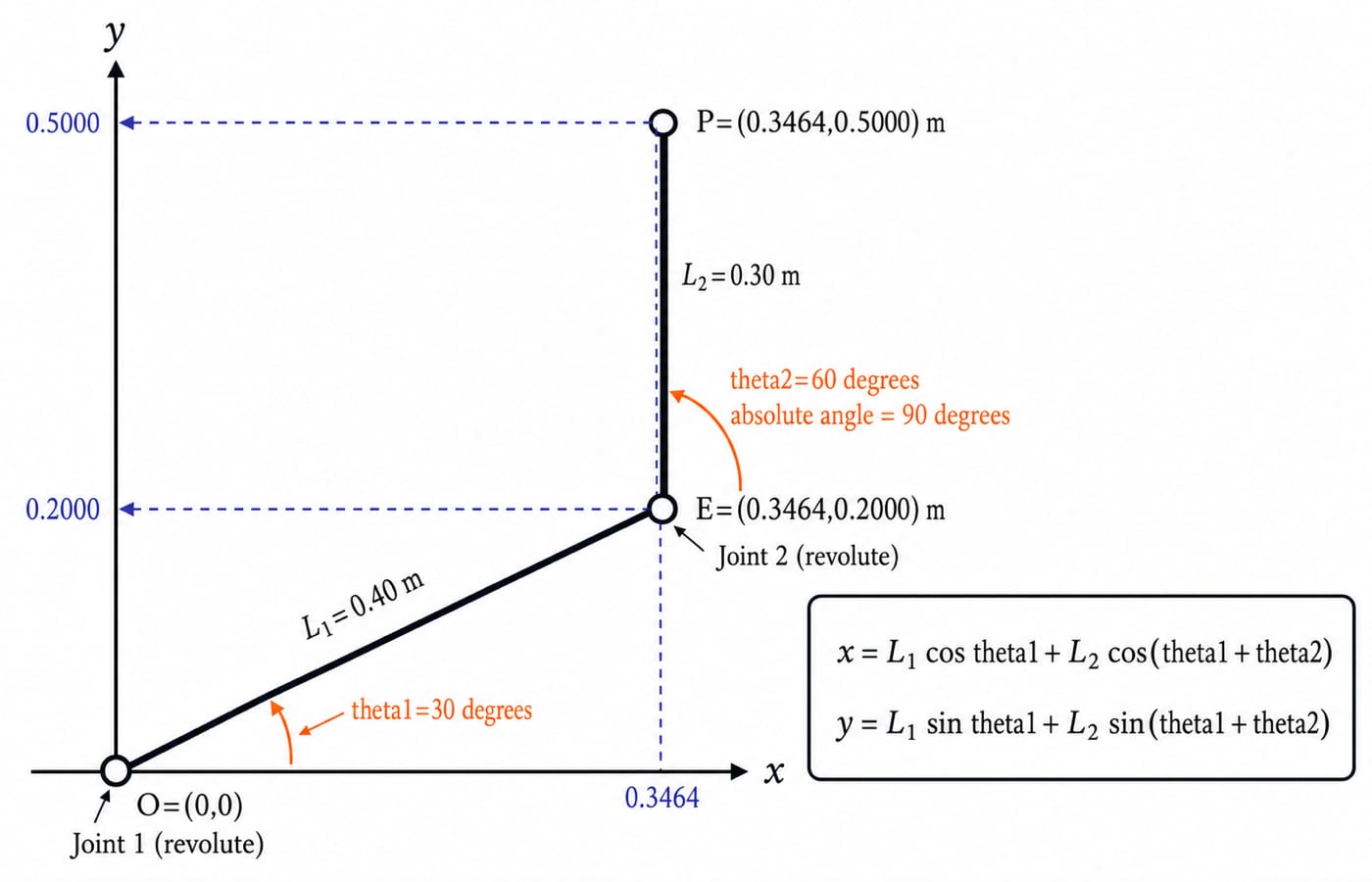
Use ideal rigid links L1 = 0.40 m and L2 = 0.30 m; ignore the gripper. Joint 1 is at the origin with theta1 = 30 degrees from positive x. Joint 2 is theta2 = 60 degrees relative to link 1, giving absolute angle theta1 + theta2 = 90 degrees.
The elbow is:
x1 = 0.40 cos 30 degrees = 0.3464 my1 = 0.40 sin 30 degrees = 0.2000 m
The end effector is:
x = L1 cos theta1 + L2 cos(theta1 + theta2) = 0.40 cos 30 degrees + 0.30 cos 90 degrees = 0.3464 my = L1 sin theta1 + L2 sin(theta1 + theta2) = 0.40 sin 30 degrees + 0.30 sin 90 degrees = 0.5000 m
Endpoint: (0.3464 m, 0.5000 m).
Using relative theta2 as absolute gives the wrong endpoint. Count independent coordinates, not links or motors, for DOF. State the angle convention first.
Mobile-robot motion: a differential-drive numerical
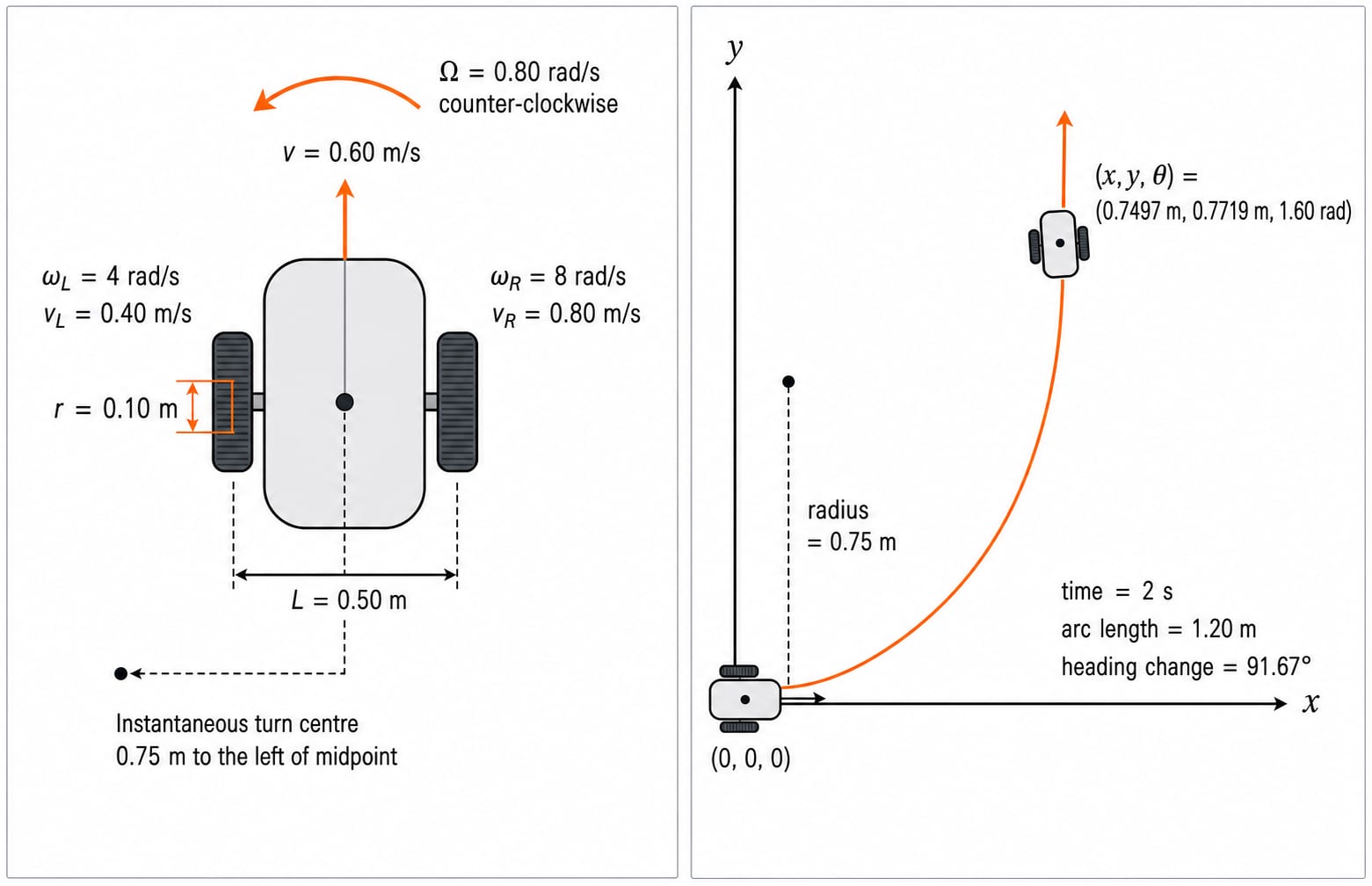
A differential-drive robot has independently driven wheels on one axle. Set r = 0.10 m, separation L = 0.50 m, omega_R = 8 rad/s, omega_L = 4 rad/s, and Delta t = 2 s. It starts at (x0,y0)=(0,0) facing positive x. Counter-clockwise is positive; ignore slip.
Convert angular to linear speeds:
v_R = r omega_R = 0.10 x 8 = 0.80 m/sv_L = r omega_L = 0.10 x 4 = 0.40 m/sv = (v_R + v_L)/2 = 0.60 m/sOmega = (v_R - v_L)/L = (0.80 - 0.40)/0.50 = 0.80 rad/s
The faster right wheel turns left. Radius R = v/Omega = 0.60/0.80 = 0.75 m. After two seconds:
Delta theta = Omega Delta t = 0.80 x 2 = 1.60 rad, about91.67 degreesArc length
= v Delta t = 0.60 x 2 = 1.20 mx = R sin(1.60) = 0.7497 my = R[1 - cos(1.60)] = 0.7719 m
Final pose: (0.7497 m, 0.7719 m, 1.60 rad).
Equal speeds give Omega = 0 and straight motion, so skip R = v/Omega. Equal and opposite speeds give v = 0 and midpoint rotation. Swapping the faster wheel reverses the turn.
Robot control, autonomy and AI
For desired angle = 50 degrees and measured angle = 42 degrees, e = 50 - 42 = 8 degrees. With hypothetical Kp = 0.5 motor-command units per degree, u = Kp e = 4 command units. The controller measures again; one command cannot guarantee position. Watch overshoot, oscillation, steady-state error, saturation and noise.
A taught-path arm is automated without learning. An autonomous robot chooses through rules or planning. AI or ML may recognise objects or learn a policy, but the robot still needs sensing, control, actuation, power and safety. Emerging Technology Trends Explained: Concepts and a Worked IoT Example maps IoT, edge, cloud and AI as separate system roles. Robotics here instead owns physical embodiment, kinematics, motion and feedback control.
Safety includes workspace limits, emergency stops, collision detection, guarded cells, speed and force limits, fault detection, safe states and supervision.
Robot types and applications
Classify by movement, mechanism and task. Manipulator, mobile, humanoid, aerial, underwater, medical and collaborative labels can overlap. An aerial inspection robot is mobile and application-specific.
Cartesian robots use prismatic axes. Cylindrical and spherical forms combine translation and rotation. SCARA arms offer selective compliance and planar assembly motion. Articulated arms chain revolute joints.
Classify four cases:
A fixed two-revolute-joint pick arm is a manipulator.
A two-wheel warehouse carrier is a differential-drive mobile robot.
A rule-based welding arm is robotic automation, but not necessarily AI.
A vision model that labels boxes is AI perception, not a complete robot by itself.
Robotics exam patterns and common traps
Questions may match components and functions, separate sensors and actuators, count DOF, order sense-plan-act-feedback, classify control loops, calculate motion, and separate robotics, automation, autonomy and AI. The decisive cue is the tested function: sensing versus actuation, coordinates versus links, fixed-rule automation versus learned inference, or wheel speed versus chassis motion.
Answer checks: arm endpoint (0.3464 m,0.5000 m); v_R = 0.80 m/s; v_L = 0.40 m/s; v = 0.60 m/s; Omega = 0.80 rad/s; R = 0.75 m; pose (0.7497 m,0.7719 m,1.60 rad); control error 8 degrees; output 4 command units under the stated gain.
Wrong move | Correction |
|---|---|
Count links as DOF | Count independent coordinates |
Treat relative angle as absolute | Add the preceding orientation |
Swap wheel separation and radius | Track symbols and units |
Faster right wheel means right turn | Here it drives a left turn |
Encoder is an actuator | It senses position |
Autonomous means AI | Rules can provide autonomy without learning |
Classifier is a robot | A robot must sense and physically act |
A recruiting body’s latest syllabus or notification is the authority for marks, question counts, dates, duration, frequency and weightage.
Robotics short version and the next step
Recall sense -> estimate -> plan -> control -> actuate -> measure again, joint angles -> link endpoint, and wheel speeds -> chassis speed and turn. Redraw both diagrams and recompute unaided.
Swap to omega_R = 4 rad/s and omega_L = 8 rad/s. Then v = 0.60 m/s, Omega = -0.80 rad/s, signed R = -0.75 m, giving the mirrored right turn.
Next, inspect the TPSC ATO (CS) exam preparation path. TPSC learners can use the TPSC Assistant Technical Officer (ATO, CS) 2026 Complete Course; UPPSC teaching aspirants can use the UPPSC Polytechnic Lecturer 2025 (CS) Complete Course as a structured next step.
Keep learning

SSC CGL Post Eligibility: Match Degrees, Age Bands and Skill Tests Before Preferences
A graduate degree does not make every SSC CGL post a safe preference. Use this three-gate worksheet to check education, age, skill standards and post-specific conditions.
Updated 30 Oct 20266 min readSSC CGL

PMMMNMTT Scheme Explained: 7 Components, Target Institutions and Exam Notes
Learn PMMMNMTT as a purpose-and-scope map, then revise its seven original components through count logic, institutional clues and exam-style checks.
Updated 12 Nov 20265 min readTeaching Recruitment (Computer Science)
Fundamentals of Systems and Information Systems: Types, Components and a Worked Inventory Model
Learn the system vocabulary, compare classifications and TPS, MIS, DSS and ESS, then follow one warehouse case from raw transactions to a 480-unit order.
Updated 15 Nov 20266 min readGATE Strategy & Roadmap

Testing React Components: A Runnable Vitest and Testing Library Tutorial
Build and test a small React progress component from its initial render through completion. The examples use accessible queries, awaited actions, and an exact mock assertion.
Updated 15 Nov 20266 min readWeb Development