

IoT, Sensors and Smart Cities Explained: Architecture, Numericals and Exam Traps
Learn the role of every IoT block, separate common sensor terms, and solve a 120-node streetlighting numerical covering data, energy and hysteresis.
KnowledgeGate Team
Exam prep & CS education
Updated 31 Oct 20266 min read
IoT questions look easy until one stem mixes a sensor, gateway, cloud store, actuator and the word “smart”. Assign every block a role, then trace data and control separately. Telemetry and control need separate paths, with local fallback when connectivity fails. ICT for Teaching Exams: Fundamentals Explained connects this topic to the wider syllabus. In an IoT service, sensors produce measurements, the network carries telemetry, local logic applies hysteresis, and automation does not require AI.
IoT, sensors and smart cities: define each term first
IoT connects identifiable physical objects that sense or act, exchange network data, and participate in a service. Devices may sense, act or both; connectivity alone is insufficient.
Term | Role | Streetlight example |
|---|---|---|
Transducer | Converts one form of energy into another | ambient-light sensor |
Sensor | Measures a physical condition | motion sensor |
Actuator | Changes the physical world | lamp-dimming actuator |
Controller | Applies local logic | pole controller |
Gateway | Aggregates or translates traffic | area gateway |
Platform | Stores, manages or analyses device data | remote device platform |
Application | Presents a service | maintenance dashboard |
A smart city applies data and connected control to lighting, water, waste, traffic, air quality or maintenance. One online device is not a smart city, and “smart” does not imply AI.
IoT architecture: follow an event to an action
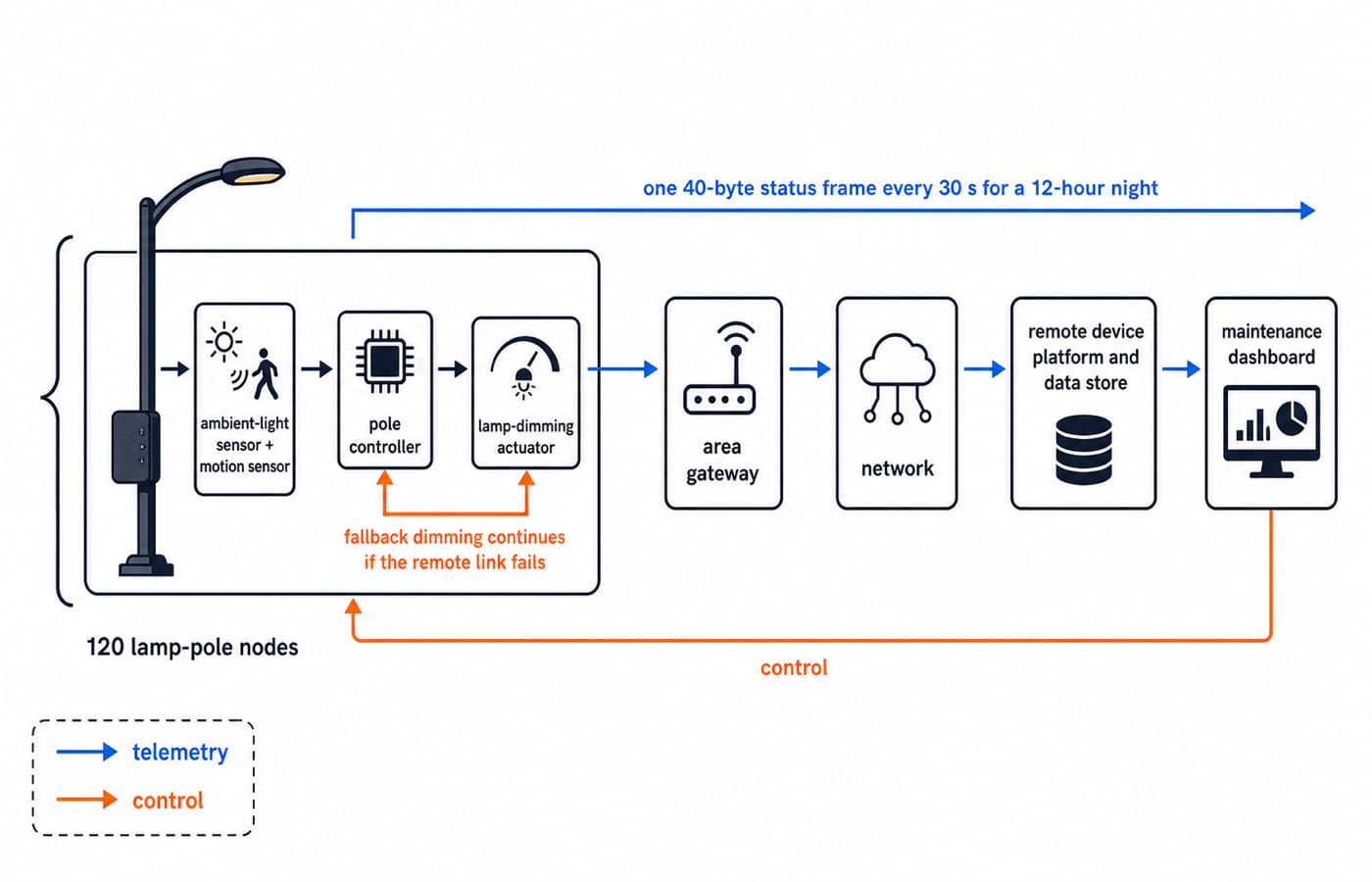
Follow this role path: physical event -> sensor or device -> local controller or edge -> gateway and network -> remote platform and store -> application or rule -> actuator or human decision. Three-layer and five-layer models group these jobs differently.
Each of 120 lamp-pole nodes has ambient-light and motion sensors, a controller and a dimming actuator. It sends one 40-byte status frame every 30 seconds for a 12-hour night through an area gateway. The platform stores status for a maintenance dashboard; local dimming survives a remote-link failure.
Light-level and lamp-state reports are telemetry; dimming commands are control. Closed loops sense and readjust. Read-only dashboards monitor. Infrastructure needs local fallback.
Sensor fundamentals and ADC terms
Analog output varies continuously; digital output is discrete. Sampling measures at chosen instants. Range is the measurable span, sensitivity is output change per input change, and resolution is the smallest representable change. Accuracy is reference closeness; precision is repeatability. Calibration uses a reference but cannot prevent drift.
For an ideal 12-bit ADC with codes 0 to 4095 over 0 to 3.3 V:
Step size = 3.3 / 4096 = 0.0008057 V, about 0.806 mV per code.
At 1.65 V, code = round((1.65 / 3.3) x 4095).
Code = round(2047.5) = 2048.
This uses the ideal-step convention. Some use Vref/(2^N - 1); follow the stem's formula.
Against a 100 lux reference, 98, 98 and 99 lux are precise but biased low. Readings 96, 100 and 104 lux average 100 but are more spread out. One average cannot establish accuracy.
IoT connectivity, messaging, edge and cloud
Choose by range, data rate, energy, latency, interference, coverage, topology, cost and reliability. Bluetooth or Zigbee may suit short-range low-data links; Wi-Fi suits powered, higher-throughput local access. LPWAN trades data rate for range and low energy; cellular can offer managed wide-area coverage. Verify the standard and coverage.
Network access differs from application messaging. MQTT commonly uses brokered publish/subscribe topics; CoAP commonly uses lightweight request/response. Neither is a sensor, radio, gateway or platform, and MQTT does not create AI.
Rejecting an impossible motion reading at the pole is edge processing. Retaining fleet history and building a city-wide view is cloud-side work. A fixed threshold is automation; a data-trained model may be AI. Machine learning is optional.
For the cross-technology map and a smart-irrigation edge/cloud payload-reduction case, use Emerging Technology Trends Explained: Concepts and a Worked IoT Example. The IoT-specific streetlighting problem instead combines sensor and ADC behaviour, MQTT and CoAP, telemetry, energy, hysteresis and failure-safe control.
Worked smart-streetlighting traffic and energy numerical
The hypothetical has 120 lamps using 100 W full and 30 W dimmed. In 12 hours, each spends 3 hours full and 9 dimmed. Each node sends one complete 40-byte frame every 30 seconds, plus 5% retransmissions. Size includes assumed headers; gateway traffic, acknowledgements and other overhead are excluded.
Traffic calculation
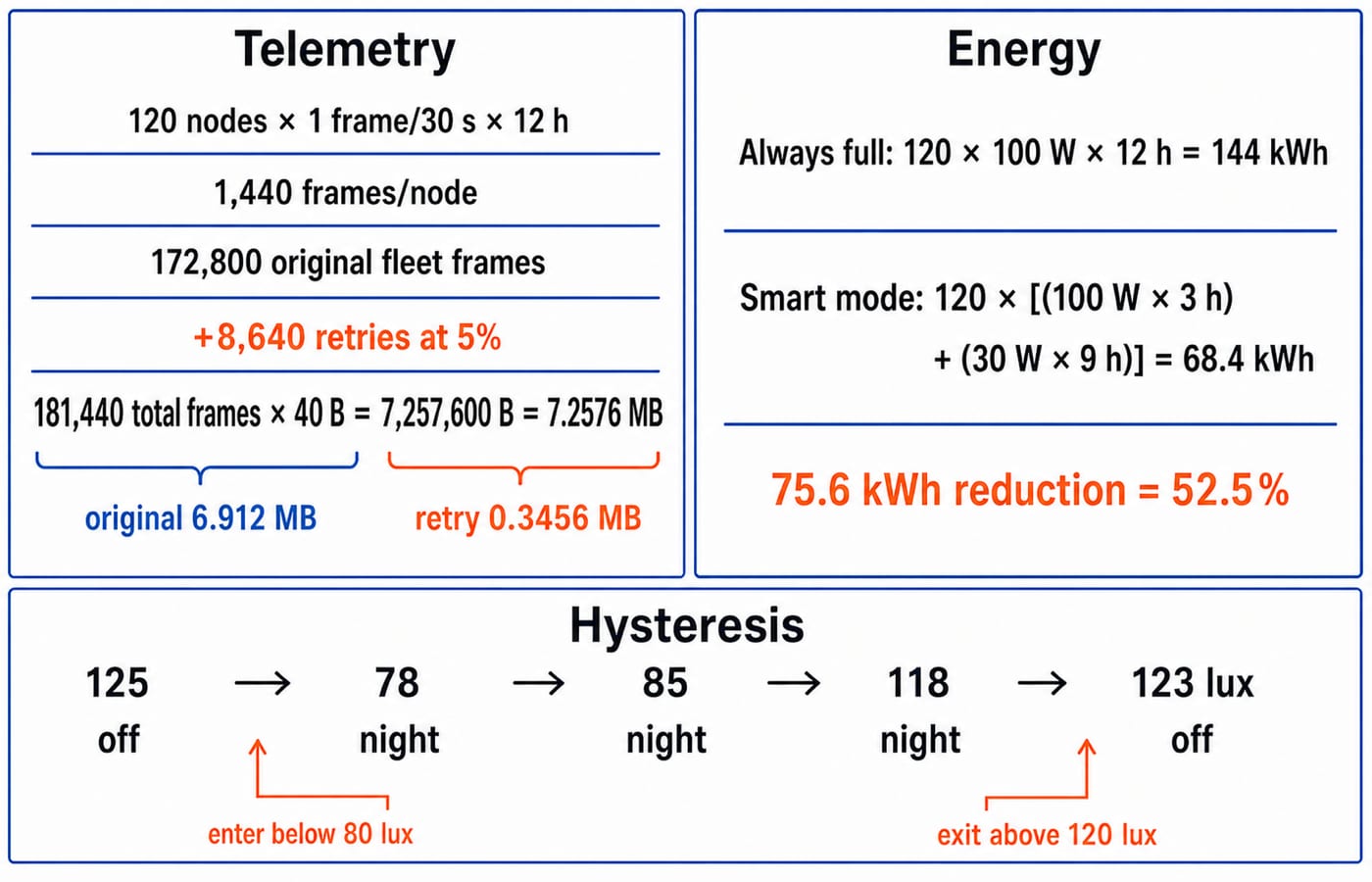
Frames per node = 12 x 60 x 60 / 30 = 1,440.
Original fleet frames = 120 x 1,440 = 172,800.
Original traffic = 172,800 x 40 = 6,912,000 bytes = 6.912 MB, using decimal MB.
Retries = 0.05 x 172,800 = 8,640 frames = 345,600 bytes.
Total = 172,800 + 8,640 = 181,440 frames.
Total traffic = 181,440 x 40 = 7,257,600 bytes = 7.2576 MB.
Five per cent retries means 105% of the original, not original/0.95.
Lighting-energy calculation
Always-full baseline = 120 x 100 W x 12 h = 144,000 Wh = 144 kWh.
Smart case = 120 x [(100 W x 3 h) + (30 W x 9 h)].
Smart case = 120 x (300 + 270) Wh = 68,400 Wh = 68.4 kWh.
Reduction = 144 - 68.4 = 75.6 kWh.
Percentage reduction = 75.6 / 144 x 100 = 52.5%.
Enter night mode below 80 lux and exit above 120 lux; preserve state between them. Starting outside night mode, 125, 78, 85, 118, 123 lux gives off -> night -> night -> night -> off. Hysteresis prevents dusk switching. Motion selects full or dim within night mode.
Smart-city use cases, limits and safeguards
Service | Sensor/input | Decision | Actuator/output | Failure-safe question |
|---|---|---|---|---|
Streetlighting | Ambient light and motion | Full or dim output | Lamp dimming | What if motion data is missing? |
Water distribution | Pressure or flow | Leak alert or isolation | Alert or valve control | Can a false alarm interrupt supply? |
Waste collection | Fill level | Route priority | Route plan | What if a bin stops reporting? |
Air-quality monitoring | Particulate reading | Alert threshold | Public or operator alert | Who checks a false positive? |
Ask what is measured, where decisions run, what missing data causes, and who suffers from false results. Remote analytics may optimise services, but safety-critical control needs validated limits, oversight and fallback. An actuator is not always required.
Security needs unique identity, authentication, in-transit encryption, least privilege, segmentation, verified updates, patching and logging. Privacy needs data minimisation and retention limits. Encryption cannot fix compromised credentials, unsafe firmware, excess collection or bad fallback.
IoT exam patterns and common traps
Questions may match roles, order architecture, select connectivity, separate edge and cloud, trace hysteresis, or calculate samples, frames, data and energy. Underline the verb and unit. Checks: ADC 2048; original frames 172,800; after retries 181,440; traffic 7.2576 MB; energy reduction 52.5%. At 85 and 118 lux, exit has not crossed 120 lux.
Common corrections are:
sensor equals actuator -> measurement and action differ
every automated rule is AI -> fixed logic is automation
every online device is IoT -> sensing or actuation must serve a context
resolution equals accuracy -> step size and reference closeness differ
MQTT is a radio -> it is application messaging
omit the fleet factor -> keep node, time and fleet factors visible
MB equals Mb -> one byte is eight bits
Use the latest official syllabus or notification for exam structure, weightage, marks, dates, counts, duration and frequency.
IoT and smart cities: the short version and next step
Recall: condition -> sensor -> controller or edge -> network and gateway -> platform -> decision -> actuator or human. Sensor differs from actuator; automation need not be AI; a smart-city service is an objective, not a gadget.
Redraw and recompute 1,440, 172,800, 181,440, 7.2576 MB, 144 kWh, 68.4 kWh and 52.5%. At 60 seconds, check 720 frames per node, 86,400 originals, 4,320 retries, 90,720 total, and 3,628,800 bytes = 3.6288 MB. Energy is unchanged.
Use Govt Teaching Job Exam Preparation to choose the relevant route. For Paper 1 ICT preparation, use the NTA UGC NET Paper 1 Course. DSSSB aspirants can use the DSSSB TGT CS 2026 Section B Course. Then confirm the current exam structure and weightage in the recruiting body’s official notification.
Keep learning
Future Internet Explained: Architecture, a Worked IoT Example and Exam Traps
Learn how device, edge, network, cloud and application layers cooperate, then solve a smart-campus example for data reduction and control-loop latency.
Updated 16 Nov 20266 min readWeb Development
Internet of Things (IoT) MCQs: 10 Solved Architecture and Applications Questions
Solve 10 published IoT MCQs on architecture, wireless links, Zigbee, MQTT, SCADA and distributed systems. Each answer includes a concise explanation.
Updated 30 Oct 20267 min readComputer Networks MCQs

Internet of Things (IoT) MCQs: 10 Solved Questions on Architecture, ZigBee, WSN and MQTT
Solve 10 previous-year IoT questions using a four-stage architecture map, a ZigBee topology and direct option elimination. Recheck the key traps around wireless links, layers and MQTT.
Updated 30 Oct 20267 min readComputer Networks MCQs

Smart Pointers in C++: unique_ptr, shared_ptr and weak_ptr with Worked Examples
Learn who owns a C++ object, when it is destroyed, and how to choose among unique_ptr, shared_ptr, weak_ptr and a borrowed raw pointer.
Updated 1 Oct 20265 min read105 viewsC Programming & Data Structures