

PMMMNMTT Scheme Explained: 7 Components, Target Institutions and Exam Notes
Learn PMMMNMTT as a purpose-and-scope map, then revise its seven original components through count logic, institutional clues and exam-style checks.
KnowledgeGate Team
Exam prep & CS education
Updated 12 Nov 20265 min read
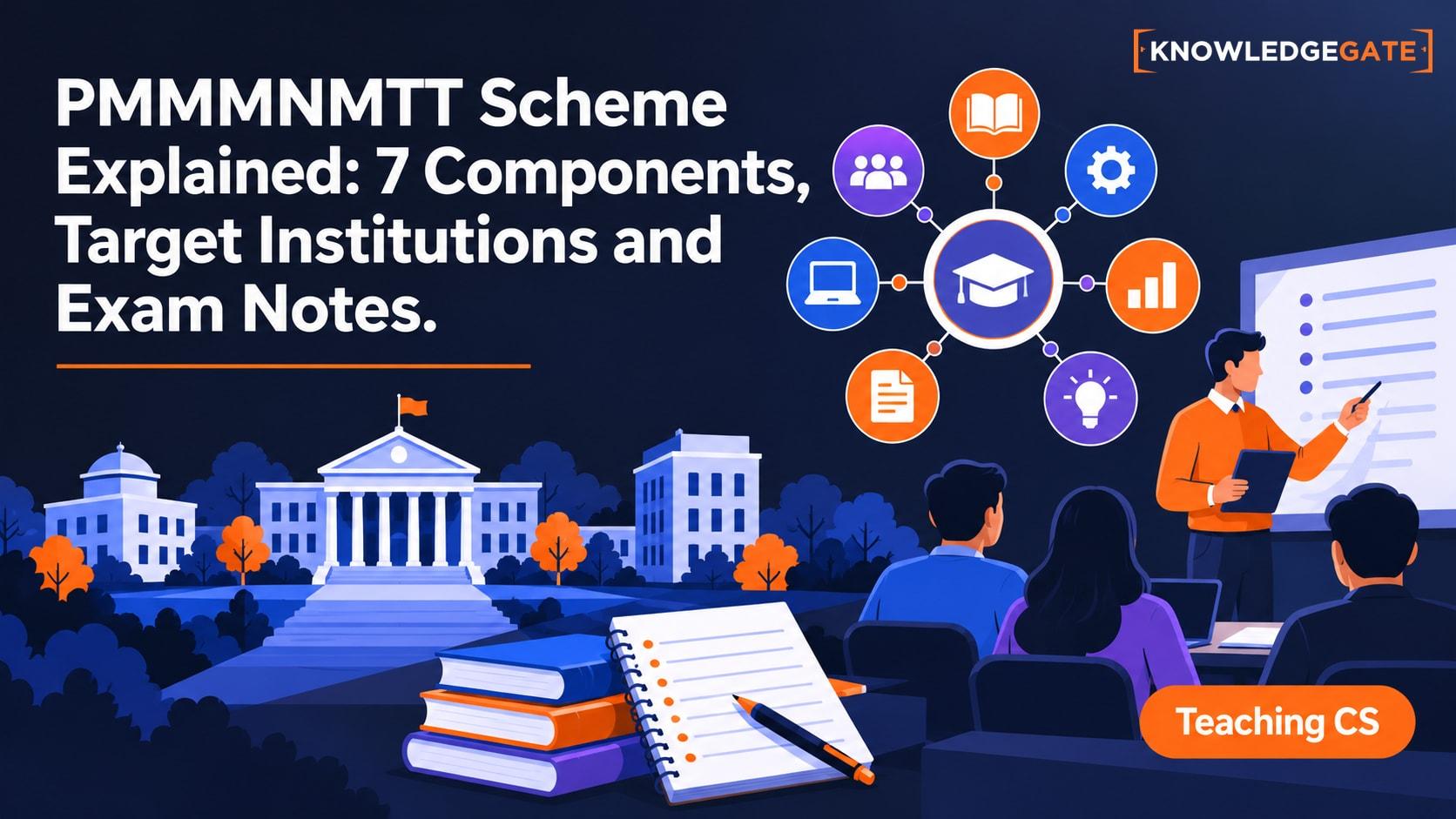
The PMMMNMTT expansion alone misses swapped components, institutions, subcomponents and the later MMTTP name. Its purpose is teacher supply and preparation, professional development, curriculum, pedagogy, assessment, research, institutional capacity and leadership. The original structure has seven components, five fixed-number heads and three subcomponents nested under the 50-centre head. Planned allocations and later approvals are different counts.
PMMMNMTT full form, launch and purpose
PMMMNMTT stands for Pandit Madan Mohan Malaviya National Mission on Teachers and Teaching. The Ministry's PMMMNMTT scheme page and linked records identify it as a Central Sector Scheme launched on 25 December 2014 at Banaras Hindu University.
Its purpose connects teacher supply and preparation, professional development, curriculum, pedagogy, assessment, research, institutional capacity and leadership. The urgent horizon addressed supply, talent and quality. The longer horizon sought a professional cadre, performance standards and strong institutions.
PMMMNMTT was neither a scholarship, recruitment board, single course nor school-only scheme. It was institutional and multi-level. Teaching Aptitude for CS Recruitment Exams covers learner psychology, teaching methods and assessment; PMMMNMTT instead concerns the institutions and programmes that build teaching capacity.
PMMMNMTT target levels, people and institutions
Level | People or institution | Mission function |
|---|---|---|
Elementary and secondary | Teachers, teacher educators, schools and specialist institutions | Preparation, curriculum, pedagogy, materials and research |
Higher education | Faculty, researchers, Central Universities, universities and colleges | Development, resources, research, networks and leadership |
Technical education | Technical teachers, institutions and administrators | Teaching quality and institutional capacity |
The lifecycle covered pre-service preparation, in-service development, curriculum, materials, research, networks, resources and leadership. Later records added Faculty Induction Programme, ARPIT and LEAP, not original-list items.
Boundary test: teacher-educator preparation, curriculum research and university leadership fit; a cash transfer to every teacher does not. One builds capacity, while the other invents a mechanism.
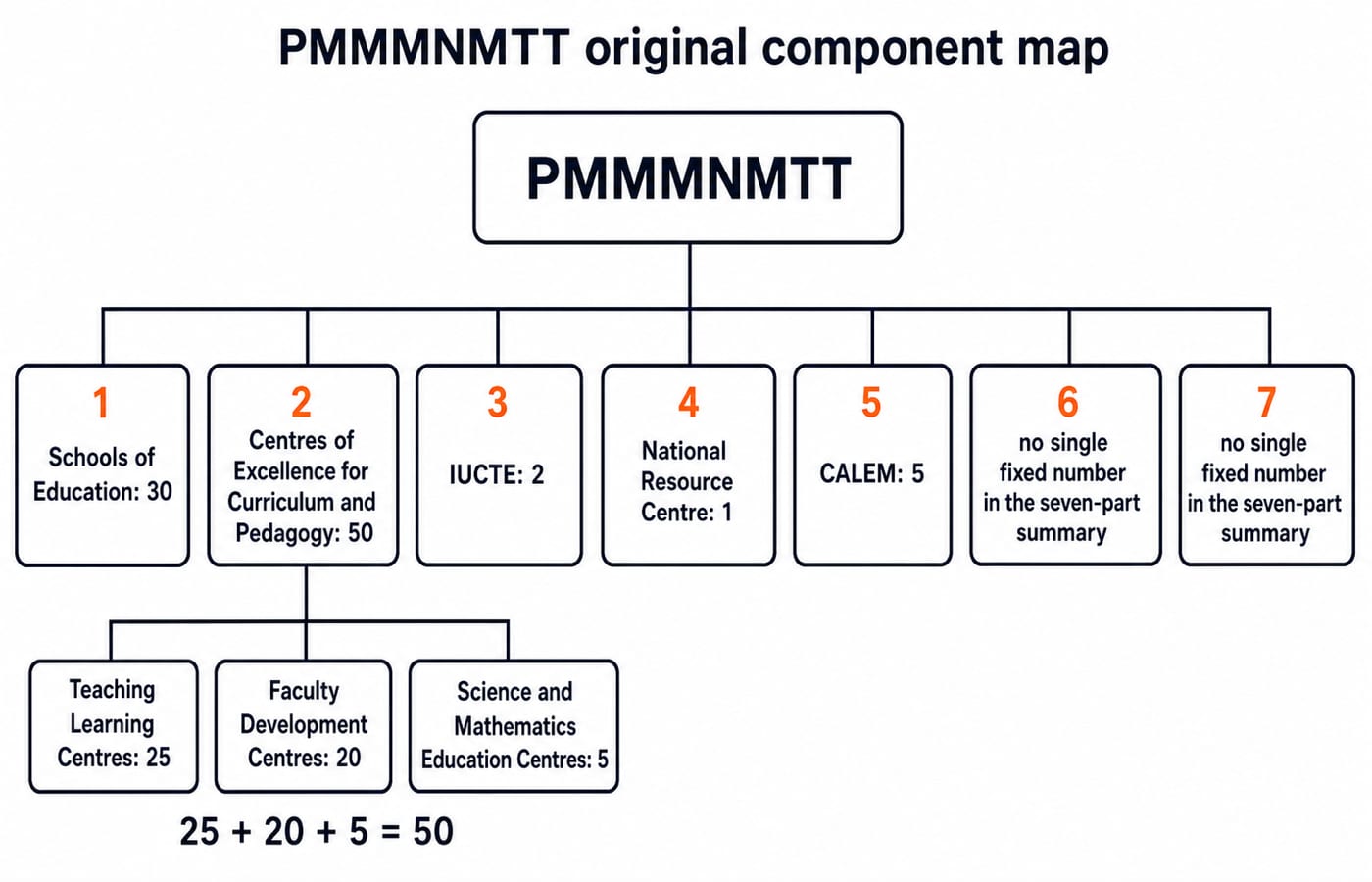
PMMMNMTT components: the original seven-part map
Major component | Planned number in original guidelines | Recognition cue | Main institutional home or role |
|---|---|---|---|
Schools of Education in Central Universities | 30 | Integrated teacher education and research | Central Universities |
Centres of Excellence for Curriculum and Pedagogy | 50 | Parent of three subcomponents | Curriculum and faculty capacity |
Inter-University Centres for Teachers' Education | 2 | Shared expertise and facilities | University coordination |
National Resource Centre for Education | 1 | Electronic resources and teacher database | National network |
Centres for Academic Leadership and Education Management | 5 | Academic and educational leaders | Leadership development |
Innovations, Awards, Teaching Resource Grant, including Workshop and Seminar | No single fixed number in the seven-part summary | Innovation and resources | Grants and activities |
Subject Networks for Curricular Renewal and Reforms | No single fixed number in the seven-part summary | Discipline networks | Curriculum renewal |
25 Teaching Learning Centres (TLCs) + 20 Faculty Development Centres (FDCs) + 5 Centres of Excellence in Science and Mathematics Education = 50.
The 50 is the parent total, not another allocation. Use full names first; SoE, TLC, FDC, IUCTE, NRC and CALEM are only revision aids.
Worked example: count fixed units without double counting
Question: How many units were planned under the five major components with fixed allocations?
Schools of Education: 30
Curriculum and Pedagogy parent component: 50
IUCTEs: 2
National Resource Centre: 1
CALEM centres: 5
So, 30 + 50 + 2 + 1 + 5 = 88 fixed-number units.
Check the parent: 25 + 20 + 5 = 50. The wrong method, 30 + 50 + 25 + 20 + 5 + 2 + 1 + 5 = 138, counts the same 50 children again.
Read the noun. Major components means 7. Subcomponents under the 50-centre head means 3, counted 25, 20 and 5. Five fixed-number major heads total 88, a planned-allocation derivation rather than eventual establishments.
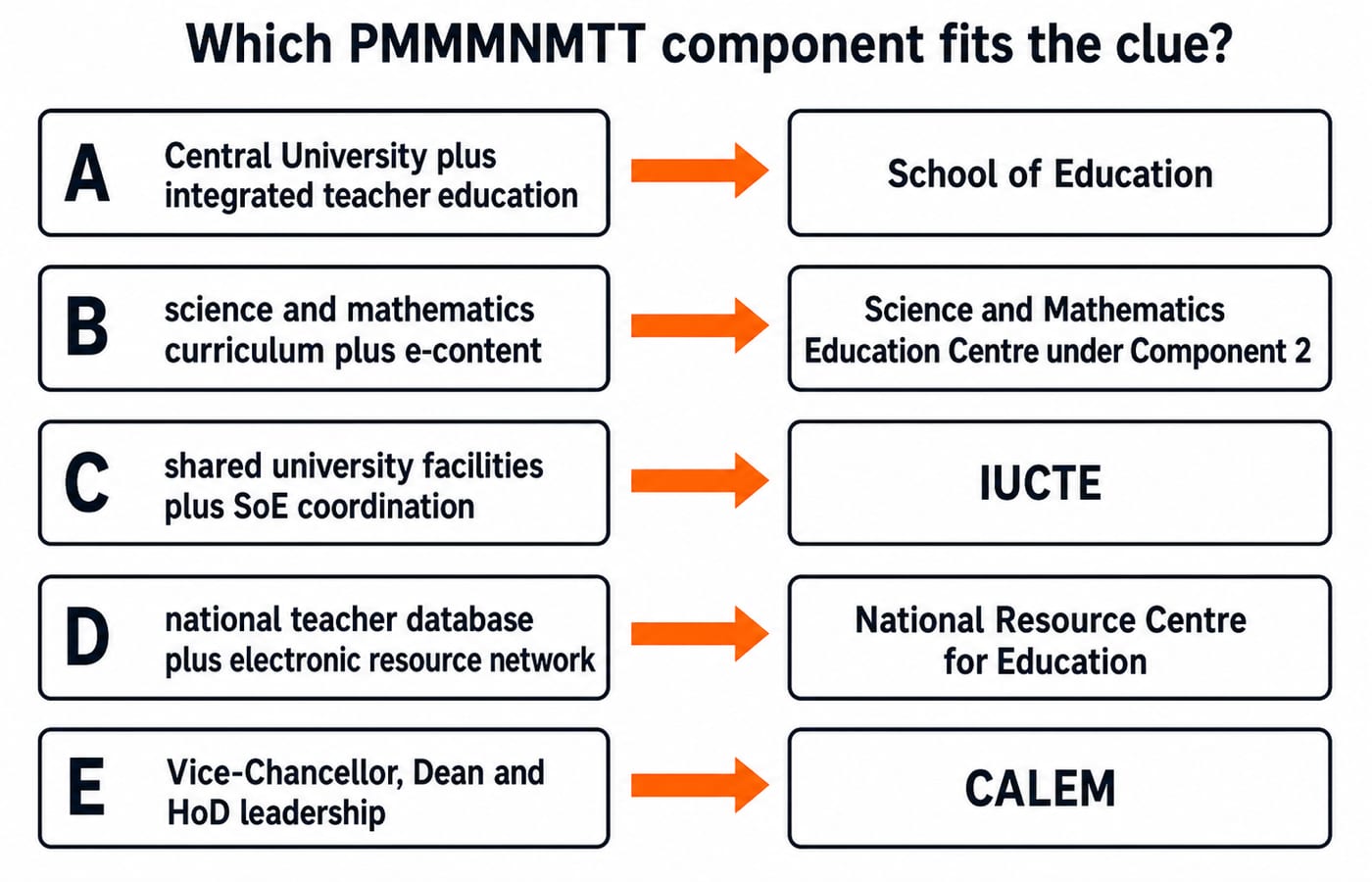
Worked matching set: map clues to components
A: A Central University proposes integrated teacher-education programmes and research from elementary through higher and technical education, with an international mentoring relationship.
B: A specialist centre develops science and mathematics curricula, pedagogy, learning material and e-content.
C: An autonomous university-system centre offers shared advanced facilities and coordinates work among Schools of Education.
D: A national electronic repository builds a higher-education teacher database, identification framework and resource-sharing network.
E: A centre develops Vice-Chancellors, Deans, Heads of Department and other academic administrators as educational leaders.
Answer key: A is a School of Education, signalled by the Central University and integrated role. B is a Centre of Excellence in Science and Mathematics Education, for discipline-specific curriculum and pedagogy. C is an IUCTE, for shared facilities and coordination. D is the National Resource Centre for Education, for its database and network. E is CALEM, for academic leadership.
TLCs and FDCs share the 50-centre umbrella and have overlapping teaching-improvement and faculty-development roles. Their labels overlap, so a question needs a dated source before assuming a narrower division. Computer Science Pedagogy for Teacher Exams distinguishes curriculum, classroom method and teacher capacity.
PMMMNMTT traps: original components, later programmes and MMTTP
Trap | Why it fails | Correction |
|---|---|---|
Add 50 and its 25, 20 and 5 children | Double counting | Count the parent once |
Say it covered only schools | Higher and technical education are omitted | Check the level |
Make every workshop a component | Activity is not a major head | Use the seven-part map |
Expand PMMMNMTT incorrectly | Similar words hide errors | Use the official name |
Make PMMMNMTT and MMTTP identical | Names and structures differ | Follow the dated document |
The original guidelines have seven components. The Ministry's 2019 PAB record adds ARPIT, the Faculty Induction Programme and LEAP. Use the seven-part map for original-guideline questions and the named report for later structures.
The Ministry's 2023-24 annual report calls Malaviya Mission Teacher Training Programme a re-envisioned arrangement drawing on PMMMNMTT centres and UGC Human Resource Development Centres. It is not an unchanged synonym, and historical counts are not current status.
PMMMNMTT practice questions: recall, matching and assertion-reason
Practise four question forms: full-form and launch recall, function matching, number hierarchy, and assertion-reason. A current official notice determines whether PMMMNMTT appears in a particular exam syllabus. UGC NET Paper 1 vs Paper 2 explains how general teaching aptitude in Paper 1 differs from the chosen subject in Paper 2.
Assertion: The original Centres of Excellence for Curriculum and Pedagogy component had a planned total of 50 centres.
Reason: Its three subcomponents were 25 Teaching Learning Centres, 20 Faculty Development Centres and 5 Centres of Excellence in Science and Mathematics Education.
Answer: Both are true, and the reason correctly explains the total because 25 + 20 + 5 = 50.
Two quick checks:
Which component is singular in the original fixed allocations? National Resource Centre for Education, 1.
Which clue means CALEM, not IUCTE? Developing academic administrators and leaders. Shared facilities and coordination mean IUCTE.
PMMMNMTT short notes and the next revision step
Recall: full form; Ministry-recorded launch in December 2014; preparation, development, curriculum, pedagogy, assessment, research and leadership; seven components; 30, 50, 2, 1, 5; then 25 + 20 + 5 under 50.
In ten minutes, redraw seven boxes, recompute 88, explain why 138 is wrong and solve the matches. Verify names against dated Ministry material.
For the wider sequence, use the NTA UGC NET Paper 1 Course. For exam routes, start with Govt Teaching Job Exam Preparation. Keep the timelines separate.
Keep learning
UGC NET Paper 1 Higher Education Timeline: Institutions, Commissions, Policies and Digital Initiatives
Turn disconnected Higher Education dates into a classified timeline. Learn the ancient centres, modern bodies, policies and digital initiatives through worked ordering drills.
Updated 3 Sep 20266 min read80 viewsNET Strategy & Updates
Robotics Explained: Components, Degrees of Freedom, Worked Numericals and Exam Patterns
A robot is a complete sense-plan-act-feedback system, not merely an AI model or a moving machine. Learn its components, calculate a 2R arm endpoint and a differential-drive pose, then avoid common exam traps.
Updated 1 Nov 20266 min readTeaching Recruitment (Computer Science)
Fundamentals of Systems and Information Systems: Types, Components and a Worked Inventory Model
Learn the system vocabulary, compare classifications and TPS, MIS, DSS and ESS, then follow one warehouse case from raw transactions to a 480-unit order.
Updated 15 Nov 20266 min readGATE Strategy & Roadmap
Testing React Components: A Runnable Vitest and Testing Library Tutorial
Build and test a small React progress component from its initial render through completion. The examples use accessible queries, awaited actions, and an exact mock assertion.
Updated 15 Nov 20266 min readWeb Development