

Fundamentals of Systems and Information Systems: Types, Components and a Worked Inventory Model
Learn the system vocabulary, compare classifications and TPS, MIS, DSS and ESS, then follow one warehouse case from raw transactions to a 480-unit order.
KnowledgeGate Team
Exam prep & CS education
Updated 15 Nov 20266 min read
Terms such as input, feedback, boundary, MIS and DSS look simple in isolation. The difficulty begins when one scenario fits several labels and two options both seem reasonable. The warehouse model connects the same transactions to information quality, TPS, MIS, DSS, ESS and a replenishment decision. For broader concept-first study, use GATE CS Exam Preparation.
System fundamentals: objective, boundary and the input-process-output loop
A system is an organised set of interdependent components working towards an objective. Input enters, a process transforms it, and output leaves. Feedback reports the result, while control changes or constrains later behaviour.
The boundary decides what is inside; the environment contains outside actors and conditions. An interface carries material, data or control signals between parts or across the boundary. A subsystem sits inside the main system, which can itself belong to a larger suprasystem.
A warehouse inventory information system links sales orders, goods receipts, stock updates and reorder decisions. It receives sales orders and goods receipts, updates stock, checks projected stock against a reorder rule and sends a purchase order to a supplier.
System classifications: classify the warehouse from evidence
Systems show organisation, interaction, interdependence, integration and a central objective. Before attaching a type, fix the boundary and identify the evidence for each independent axis. A delayed goods-receipt update, for example, can trigger an unnecessary purchase order because the warehouse components are interdependent.
Axis | Classification here | Evidence |
|---|---|---|
Open vs closed | Open | Sales orders and goods receipts cross the application boundary. |
Static vs dynamic | Dynamic | Stock changes from 620 to 550 to 420 units over two days. |
Deterministic vs probabilistic | Deterministic rule in a probabilistic environment | Fixed inputs force the reorder result, while demand and supplier lead time can vary. |
Adaptive vs non-adaptive | Non-adaptive under the stated rule | Feedback is measured, but the demand, lead-time and threshold parameters do not update automatically. |
Human-machine | Human-machine | Operators authorise purchases and handle exceptions alongside the application. |
The model is man-made, open, dynamic, complex and human-machine. Its reorder calculation is deterministic, while its operating environment is probabilistic. It is non-adaptive under the stated rule because feedback is observed without automatically changing a parameter. For the broader taxonomy and a calculated adaptive-control example, use Advanced System Types: Classification Axes, a Worked Feedback Example and Exam Traps. The inventory model instead connects system fundamentals and information quality with TPS, MIS, DSS and ESS.
Data, information and information quality: turn records into a decision
The values opening stock = 620 units, scheduled receipt = 80 units and sales orders = 150 units are data. Processing them gives projected stock = 620 + 80 - 150 = 550 units. That result is information because it answers a decision question: what stock will remain after the recorded transactions?
The information cycle is capture, validate, process, store, distribute, use, then feedback into the next cycle. Quality requires accuracy, completeness, relevance, timeliness, consistency and suitable detail. If the 80-unit receipt is recorded twice, the system reports 620 + 80 + 80 - 150 = 630, not 550. Correct arithmetic cannot repair bad input.
So the hierarchy is practical: data are raw observations, information is processed data with context, and a decision applies a rule or judgement to that information.
Information-system components and levels: TPS, MIS, DSS and ESS
An information system is wider than software. It combines people, procedures, data, hardware, software, networks and controls. Operators, authorisation and exception handling also affect its results.
Type | Inventory-system role |
|---|---|
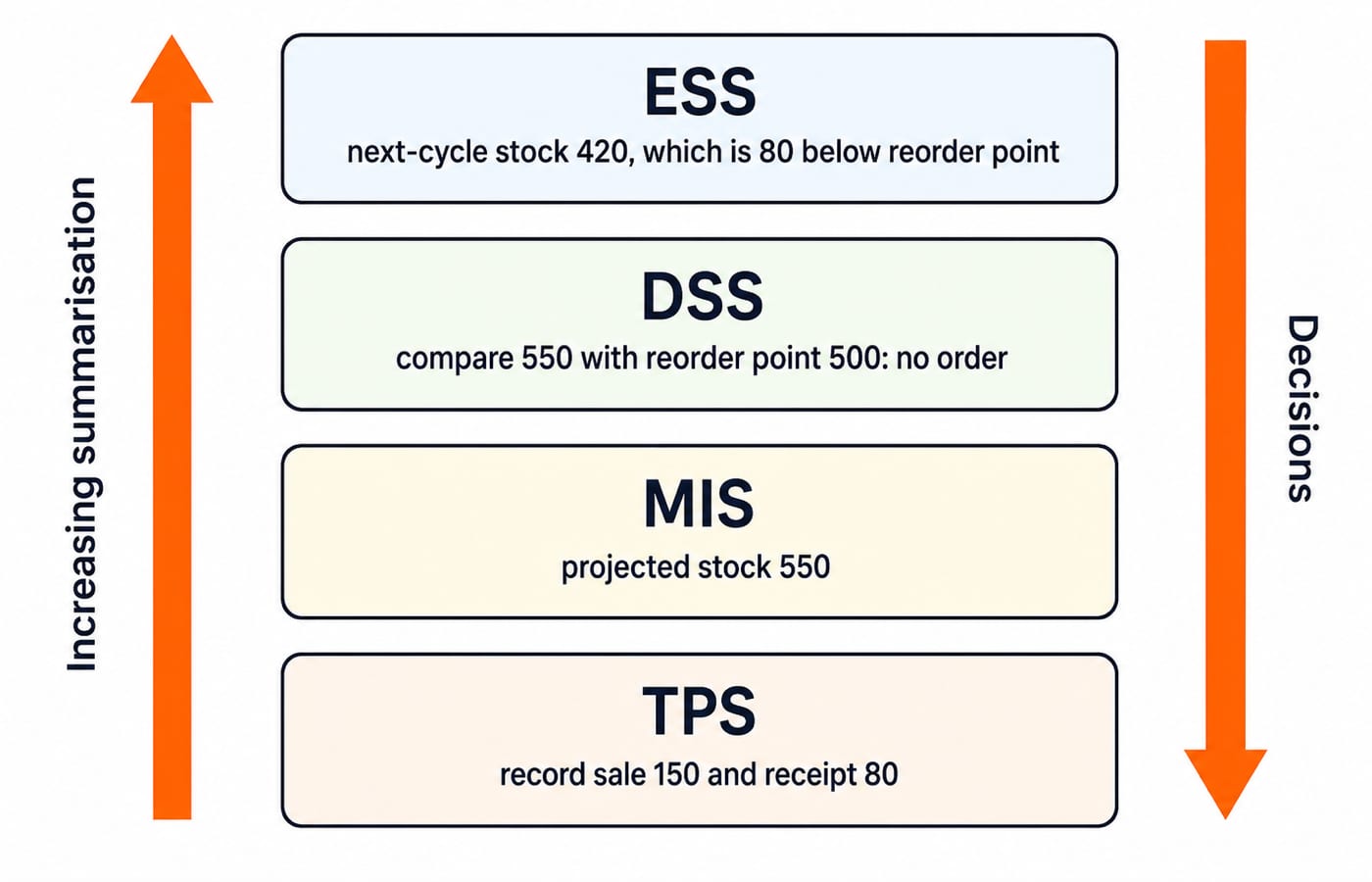
TPS | Records the 150-unit sale and 80-unit receipt as routine transactions. |
MIS | Reports the summarised projected stock of 550 units. |
DSS | Compares 550 with the 500-unit reorder point and recommends no order. |
ESS | Receives a higher-level exception summary when next-cycle stock is 420, which is 80 units below the reorder point. |
TPS records routine activity. MIS produces structured, recurring reports, while DSS uses rules, models or alternatives for semi-structured choices. ESS presents summarised monitoring and exceptions. Office automation systems support documents, communication and scheduling, but every product need not fit this hierarchy.
Worked inventory information system: calculate output, control and feedback
The policy sets average daily demand at 90 units, supplier lead time at 5 days, safety stock at 50 units and the replenishment target at 900 units.
Reorder point = demand during lead time + safety stock.
Demand during lead time =
90 x 5 = 450 units.Reorder point =
450 + 50 = 500 units.
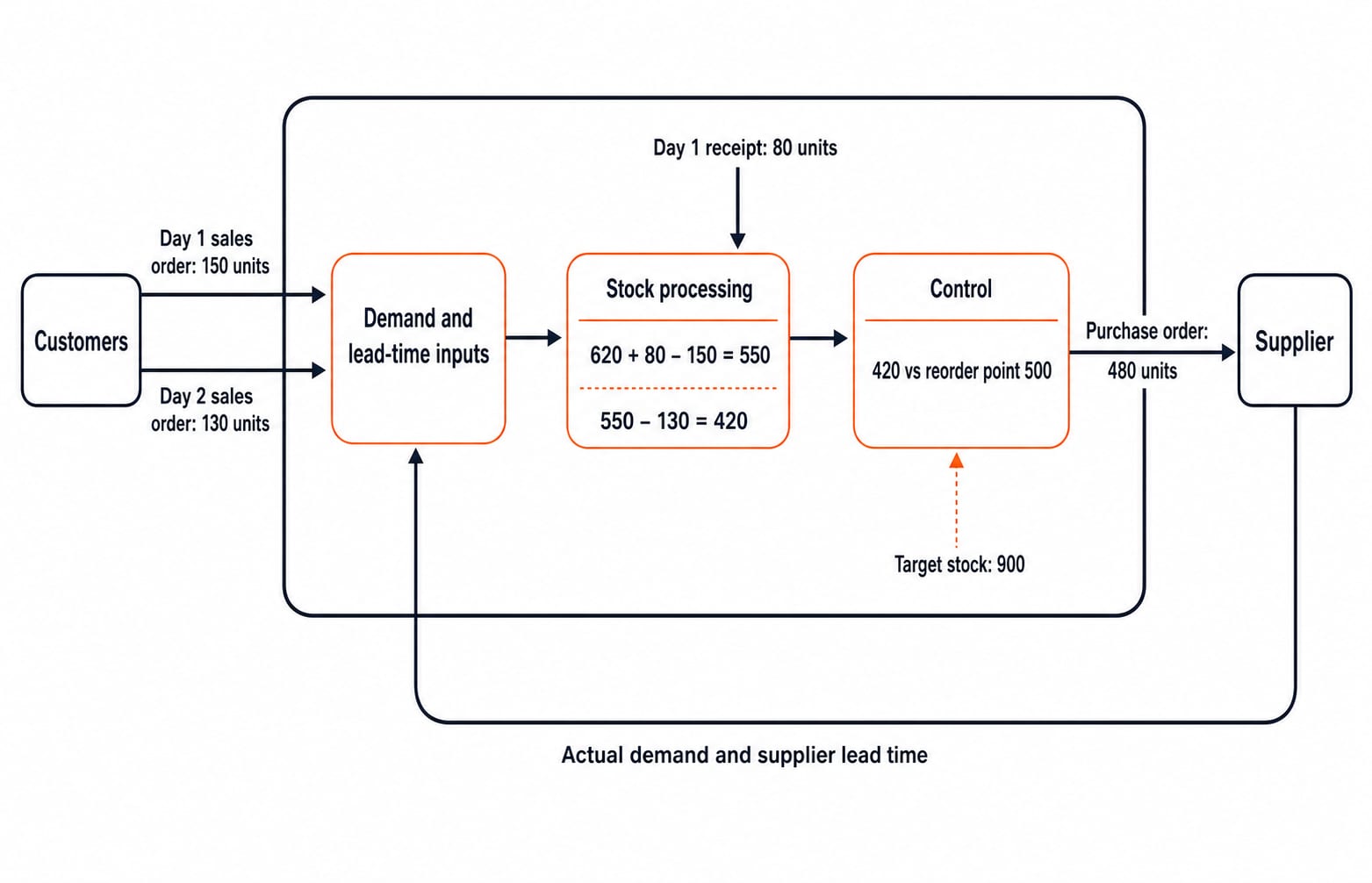
On Day 1, projected stock is 620 + 80 - 150 = 550 units. Since 550 > 500, the control rule says no reorder.
On Day 2, there is no receipt and sales are 130 units. Projected stock becomes 550 - 130 = 420 units. Since 420 <= 500, the order quantity is 900 - 420 = 480 units. The exception gap is 500 - 420 = 80 units.
Inputs are sales of 150 then 130 units and the 80-unit receipt. Processing is the stock and reorder arithmetic. Outputs are the 480-unit purchase order and low-stock alert. Feedback supplies actual demand and realised lead time. Control is the projected stock <= 500 rule plus purchase authorisation.
The boundary contains order capture, inventory update and the reorder decision. Customers and the supplier are outside; orders and receipts cross interfaces.
Common system and information-system traps
Feedback is not control. Feedback reports the 420-unit result. Control applies the 500-unit threshold and authorises a response.
Boundary is not interface. The application boundary defines scope. A supplier API is an interface across that boundary.
A processed value is not automatically useful information. 550 units needs context such as “projected stock after today's transactions”. Without meaning, it is only a stored value.
A manager does not automatically imply MIS. A recurring summary suggests MIS. Comparing alternatives or applying a decision model suggests DSS.
Classifications are not mutually exclusive. The inventory system is open, dynamic and human-machine together. It is not adaptive under the stated rule because no feedback changes a parameter. Also keep the information system separate from the broader organisational system it supports.
How objective questions test the topic, and the right preparation order
Common question forms include definition matching, scenario classification, a missing element in the system loop, data-versus-information distinctions and TPS/MIS/DSS/ESS comparisons.
Classify the warehouse from evidence: it is man-made, open, dynamic, complex and human-machine. The fixed reorder rule is deterministic, while customer demand and supplier lead time make the environment probabilistic. With no automatic parameter update, calling this implementation adaptive would be unsupported. The 480-unit recommendation is DSS output, not an MIS report, because a rule is applied to current information to recommend a decision.
Revise in this order: system vocabulary, boundaries and interfaces, classification axes, data versus information, information quality, then TPS, MIS, DSS and ESS. Next, solve mixed scenarios that force more than one label or place a calculation inside an information-system level.
Use GATE CS Subject Weightage: Where Hours Pay Off to allocate time across a wider plan. After concept revision, use the GATE Test Series for timed mixed practice.
Fundamentals of systems and information systems: the short version
A system pursues an objective.
Its boundary separates it from the environment.
A process transforms input into output.
Feedback informs control.
An information system combines people, procedures, data and technology to support operations and decisions.
In the warehouse, 550 units means no reorder against a 500-unit threshold, while 420 units triggers a 480-unit order towards the 900-unit target. Revise the evidence table, redraw the closed loop without looking, then solve mixed questions. For a broader preparation sequence, GATE Guidance by Sanchit Sir is the structured course option.
Go deeper with the full courseGATE Guidance by Sanchit Sir
Keep learning
Computer Graphics Fundamentals: Applications, Core Components and a Worked Pixel Pipeline
Follow a triangle from object coordinates to a tested screen pixel, then calculate the colour and depth-buffer memory needed to store the result.
Updated 11 Nov 20266 min readComputer Organization & Architecture
DBMS Data Models, Architecture and Components MCQs: 12 Solved Questions
Test whether you can separate data models, abstraction levels, catalogs, schemas and metadata. These 12 MCQs include concise explanations and a diagnostic review plan.
Updated 29 Oct 20267 min read158 viewsDBMS MCQs
Intrusion Detection Systems (IDS): Types, Detection Methods and a Worked Metrics Example
Understand where an IDS collects evidence, how it detects suspicious activity, and why recall, precision and false-positive rate matter more than accuracy alone.
Updated 2 Nov 20266 min readGATE Strategy & Roadmap

RSSB Computer Instructor Digital Logic and Computer Fundamentals: Worked Number Systems, Boolean Algebra and Memory Basics
Connect number systems, Boolean algebra, memory capacity and CPU organisation through four checked examples designed for RSSB Computer Instructor preparation.
Updated 25 Aug 20266 min readDigital Logic