

Emerging Technology Trends Explained: Concepts and a Worked IoT Example
Separate IoT, edge, cloud, AI, blockchain, 5G, big data and AR/VR by the job each performs. Then follow a smart-irrigation stack and verify its 75% payload reduction.
KnowledgeGate Team
Exam prep & CS education
Updated 29 Oct 20265 min read
AI, IoT, cloud, edge, blockchain, 5G, big data and AR/VR are often taught as a list. Then a question combines three of them in one scenario, and similar-looking options turn the answer into guesswork. Treat them as system roles: devices sense and act, networks connect, edge and cloud process or store, AI infers, blockchain protects shared records, and AR/VR shapes the interface. A smart-irrigation calculation makes the boundaries concrete.
Emerging technology trends: meaning, scope and an exam-ready definition
An emerging technology is one whose capabilities, adoption or applications are developing quickly in the context being discussed. Emerging is not a permanent label. A technology can be established in one field but still emerging in another.
Keep three related ideas separate:
An invention is the creation of something new.
A technology trend is a sustained direction of development or adoption.
A mature technology is already widely established in its context.
For every term, note its definition, core capability, one use case, and one limitation or non-example.
Separate the terms by their core capability
The technologies can work together, but they do different jobs:
Technology | Core capability |
|---|---|
IoT | Connects physical objects that sense conditions or act on the physical world |
Edge computing | Processes data near its source |
Cloud computing | Supplies compute or storage through a remote network-accessed service |
AI/ML | Infers results or learns patterns from data |
Big-data systems | Handle data whose scale, speed or variety requires scalable methods |
Blockchain | Maintains a shared, append-only record linked using cryptographic techniques |
5G | Provides a generation of mobile-network connectivity, not an application by itself |
AR and VR | AR overlays digital content on a physical view; VR creates an immersive digital environment |
Group them by role: IoT senses or acts, networks such as 5G connect, edge and cloud process or store, big-data platforms handle demanding workloads, AI/ML infers, blockchain supports shared record integrity, and AR/VR presents an experience.
Read the technologies as a stack
Read a system from left to right:
Physical event -> sensor or device -> edge gateway -> network -> cloud or data platform -> rule or AI model -> actuator or human decision
The question's verb usually reveals the tested layer. Values averaged near their source point to edge computing. A forecast produced by a trained model points to AI/ML.
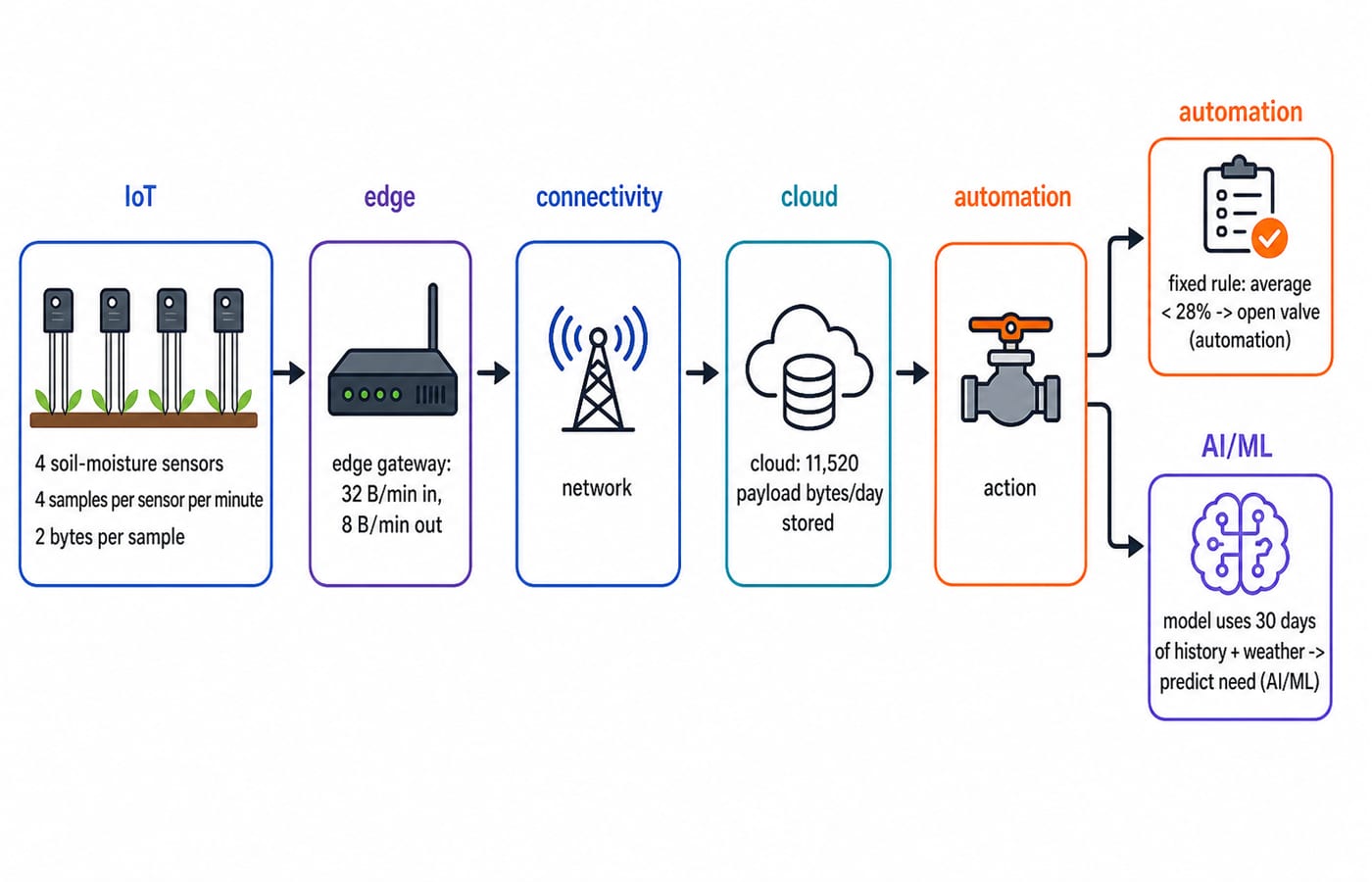
In the irrigation stack, four soil-moisture sensors send readings to one field gateway. It calculates four per-sensor averages, which a network carries to cloud storage. A fixed threshold may open a valve; a separately trained model could predict future watering need.
Worked example: calculate smart-irrigation data reduction
In one minute, each of four sensors produces four moisture readings. Each is stored as a 2-byte payload value:
S1 = 28, 30, 32, 30
S2 = 24, 26, 25, 25
S3 = 40, 38, 39, 39
S4 = 33, 34, 32, 33
The byte totals below exclude packet headers, timestamps and other metadata.
4 sensors x 4 samples per sensor x 2 bytes = 32 B/min
The gateway calculates each per-sensor average:
S1: (28 + 30 + 32 + 30) / 4 = 120 / 4 = 30%
S2: (24 + 26 + 25 + 25) / 4 = 100 / 4 = 25%
S3: (40 + 38 + 39 + 39) / 4 = 156 / 4 = 39%
S4: (33 + 34 + 32 + 33) / 4 = 132 / 4 = 33%
4 averages x 2 bytes = 8 B/min
(32 - 8) / 32 x 100 = 24 / 32 x 100 = 75%
Across 24 hours, raw payload is 32 x 60 x 24 = 46,080 bytes, summarised payload is 8 x 60 x 24 = 11,520 bytes, and the saving is 46,080 - 11,520 = 34,560 bytes.
Sensors and connectivity make this an IoT setup. Gateway averaging is edge computing; remote storage is cloud use. Opening the valve when an average is below 28% flags only S2 and is ordinary automation. It becomes AI/ML only if a trained model uses inputs such as 30 days of history and weather to infer future need.
Classify scenarios by the job being performed
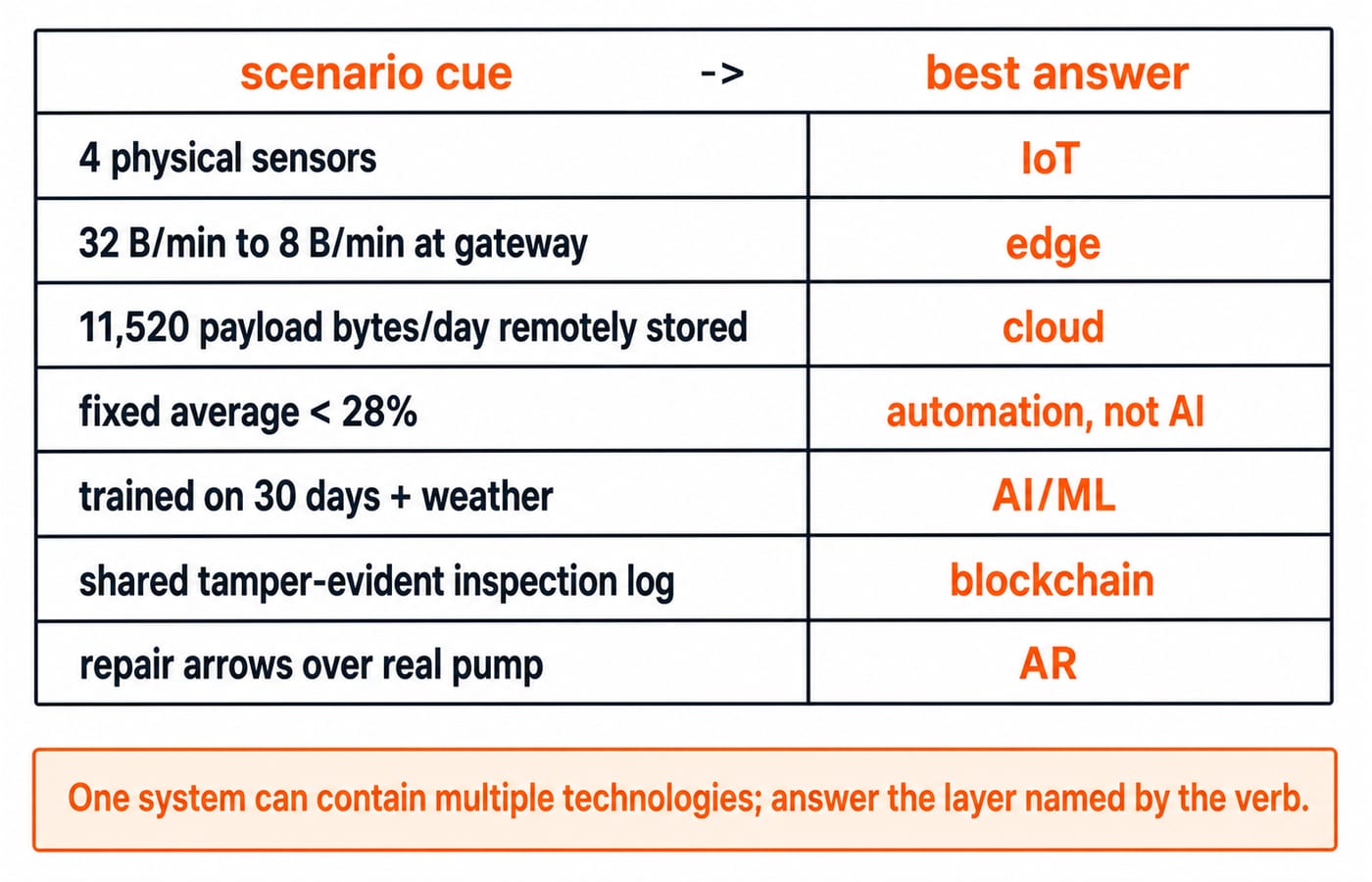
Choose the narrowest role named by the action:
Scenario cue | Best answer and reason |
|---|---|
Four field sensors collect physical readings | IoT, because physical devices sense conditions |
Gateway reduces 32 B/min to 8 B/min locally | Edge, because processing happens near the source |
Remote service stores 11,520 payload bytes/day | Cloud, because a remote service supplies storage |
Trained model uses 30 days of history plus weather | AI/ML, because a learned model predicts need |
Two independent agencies share a tamper-evident inspection log | Blockchain, because the requirement is a shared integrity-protected record |
Smart glasses place repair arrows over a real pump | AR, because the real view remains visible |
Several labels may describe the whole system. If the stem asks where processing happens, how a prediction is made, or which interface is used, answer that narrower role.
Common traps and boundary cases
IoT is not automatically AI. Internet access alone is not cloud computing. One large file does not establish a big-data problem. Blockchain is broader than cryptocurrency. 5G can carry IoT traffic, but is not IoT. AR keeps the real scene visible; VR replaces it.
In the irrigation example, the 28% threshold is hand-written logic; the history-and-weather predictor is learned inference. A system is not AI merely because it is automatic or called smart. Approaches to AI develops this distinction.
Labels depend on the stated architecture. If the gateway stores and processes everything locally, do not insert cloud computing. If one organisation controls an ordinary database, do not insert blockchain without a shared-ledger requirement.
How to answer emerging-trends questions safely
Questions may use definition-to-term, capability matching, scenario classification, assertion and reason, or multiple-correct combinations across several layers. The exact mix depends on the recruitment body.
Use three passes:
Underline the action verb.
Identify the layer performing that action.
Eliminate options that add an unstated feature.
Map senses to IoT, near the source to edge, remote network-accessed resource to cloud, learns or infers to AI/ML, shared tamper-evident record to blockchain, overlays to AR, and immerses to VR. Match board-specific requirements against the latest syllabus or notification on the recruitment body's official website.
Use the Emerging Trends Introduction MCQs to practise term recognition, scripting and metadata distinctions, and application matching. The stack and irrigation calculation above instead connect multiple technologies inside one system.
The short version and the next step
Remember: IoT senses or acts, edge works near the source, networks connect, cloud supplies remote resources, AI/ML learns or infers, blockchain supports a shared tamper-evident record, and AR/VR shapes the interface.
Now recompute 32 B/min -> 8 B/min -> 75% reduction without looking, then classify every layer. Once the concept is clear, use the Govt Teaching Jobs category to choose the relevant exam path. DSSSB aspirants can continue with the DSSSB TGT Computer Science Section B course, while HPSC aspirants can use the HPSC PGT Computer Science course.
Keep learning
Emerging Technology Trends in ICT: AI, Cloud, IoT and Blockchain with Worked Examples
Learn what AI, cloud, IoT, blockchain and related ICT technologies actually do. One smart-classroom case connects the definitions to two worked calculations.
Updated 10 Nov 20265 min readGATE Strategy & Roadmap
Emerging Technologies in Web Technology: Cloud, IoT, Edge and Blockchain with Worked Examples
Follow 200 factory sensors from MQTT messages to edge decisions, cloud functions, a live dashboard and a toy blockchain. The worked numbers make each role concrete.
Updated 27 Oct 20265 min readGATE Strategy & Roadmap

Emerging Trends Introduction MCQs: 12 Solved Questions with Explanations
Solve 12 Emerging Trends Introduction questions with clear answer logic, exam-year labels and a compact trap check for focused revision.
Updated 29 Oct 20268 min read67 viewsTeaching Recruitment (Computer Science)

Composite and Alternate Keys in DBMS: Worked Example and Exam Traps
Learn how composite, candidate, primary and alternate keys differ. Derive two candidate keys from one relation, enforce them in SQL, and avoid common classification traps.
Updated 14 Nov 20266 min readDBMS