Ring and Johnson Counter MCQs: 10 Solved Questions with Explanations
Solve ten published ring and Johnson counter questions, then check each answer through state models, binary traces and compact exam-ready rules.
KnowledgeGate Team
Exam prep & CS education
Updated 7 Sep 20267 min read
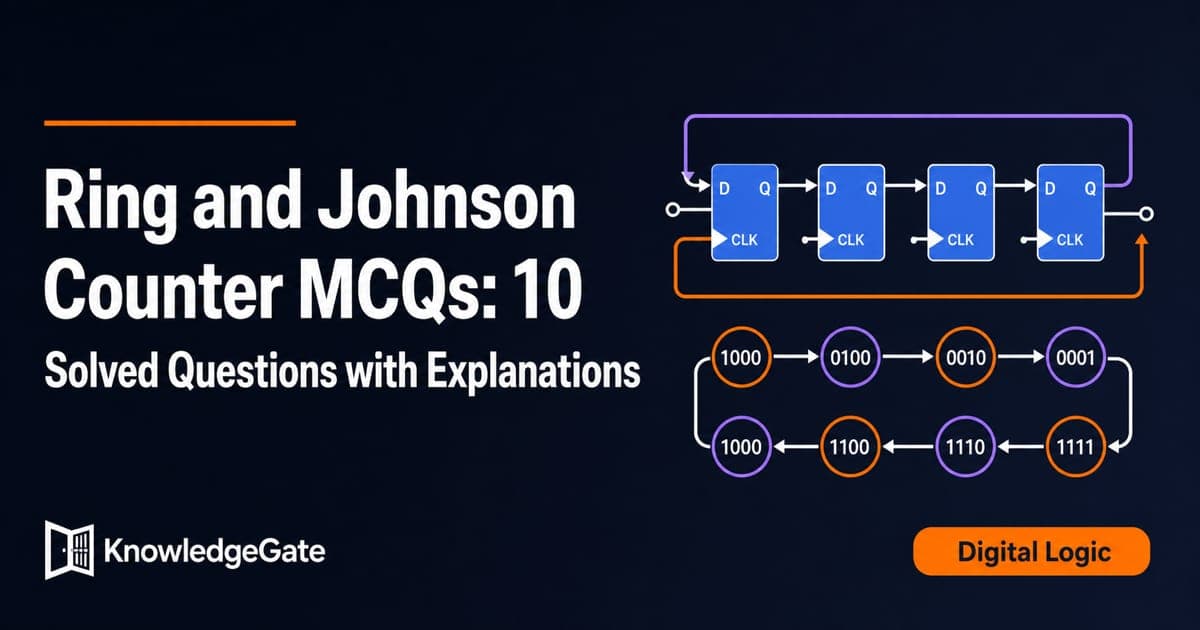
Students often remember that a ring counter circulates a bit and a Johnson counter feeds back a complement, then mix up n, 2n and 2^n under pressure. The key distinctions are feedback direction, intended state count, one-hot decoding, binary sequence order, unused states and Hamming distance. Answer each question before reading its explanation.
Related reading: ripple counter MCQs and sequential circuits and counters.
1. Write the two counter models before solving anything
An n-flip-flop ring counter circulates a one-hot word through direct last-stage feedback and has n intended states. An n-flip-flop Johnson counter, also called a twisted-ring or switch-tail counter, returns the complement and has 2n intended states. Both sit inside a 2^n-state flip-flop space. Revise the wider model in Sequential Circuits: Flip-Flops and Counters.
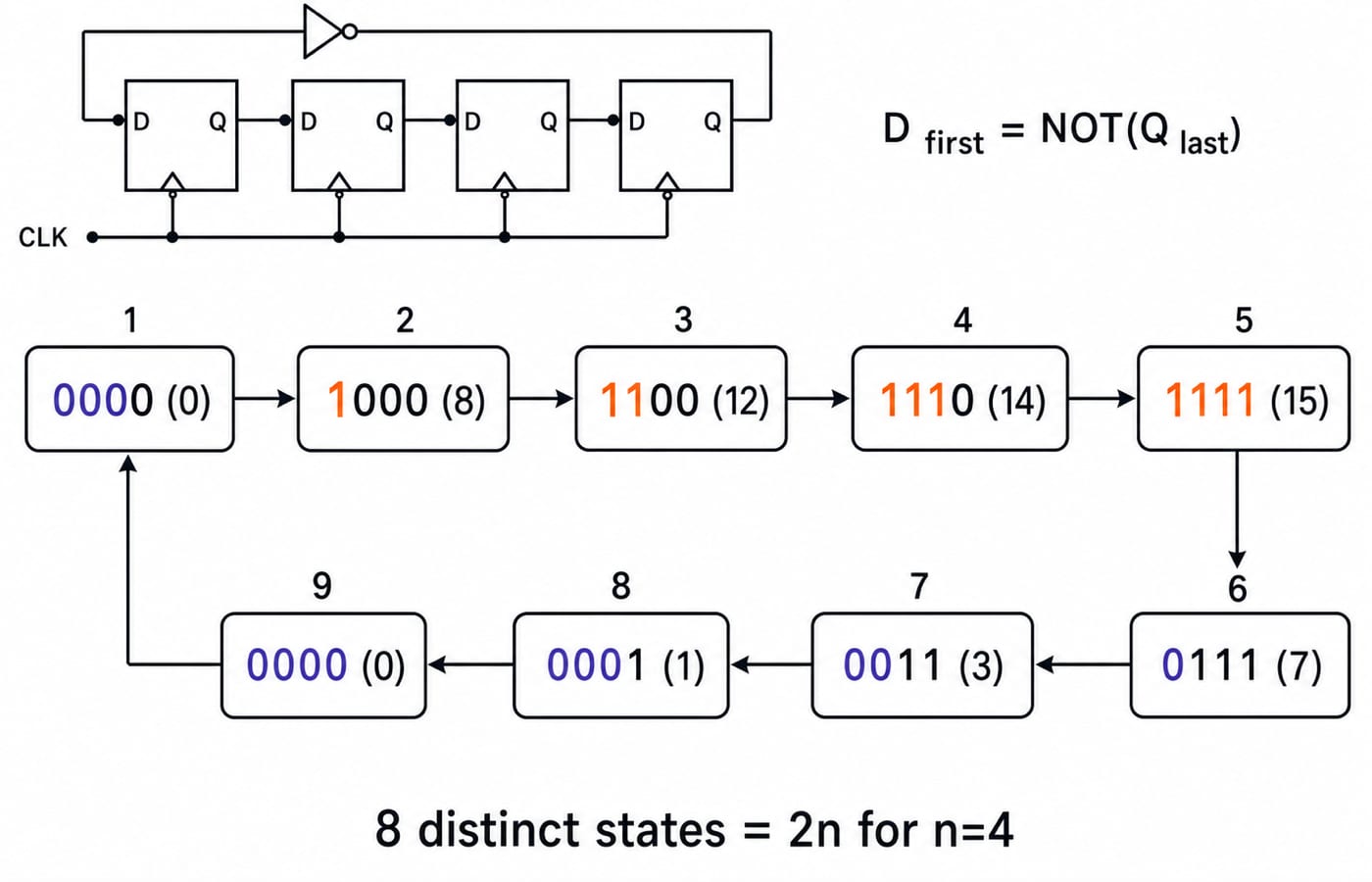
For n=4, the ring cycle is 1000 -> 0100 -> 0010 -> 0001 -> 1000, giving 4 intended states. The Johnson cycle is 0000 -> 1000 -> 1100 -> 1110 -> 1111 -> 0111 -> 0011 -> 0001 -> 0000, giving 8 intended states. The 4-bit ring cycle has 4 intended states, and the 4-bit Johnson cycle has 8 intended states.
2. Identify the counter from its use and feedback path
Question 1 (UGC NET 2024, Paper 2 August)
Match List I to List II
List - I (Counter) List - II (uses/working)(A) N-bit Ring Counter (I) Uses universal clock(B) Synchronous Counter (II) Counts exactly N states(C) Asynchronous Counter (III) Counts 0 to 9(D) Decimal Counter (IV) Main clock is applied to first flip-flop onlyChoose the correct answer from the options given below:
A. (A)-(II), (B)-(IV), (C)-(I), (D)-(III)
B. (A)-(IV), (B)-(II), (C)-(III), (D)-(I)
C. (A)-(II), (B)-(I), (C)-(IV), (D)-(III)
D. (A)-(IV), (B)-(I), (C)-(II), (D)-(III)
Answer: C. Check all four pairs: A -> II, since an N-bit ring has N one-hot positions; B -> I, since every synchronous stage uses the common clock; C -> IV, since only the first stage takes the external clock in a ripple chain; and D -> III, since a decimal counter cycles from 0 to 9. The complete four-pair check confirms C. Review the worked solution.
Question 2 (ISRO 2007 and BEL 2007)
Ring counter is analogous to
A. Toggle Switch
B. Latch
C. Stepping Switch
D. S-R flip flop
Answer: C, Stepping Switch. A ring counter moves one active output per clock and wraps around: 1000 -> 0100 -> 0010 -> 0001 -> 1000. Only one output is selected, like a stepping switch moving contact by contact. A latch or S-R flip flop stores a state but does not describe rotating selection. The analogy concerns output selection, not the storage element inside the circuit. Review the worked solution.
Question 3 (DSSSB 2021, TGT Shift 5)
Which counter is a shift register with its complement output of the last stage connected to the D-input of the first stage?
A. Synchronous
B. Twisted Ring
C. Up
D. Down
Answer: B, Twisted Ring. Translate the stem as D_first = NOT(Q_last), the Johnson or twisted-ring connection. An ordinary ring returns Q_last without inversion. Starting a 4-bit Johnson counter at zero shows the difference: 0000 -> 1000. The inverted last-stage zero injects the first 1, then repeated shifts grow a block of ones. This growing-ones pattern is a quick confirmation in a feedback diagram. Review the worked solution.
3. Count required flip-flops and recognise one-hot decoding
A ring needs one flip-flop per intended state. A binary counter plus decoder reaches the same one-hot behaviour another way.
Question 4 (ISRO 2015)
A modulus -12 ring counter requires a minimum of
A. 10 flip-flops
B. 12 flip-flops
C. 8 flip-flops
D. 6 flip-flops
Answer: B, 12 flip-flops. One circulating 1 gives one state per stage, so a MOD-12 ring needs 12 stages. A binary MOD-12 counter needs ceil(log2 12) = 4 flip-flops because 2^3 < 12 <= 2^4. “Ring” rules out logarithmic counting.
Question 5 (GATE 2014, Set 2)
Let
k = 2^n. A circuit is built by giving the output of ann-bit binary counter as input to ann-to-2^ndecoder. This circuit is equivalent to a
A. k-bit binary up counter.
B. k-bit binary down counter.
C. k-bit ring counter.
D. k-bit Johnson counter.
Answer: C. Take n=3, so k=2^3=8. The counter supplies 000, 001, ..., 111, and the decoder makes one of eight lines HIGH for each code. The HIGH position advances and repeats, giving 8-bit one-hot ring behaviour. An 8-flip-flop Johnson counter has 16 intended states. Review the worked solution.
Question 6 (Concept check)
A switch-tail ring counter consists of 5 flip-flops. If it has
Pintended states and reaches a maximum decimal valueQ, what arePandQ?
A. 10, 63
B. 10, 31
C. 5, 100
D. None of the above
Answer: B, P = 10 and Q = 31. A switch-tail ring counter is a Johnson counter, so five stages give P=2n=10 intended states. Five flip-flops represent values from 0 through 2^5-1=31, and the standard Johnson cycle reaches 11111, so Q=31. Review the worked solution.
4. Test each counter statement instead of guessing from one keyword
Audit the claims separately:
Johnson stages share one clock.
Ripple stages do not share the external clock directly.
Ripple propagation accumulates delay.
A bidirectional counter uses a control input to select up or down.
For a wider set on flip-flops, latches and mixed counter types, use Sequential Circuits MCQs: 11 Solved Flip-Flops. Ring and Johnson practice instead centres on feedback, sequences and intended state counts.
Question 7 (Coal India 2017)
Which of the following statements is FALSE?
A. Johnson counter is a synchronous counter.
B. Ripple counter is an asynchronous counter.
C. Asynchronous counters are slower than synchronous counters.
D. A counter may count up or count down, but cannot count both up and down.
Answer: D. A is true because Johnson stages share a clock. B is true by the definition of a ripple counter. C is true because ripple delay accumulates. D is false because a direction input selects either sequence. From 00, a 2-bit counter moves to 01 in up mode and 11 in down mode. The hardware supports both. Review the worked solution.
5. Trace a Johnson sequence in binary before reading decimal options
Use this convention: invert the last-stage bit, feed the leftmost stage, and shift right. Finish the binary path before converting to decimal.
Question 8 (GATE 2015, Set 1)
Consider a 4-bit Johnson counter with an initial value of 0000. The counting sequence of this counter is
A. 0, 1, 3, 7, 15, 14, 12, 8, 0
B. 0, 1, 3, 5, 7, 9, 11, 13, 15, 0
C. 0, 2, 4, 6, 8, 10, 12, 14, 0
D. 0, 8, 12, 14, 15, 7, 3, 1, 0
Answer: D. Trace 0000 -> 1000 -> 1100 -> 1110 -> 1111 -> 0111 -> 0011 -> 0001 -> 0000, then convert to 0 -> 8 -> 12 -> 14 -> 15 -> 7 -> 3 -> 1 -> 0. Four ones enter, then four leave, producing 2n=8 distinct states. A is the mirror sequence under the opposite bit order, but the standard convention gives D. Review the worked solution.
6. Calculate unused states and Hamming distance from the same 4-bit model
Question 9 (NAT)
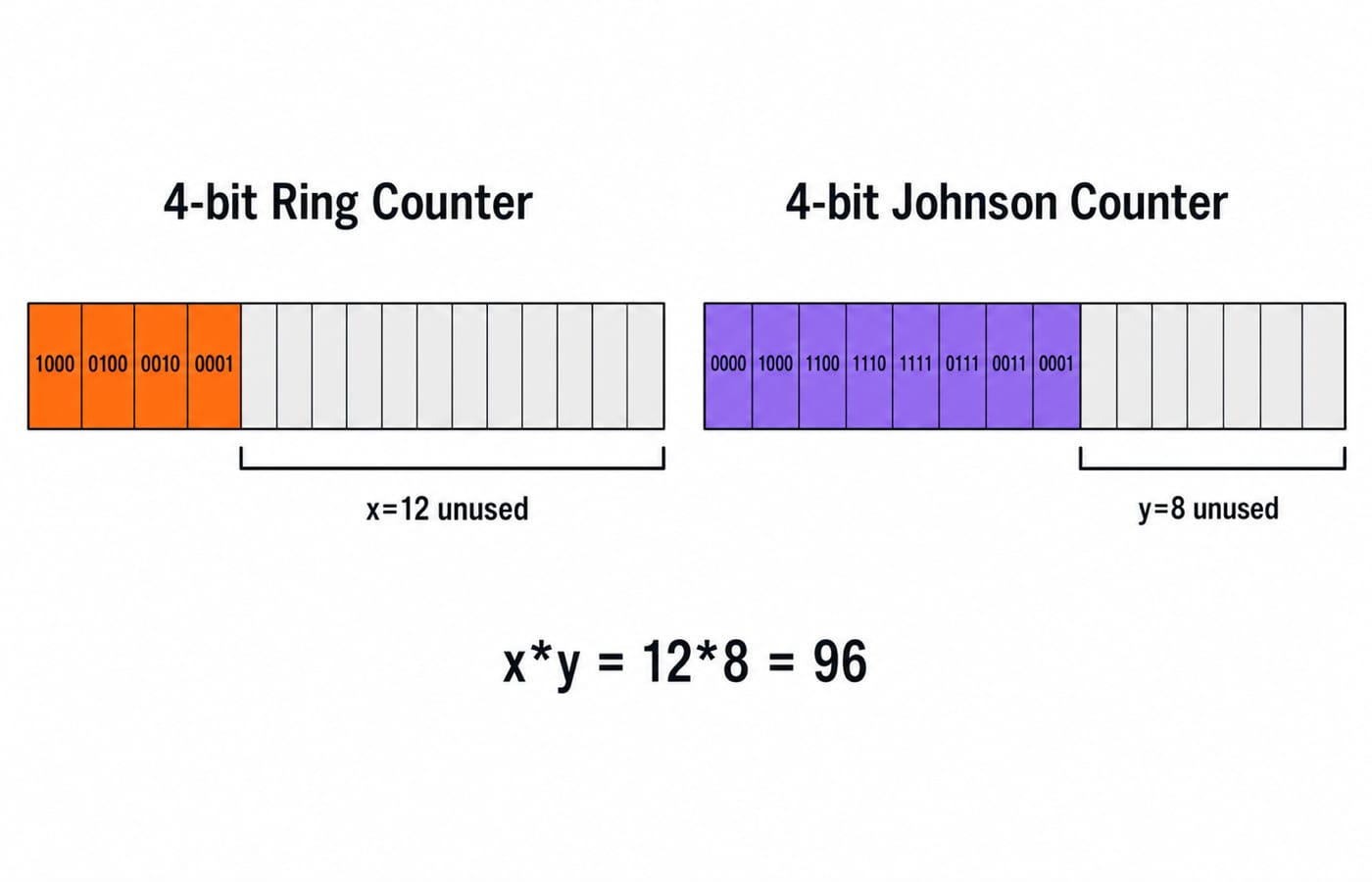
The number of unused states in 4-bit ring counter and 4-bit Johnson counter are x and y respectively, then the value of x * y is ?
Answer: 96. Keep the three quantities separate:
Quantity | Calculation | Result |
|---|---|---|
Total configurations |
| 16 |
Ring unused states, |
| 12 |
Johnson unused states, |
| 8 |
Thus x*y=12*8=96. Common traps are using 2^n-n for both counters or reading Johnson's 2n as 2^n.
Question 10 (NAT)
Hamming distance is the number of position at which the corresponding symbols are different. The Hamming distance of a ring counter is
Answer: 2. Compare consecutive one-hot states:
Position | 1 | 2 | 3 | 4 |
|---|---|---|---|---|
| 1 | 0 | 0 | 0 |
| 0 | 1 | 0 | 0 |
Different? | Yes | Yes | No | No |
Two positions change. 0100 -> 0010 confirms one bit changes from 1 to 0 and another from 0 to 1. Distance is not the flip-flop count.
7. The short version and your next practice step
Ring uses direct feedback and has
nintended states.Johnson uses complemented feedback and has
2nintended states.The complete register space contains
2^nconfigurations.One-hot decoder outputs behave like a ring counter.
Adjacent one-hot ring states have Hamming distance 2.
A score of 9-10 means the three state-count formulas are stable. At 7-8, redo Questions 4, 8 and 9 without notes. At 0-6, rebuild both cycles. Then continue with Sync Counter Analysis MCQs for common-clock state equations and transition tables, which differ from the feedback-loop and one-hot models used here.
For the wider map, open CS Fundamentals for Exams and Placements. Use Zero to Hero, Complete CS Course for a full CS foundation. Redraw Question 8 and recompute Question 9 from a blank page before moving on.
Keep learning
Special Logic Circuits MCQs: 12 Solved Questions on Adders, Encoders, PLA and DAC
Solve 12 special logic circuits MCQs covering recognition, hardware counts, Boolean identities and numerical calculations. Each answer includes the reasoning you should reproduce in an exam.
19 Sep 20268 min readDigital Electronics MCQs
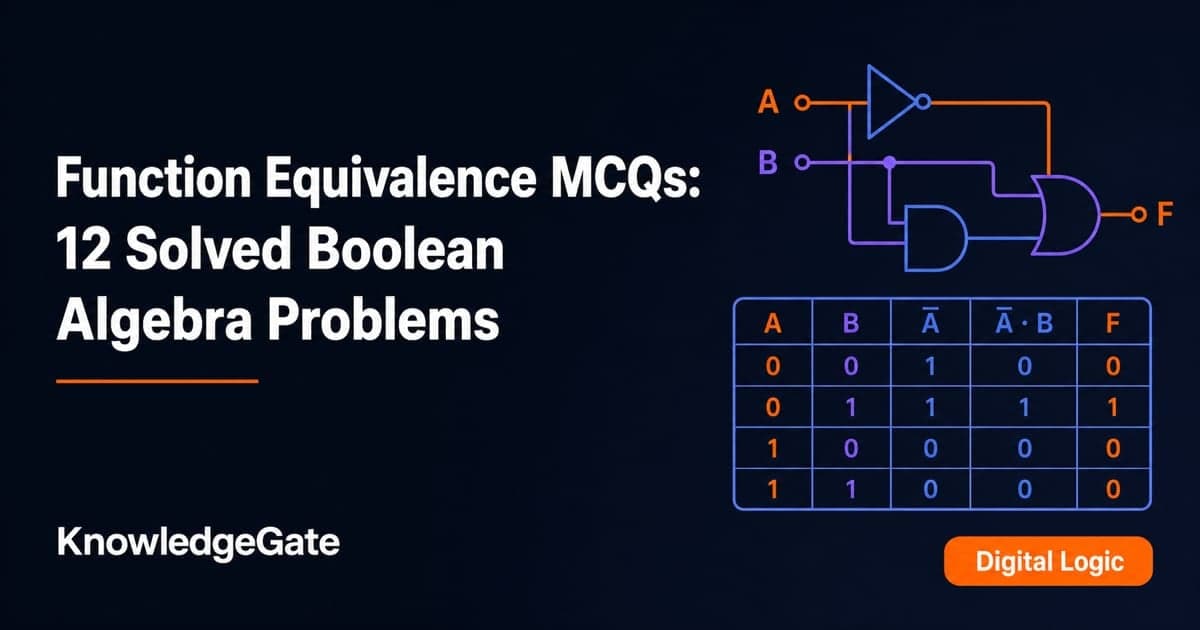
Function Equivalence MCQs: 12 Solved Boolean Algebra Problems
Solve 12 function-equivalence questions step by step, from De Morgan's law and absorption to minterm sets, counterexamples and a four-option MSQ.
Updated 17 Sep 20268 min readDigital Electronics MCQs

CLA & Arithmetic Logic MCQs: 10 Solved Questions with Explanations
Solve ten CLA and arithmetic logic MCQs with compact workings for carry equations, timing paths, hardware sizing and operand-pair counting.
Updated 16 Sep 20267 min readDigital Electronics MCQs
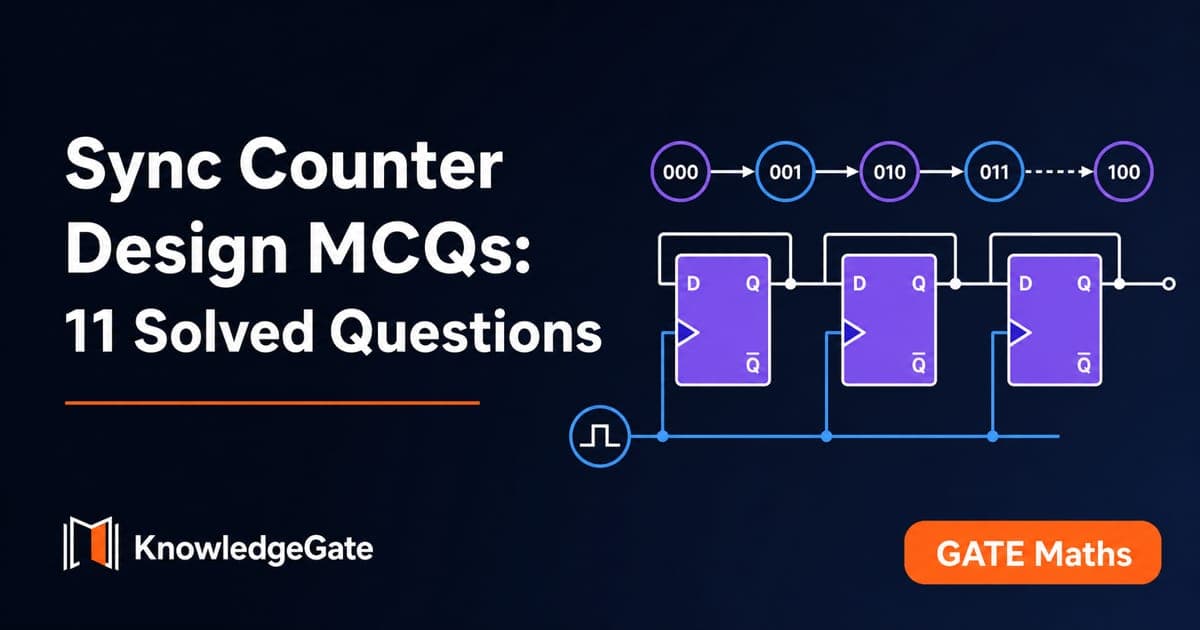
Sync Counter Design MCQs: 11 Solved Questions on Modulus, State Sequences and Excitation Logic
Solve 11 synchronous-counter questions covering modulus boundaries, repeated outputs, common-clock tracing, excitation equations, enables and composite states.
Updated 14 Sep 20267 min readDigital Electronics MCQs