Sequential Logic and Latches MCQs: 10 Solved Questions with Explanations
Solve 10 published-bank questions on sequential logic, latch polarity, state transitions and multivibrators. Each answer explains the decision that gets you to the next state.
KnowledgeGate Team
Exam prep & CS education
Updated 6 Sep 20267 min read
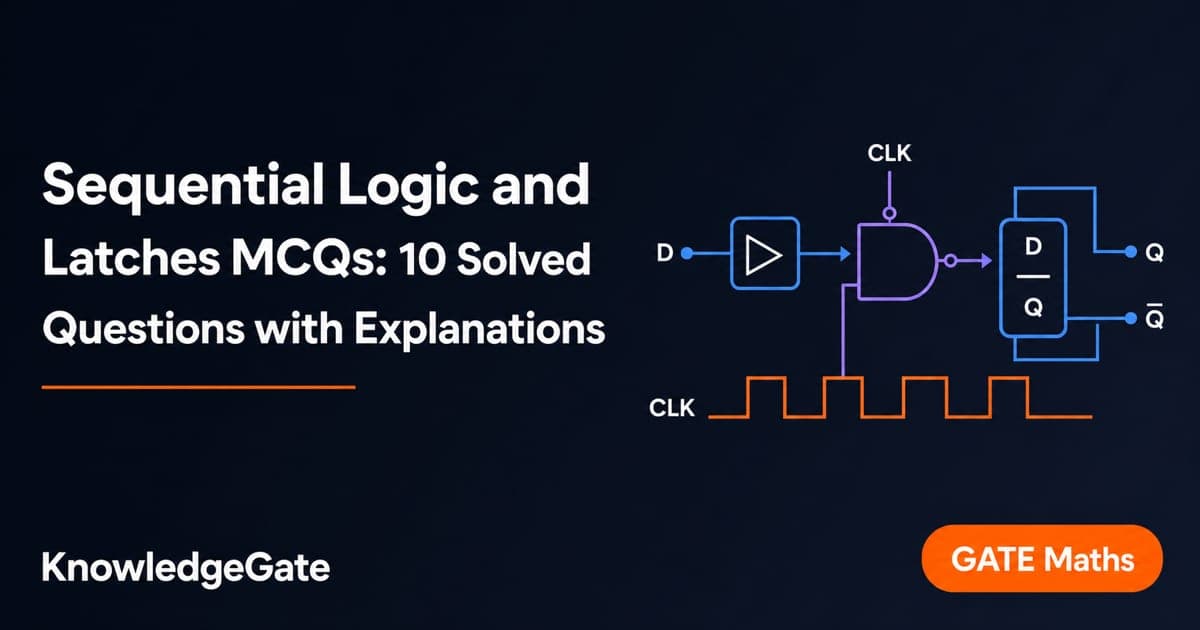
Sequential-logic questions mix three different jobs: recognising memory, reading a state transition, and applying active-HIGH versus active-LOW latch rules. A learner who remembers only a truth table can still reverse set and reset or miss what a forbidden input does. These 10 questions test a different decision each: identify memory, apply flip-flop or latch rules, trace the next state, and count multivibrator states. Attempt each question before reading its explanation, and write present state -> next state beside every latch or state-machine item; if latch, flip-flop and state machine still feel interchangeable, repair that foundation first with Sequential Circuits: Flip-Flops and Counters.
Sequential logic and latch rules to use before solving
A combinational circuit has no stored state, so its current output can be written as Y_n = f(X_n). A sequential circuit carries state: Q_(n+1) = f(Q_n, X_n). Its output is Y_n = g(Q_n) in a Moore model or Y_n = g(Q_n, X_n) in a Mealy model. The stored Q_n is how relevant past inputs continue to matter.
Element | Input or state rule | Result |
|---|---|---|
T flip-flop |
| Hold; toggle |
Active-HIGH NOR SR latch |
| Forbidden |
Active-LOW NAND SR latch |
| Forbidden |
Multivibrators | Monostable, astable, bistable | One stable plus one quasi-stable, no stable state, two stable states |
Now trace a cold start. With Q_n=0, a T flip-flop at T=1 gives Q_(n+1)=1. A second active edge with T=1 complements it back to 0. At the next edge, T=0 holds that state at 0. The complete trace is 0 -> 1 -> 0 -> 0.
Sequential circuit memory and T flip-flop MCQs
Question 1: Identify what a sequential output depends on
UGC NET 2014
The output of a sequential circuit depends on
A. present input only
B. past input only
C. both present and past input
D. past output only
Answer: C. both present and past input. The present state summarises the relevant past, while the current input can affect the next state and, in a Mealy circuit, the current output. A memory element carries that state from one evaluation step to the next. This is the best category-level distinction among the choices, not a claim that every Moore output directly uses the present input. A combinational circuit is different because it has no stored state.
Question 2: Apply the T flip-flop toggle rule
CDAC CCAT 2025
A T flip-flop toggles its output when T equals:
A. 0
B. 1
C. Both 0 and 1
D. Neither
Answer: B. 1. The characteristic relation is Q_(n+1) = T XOR Q_n. For Q_n=0, setting T to 1 gives 1 XOR 0 = 1; for Q_n=1, it gives 1 XOR 1 = 0. At T=0, the relation becomes Q_(n+1)=Q_n, so the state holds. At T=1, the state toggles on each active edge; at T=0, it holds.
JK output states and the NOR SR forbidden input
Question 3: Count the possible output states of one JK flip-flop
CDAC CCAT 2025
A JK flip-flop has how many possible output states?
A. 1
B. 2
C. 3
D. 4
Answer: B. 2. J and K allow four input combinations, but a single flip-flop stores only one bit. That stored output can be Q=0 or Q=1, so there are two output states regardless of which input pair produced them. The trap is counting four excitation cases as four stored states.
Question 4: Find the invalid input of a NOR SR latch
CDAC CCAT 2025
The invalid (race) input combination of an SR flip-flop using NOR gates is:
A. S = 0, R = 0
B. S = 0, R = 1
C. S = 1, R = 0
D. S = 1, R = 1
Answer: D. S = 1, R = 1. A 1 at either NOR-gate input forces that gate's output to 0, so this pair forces both latch outputs low and breaks the complementary-output condition. Releasing two forced-low outputs can also make the resulting stored state uncertain. In contrast, S=R=0 is the hold input for this active-HIGH latch. For an active-LOW NAND latch, the forbidden pair is reversed to S_bar=R_bar=0.
Cross-coupled latches and an XY excitation table
Question 5: Recognise a cross-coupled NAND latch
UGC NET 2011
A latch is constructed using two cross-coupled
A. AND and OR gates
B. AND gates
C. NAND and NOR gates
D. NAND gates
Answer: D. NAND gates. Feeding each NAND output back into the opposite gate forms an active-LOW SR latch with memory between evaluations. Option C is not the intended construction because the pair uses two gates of the same type, not one NAND and one NOR. Two cross-coupled NOR gates form a separate valid SR-latch implementation, but that does not change this option set.
Question 6: Find when an XY latch complements
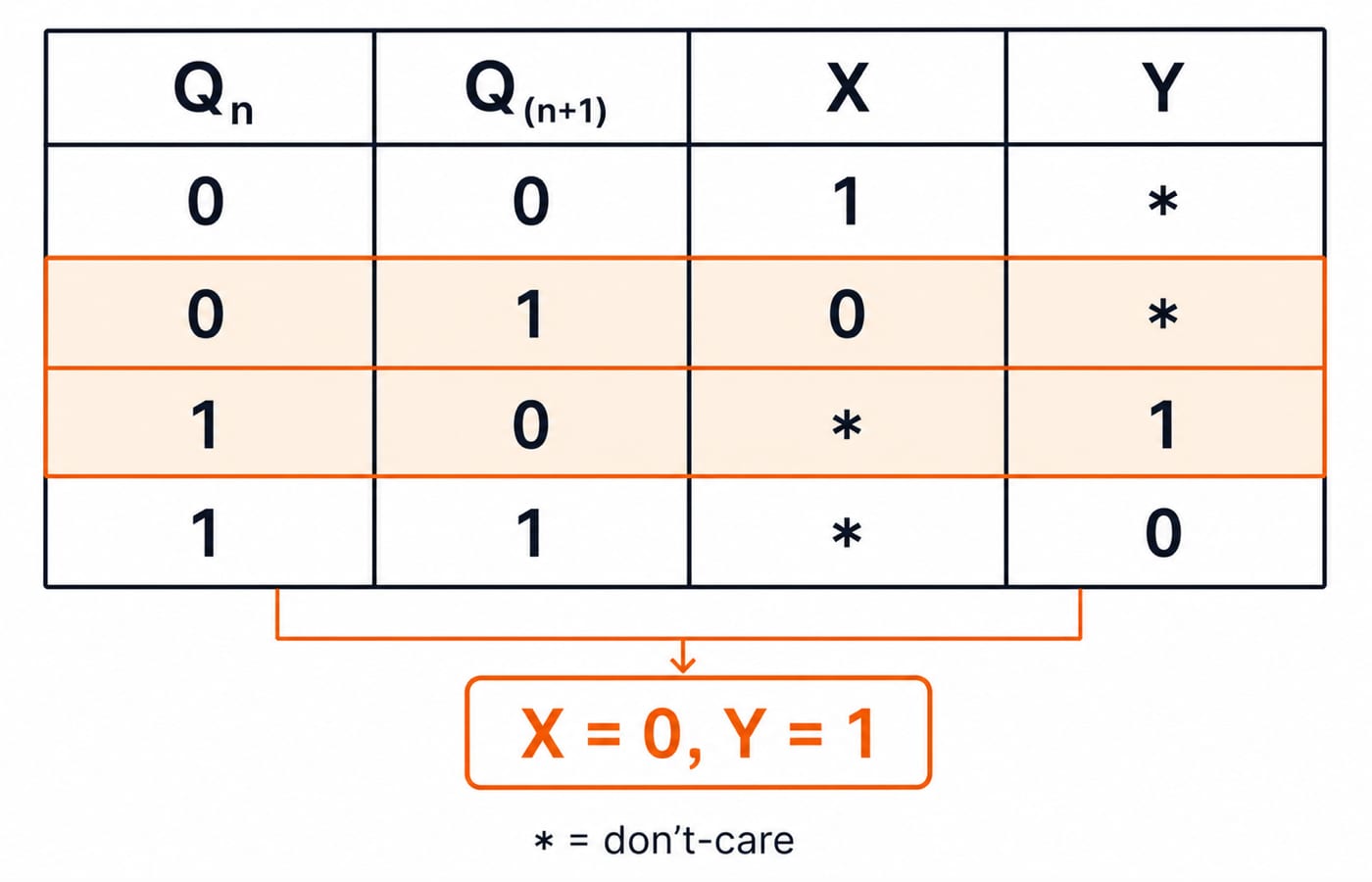
Consider the following excitation table of XY latch.
Q_n | Q_(n+1) | X | Y |
|---|---|---|---|
0 | 0 | 1 | * |
0 | 1 | 0 | * |
1 | 0 | * | 1 |
1 | 1 | * | 0 |
The latch complements its state when ____.
A. X=0, Y=1
B. X=1, Y=0
C. X=0, Y=0
D. X=1, Y=1
Answer: A. X=0, Y=1. Complementing must work in both directions. The 0 -> 1 row requires X=0 and allows either Y, while the 1 -> 0 row requires Y=1 and allows either X. The common assignment is therefore X=0, Y=1.
State transitions and release from a forbidden NAND input
Question 7: Follow one state transition from A
TPSC 2024
In a sequential circuit with states A, B, and C, if the current state is A and the next state is determined by the input as follows:
- If input is 0, stay in A.
- If input is 1, transition to B.
What will be the next state if the current state is A and the input is 1?
A. A
B. B
C. C
D. Undefined
Answer: B. B. Write the two stated rules as delta(A,0)=A and delta(A,1)=B. Substituting the given present state A and input 1 selects delta(A,1)=B. State C is irrelevant because neither listed transition reaches it from A.
Question 8: Trace a cross-coupled NAND latch after 00, 11
Consider an SR flip-flop realized with two cross-coupled NAND gates. If the input sequence is 00, 11, then the output sequence will be ___.
A. 11, 00, 11, 00
B. 00, 11, 00, 11
C. 11, 00, 10, 01
D. 00, 11, 11, 00
Answer: A. 11, 00, 11, 00. In the ideal equal-delay model used by the item, active-LOW input 00 forces both outputs to 11. Changing the inputs to 11 releases that illegal symmetric state, so both NANDs compute 0 and then both compute 1 from the new feedback, producing 11 -> 00 -> 11 -> 00. Real gate delays are unequal, so a physical latch resolves unpredictably to one stable state instead of sustaining this symmetric alternation; that is why input 00 must be avoided.
For flip-flop and counter questions beyond this latch- and multivibrator-focused set, Sequential Circuits MCQs: 11 Solved Questions on Flip-Flops and Counters provides the broader mixed practice.
Monostable, astable and bistable state-count MCQs
Question 9: Count the states of a monostable multivibrator
DSSSB 2021
A monostable multivibrator has which of the following state(s)?
I. One stable state
II. One quasi-stable state
A. Only I
B. Only II
C. Both I and II
D. Neither I nor II
Answer: C. Both I and II. A monostable can rest indefinitely in its one stable state. A trigger moves it to one quasi-stable state for a limited interval, after which it returns. Both statements therefore identify its two state categories correctly.
Question 10: Correct the astable and bistable pairings
DSSSB 2021
Which of the following pair is/are correct?
I. Astable multivibrator – Flip Flop
II. Bistable multivibrator – Free running
A. Only I
B. Only II
C. Both I and II
D. Neither I nor II
Answer: D. Neither I nor II. The labels are crossed: an astable multivibrator is free-running because it has no stable state, while a bistable multivibrator is the flip-flop form because it has two stable states. Both statements are therefore incorrect. Keep the three-way memory aid exact: monostable = 1 stable, astable = 0 stable, bistable = 2 stable.
For questions that derive one flip-flop's inputs from another device's behaviour, Flip-Flops and Conversion MCQs: 12 Solved Questions practises the conversion method. The questions here instead test latch polarity, state transitions, and multivibrator states.
Sequential logic MCQ traps, answer check and next step
Answers: C, B, B, D, D, A, B, A, C, D.
Trap | Wrong move | Repair |
|---|---|---|
Memory | Choose past input only | Combine current input with stored state |
JK states | Count four J-K input pairs as outputs | One bit stores only 0 or 1 |
SR polarity | Use the NOR forbidden pair for NAND | Label active-HIGH or active-LOW before solving |
Multivibrator names | Swap astable and bistable | Remember stable-state counts 0, 1, 2 |
Use the tally to choose your next revision step. 9-10 correct: move to mixed flip-flop and counter practice; 6-8: redo polarity and state tables; 0-5: rebuild the rule table above, trace Q_n -> Q_(n+1), then retry.
Short version
Locate memory, mark polarity, then test both states. Repair concepts with GATE Guidance by Sanchit Sir; wider route: GATE CS Exam Preparation.
Keep learning
Special Logic Circuits MCQs: 12 Solved Questions on Adders, Encoders, PLA and DAC
Solve 12 special logic circuits MCQs covering recognition, hardware counts, Boolean identities and numerical calculations. Each answer includes the reasoning you should reproduce in an exam.
19 Sep 20268 min readDigital Electronics MCQs
Function Equivalence MCQs: 12 Solved Boolean Algebra Problems
Solve 12 function-equivalence questions step by step, from De Morgan's law and absorption to minterm sets, counterexamples and a four-option MSQ.
Updated 17 Sep 20268 min readDigital Electronics MCQs

CLA & Arithmetic Logic MCQs: 10 Solved Questions with Explanations
Solve ten CLA and arithmetic logic MCQs with compact workings for carry equations, timing paths, hardware sizing and operand-pair counting.
Updated 16 Sep 20267 min readDigital Electronics MCQs
Sync Counter Design MCQs: 11 Solved Questions on Modulus, State Sequences and Excitation Logic
Solve 11 synchronous-counter questions covering modulus boundaries, repeated outputs, common-clock tracing, excitation equations, enables and composite states.
Updated 14 Sep 20267 min readDigital Electronics MCQs