Sync Counter Design MCQs: 11 Solved Questions on Modulus, State Sequences and Excitation Logic
Solve 11 synchronous-counter questions covering modulus boundaries, repeated outputs, common-clock tracing, excitation equations, enables and composite states.
KnowledgeGate Team
Exam prep & CS education
Updated 14 Sep 20267 min read
Synchronous-counter problems become easier once four operations are separated: count internal states, distinguish repeated output phases, trace simultaneous flip-flop updates and derive excitation inputs. Write the present and next states in binary before choosing a formula. A repeated visible count may still need extra phase bits, and common-clock flip-flops always sample the old state together.
Sync counter design rules to keep beside the questions
An n-flip-flop register stores at most 2^n states. A mod-N counter needs the smallest n satisfying 2^n >= N. Boundaries are 2^4=16, 2^8=256 and 2^9=512.
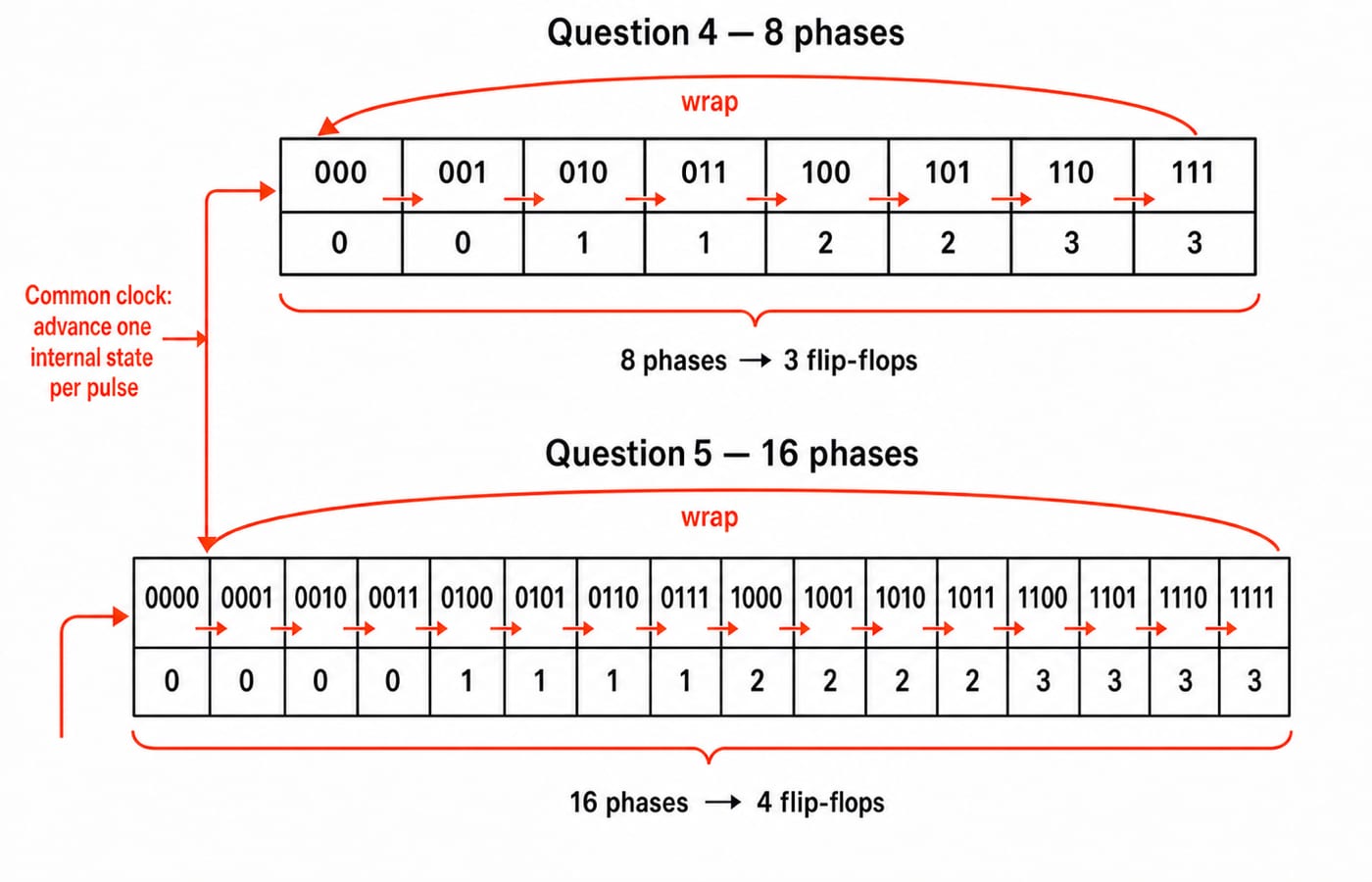
Visible output and internal phase differ when one value has different successors in a cycle. Internal states must then remember each occurrence. Thus, eight clocks may require three flip-flops even if they display only 0,1,2,3.
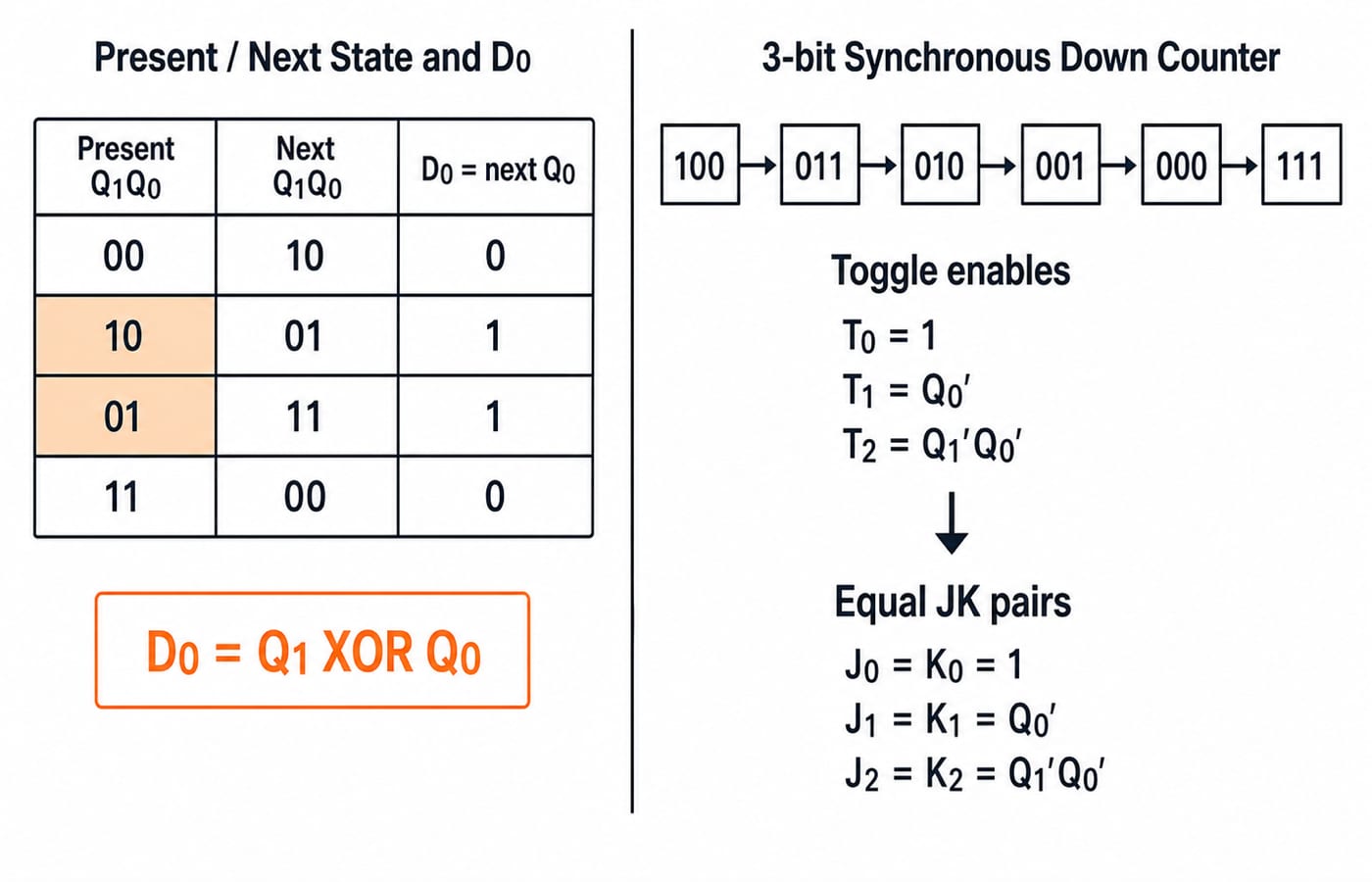
Remember D=Q(next). A JK flip-flop toggles for J=K=1 and holds for J=K=0. In a binary down counter, a higher bit toggles when every lower present bit is 0.
All flip-flops sample old values at the active edge, then change after propagation delay. Sequential Circuits MCQs: 11 Solved Questions on Flip-Flops and Counters owns the broad mix of latches, ring and Johnson counters, and state analysis. Its mod-258 and D-to-JK questions are reused here to anchor the storage boundary and common-clock trace before this set moves into repeated phases, excitation equations, enables and composite states.
Mod-N counter design MCQs: Questions 1-3
Question 1: minimum storage for a mod-16 counter
Minimum number of flip-flops required to construct a mod 16 counter
Answer: 4. Three flip-flops provide 2^3=8<16 states, while four provide 2^4=16 states. Four are therefore sufficient and minimal; 16 is the number of counter states, not the number of storage bits.
Question 2: the power-of-two boundary at mod-258
GATE 2011. Open the live solved question.
The minimum number of D flip-flops needed to design a mod-258 counter is
(a)
9(b)
8(c)
512(d)
258
Answer: (a) 9. Eight D flip-flops provide 2^8=256 states, which is two fewer than 258, whereas nine provide 2^9=512. The counter uses 258 valid states, leaving 512-258=254 unused encodings that a complete design must handle safely.
Question 3: the same boundary at modulo-272
UGC NET 2015, June. Open the live solved question.
The number of flip-flops required to design a modulo-272 counter is
(a)
8(b)
9(c)
27(d)
11
Answer: (b) 9. With the given modulus N=272, the boundary is 2^8=256<272<=512=2^9. Eleven flip-flops could encode enough states but would not be minimal, while 27 is not a storage-width calculation.
Repeated-output synchronous counters: Questions 4-5
Question 4: each count value held for two clocks
GATE 2015 Set 2. Open the live solved question.
The minimum number of JK flip-flops required to construct a synchronous counter with the count sequence (0,0,1,1,2,2,3,3,0,0,…) is __________ .
Answer: 3. The cycle has eight distinguishable clock phases: first 0, second 0, first 1, second 1, first 2, second 2, first 3 and second 3. Two bits can display the four values, but a third phase bit distinguishes hold from advance, and 2^3=8 exactly covers all phases.
Question 5: each count value held for four clocks
A synchronous counter using JK flip-flops follows 0 → 0 → 0 → 0 → 1 → 1 → 1 → 1 → 2 → 2 → 2 → 2 → 3 → 3 → 3 → 3 → 0, and so on.
What is the minimum number of flip-flops required to implement this counter?
Answer ________ .
Answer: 4. There are 4 values × 4 clock phases per value = 16 distinguishable internal states. Three flip-flops encode only eight states, while four encode exactly 2^4=16; the display alone cannot identify the first, second, third or fourth occurrence of a value.
Clock movement and simultaneous sampling: Questions 6-7
Question 6: wrap a 7-bit up counter from 84 to 20
The number of clock pulses needed to change the contents of a 7-bit up counter from 1010100 to 0010100 is _______?
Answer: 64. The endpoints are 1010100₂=84 and 0010100₂=20; a 7-bit counter is modulo 128, so the forward distance is (20-84) mod 128=64. Equivalently, use 43 pulses from 84 to 127, one pulse from 127 to 0, and 20 pulses from 0 to 20, giving 43+1+20=64.
Question 7: trace a D flip-flop driving a JK flip-flop
GATE 2015 Set 1. Open the live solved question.
A positive edge-triggered D flip-flop is connected to a positive edge-triggered JK flip-flop as follows. The Q output of the D flip-flop is connected to both the J and K inputs of the JK flip-flop, while the Q output of the JK flip-flop is connected to the input of the D flip-flop. Initially, the output of the D flip-flop is set to logic one and the output of the JK flip-flop is cleared. Which one of the following is the bit sequence (including the initial state) generated at the Q output of the JK flip-flop when the flip-flops are connected to a free-running common clock? Assume that J = K = 1 is the toggle mode and J = K = 0 is the state-holding mode of the JK flip-flop. Both the flip-flops have non-zero propagation delays.
(a)
0110110…(b)
0100100…(c)
011101110…(d)
011001100…
Answer: (a) 0110110…. Starting at (Q_D,Q_JK)=(1,0), successive rising edges produce (0,1),(1,1),(1,0),(0,1),(1,1),(1,0). Reading Q_JK, including its initial value, gives 0,1,1,0,1,1,0; non-zero propagation delay ensures both devices sample the old pair, not one another's newly changed outputs.
D and JK excitation logic: Questions 8-9
Question 8: derive D0 for the sequence 0, 2, 1, 3
A 2-bit synchronous counter built with D flip-flops follows the sequence 0, 2, 1, 3, 0, and so on. The partial circuit below leaves input D₀ unknown.
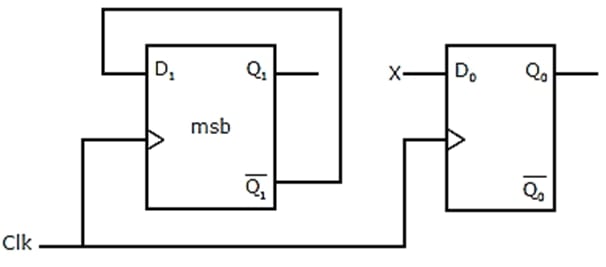
Determine X, the input D₀.
(a)
Q₁(b)
Q₀(c)
Q₁ ⊕ Q₀(d)
Q₁ ⊙ Q₀
Answer: (c) Q₁ ⊕ Q₀. The binary transitions are 00->10->01->11->00. Because D₀=Q₀(next), the input values for present states 00,10,01,11 are 0,1,1,0, exactly the XOR truth table; in sum-of-products form, D₀=Q₁Q₀' + Q₁'Q₀.
Question 9: minimise JK inputs for a 3-bit down counter
UGC NET 2017, January. Open the live solved question.
A binary 3-bit down counter uses J-K flip-flops FFᵢ with inputs Jᵢ, Kᵢ and outputs Qᵢ for i = 0, 1, 2. Which of the following minimized input expressions are correct?
I. J₀ = K₀ = 0
II. J₀ = K₀ = 1
III. J₁ = K₁ = Q₀
IV. J₁ = K₁ = Q₀′
V. J₂ = K₂ = Q₁Q₀
VI. J₂ = K₂ = Q₁′Q₀′
(a)
I, III, V(b)
I, IV, VI(c)
II, III, V(d)
II, IV, VI
Answer: (d) II, IV, VI. Q₀ toggles every clock, so J₀=K₀=1; Q₁ toggles when present Q₀=0, so J₁=K₁=Q₀'; and Q₂ toggles when Q₁Q₀=00, so J₂=K₂=Q₁'Q₀'. Transitions 100->011 and 000->111 both confirm that the most-significant bit toggles only when both lower present bits are zero.
If deriving inputs feels manageable but tracing a completed circuit costs time, work through the Sync Counter Analysis MCQs next.
Enable inputs and composite state spaces: Questions 10-11
Question 10: hold or count under external input x
DSSSB 2022. Open the live solved question.
A clocked sequential circuit is to be designed (using D flip-flops) that goes through sequence of repeated binary states 00, 01, 10, and 11 when value of external input x = 1. The state of the circuit remains unchanged when x = 0. Which statement is correct about the design of this circuit?
(a)
It requires 3 flip-flops.(b)
It has one external output.(c)
The input of the left-most flip flop (corresponding to most significant bit of the state) does not depend on external input x.(d)
The input of the right-most flip flop (corresponding to least significant bit of the state) depends on external input x.
Answer: (d). Two state bits represent 00,01,10,11. The least-significant bit holds for x=0 and toggles for x=1, giving D₀=Q₀ XOR x; the most-significant input also uses the enable, for example D₁=Q₁ XOR (xQ₀), so C is false as well.
Question 11: count nine unique ordered-pair states
A synchronous counter is to be designed using JK flip-flops to follow the sequence of decimal states:
(0,0),(1,0),(1,1),(2,1),(3,1),(3,2),(2,2),(2,0),(0,1),(0,0),…
Each listed state occurs once before the cycle returns to (0,0). At state (2,2), the counter transitions conditionally based on external input X:
If X = 1, the next state is (2,0).
If X = 0, the next state is (0,1).
States are encoded in binary using the minimum number of JK flip-flops required to represent all unique states.
Question:
What is the minimum number of JK flip-flops required to implement this synchronous counter?
Answer _______
Answer: 4. The nine distinct pairs are (0,0),(1,0),(1,1),(2,1),(3,1),(3,2),(2,2),(2,0),(0,1). Three flip-flops encode only 2^3=8 states, while four encode 16; the branch adds no state because both possible destinations already belong to the nine-state set.
Sync counter design score map and next practice step
Use each miss to choose one repair. For Questions 1-3, practise ceil(log2 N) around powers of two. For Questions 4-5, count clock phases rather than displayed values. For Questions 6-7, retrace modulo distance and simultaneous old-state sampling. For Questions 8-10, rebuild D next-state values and JK toggle conditions. For Question 11, count unique composite states before selecting register width. Browse the GATE CS Exam Preparation Courses & Test Series for the wider route. Use GATE Guidance by Sanchit Sir when state tables and excitation equations need structured rebuilding; move to the GATE Test Series once you can solve Questions 6, 8 and 9 without the worked steps.
Keep learning
Special Logic Circuits MCQs: 12 Solved Questions on Adders, Encoders, PLA and DAC
Solve 12 special logic circuits MCQs covering recognition, hardware counts, Boolean identities and numerical calculations. Each answer includes the reasoning you should reproduce in an exam.
19 Sep 20268 min readDigital Electronics MCQs
Function Equivalence MCQs: 12 Solved Boolean Algebra Problems
Solve 12 function-equivalence questions step by step, from De Morgan's law and absorption to minterm sets, counterexamples and a four-option MSQ.
Updated 17 Sep 20268 min readDigital Electronics MCQs

CLA & Arithmetic Logic MCQs: 10 Solved Questions with Explanations
Solve ten CLA and arithmetic logic MCQs with compact workings for carry equations, timing paths, hardware sizing and operand-pair counting.
Updated 16 Sep 20267 min readDigital Electronics MCQs
Logic Circuit Analysis MCQs: 12 Solved Questions on Gates and Boolean Functions
Practise 12 logic circuit analysis questions with fresh explanations covering minterm sets, bubbles, hazards, XOR patterns, and equivalent Boolean forms.
Updated 13 Sep 20267 min readDigital Electronics MCQs