Resume Tailoring for a Job Description: Match Evidence Without Keyword Stuffing
Use one evidence ledger to create honest developer, testing and support resumes. Follow a worked matrix, three bullet rewrites and a 40-minute cycle.
KnowledgeGate Team
Exam prep & CS education
Updated 8 Aug 20265 min read
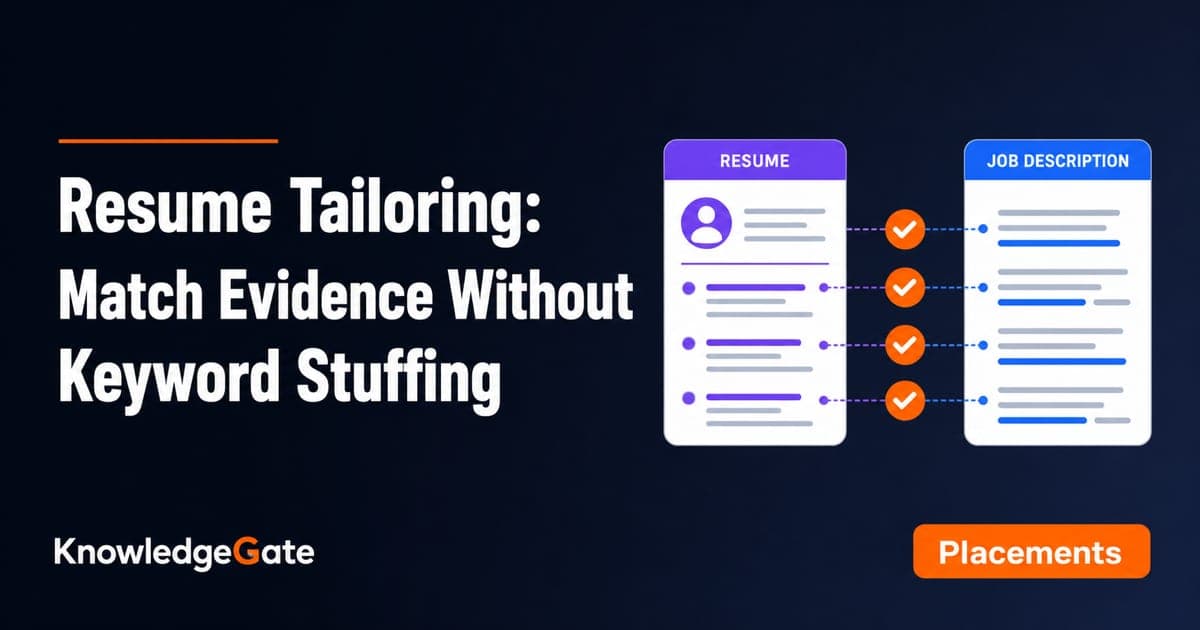
One honest base resume may contain enough evidence for development, testing and support roles, but identical wording hides relevant proof. Copying a job description line by line makes the document sound unlike the candidate and risks claims they cannot prove. Seven steps do the work: build an evidence ledger, score the posting against it, rephrase each requirement into defensible wording, reorder the sections, rewrite three bullets, run a 40-minute cycle per application and finish with a consistency check. Tailoring changes emphasis, not history. Meera, a fictional candidate with one CampusHelp project and one support internship, supplies every number here. Wider preparation for this stage sits under Resume and Interview Preparation.
1. Build a Master Evidence Ledger Before Reading the Job Description
All values come from Meera's fictional ledger.
ID | Verified fact | Proof |
|---|---|---|
E1 | Built 8 REST endpoints using Node.js and Express with PostgreSQL | Repository and API documentation |
E2 | Wrote 31 Jest tests covering authentication and the 8 endpoints | Test folder and CI log |
E3 | Ran the test suite in GitHub Actions on every pull request | Workflow file |
E4 | Logged 7 defects before the final college demo | Issue tracker |
E5 | Owned the backend in a 4-person project team | Project report |
E6 | Resolved an average of 18 setup and API tickets per week during an internship | Ticket export |
E7 | Wrote 6 troubleshooting runbooks | Shared documentation |
E8 | Repeat setup requests fell from 12 to 5 per week after the runbooks were introduced | Four-week support tracker |
The ledger can outgrow the resume, but no tailored version may add a tool, number, responsibility or outcome absent from it. If unmeasured, use a verified scale such as 8 endpoints, or omit the metric. Never estimate later. Resume for Freshers: Clear the First Screen explains how to build that base resume. Role-specific tailoring starts once it exists.
2. Turn the Job Description into a Six-Row Evidence Matrix
Score these six fictional junior backend requirements for editing priority: 0 means no evidence, 1 related but indirect, and 2 direct. This is a self-review tool, not an ATS score or recruiter rubric.
Requirement | Ledger match | Score |
|---|---|---|
Node.js | E1 | 2 |
REST APIs | E1 | 2 |
relational databases | PostgreSQL in E1 | 2 |
automated testing | E2-E3 | 2 |
Git-based collaboration | Pull requests in E3 and 4-person team in E5 | 2 |
troubleshoot production defects | Internship tickets in E6, related but not production incidents | 1 |
The calculation is 2 + 2 + 2 + 2 + 2 + 1 = 11/12. Lead with the five direct matches and describe related troubleshooting honestly. A zero or one shows where to be modest or reconsider fit, not which phrase to paste. Setup tickets are not production incidents.
3. Translate Keywords into Natural, Defensible Language
Translate each requirement through three steps: posting term -> real tool or action -> proof-bearing sentence.
Posting term | Real evidence | Natural wording |
|---|---|---|
relational database | PostgreSQL | Built 8 REST endpoints backed by PostgreSQL |
automated testing | Jest | Wrote 31 Jest tests |
Git-based collaboration | Pull requests and GitHub Actions | Ran checks on every pull request |
Use an exact posting term once only when evidence supports it.
Stuffed: Node.js REST API developer with Node.js, REST APIs, SQL, testing, Git, debugging and troubleshooting.
Natural: Built 8 REST endpoints in Node.js and Express backed by PostgreSQL; added 31 Jest tests and ran them through GitHub Actions on every pull request.
It has one owned action, three connected technologies and two verified scale facts. Keep official job titles, employers and dates. Never hide terms in white text or a footer, turn support tickets into production incidents, or claim managed deployments without proof.
4. Reorder the Same Evidence for Development, Testing and Support
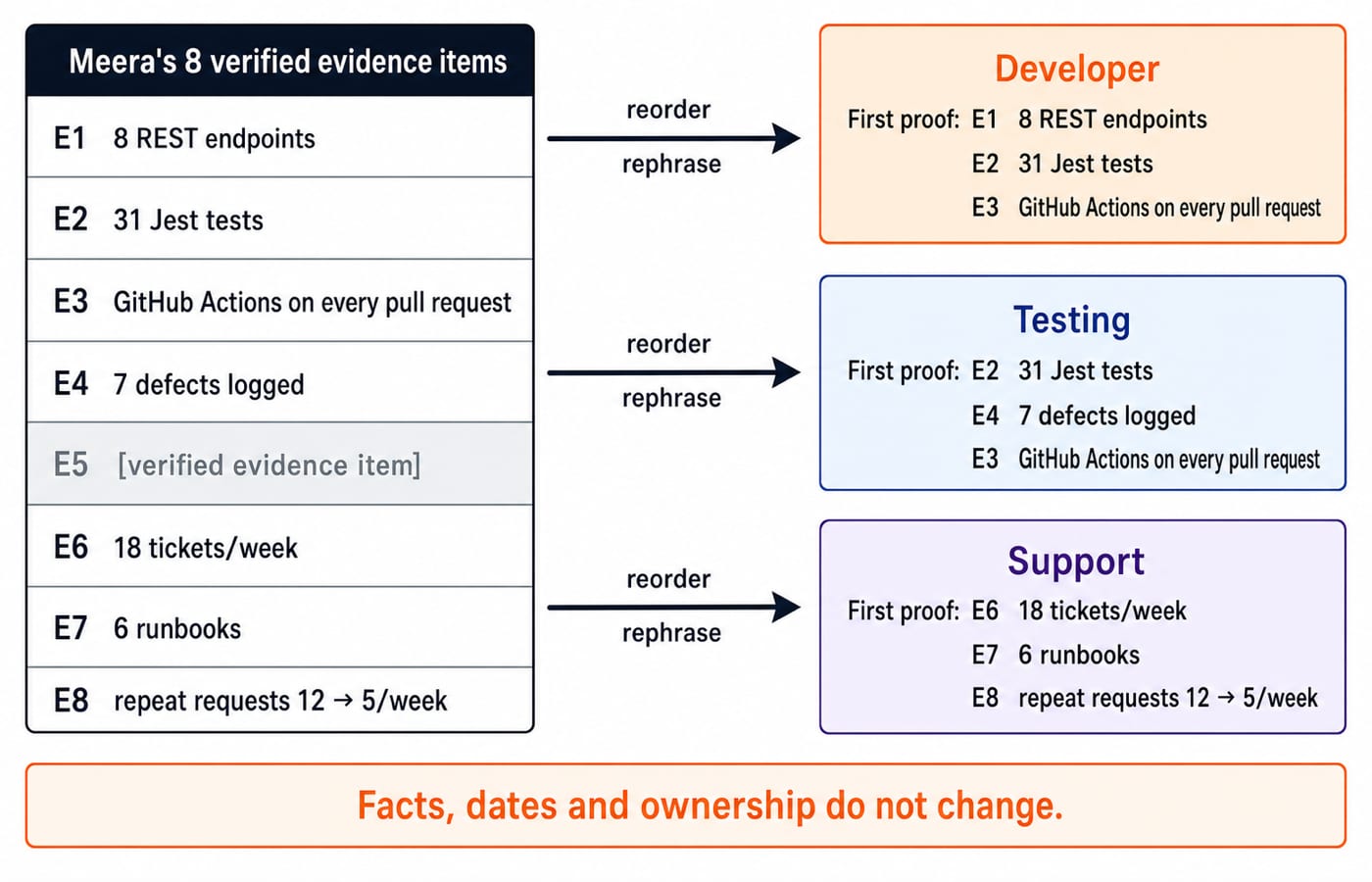
Create three orders from the same ledger:
Developer: two-line summary;
Node.js | Express | PostgreSQL | Jest | GitHub Actions; CampusHelp led by E1-E3; internship E6-E8.Testing: summary;
Jest | API testing | PostgreSQL | GitHub Actions | defect logging; CampusHelp led by E2-E4; remaining project and internship proof.Support: summary; internship led by E6-E8;
API troubleshooting | PostgreSQL | runbook writing | Git; CampusHelp.
Education and dates never change. From 8 items, promote 3 into the first proof block, retain relevant items lower and omit space-wasters. Never force all 8 into one version.
5. Write Three Role-Specific Bullets Without Changing the Facts
Developer:
Built 8 REST endpoints in Node.js and Express backed by PostgreSQL; added 31 Jest tests and automated checks in GitHub Actions for a 4-person college project.Testing:
Created 31 Jest tests across authentication and 8 REST endpoints, automated the suite in GitHub Actions and logged 7 defects before the final demo.Support:
Resolved an average of 18 setup and API tickets per week and wrote 6 runbooks, reducing repeat setup requests from 12 to 5 per week.
Construction leads development, coverage and defects lead testing, and resolution and documentation lead support. The 8 endpoints, 31 tests, 7 defects, 18 tickets, 6 runbooks, 12-to-5 result and ownership remain fixed; keep the bullets separate. 7 Placement Preparation Mistakes to Avoid covers generic resumes, unsupported impact, title inflation and contradictions. Log which version each employer received.
6. Use a 40-Minute Tailoring Cycle and a Missed-Day Rule
One-time setup takes 45 minutes to collect evidence, 25 to verify tools and numbers, and 20 to make three base variants: 90 minutes total. It creates reusable starting points, not a universal promise.
Per application, take 8 minutes to extract 6-8 requirements; 8 to score the matrix; 14 to reorder sections and rewrite at most 3 bullets; 5 to verify changed claims; and 5 to check the role, employer, file name and export. 8 + 8 + 14 + 5 + 5 = 40 minutes. Four applications plus one Friday review take 4 x 40 + 40 = 200 minutes, or 3 hours 20 minutes per active week.
Move one missed 40-minute block to Friday. If two are missed, complete the two best-fit applications fully and carry the others forward. Do not squeeze four into 80 minutes, reuse the wrong company name or paste the posting.
7. Run the Final Consistency Check and Move to Interview Preparation
Use 10 minutes for eight checks:
Employer and role are correct.
File name matches the role.
Dates and job titles match the master resume.
Every tool appears in the evidence ledger.
Every number matches its source.
The first proof block answers the strongest requirements.
No copied responsibility exceeds actual ownership.
PDF text remains selectable and readable.
Use clear files such as Meera_Rao_Backend_Developer_Resume.pdf, Meera_Rao_QA_Trainee_Resume.pdf and Meera_Rao_Application_Support_Resume.pdf.
The short version
Build proof once, score the posting, promote the strongest 3 items, phrase them naturally and log the submitted version. Make relevance visible without imitating the posting.
Next, use the Interview & Resume Preparation Course for structured resume building, one-to-one resume review, technical and HR interview preparation and mock interviews. After shortlisting, practise with HR Interview Questions for Freshers: How to Answer Honestly. Neither promises selection.
Keep learning
Placement Mock Analysis: One Error Ledger Across Every Test Round
Use one error ledger without flattening unlike round results. This worked example shows how to find the first wrong step, prioritise repairs and close errors only after fresh retests.
Updated 4 Oct 20265 min readInterview Corner
Internship to PPO: Build a Weekly Evidence Trail Before the Final Review
Use a weekly outcome ledger to make your internship work visible before the final review. This practice model shows how to record delivery, feedback, effect and handoff honestly.
Updated 28 Sep 20265 min readInterview Corner
DSA Mock Interview Rubric: A 100-Point Scorecard for Reasoning, Code and Communication
A practical six-part scorecard for running comparable DSA mocks, grading visible evidence and turning weak areas into the next week's practice.
Updated 25 Sep 20265 min readInterview Corner
Campus Recruitment Timeline: Stage by Stage from Pre-Placement Talk to Written Offer
Follow a campus drive without guessing. Build an evidence sheet, verify eligibility, plan each preparation window and check the written offer before responding.
Updated 24 Sep 20265 min readInterview Corner